Results by title
137 books match the query 'Poverty' and 3 start with o
Obesity among Poor Americans
Is Public Assistance the Problem?Patricia K. Smith
Vanderbilt University Press, 2009
This book investigates the controversial claim by welfare critics that public assistance programs like Food Stamps and the National School Lunch programs contribute to obesity among the poor. The author synthesizes empirical evidence from an array of disciplines--anthropology, economics, epidemiology, medicine, nutrition science, marketing, psychology, public health, sociology, and urban planning--to test this claim and to test whether other causal processes are at work.
With a lucid presentation that makes it a model for applying research to questions of social policy, the book lays out the different hypotheses and the possible causal pathways within each. The four central chapters test whether "public assistance causes obesity," "obesity causes public assistance," "poverty causes both public assistance and obesity," and "Factor X causes both." The factors in the last category that may relate to both public assistance and obesity include stress, disability, and physical abuse.
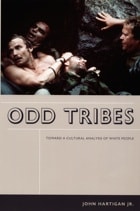
Odd Tribes
Toward a Cultural Analysis of White PeopleJohn Hartigan Jr.
Duke University Press, 2005
Odd Tribes engages debates in history, anthropology, sociology, and cultural studies over how race matters. Hartigan tracks the spread of “white trash” from an epithet used only in the South prior to the Civil War to one invoked throughout the country by the early twentieth century. He also recounts how the cultural figure of “white trash” influenced academic and popular writings on the urban poor from the 1880s through the 1990s. Hartigan’s critical reading of the historical uses of degrading images of poor whites to ratify lines of color in this country culminates in an analysis of how contemporary performers such as Eminem and Roseanne Barr challenge stereotypical representations of “white trash” by claiming the identity as their own. Odd Tribes presents a compelling vision of what cultural studies can be when diverse research methodologies and conceptual frameworks are brought to bear on pressing social issues.
Ordinary Poverty
A Little Food and Cold StorageWilliam DiFazio
Temple University Press, 2005
In this trenchant and groundbreaking work, DiFazio presents the results of welfare reform—from ending entitlements to diminished welfare benefits—through the eyes and voices of those who were most directly affected by it. Ordinary Poverty concludes with a program to guarantee universal rights to a living wage as a crucial way to end poverty. Ultimately, DiFazio articulates the form a true poor people's movement would take—one that would link the interests of all social movements with the interests of ending poverty.