Results by title
56 books match the query 'Religions' and 3 start with o
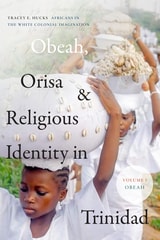
Obeah, Orisa, and Religious Identity in Trinidad, Volume I, Obeah
Africans in the White Colonial Imagination, Volume 1Tracey E. Hucks
Duke University Press, 2022
Obeah, Orisa, and Religious Identity in Trinidad is an expansive two-volume examination of social imaginaries concerning Obeah and Yoruba-Orisa from colonialism to the present. Analyzing their entangled histories and systems of devotion, Tracey E. Hucks and Dianne M. Stewart articulate how these religions were criminalized during slavery and colonialism yet still demonstrated autonomous modes of expression and self-defense. In Volume I, Obeah, Hucks traces the history of African religious repression in colonial Trinidad through the late nineteenth century. Drawing on sources ranging from colonial records, laws, and legal transcripts to travel diaries, literary fiction, and written correspondence, she documents the persecution and violent penalization of African religious practices encoded under the legal classification of “obeah.” A cult of antiblack fixation emerged as white settlers defined themselves in opposition to Obeah, which they imagined as terrifying African witchcraft. These preoccupations revealed the fears that bound whites to one another. At the same time, persons accused of obeah sought legal vindication and marshaled their own spiritual and medicinal technologies to fortify the cultural heritages, religious identities, and life systems of African-diasporic communities in Trinidad.
[more]
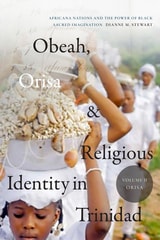
Obeah, Orisa, and Religious Identity in Trinidad, Volume II, Orisa
Africana Nations and the Power of Black Sacred Imagination, Volume 2Dianne M. Stewart
Duke University Press, 2022
Obeah, Orisa, and Religious Identity in Trinidad is an expansive two-volume examination of social imaginaries concerning Obeah and Yoruba-Orisa from colonialism to the present. Analyzing their entangled histories and systems of devotion, Tracey E. Hucks and Dianne M. Stewart articulate how these religions were criminalized during slavery and colonialism yet still demonstrated autonomous modes of expression and self-defense. In Volume II, Orisa, Stewart scrutinizes the West African heritage and religious imagination of Yoruba-Orisa devotees in Trinidad from the mid-nineteenth century to the present and explores their meaning-making traditions in the wake of slavery and colonialism. She investigates the pivotal periods of nineteenth-century liberated African resettlement, the twentieth-century Black Power movement, and subsequent campaigns for the civil right to religious freedom in Trinidad. Disrupting syncretism frameworks, Stewart probes the salience of Africa as a religious symbol and the prominence of Africana nations and religious nationalisms in projects of black belonging and identity formation, including those of Orisa mothers. Contributing to global womanist thought and activism, Yoruba-Orisa spiritual mothers disclose the fullness of the black religious imagination’s affective, hermeneutic, and political capacities.
[more]
Occultism, Witchcraft, and Cultural Fashions
Essays in Comparative ReligionMircea Eliade
University of Chicago Press, 1978
In the period domoninated by the triumphs of scientific rationalism, how do we account for the extraordinary success of such occult movements as astrology or the revival of witchcraft? From his perspective as a historian of religions, the eminent scholar Mircea Eliade shows that such popular trends develop from archaic roots and periodically resurface in certain myths, symbols, and rituals. In six lucid essays collected for this volume, Eliade reveals the profound religious significance that lies at the heart of many contemporary cultural vogues.
Since all of the essays except the last were originally delivered as lectures, their introductory character and lively oral style make them particularly accessible to the intelligent nonspecialist. Rather than a popularization, Occultism, Witchcraft, and Cultural Fashions is the fulfillment of Eliade's conviction that the history of religions should be read by the widest possible audience.
Since all of the essays except the last were originally delivered as lectures, their introductory character and lively oral style make them particularly accessible to the intelligent nonspecialist. Rather than a popularization, Occultism, Witchcraft, and Cultural Fashions is the fulfillment of Eliade's conviction that the history of religions should be read by the widest possible audience.
[more]