Results by title
15 books match the query 'Habitat'
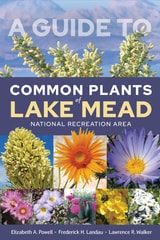
A Guide to Common Plants of Lake Mead National Recreation Area
Elizabeth A. Powell
University of Nevada Press, 2023
A Guide to Common Plants of Lake Mead National Recreation Area is the definitive book for weekend explorers and botanists alike who venture into LMNRA ready to discover the many wonders of the local flora. The authors highlight 183 plants that hikers are most likely to encounter along popular trails, washes, and surrounding hot springs, helping the area’s millions of annual visitors identify and enjoy these common plants. This guide includes photos and descriptions of each plant, along with a map of LMNRA.
The authors also provide a primer on plant ecology, including a guide to plant structures, desert adaptations and life forms, plant-to-plant interactions, and plant-animal interactions. Plants are grouped by life forms, such as tree, shrub, cactus, or grass, and by flower color within the wildflower section. The guide will encourage readers to pause and look carefully at each plant they encounter, giving them an enriched experience during their exploration.
Bird Watch
A Survey of Planet Earth's Changing EcosystemsMartin Walters
University of Chicago Press, 2011
From the tufted puffin in the Pacific Northwest to the hook-billed hermit in the Brazilian rainforest, birds suffer from the effects of climate change in every corner of the globe. Scientists have found declines of up to 90 percent in some troubled bird populations and unprecedented reproductive failure in others. The most recent studies suggest dire prospects: 1,227 avian species are threatened with extinction and an additional 838 near-threatened species are urgent priorities for conservation action.
As much an indispensable guide as a timely call to action, Bird Watch is an illustrated tour of these endangered birds and their habitats. Encyclopedic in scope, this book features all 1,227 species on the International Union for Conservation of Nature (IUCN) Red List, thoroughly detailing the environmental pressures and conservation prescriptions that hold their futures in the balance. After introducing readers to the main threats to birds and regions at high risk, Bird Watch presents a visually stunning and scientifically accurate flight over the major bird habitats, including tropical forests; temperate and northern forests; deserts; mountains; grasslands; and Mediterranean, marine, freshwater, and oceanic islands. The volume concludes with an overview of bird species by region—categorized by family within each region, and a guide to the world’s best birding sites. Produced in cooperation with BirdLife International, Bird Watch is a celebration of the beauty and diversity of birds and their habitats—and a warning of the dangers they face around the world.
Creatures Of Habitat
The Changing Nature of Wildlife and Wild Places in Utah and the Intermountain WestMark Gerard Hengesbaugh
Utah State University Press, 2001
From flying squirrels on high wooded plateaus to hanging gardens in redrock canyons, the Intermountain West is home to some of the world's rarest and most fascinating animals and plants. Creatures of Habitat details many unique but little-known talents of this region's strange and wonderful wild inhabitants and descibes their connections with native environments. For example, readers will learn about the pronghorn antelope's supercharged cardiovascular system, a brine shrimp-powered shorebird that each year flies nonstop from the Great Salt Lake to Central Argentina, and a rare mustard plant recently discovered on Mount Ogden. Emphasizing how increasing loss and degradation of habitat hinders native species' survival, Mark Gerard Hengesbaugh discusses what is happening to wildlife and wild places and what is being done about it.
Well illustrated, this book has habitat maps, pen-and-ink illustrations, and fifty photos of wildlife and wild places selected by photo editor Dan Miller. Also included are guides to wildlife viewing and lists of Utah species, including those considered sensitive, threatened, or endangered.

Eleonora's Falcon
Adaptations to Prey and Habitat in a Social RaptorHarmut Walter
University of Chicago Press, 1979
In this study—illustrated beautifully and extensively with 59 line drawings and 38 photographs—Hartmut Walter shows how the unique geographical and biological situation of Falco eleonorae makes the species' health an important indicator of environmental decay. For though it lives in relatively isolated areas, Eleonora's falcon nevertheless may ingest the many pollutants contained in its diet of birds migrating from industrial Europe. Walter, who has studied raptors on several continents and has been an ornithologist since his early youth, examines several discrete colonies of Eleonora's falcon. He concentrates on the species' intraspecific behavior and ecology—such as the falcons' aggressive actions, hunting strategies, and response to fluctuating environmental conditions—and investigates their evolutionary past.
Magellanic Sub-Antarctic Ornithology
First Decade of Long-Term Bird Studies at the Omora Ethnobotanical Park, Cape Horn Biosphere Reserve, ChileRicardo Rozzi
University of North Texas Press, 2014
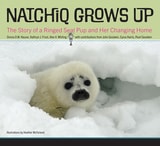
Natchiq Grows Up
The Story of an Alaska Ringed Seal Pup and Her Changing HomeDonna D.W. Hauser
University of Alaska Press, 2023
Beginning in the 1980s, scientists started traveling to northwest Alaska to research the lives of ringed seals, bringing Labrador retrievers who could sniff out seals and their snow cave homes (called lairs) on the sea ice. Decades later, scientists partnered with the Iñupiaq people of
Qikiktaġruk (Kotzebue) to learn more about ringed seals. They relied on a combination of Indigenous Knowledge and scientific techniques to capture and apply tags to understand the movements and behavior of ringed seals.
But the Arctic homes of ringed seals are changing, and the long history of ringed seal science in the Kotzebue Sound proved to be just the beginning of long and cooperative relationships melding science and Indigenous knowledge. During 2018 and 2019, with unprecedented sea ice conditions, Qikiktagrumiut Elders and scientists returned to the ice to measure changes in the habitat available for ringed seal pups in the region.
Neotropical Birds
Ecology and ConservationDouglas F. Stotz, John W. Fitzpatrick, Theodore A. Parker III, and Debra K. Moskovits
University of Chicago Press, 1996
Because bird communities are good indicators of habitat type and condition, and because extensive bird surveys can be done quickly, bird communities are critical to rapid evaluations of an ecosystem's biological value and integrity. The authors analyze the bird species of major habitats from a conservation perspective, and develop specific guidelines to illustrate how governments, conservation organizations, and wildlife managers can use this ecological information to anchor conservation strategies on sound biological reality.
"Students of ecology and wildlife management, as well as conservationists, will benefit from this book . . . . Governmental and conservation agencies should use this book when making critical decisions about where to focus their efforts as they work to preserve the environment in fragile regions of the world." —Edward I. Saiff, Science Books & Films
New England Wildlife
Habitat, Natural History, and DistributionRichard M. DeGraaf and Mariko Yamasaki
University Press of New England, 2000
Peril in the Ponds
Deformed Frogs, Politics, and a Biologist's QuestJudy Helgen
University of Massachusetts Press, 2012
By the 1990s, wetlands across the United States were endangered from pollution and decades of drainage to convert them into farmland and urban developments. But when deformed frogs—many with missing legs or eyes, footless stumps, or misshapen jaws—began to emerge from Minnesota wetlands, alarm bells went off. What caused such deformities? Pollution? Ultraviolet rays? Biological agents? And could the mysterious cause also pose a threat to humans?
Judy Helgen writes with passionate concern about vulnerable frogs and wetlands as she navigates through a maze of inquisitive media and a reluctant government agency. She reports on the complexity of a growing catastrophe for frogs and broadens the issue as she researches and meets with scientists from around the world. She affirms the importance of examining aquatic life to understand pollution and the need to rescue our remaining wetlands. She also shares the fears expressed by the teachers, students, and other citizens who found these creatures, sensed a problem, and looked to her for answers. Ultimately, this is a story about the biological beauty of wetlands and our need to pay attention to the environment around us.
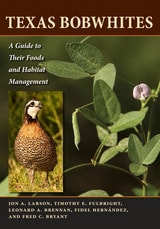
Texas Bobwhites
A Guide to Their Foods and Habitat ManagementBy Jon A. Larson, Timothy E. Fulbright, Leonard A. Brennan, Fidel Hernández, and Fred C. Bryant
University of Texas Press, 2010
Northern bobwhites are one of the most popular game birds in the United States. In Texas alone, nearly 100,000 hunters take to the field each fall and winter to pursue wild bobwhite quail. Texas is arguably the last remaining state with sufficient habitat to provide quail-hunting opportunities on a grand scale, and Texas ranchers with good bobwhite habitat often generate a greater proportion of their income from fees paid by quail hunters than from livestock production. Managing and expanding bobwhite habitat makes good sense economically, and it benefits the environment as well. The rangelands and woodlands of Texas that produce quail also support scores of other species of wildlife.
Texas Bobwhites is a field guide to the seeds commonly eaten by northern bobwhites, as well as a handbook for conserving and improving northern bobwhite habitat. It provides identifying characteristics for the seeds of 91 species of grasses, forbs, woody plants, and succulents. Each seed description includes a close-up and a scale photo of the seed and the plant that produces it, along with a range map. Using this information, hunters can readily identify concentrations of plants that are most likely to attract quail. Landowners and rangeland managers will greatly benefit from the book's state-of-the-art guidance for habitat management and restoration, including improving habitat dominated by invasive and nonnative grasses.
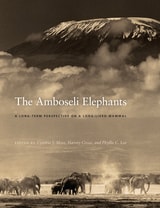
The Amboseli Elephants
A Long-Term Perspective on a Long-Lived MammalEdited by Cynthia J. Moss, Harvey Croze, and Phyllis C. Lee
University of Chicago Press, 2011
Elephants have fascinated humans for millennia. Aristotle wrote of them with awe; Hannibal used them in warfare; and John Donne called the elephant “Nature’s greatest masterpiece. . . . The only harmless great thing.” Their ivory has been sought after and treasured in most cultures, and they have delighted zoo and circus audiences worldwide for centuries. But it wasn’t until the second half of the twentieth century that people started to take an interest in elephants in the wild, and some of the most important studies of these intelligent giants have been conducted at Amboseli National Park in Kenya.
The Amboseli Elephants is the long-awaited summation of what’s been learned from the Amboseli Elephant Research Project (AERP)—the longest continuously running elephant research project in the world. Cynthia J. Moss and Harvey Croze, the founders of the AERP, and Phyllis C. Lee, who has been closely involved with the project since 1982, compile more than three decades of uninterrupted study of over 2,500 individual elephants, from newborn calves to adult bulls to old matriarchs in their 60s. Chapters explore such topics as elephant ecosystems, genetics, communication, social behavior, and reproduction, as well as exciting new developments from the study of elephant minds and cognition. The book closes with a view to the future, making important arguments for the ethical treatment of elephants and suggestions to aid in their conservation.
The most comprehensive account of elephants in their natural environment to date, The Amboseli Elephants will be an invaluable resource for scientists, conservationists, and anyone interested in the lives and loves of these extraordinary creatures.
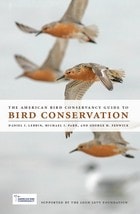
The American Bird Conservancy Guide to Bird Conservation
Daniel J. Lebbin, Michael J. Parr, and George H. Fenwick
University of Chicago Press, 2010
Whether we live in cities, in the suburbs, or in the country, birds are ubiquitous features of daily life, so much so that we often take them for granted. But even the casual observer is aware that birds don’t fill our skies in the number they once did. That awareness has spawned conservation action that has led to notable successes, including the recovery of some of the nation’s most emblematic species, such as the Bald Eagle, Brown Pelican, Whooping Crane, and Peregrine Falcon. Despite this, a third of all American bird species are in trouble—in many cases, they’re in imminent danger of extinction. The most authoritative account ever published of the threats these species face, The American Bird Conservancy Guide to Bird Conservation will be the definitive book on the subject.
The Guide presents for the first time anywhere a classification system and threat analysis for bird habitats in the United States, the most thorough and scientifically credible assessment of threats to birds published to date, as well as a new list of birds of conservation concern. Filled with beautiful color illustrations and original range maps, the Guide is a timely, important, and inspiring reference for birders and anyone else interested in conserving North America’s avian fauna. But this book is far more than another shout of crisis. The Guide also lays out a concrete and achievable plan of long-term action to safeguard our country’s rich bird life. Ultimately, it is an argument for hope. Whether you spend your early weekend mornings crouched in silence with binoculars in hand, hoping to check another species off your list, or you’ve never given much thought to bird conservation, you’ll appreciate the visual power and intellectual scope of these pages.
The Global Pigeon
Colin Jerolmack
University of Chicago Press, 2013
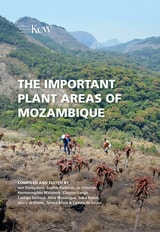
The Important Plant Areas of Mozambique
Edited by Iain Darbyshire, Sophie Richards, and Jo Osborne
Royal Botanic Gardens, Kew, 2023
The Important Plant Areas of Mozambique is based on the Mozambique TIPAs project run in collaboration between Royal Botanic Gardens, Kew, Mozambique’s Agricultural Research Institute (Instituto de Investigação Agrária de Moçambique – IIAM), and the University Eduardo Mondlane. Drawing on information from the TIPAs database, The Important Plant Areas of Mozambique includes color maps and photographs, site descriptions, and tables to present information on the botanical significance, habitat, and geology of the region. The book will also address conservation issues and ecosystem services to promote Mozambique’s critical plant sites and inform conservation leaders in government, NGOs, universities, and local communities about Mozambique’s threatened habitats.
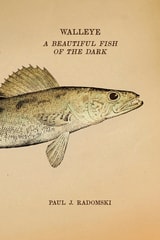
Walleye
A Beautiful Fish of the DarkPaul J. Radomski
University of Minnesota Press, 2022
Walleye, the holy grail of game fish: on catching them, understanding their biology and history, and ensuring their survival
Among the more than 34,000 species of fish, few have the walleye’s following—among anglers and diners, states conferring official status on the fish, and towns battling for recognition as the Walleye Capital of the World. And among those passionate fans, few know the walleye as well as Paul J. Radomski does—a fisheries biologist, lake ecology scientist, and old fisherman. In Walleye: A Beautiful Fish of the Dark he unspools the mysteries of this fascinating fish.
Radomski looks at walleye from every angle, with something to say to the curious naturalist, committed ecologist, and avid fishing enthusiast. People who view walleye as the “lion of the lakes” might be surprised to learn that rivers are their ancestral habitat. Some might wonder about the name “wall-eye,” a nod to an evolutionary adaptation to dark water environments. Others might simply ask: why walleye? What are they, where do they exist, how do they survive, and how have people come to depend on them? Radomski discusses the principles and pitfalls of managing this predator of the twilight (and the history and methods of doing so) and shares his informed perspective on when and where stocking is prudent. Finally, he explores three of the best walleye lakes: Winnebago, the largest inland walleye fishery in Wisconsin, and Mille Lacs and Red Lake in Minnesota.
From the simple pleasures of fishing for walleye to the most pressing questions about how this species survives, this book is the best word on this beautiful fish of the dark.