Results by title
63 books match the query 'Scientists' and 2 start with o
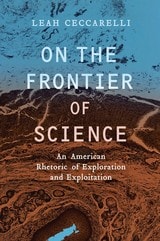
On the Frontier of Science
An American Rhetoric of Exploration and ExploitationLeah Ceccarelli
Michigan State University Press, 2013
“The frontier of science” is a metaphor that has become ubiquitous in American rhetoric, from its first appearance in the public address of early twentieth-century American intellectuals and politicians who aligned a mythic national identity with scientific research, to its more recent use in scientists’ arguments in favor of increased research funding. Here, Leah Ceccarelli explores what is selected and what is deflected when this metaphor is deployed, its effects on those who use it, and what rhetorical moves are made by those who try to counter its appeal. In her research, Ceccarelli discovers that “the frontier of science” evokes a scientist who is typically male, a risk taker, an adventurous loner—someone separated from a public that both envies and distrusts him, with a manifest destiny to penetrate the unknown. It conjures a competitive desire to claim the riches of a new territory before others can do the same. Closely reading the public address of scientists and politicians and the reception of their audiences, this book shows how the frontier of science metaphor constrains American speakers, helping to guide the ends of scientific research in particular ways and sometimes blocking scientists from attaining the very goals they set out to achieve.
[more]
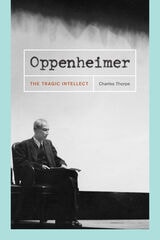
Oppenheimer
The Tragic IntellectCharles Thorpe
University of Chicago Press, 2007
At a time when the Manhattan Project was synonymous with large-scale science, physicist J. Robert Oppenheimer (1904–67) represented the new sociocultural power of the American intellectual. Catapulted to fame as director of the Los Alamos atomic weapons laboratory, Oppenheimer occupied a key position in the compact between science and the state that developed out of World War II. By tracing the making—and unmaking—of Oppenheimer’s wartime and postwar scientific identity, Charles Thorpe illustrates the struggles over the role of the scientist in relation to nuclear weapons, the state, and culture.
A stylish intellectual biography, Oppenheimer maps out changes in the roles of scientists and intellectuals in twentieth-century America, ultimately revealing transformations in Oppenheimer’s persona that coincided with changing attitudes toward science in society.
“This is an outstandingly well-researched book, a pleasure to read and distinguished by the high quality of its observations and judgments. It will be of special interest to scholars of modern history, but non-specialist readers will enjoy the clarity that Thorpe brings to common misunderstandings about his subject.”—Graham Farmelo, Times Higher Education Supplement
“A fascinating new perspective. . . . Thorpe’s book provides the best perspective yet for understanding Oppenheimer’s Los Alamos years, which were critical, after all, not only to his life but, for better or worse, the history of mankind.”—Catherine Westfall, Nature
[more]