Results by title
105 books match the query 'Self' and 3 start with o
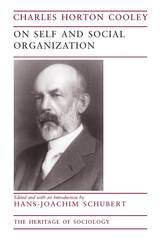
On Self and Social Organization
Charles Horton Cooley
University of Chicago Press, 1998
It is almost impossible now to imagine the prestigious position Charles Horton Cooley (1864-1929) held within the founding generation of American sociologists. His seminal work on human communication, social organization, and public opinion stimulated and guided much of early American sociological thought.
Cooley's work relating self and community is now more relevant than ever to the problems of understanding and directing modern democratic societies. Cooley applied the ideas of pragmatism to developing a systematic way of approaching social action, social change, and social order; he used these interrelated theories to analyze the social problems and cultural crises of the age. According to Cooley, social change is a fragile, interactive process that, due to constantly arising problems of action, requires ongoing scrutiny by the public. This collection of Cooley's best work is an important contribution not only to the history of ideas—especially to the origin of modern sociological theory— but also to the current public debate on civil society, community, and democracy.
Cooley's work relating self and community is now more relevant than ever to the problems of understanding and directing modern democratic societies. Cooley applied the ideas of pragmatism to developing a systematic way of approaching social action, social change, and social order; he used these interrelated theories to analyze the social problems and cultural crises of the age. According to Cooley, social change is a fragile, interactive process that, due to constantly arising problems of action, requires ongoing scrutiny by the public. This collection of Cooley's best work is an important contribution not only to the history of ideas—especially to the origin of modern sociological theory— but also to the current public debate on civil society, community, and democracy.
[more]
Osiris, Volume 22
The Self as Project: Politics and the Human SciencesEdited by Greg Eghigian, Andreas Killen, and Christine Leuenberger
University of Chicago Press, 2007
Osiris annually examines a particular topic in the history of science, bringing together experts in the field to consider multiple aspects of the time period, episode, or theme. Volume 22 explores the ways that twentieth-century political institutions and the human sciences in the western world attempted to understand and shape the attitudes and behaviors of individuals.
[more]
Otto Weininger
Sex, Science, and Self in Imperial ViennaChandak Sengoopta
University of Chicago Press, 2000
Turn-of-the century Vienna is remembered as an aesthetic, erotic, and intellectual world: the birthplace of Freud and psychoanalysis, the waltz, and novels of Schnitzler. The contexts of this cultural vibrancy, Chandak Sengoopta argues, were darker and more complex than we might imagine.
This provocative, enlightening study explores the milieu in which the philosopher Otto Weininger (1880-1903) wrote his controversial book Sex and Character. Shortly after its publication, Weininger committed suicide at the age of twenty-three. His book, which argued that women and Jews were mere sexual beings who lacked individuality, became a bestseller.
Hailed as a genius by intellectuals such as Ludwig Wittgenstein and Karl Kraus, Weininger was admired, not for his prejudices, but for his engagement with the central issues of the time—the nature and meanings of identity. Sengoopta pays particular attention to how Weininger appropriated scientific language and data to defend his views and examines the scientific theories themselves.
[more]