546 books match the query 'Semiotics & Theory' and 16 start with o
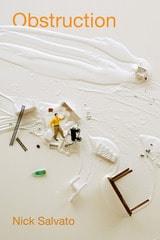
cover of Obstruction

Obstruction

Nick Salvato

Duke University Press, 2016
Can a bout of laziness or a digressive spell actually open up paths to creativity and unexpected insights? In Obstruction Nick Salvato suggests that for those engaged in scholarly pursuits laziness, digressiveness, and related experiences can be paradoxically generative. Rather than being dismissed as hindrances, these obstructions are to be embraced, clung to, and reoriented. Analyzing an eclectic range of texts and figures, from the Greek Cynics and Denis Diderot to Dean Martin and the Web series Drunk History, Salvato finds value in five obstructions: embarrassment, laziness, slowness, cynicism, and digressiveness. Whether listening to Tori Amos's music as a way to think about embarrassment, linking the MTV series Daria to using cynicism to negotiate higher education's corporatized climate, or examining the affect of slowness in Kelly Reichardt's films, Salvato expands our conceptions of each obstruction and shows ways to transform them into useful provocations. With a unique, literary, and self-reflexive voice, Salvato demonstrates the importance of these debased obstructions and shows how they may support alternative modes of intellectual activity. In doing so, he impels us to rethink the very meanings of thinking, work, and value. 
 
 
[more]
cover of Oh, Say, Can You See: The Semiotics of the Military in Hawai’i

Oh, Say, Can You See

The Semiotics of the Military in Hawai’i

Kathy E. Ferguson

University of Minnesota Press, 1998

Considers what the military presence in Hawai’i tells us about colonialism, gender, race, and class.

Everywhere you look in Hawai’i, you might see the military. And yet, in daily life few residents see the military at all-it is hidden in plain sight. This paradox of invisibility and visibility, of the available and the hidden, is the subject of Oh, Say, Can You See?, which maps the power relations involving gender, race, and class that define Hawai’i in relation to the national security state.

Western intruders into Hawai’i-from the early explorers, missionaries, and sugar planters to the military, tourists, and foreign investors-have seen the island nation as a feminine place, waiting to embrace those who come to penetrate, protect, mold, and develop, yet conveniently lacking whatever the newcomers claim to possess. Thus feminized, this book contends, the islands and the people have been reinscribed with meanings according to the needs, fears, and desires of outsiders. Authors Kathy E. Ferguson and Phyllis Turnbull locate and “excavate” sites of memory, such as cemeteries, memorials, monuments, and museums, to show how the military constructs its gendered narrative upon prior colonial discourses. Among the sites considered are Fort DeRussy, Pearl Harbor, and Punchbowl Cemetery, as well as the practices of citizenship that are produced or foreclosed by the narratives of order and security written upon Hawai’i by the military.This semiotic investigation of ways the military marks Hawai’i necessarily explores the intersection of immigration, colonialism, military expansion, and tourism on the islands. Attending to the ways in which the military represents itself and others represent the military, the authors locate the particular representational elements that both conceal and reveal the military’s presence and power; in doing so, they seek to expand discursive space so that other voices can be heard. ISBN 0-8166-2978-1 Cloth $49.95xxISBN 0-81662979-X Paper $19.95x240 pages 5 7/8 x 9 DecemberBorderlines Series, Volume 10Translation inquiries: University of Minnesota Press
[more]
cover of On Close Reading

On Close Reading

John Guillory

University of Chicago Press, 2025

John Guillory considers close reading within the larger history of reading and writing as cultural techniques.
 
At a time of debate about the future of “English” as a discipline and the fundamental methods of literary study, few terms appear more frequently than “close reading,” now widely regarded as the core practice of literary study. But what exactly is close reading, and where did it come from? Here John Guillory, author of the acclaimed Professing Criticism, takes up two puzzles. First, why did the New Critics—who supposedly made close reading central to literary study—so seldom use the term? And second, why have scholars not been better able to define close reading?
 
For Guillory, these puzzles are intertwined. The literary critics of the interwar period, he argues, weren’t aiming to devise a method of reading at all. These critics were most urgently concerned with establishing the judgment of literature on more rigorous grounds than previously obtained in criticism. Guillory understands close reading as a technique, a particular kind of methodical procedure that can be described but not prescribed, and that is transmitted largely by demonstration and imitation.
 
Guillory’s short book will be essential reading for all college teachers of literature. An annotated bibliography, curated by Scott Newstok, provides a guide to key documents in the history of close reading along with valuable suggestions for further research. 
[more]
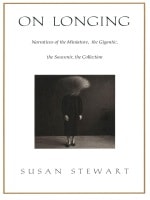
cover of On Longing: Narratives of the Miniature, the Gigantic, the Souvenir, the Collection

On Longing

Narratives of the Miniature, the Gigantic, the Souvenir, the Collection

Susan Stewart

Duke University Press, 1993

Miniature books, eighteenth-century novels, Tom Thumb weddings, tall tales, and objects of tourism and nostalgia: this diverse group of cultural forms is the subject of On Longing, a fascinating analysis of the ways in which everyday objects are narrated to animate or realize certain versions of the world. Originally published in 1984 (Johns Hopkins University Press), and now available in paperback for the first time, this highly original book draws on insights from semiotics and from psychoanalytic, feminist, and Marxist criticism. Addressing the relations of language to experience, the body to scale, and narratives to objects, Susan Stewart looks at the "miniature" as a metaphor for interiority and at the "gigantic" as an exaggeration of aspects of the exterior. In the final part of her essay Stewart examines the ways in which the "souvenir" and the "collection" are objects mediating experience in time and space.
[more]
cover of On Moral Personhood: Philosophy, Literature, Criticism, and Self-Understanding

On Moral Personhood

Philosophy, Literature, Criticism, and Self-Understanding

Richard Eldridge

University of Chicago Press, 1989

In this remarkable blend of sophisticated philosophical analysis and close reading of literary texts, Richard Eldridge presents a convincing argument that literature is the most important and richest source of insights in favor of a historicized Kantian moral philosophy. He effectively demonstrates that only through the interpretation of narratives can we test our capacities as persons for acknowledging the moral laws as a formula of value and for acting according to it.

Eldridge presents an extensive new interpretation of Kantian ethics that is deeply informed by Kant's aesthetics. He defends a revised version of Kantian universalism and a Kantian conception of the content of morality. Eldridge then turns to literature armed not with any a priori theory but with an interpretive stance inspired by Hegel's phenomenology of self-understanding, more or less naturalized, and by Wittgenstein's work on self-understanding as ongoing narrative-interpretive activity, a stance that yields Kantian results about the universal demands our nature places on itself.

Eldridge goes on to present readings of novels by Conrad and Austen and poetry by Wordsworth and Coleridge. In each text protagonists are seen to be struggling with moral conflicts and for self-understanding as moral persons. The route toward partial resolution of their conflicts is seen to involve multiple and ongoing activities of reading and interpreting. The result of this kind of interpretation is that such literature—literature that portrays protagonists as themselves readers and interpreters of human capacities for morality—is a primary source for the development of morally significant self-understanding. We see in the careers of these protagonists that there can be genuine and fruitful moral deliberation and valuable action, while also seeing how situated and partial any understanding and achievement of value must remain.

On Moral Personhood at once delineates the moral nature of persons; shows various conditions of the ongoing, contextualized, partial acknowledgment of that nature and of the exercise of the capacities that define it; and enacts an important way of reading literature in relation to moral problems. Eldridge's work will be important reading for moral philosophers (especially those concerned with Kant, Hegel, and issues dividing moral particularists from moral universalists), literary theorists (especially those concerned with the value of literature and its relation to philosophy and to moral problems), and readers and critics of Conrad, Wordsworth, Coleridge, and Austen.
[more]
cover of On Narrative

On Narrative

W. J. T. Mitchell

University of Chicago Press, 1981

The fourteen distinguished contributors to this volume explore ways we tell, understand, and use stories. More important, through their exploration they collectively demonstrate that the study of narrative, like the study of other significant human creations, has taken a quantum leap in the modern era. No longer the province of literary specialists who borrow their terms from psychology or linguistics, the study of narrative has become and invaluable source of insight for all the branches of human and natural science. Multidisciplinary in scope, these essays dramatize and and clarify the most fundamental debates about the nature and value of narrative as a means by which human beings attempt to represent and make sense of the world. 
[more]
cover of On Paradox: The Claims of Theory

On Paradox

The Claims of Theory

Elizabeth S. Anker

Duke University Press, 2022
In On Paradox literary and legal scholar Elizabeth S. Anker contends that faith in the logic of paradox has been the cornerstone of left intellectualism since the second half of the twentieth century. She attributes the ubiquity of paradox in the humanities to its appeal as an incisive tool for exposing and dismantling hierarchies. Tracing the ascent of paradox in theories of modernity, in rights discourse, in the history of literary criticism and the linguistic turn, and in the transformation of the liberal arts in higher education, Anker suggests that paradox not only generates the very exclusions it critiques but also creates a disempowering haze of indecision. She shows that reasoning through paradox has become deeply problematic: it engrains a startling homogeneity of thought while undercutting the commitment to social justice that remains a guiding imperative of theory. Rather than calling for a wholesale abandonment of such reasoning, Anker argues for an expanded, diversified theory toolkit that can help theorists escape the seductions and traps of paradox.
[more]
cover of On Symbols and Society

On Symbols and Society

Kenneth Burke

University of Chicago Press, 1989

Kenneth Burke's innovative use of dramatism and dialectical method have made him a powerful critical force in an extraordinary variety of disciplines—education, philosophy, history, psychology, religion, and others. While most widely acclaimed as a literary critic, Burke has elaborated a perspective toward the study of behavior and society that holds immense significance and rich insights for sociologists. This original anthology brings together for the first time Burke's key writings on symbols and social relations to offer social scientists access to Burke's thought.

In his superb introductory essay, Joseph R. Gusfield traces the development of Burke's approach to human action and its relationship to other similar sources of theory and ideas in sociology; he discusses both Burke's influence on sociologists and the limits of his perspective. Burke regards literature as a form of human behavior—and human behavior as embedded in language. His lifework represents a profound attempt to understand the implications for human behavior based on the fact that humans are "symbol-using animals." As this volume demonstrates, the work that Burke produced from the 1930s through the 1960s stands as both precursor and contemporary key to recent intellectual movements such as structuralism, symbolic anthropology, phenomenological and interpretive sociology, critical theory, and the renaissance of symbolic interaction.
[more]
cover of On the Communicative Turn in Philosophy: Exploring Intersubjectivity, Community and the Ethics of Dialogue

On the Communicative Turn in Philosophy

Exploring Intersubjectivity, Community and the Ethics of Dialogue

Claude Mangion

Intellect Books, 2025

Beyond language and pragmatics, an argument for communication as a philosophical force in its own right.

Philosophy has long grappled with questions of meaning and human connection, yet communication itself remains an underexplored concept in the field. Claude Mangion shifts the focus by examining how communication has shaped debates on intersubjectivity and ethics.

By tracing its role across key philosophical discussions, this book offers a new outlook on how dialogue informs our understanding of self and society. Accessible and rigorously argued, it bridges the gap between philosophy and communication theory, making it a useful reference for students and scholars alike. This work provides a compelling argument for thinking about communication as a philosophical practice, whether you’re exploring community, the ethics of dialogue, or the foundations of intersubjectivity.
 
[more]
cover of On the Inconvenience of Other People

On the Inconvenience of Other People

Lauren Berlant

Duke University Press, 2022
In On the Inconvenience of Other People Lauren Berlant continues to explore our affective engagement with the world. Berlant focuses on the encounter with and the desire for the bother of other people and objects, showing that to be driven toward attachment is to desire to be inconvenienced. Drawing on a range of sources, including Last Tango in Paris, Ralph Waldo Emerson, Claudia Rankine, Christopher Isherwood, Bhanu Kapil, the Occupy movement, and resistance to anti-Black state violence, Berlant poses inconvenience as an affective relation and considers how we might loosen our attachments in ways that allow us to build new forms of life. Collecting strategies for breaking apart a world in need of disturbing, the book’s experiments in thought and writing cement Berlant’s status as one of the most inventive and influential thinkers of our time.
[more]
cover of On the Way to Theory

On the Way to Theory

Lawrence Grossberg

Duke University Press, 2024
In On the Way to Theory, Lawrence Grossberg introduces the major ways of thinking that provide the backstory for contemporary Western theory. Asking readers to think about thinking, Grossberg traces cultural and critical theory’s foundations from the contested enlightenments to modern and postmodern conceptualizations of power, experience, language, and existence. He introduces key figures as historical characters and lays out the unique set of tools for thought that their “deep theories” offer. Through finely tuned and accessible descriptions of their concepts and logics, Grossberg highlights thinkers including Spinoza, Kant, Hegel, Marx, Nietzsche, Wittgenstein, Heidegger, Derrida, Foucault, Deleuze, and Hall, defining the possibilities of their thought. This book is essential for those interested in how theories shape our understanding of the world, influence our choices, and define our realities. It challenges us to recognize the multiplicity and complexities of ways of thinking in our quest for knowledge and understanding. By setting out a story of theoretical foundations, Grossberg invites readers to think toward the future of theory and expand conversations around theoretical scrutiny and criticism.
[more]
cover of Ontological Terror: Blackness, Nihilism, and Emancipation

Ontological Terror

Blackness, Nihilism, and Emancipation

Calvin L. Warren

Duke University Press, 2018

In Ontological Terror Calvin L. Warren intervenes in Afro-pessimism, Heideggerian metaphysics, and black humanist philosophy by positing that the "Negro question" is intimately imbricated with questions of Being. Warren uses the figure of the antebellum free black as a philosophical paradigm for thinking through the tensions between blackness and Being. He illustrates how blacks embody a metaphysical nothing. This nothingness serves as a destabilizing presence and force as well as that which whiteness defines itself against. Thus, the function of blackness as giving form to nothing presents a terrifying problem for whites: they need blacks to affirm their existence, even as they despise the nothingness they represent. By pointing out how all humanism is based on investing blackness with nonbeing—a logic which reproduces antiblack violence and precludes any realization of equality, justice, and recognition for blacks—Warren urges the removal of the human from its metaphysical pedestal and the exploration of ways of existing that are not predicated on a grounding in being.
[more]
cover of Oscar Wilde's Decorated Books

Oscar Wilde's Decorated Books

Nicholas Frankel

University of Michigan Press, 2000

Oscar Wilde's Decorated Books addresses Wilde's obsession with the visual appearance or "look" of his published writings. It examines the role played by graphic designers in the production of Wilde's writings and demonstrates how marginal and decorative elements of the printed book affect interpretation. Nicholas Frankel approaches Wilde's writings as graphical or "printed" phenomena that reveal their significance through the beautiful and elaborate decorations with which they were published in Wilde's own lifetime. With extensive reference to and exposition on Wilde's theoretical writings and letters, the author shows that, far from being marginal elements of the literary text, these decorative devices were central to Wilde's understanding of his own writings as well as to his "aesthetic" theory of language. Extensive illustrations support Frankel's arguments. The first part of the book lays out a broadly historical view of Wilde’s writings, emphasizing their volatility at the hands of time as well as Wilde’s changing conceptions of his own work. The second part demonstrates the significance that Wilde and his publishers attached to the process of graphic design, showing how marginal and decorative elements of the printed book affect interpretation. Both parts stress the importance of late-Victorian publishing practices to our understanding of Wilde’s writings. The book further challenges the prevailing view of Wilde as essentially a playwright, demonstrating the importance of poetry to Wilde’s own understanding of himself as an author.The book attempts to do justice to Wilde’s own valorization of literature as one of the decorative arts. By emphasizing the visual and collaborative dimensions of Wilde’s texts, Frankel argues that visual decoration was central to Wilde’s theory of language as well as his practice as a writer. Anticipating Baudrillard's distinctionbetween appearance and the transparency, of the sign, Wilde’s writings argue that literary language is both a visual and a material phenomenon — what Wilde himself would call a “beautiful untrue thing” — that demands to be read with the eye as much as the brain.This book will appeal to specialists of Oscar Wilde and the Victorian fin de siècle, to textual and literary scholars, art historians, and linguistic philosophers interested in the graphical nature of the linguistic sign.
[more]
cover of Other Lovings: An AfroAsian American Theory of Life

Other Lovings

An AfroAsian American Theory of Life

Seulghee Lee

The Ohio State University Press, 2025

In Other Lovings, Seulghee Lee traces the presence and plenitude of love embedded in Black and Asian American literatures and cultures to reveal their irreducible power to cohere minoritarian social life. Bringing together Black studies, Asian American studies, affect theory, critical theory, and queer of color critique, Lee examines the bonds of love in works by Amiri Baraka, Audre Lorde, David Henry Hwang, Gayl Jones, Fred Moten, Adrian Tomine, and Charles Yu. He attends to the ontological force of love in popular culture, investigating Asian American hip-hop and sport through readings of G Yamazawa, Year of the Ox, and Jeremy Lin, as well as in Black public culture through bell hooks, Martin Luther King Jr., and Cornel West.

By assessing love’s positive function in these works, Lee argues against critical regimes, such as Afropessimism and racial melancholia, that center negativity. In revealing what Black and Asian American traditions share in their positive configurations of being and collectivity, and in their responses to the overarching logic of white supremacy, Other Lovings suggests possibilities for thinking beyond sociological opposition and historical difference and toward political coalition and cultural affinity. Ultimately, Other Lovings argues for a counter-ontology of love—its felt presence, its relational possibilities, and its lived practices.
[more]
cover of Out of Mind: Mode, Mediation, and Cognition in Twenty-First-Century Narrative

Out of Mind

Mode, Mediation, and Cognition in Twenty-First-Century Narrative

Torsa Ghosal

The Ohio State University Press, 2021

What is the relationship between aesthetic presentation of thought and scientific conceptions of cognition? Torsa Ghosal’s Out of Mind: Mode, Mediation, and Cognition in Twenty-First-Century Narrative answers this question by offering incisive commentary on a range of contemporary fictions that combine language, maps, photographs, and other images to portray thought. Situating literature within groundbreaking debates on memory, perception, abstraction, and computation, Ghosal shows how stories not only reflect historical beliefs about how minds work but also participate in their reappraisal.

Out of Mind makes a compelling case for understanding narrative forms and cognitive-scientific frameworks as co-emergent and cross-pollinating. To this end, Ghosal harnesses narrative theory, multimodality studies, cognitive sciences, and disability studies to track competing perspectives on remembering, reading, and sense of place and self. Through new readings of the works of Kamila Shamsie, Aleksandar Hemon, Mark Haddon, Lance Olsen, Steve Tomasula, Jonathan Safran Foer, and others, Out of Mind generates unique insights into literary imagination’s influence on how we think and perceive amid twenty-first-century social, technological, and environmental changes.

[more]
cover of Out of Russia: Fictions of a New Translingual Diaspora

Out of Russia

Fictions of a New Translingual Diaspora

Adrian Wanner

Northwestern University Press, 2011

Out of Russia is the first scholarly work to focus on a group of writers who, over the past decade, have formed a distinct phenomenon: immigrants with cultural and linguistic roots in Russia who have chosen to write in the language of their adopted countries. The best known among these are Andreï Makine, who writes in French, Wladimir Kaminer, who writes in German, and Gary Shteyngart, who writes in English. Wanner also addresses the work of emerging immigrant writers active in North America, Germany, and Israel. He argues that it is in part by writing in a language other than their native Russian that these writers have made something of a commodity of their “Russianness.” That many of them also happen to be Jewish adds still another layer to the questions of identity raised by their work. In situating these writers within broader contexts, Wanner explores such topics as migration, cultural hybrids, and the construction and perception of ethnicity.
[more]