Results by title
216 books match the query 'Social' and 7 start with o
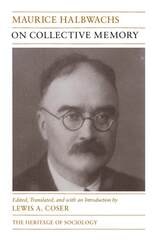
On Collective Memory
Maurice Halbwachs
University of Chicago Press, 1992
How do we use our mental images of the present to reconstruct our past? Maurice Halbwachs (1877-1945) addressed this question for the first time in his work on collective memory, which established him as a major figure in the history of sociology. This volume, the first comprehensive English-language translation of Halbwach's writings on the social construction of memory, fills a major gap in the literature on the sociology of knowledge.
Halbwachs' primary thesis is that human memory can only function within a collective context. Collective memory, Halbwachs asserts, is always selective; various groups of people have different collective memories, which in turn give rise to different modes of behavior. Halbwachs shows, for example, how pilgrims to the Holy Land over the centuries evoked very different images of the events of Jesus' life; how wealthy old families in France have a memory of the past that diverges sharply from that of the nouveaux riches; and how working class construction of reality differ from those of their middle-class counterparts.
With a detailed introduction by Lewis A. Coser, this translation will be an indispensable source for new research in historical sociology and cultural memory.
Lewis A. Coser is Distinguished Professor of Sociology Emeritus at the State University of New York and Adjunct Professor of Sociology at Boston College.
On Collective Memory
Maurice Halbwachs
University of Chicago Press, 1992
This is an auto-narrated audiobook version of this book.
How do we use our mental images of the present to reconstruct our past? Maurice Halbwachs (1877-1945) addressed this question for the first time in his work on collective memory, which established him as a major figure in the history of sociology. This volume, the first comprehensive English-language translation of Halbwach's writings on the social construction of memory, fills a major gap in the literature on the sociology of knowledge.
Halbwachs' primary thesis is that human memory can only function within a collective context. Collective memory, Halbwachs asserts, is always selective; various groups of people have different collective memories, which in turn give rise to different modes of behavior. Halbwachs shows, for example, how pilgrims to the Holy Land over the centuries evoked very different images of the events of Jesus' life; how wealthy old families in France have a memory of the past that diverges sharply from that of the nouveaux riches; and how working class construction of reality differ from those of their middle-class counterparts.
With a detailed introduction by Lewis A. Coser, this translation will be an indispensable source for new research in historical sociology and cultural memory.
Lewis A. Coser is Distinguished Professor of Sociology Emeritus at the State University of New York and Adjunct Professor of Sociology at Boston College.

On Future Of Educational Institutions
Friedrich Nietzsche
St. Augustine's Press, 2004
On the Future of Our Educational Institutions, the work that was to have been Nietzsche's second book until he canceled the contract and used portions in his Untimely Meditations, is a substantial call for radical educational reform presented in the form of a prolonged narrative dialogue. It is presented here in the first English translation ever from the standard critical edition (a little-known translation was made for the Complete Works of 1909, long out of print). Here Nietzsche, through the characters of this prolonged narrative dialogue, starts from a consideration of German educational institutions and rises to a consideration of what is needed for true, or classical, education. Though Nietzsche engages his contemporary world more in this work than in perhaps any other, this engagement is neither arbitrary nor limiting. Starting where one is and has grown up happens to be the necessary grounding of the organic unity that belongs to true culture: "Every so-called classical education has only one healthy and natural starting point, the artistic, serious, and rigorous habituation in the use of the mother tongue. . . . Here where gradually the distinguishing feeling for form and for barbarism awakes, the wing bestirs itself for the first time that carries to the right and sole home of education, to Greek antiquity. Of course we would not come very far with the help of that wing all alone in the attempt to bring ourselves close to that castle of the Hellenic, infinitely distant and enclosed within diamond ramparts: rather anew we need the same leaders, the same teachers, our German classics, in order ourselves to become swept away under the wingbeat of their ancient endeavors to the land of longing, to Greece."
In this dialogue, Nietzsche considers what it would mean to put education, culture, first in priority above all else, above religion, above economics, even above the state. The dialogue's call for educational reform goes so far as to require that the state be completely subordinated to the demands and needs of culture. The state must not be "a border guard, regulator, or overseer for his culture; rather the robust, muscular comrade, ready for battle, and companion on the way, who gives the admired, nobler, and, as it were, unearthly friend safe conduct through the harsh realities and for that earns his thankfulness."
Not only does the dialogue demand that the state subordinate itself to education, but it goes on to suggest that widespread educational institutions are for the sake of only a small number of beneficiaries. This radical and uncompromising devotion to the education of a very few sketches Nietzsche's thoughts on education perhaps more completely than any other work.
In addition, this dialogue offers numerous other objects of interest. The dialogue form shows off Nietzsche's literary art and offers an occasion to think carefully about the special tasks involved in reading philosophic texts well. The circumstances of this text's writing and its nearly being published offer insights both into Nietzsche's development and into the production of his works, especially regarding the Untimely Meditations. The letters and notes in the appendices help to flesh out the thinking that surrounds this text as well as to suggest the form of the never-written sixth lecture. Also Nietzsche's engagement with the immediate tradition of his contemporary milieu, not only with Goethe, Schiller, and Lessing but also with lesser figures such as Koetzebue, Grillparzer, and Gutzkow, should be of interest to intellectual historians and students of European culture.
Nietzsche read On the Future of Our Educational Institutions publicly in the form of five lectures. He then tried to rush it into publication, and it very nearly became Nietzsche's second book. Only at the last moment did he withdraw the book from the public. Now it is available in English.
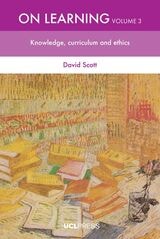
On Learning, Volume 3
Knowledge, Curriculum and EthicsDavid Scott
University College London, 2025
What does it mean to learn? In On Learning, Volume 3: Knowledge, Curriculum and Ethics, David Scott probes the intricate relationship between knowledge and learning, questioning reductionist and empiricist perspectives that dominate contemporary education. This volume, like the first two in the series, critically analyzes the philosophical and ethical dimensions of learning, pushing beyond simplified notions of curriculum and assessment. Scott ties in a range of key concepts, including epistemology and critical realism, to offer a profound rethinking of what it means to know and engage with the world.
At the heart of this book is a call to recognize that learning is not merely a mechanical process or a set of measurable outcomes but a deeply human and ethical endeavor. On Learning, Volume 3 urges readers to reconsider the structures that shape education today and invites us to rethink how we understand knowledge and learning, and the values that underpin them.
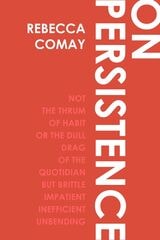
On Persistence
Rebecca Comay
Seagull Books, 2026
On Persistence is an exploration into the elusive, unruly force of endurance—not as moral virtue or capitalist work ethic, but as a temporal and affective structure that resists assimilation. In these wide-ranging philosophical and literary essays, Rebecca Comay interrogates what it means to persist when progress stalls and resolution fails to arrive. Engaging figures from Freud to Beckett, Proust to Benjamin, Hamlet to Niobe, Comay tracks the strange temporality of suspended life: interminable mourning, unfinished projects, the persistence of the past, the undead stirrings of the death drive. What emerges is a radically different model of time—neither static nor teleological, but a form of interruption that opens space for rethinking agency, grief, resistance, and repair.
On Persistence offers a profound meditation on what it means to endure—and to endure differently—in a time that demands something else of us.
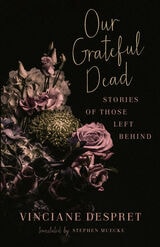
Our Grateful Dead
Stories of Those Left BehindVinciane Despret
University of Minnesota Press, 2021
An award-winning exploration of the presence of the dead in the lives of the living
A common remedy after suffering the loss of a loved one is to progress through the “stages of grief,” with “acceptance” as the final stage in the process. But is it necessary to leave death behind, to stop dwelling on the dead, to get over the pain? Vinciane Despret thinks not. In her fascinating, elegantly translated book, this influential thinker argues that, in practice, people in all cultures continue to enjoy a lively, inventive, positive relationship with their dead.
Through her unique storytelling woven from ethnographic sources and her own family history, Despret assembles accounts of those who have found ways to live their daily lives with their dead. She rejects the idea that one must either subscribe to “complete mourning” (in a sense, to get rid of the dead) or else fall into fantasy and superstition. She explores instead how the dead still play an active, tangible role through those who are living, who might assume their place in a family or in society; continue their labor or art; or thrive from a shared inheritance or an organ donation. This is supported by dreams and voices, novels, television and popular culture, the work of clairvoyants, and the everyday stories and activities of the living. For decades now, in the West, the dead have been discreet and invisible. Today, especially as a result of the Covid-19 pandemic, Despret suggests that perhaps we will be willing to engage with the dead in ways that bring us happiness despite our loss.
Despret’s unique method of inquiry makes her book both entertaining and instructive. Our Grateful Dead offers a new, pragmatic approach to social and cultural research and may indeed provide compassionate therapy for those of us coping with death.
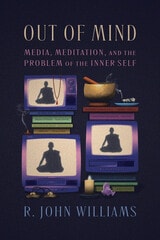
Out of Mind
Media, Meditation, and the Problem of the Inner SelfR. John Williams
University of Chicago Press, 2026
A history of modern mindfulness meditation and a critique of it as a practice that deeply misunderstands human consciousness.
Mindfulness meditation is often presented as a simple practice of turning inward and quieting the world to discover an authentic “inner voice,” but the very idea that consciousness contains such a voice depends on a slew of contradictory beliefs about Buddhism, neuroscience, and more. In Out of Mind, R. John Williams challenges the core (and misguided) assumptions about human nature that shaped the development of modern meditation, revealing how they were informed by nineteenth-century theosophy, German idealism, Buddhist modernism, Heideggerian mindfulness, Cold War brainwashing, and even phenomena like sensory deprivation tanks. Against the notion that truth lies hidden in our brains, Williams argues that we are never sealed off from the world. Our consciousness extends beyond our own minds—into the intricate web of language, literature, art, and other people to which we are intimately connected.