Results by title
1861 books match the query 'Social life and customs' and 52 start with o

O Little Town
Remembering Life in a Prairie VillageHarlo L. Jones
University of Manitoba Press, 1995
ORDINATION
SCOTT A KAUKONEN
The Ohio State University Press, 2005
“If my mother were to tell the story . . .” So begins the title piece in this debut collection of short fiction, eight stories that explore the gap between the stories we tell ourselves and the stories we have lived. In “Punitive Damages,” a father, the beneficiary of a huge financial settlement in compensation for his son’s death, must confront the truth of the life that the son’s death has provided. In “Punnett’s Squares,” winner of the Chicago Tribune’s Nelson Algren Award, an adopted son seeks to prove, against all evidence to the contrary, that his adoptive father is in fact his biological father. In “Induction Ceremony,” a small-town basketball hero returns to his hometown no longer a man but now a woman, and his onetime teammate-and-friend must reconsider who they were and who they are now. In the pair of pieces that bookend the collection, “Ordination” and “Be a Missionary,” a Baptist preacher’s son must reconcile the distance between the evidence of things seen and the evidence of things unseen.
These are men and boys who like to see themselves as worthy of the titles of father, son, husband, lover, and friend, but who must fight their own instincts and desires to claim such honors. These are boys and men for whom questions of identity—biological, cultural, sexual, religious, moral—are unavoidable, men and boys always seeking to be who they want to be, always aware of who they are.
Oaxaca al Gusto
An Infinite GastronomyBy Diana Kennedy
University of Texas Press, 2010
No one has done more to introduce the world to the authentic, flavorful cuisines of Mexico than Diana Kennedy. Acclaimed as the Julia Child of Mexican cooking, Kennedy has been an intrepid, indefatigable student of Mexican foodways for more than fifty years and has published several classic books on the subject, including The Cuisines of Mexico (now available in The Essential Cuisines of Mexico, a compilation of her first three books), The Art of Mexican Cooking, My Mexico, and From My Mexican Kitchen. Her uncompromising insistence on using the proper local ingredients and preparation techniques has taught generations of cooks how to prepare—and savor—the delicious, subtle, and varied tastes of Mexico.
In Oaxaca al Gusto, Kennedy takes us on an amazing journey into one of the most outstanding and colorful cuisines in the world. The state of Oaxaca is one of the most diverse in Mexico, with many different cultural and linguistic groups, often living in areas difficult to access. Each group has its own distinctive cuisine, and Diana Kennedy has spent many years traveling the length and breadth of Oaxaca to record in words and photographs "these little-known foods, both wild and cultivated, the way they were prepared, and the part they play in the daily or festive life of the communities I visited." Oaxaca al Gusto is the fruit of these labors—and the culmination of Diana Kennedy's life's work.
Organized by regions, Oaxaca al Gusto presents some three hundred recipes—most from home cooks—for traditional Oaxacan dishes. Kennedy accompanies each recipe with fascinating notes about the ingredients, cooking techniques, and the food's place in family and communal life. Lovely color photographs illustrate the food and its preparation. A special feature of the book is a chapter devoted to the three pillars of the Oaxacan regional cuisines—chocolate, corn, and chiles. Notes to the cook, a glossary, a bibliography, and an index complete the volume.
An irreplaceable record of the infinite world of Oaxacan gastronomy, Oaxaca al Gusto belongs on the shelf of everyone who treasures the world's traditional regional cuisines.
Oaxaca in Motion
An Ethnography of Internal, Transnational, and Return MigrationIván Sandoval-Cervantes
University of Texas Press, 2022
Migration is typically seen as a transnational phenomenon, but it happens within borders, too. Oaxaca in Motion documents a revealing irony in the latter sort: internal migration often is global in character, motivated by foreign affairs and international economic integration, and it is no less transformative than its cross-border analogue.
Iván Sandoval-Cervantes spent nearly two years observing and interviewing migrants from the rural Oaxacan town of Santa Ana Zegache. Many women from the area travel to Mexico City to work as domestics, and men are encouraged to join the Mexican military to fight the US-instigated “war on drugs” or else leave their fields to labor in industries serving global supply chains. Placing these moves in their historical and cultural context, Sandoval-Cervantes discovers that migrants’ experiences dramatically alter their conceptions of gender, upsetting their traditional notions of masculinity and femininity. And some migrants bring their revised views with them when they return home, influencing their families and community of origin. Comparing Oaxacans moving within Mexico to those living along the US West Coast, Sandoval-Cervantes clearly demonstrates the multiplicity of answers to the question, “Who is a migrant?”
Objects of Special Devotion
Fetishes and Fetishism in Popular CultureRay B. Browne
University of Wisconsin Press, 1982
This book demonstrates the importance of the study of fetishes and fetishism in the study of popular culture. Some of the essays cover rather "conventional" manifestations in the world today; others demonstrate the fetishistic qualities of some unusual items. But all illustrate without any doubt that, like the icon, the ritual, and many other items in society, fetishes, fetishism and fetishists must be studied and understood before we can begin to understand the complexity of present-day society.
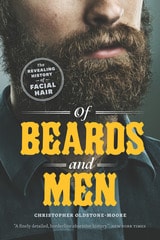
Of Beards and Men
The Revealing History of Facial HairChristopher Oldstone-Moore
University of Chicago Press, 2015
Of Beards and Men makes the case that today’s bearded renaissance is part of a centuries-long cycle in which facial hairstyles have varied in response to changing ideals of masculinity. Christopher Oldstone-Moore explains that the clean-shaven face has been the default style throughout Western history—see Alexander the Great’s beardless face, for example, as the Greek heroic ideal. But the primacy of razors has been challenged over the years by four great bearded movements, beginning with Hadrian in the second century and stretching to today’s bristled resurgence. The clean-shaven face today, Oldstone-Moore says, has come to signify a virtuous and sociable man, whereas the beard marks someone as self-reliant and unconventional. History, then, has established specific meanings for facial hair, which both inspire and constrain a man’s choices in how he presents himself to the world.
This fascinating and erudite history of facial hair cracks the masculine hair code, shedding light on the choices men make as they shape the hair on their faces. Oldstone-Moore adeptly lays to rest common misperceptions about beards and vividly illustrates the connection between grooming, identity, culture, and masculinity. To a surprising degree, we find, the history of men is written on their faces.
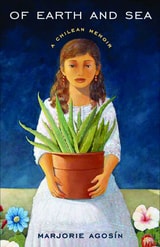
Of Earth and Sea
A Chilean MemoirMarjorie Agosín
University of Arizona Press, 2008
This collection of prose vignettes and free verse draws upon her experiences as a child in Chile, an expatriate abroad, and a minority Jew—even in the land she calls home—to create a striking portrait of a life of exile. The tone of the book varies as it lyrically explores the geography of Chile and weaves into it the themes of exile and oppression. At times the words become hymns to the physical beauty of her country, evoking the grandeur of this land extending to the southernmost tip of the world. At times they are intimate and melancholy, exploring personal and familial history through miniature portraits that reveal the pain of being different. Finally the tone becomes angry as she denounces the injustices committed against her friends and against the families of the disappeared during the seventeen-year dictatorship of Augusto Pinochet.
Combining themes of memory, childhood, minority issues, Judaism, and political oppression, this collection contains some of Agosín’s strongest work. Of Earth and Sea is a poetic autobiography that explores the world of Chile with eyes that see both despair and hope.
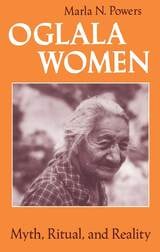
Oglala Women
Myth, Ritual, and RealityMarla N. Powers
University of Chicago Press, 1986
"It is a happy event when a fine scholarly work is rendered accessible to the general reader, especially so when none of the complexity of the subject matter is sacrificed. Oglala Women is a long overdue revisionary ethnography of Native American culture."—Penny Skillman, San Francisco Chronicle Review
"Marla N. Powers's fine study introduced me to Oglala women 'portrayed from the perspectives of Indians,' to women who did not pity themselves and want no pity from others. . . . A brave, thorough, and stimulating book."—Melody Graulich, Women's Review of Books
"Powers's new book is an intricate weaving . . . and her synthesis brings all of these pieces into a well-integrated and insightful whole, one which sheds new light on the importance of women and how they have adapted to the circumstances of the last century."—Elizabeth S. Grobsmith, Nebraska History

Oh, Say, Can You See
The Semiotics of the Military in Hawai’iKathy E. Ferguson
University of Minnesota Press, 1998
Considers what the military presence in Hawai’i tells us about colonialism, gender, race, and class.
Everywhere you look in Hawai’i, you might see the military. And yet, in daily life few residents see the military at all-it is hidden in plain sight. This paradox of invisibility and visibility, of the available and the hidden, is the subject of Oh, Say, Can You See?, which maps the power relations involving gender, race, and class that define Hawai’i in relation to the national security state.
Western intruders into Hawai’i-from the early explorers, missionaries, and sugar planters to the military, tourists, and foreign investors-have seen the island nation as a feminine place, waiting to embrace those who come to penetrate, protect, mold, and develop, yet conveniently lacking whatever the newcomers claim to possess. Thus feminized, this book contends, the islands and the people have been reinscribed with meanings according to the needs, fears, and desires of outsiders. Authors Kathy E. Ferguson and Phyllis Turnbull locate and “excavate” sites of memory, such as cemeteries, memorials, monuments, and museums, to show how the military constructs its gendered narrative upon prior colonial discourses. Among the sites considered are Fort DeRussy, Pearl Harbor, and Punchbowl Cemetery, as well as the practices of citizenship that are produced or foreclosed by the narratives of order and security written upon Hawai’i by the military.This semiotic investigation of ways the military marks Hawai’i necessarily explores the intersection of immigration, colonialism, military expansion, and tourism on the islands. Attending to the ways in which the military represents itself and others represent the military, the authors locate the particular representational elements that both conceal and reveal the military’s presence and power; in doing so, they seek to expand discursive space so that other voices can be heard. ISBN 0-8166-2978-1 Cloth $49.95xxISBN 0-81662979-X Paper $19.95x240 pages 5 7/8 x 9 DecemberBorderlines Series, Volume 10Translation inquiries: University of Minnesota Press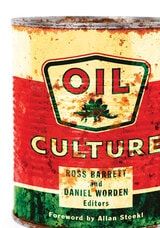
Oil Culture
Ross Barrett
University of Minnesota Press, 2014
In the 150 years since the birth of the petroleum industry oil has saturated our culture, fueling our cars and wars, our economy and policies. But just as thoroughly, culture saturates oil. So what exactly is “oil culture”? This book pursues an answer through petrocapitalism’s history in literature, film, fine art, wartime propaganda, and museum displays. Investigating cultural discourses that have taken shape around oil, these essays compose the first sustained attempt to understand how petroleum has suffused the Western imagination.
The contributors to this volume examine the oil culture nexus, beginning with the whale oil culture it replaced and analyzing literature and films such as Giant, Sundown, Bernardo Bertolucci’s La Via del Petrolio, and Ben Okri’s “What the Tapster Saw”; corporate art, museum installations, and contemporary photography; and in apocalyptic visions of environmental disaster and science fiction. By considering oil as both a natural resource and a trope, the authors show how oil’s dominance is part of culture rather than an economic or physical necessity. Oil Culture sees beyond oil capitalism to alternative modes of energy production and consumption.
Contributors: Georgiana Banita, U of Bamberg; Frederick Buell, Queens College; Gerry Canavan, Marquette U; Melanie Doherty, Wesleyan College; Sarah Frohardt-Lane, Ripon College, Matthew T. Huber, Syracuse U; Dolly Jørgensen, Umeå U; Stephanie LeMenager, U of Oregon; Hanna Musiol, Northeastern U; Chad H. Parker, U of Louisiana at Lafayette; Ruth Salvaggio, U of North Carolina, Chapel Hill; Heidi Scott, Florida International U; Imre Szeman, U of Alberta; Michael Watts, U of California, Berkeley; Jennifer Wenzel, Columbia University; Sheena Wilson, U of Alberta; Rochelle Raineri Zuck, U of Minnesota Duluth; Catherine Zuromskis, U of New Mexico.

Oktoberfest in Brazil
Domestic Tourism, Sensescapes, and German Brazilian IdentityAudrey Ricke
University of Alabama Press, 2023
An immersive ethnography uncovering how sensory experience, tourism, and heritage performance shape German Brazilian identity across local, national, and transnational landscapes.
Oktoberfest in Brazil: Domestic Tourism, Sensescapes, and German Brazilian Identity is one of the first ethnographies to analyze the tourism industry based on German cultural heritage in southern Brazil. Southern Brazil’s booming domestic tourism industry draws more than 500,000 people to events such as the Oktoberfest in Blumenau. Ricke investigates domestic tourism as sensescapes, focusing on the multiple and layered meanings associated with tourism’s sensory experiences and interactions. The author also introduces the “economy of aesthetics” as a new framework to capture how the sensescapes associated with domestic tourism are intertwined in the negotiation of ethnic, national, and transnational identities. These sensescapes also intersect with discourses on class and race, which are examined as well.
Oktoberfest in Brazil leads readers on a tour through German Brazilian home gardens, folk dance performances, and the largest Oktoberfest in Brazil. These sensory-rich spaces of interaction provide access to different perspectives and types of identity negotiation at multiple levels from the local to the transnational. Ricke illustrates how the emotions and sensory experiences of these sensescapes associated with German cultural heritage function as a means for German Brazilians to negotiate senses of belonging as Brazilians as well as their ethnic and transnational identities.
This book also provides historical and contemporary insights into the politics of citizenship associated with cultural heritage. As politics become more polarized, the need to analyze different ways of communicating through sensory experiences increases. The unique contribution of the economy of aesthetics framework is its ability to capture the influential power of sensory experience in the negotiation of identity and senses of belonging and citizenship more broadly. It provides new insights into how and why some sensory experiences within domestic tourism foster belonging and identity while other experiences reinforce social distinctions and national divisions.
Olav Audunssøn
III. CrossroadsSigrid Undset
University of Minnesota Press, 2022
The third volume in the Nobel Prize–winning writer’s epic story of medieval Norway, finely capturing Undset’s fluid, natural style in the first English translation in nearly a century
In the early fourteenth century, Norway is a kingdom in political turmoil, struggling with opposing forces within its own borders and drawn into strife with neighboring Sweden and Denmark. Bloody family vendettas and conflicting loyalties sparked by the irrepressible passion of a boy and his foster sister (also his betrothed) have now set in motion a series of terrible consequences—with a legacy of betrayal, murder, and disgrace that will echo down through the generations. Crossroads, the third of Olav Audunssøn’s four volumes, finds Olav heartbroken by loss and further estranged from his son. To escape his grief, Olav leaves his home estate of Hestviken and agrees to serve as captain on a small merchant ship headed to London. There, separated from everything familiar to him, Olav begins a visionary journey that will send him far into the forest and deep into his soul. Questioning past decisions and future plans, Olav must grapple with his own perceptions of love and guilt, sin and penitence, vengeance and forgiveness.
Set in a time and place where royalty and religion vie for power, and bloodlines and loyalties are law, Crossroads summons a powerful picture of Northern life in medieval times, as the Swedish Academy noted in awarding Sigrid Undset the Nobel Prize in 1928. Conveying both the intimate drama and epic sweep of Olav’s story as grief and guilt drive him to ever more desperate action, Crossroads is a moving and masterly re-creation of a vanished world tainted by bloodshed and haunted by sin and retribution.
As with Kristin Lavransdatter, her earlier medieval epic, Undset immersed herself in the legal, religious, and historical documents of the time while writing Olav Audunssøn to create astoundingly authentic and compelling portraits of Norwegian life in the Middle Ages. And as in her translation of Kristin Lavransdatter, Tiina Nunnally does full justice to Undset’s natural, fluid prose, in a style that delicately and lyrically conveys the natural world, the complex culture, and the fraught emotional territory against which Olav’s story inexorably unfolds.
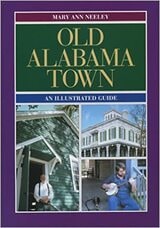
Old Alabama Town
An Illustrated GuideMary Ann Neeley
University of Alabama Press, 2002
Old Alabama Town is a visual and historical chronicle of one of the South's important architectural landmarks—four blocks of 19th-century buildings restored to their original condition, collectively forming an educational village that preserves and displays life as it was lived in Alabama from the 1830s through the 1890s. A creation of the Landmarks Foundation of Montgomery, a nonprofit organization developed in 1967, Old Alabama Town displays the lifestyles and environment of the time period through architecture, decorative arts, and living history. The "town" has been made available for students, secondary school educators for field trips, and to tourists for entertainment and family excursions.
More than 50 historic structures, all formerly in danger of demolition, have been transported from around central Alabama and restored on site. The Living Block of the village allows visitors to explore a log cabin, dogtrot house, carriage house, "shotgun" house, pole barn, schoolhouse, tavern, grange hall, and grocery. The Working Block allows patrons to visit a blacksmith's shop, drugstore, grist mill, cotton gin, woodcarver's shop, print shop, and cookhouse. Additional regions of the village present some of the most significant historic homes to be preserved in the state: the Cram-Lakin House, Thompson Mansion, and the Ordeman-Mitchell-Shaw House, among others.
Designed in full color, this paperback guide is introduced by the author's historical, sociological, and cultural overview of Montgomery. The 45 individual entries detail the history and features of each structure and are supplemented by a map, archival photographs of the buildings, and 60 contempo-rary color photographs. This book will be useful to tourists, preservationists, students and scholars of Alabama history and architecture, and all those interested in an interpretive museum of southern life.
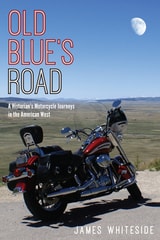
Old Blue's Road
A Historian's Motorcycle Journeys in the American WestJames Whiteside
University Press of Colorado, 2014
In 2005, Whiteside bought a Harley Davidson Heritage Softail, christened it “Old Blue,” and set off on a series of far-reaching motorcycle adventures. Over six years he traveled more than 15,000 miles. Part travelogue and part historical tour, this book takes the reader along for the ride. Whiteside’s travels to the Pacific Northwest, Yellowstone, Dodge City, Santa Fe, Wounded Knee, and many other locales prompt consideration of myriad topics—the ongoing struggle between Indian and mainstream American culture, the meaning of community, the sustainability of the West's hydraulic society, the creation of the national parks system, the Mormon experience in Utah, the internment of Japanese Americans during World War II, and more.
Delightfully funny and insightful, Old Blue’s Road links the colorful history and vibrant present from Whiteside’s unique vantage point, recognizing and reflecting on the processes of change that made the West what it is today. The book will interest the general reader and western historian alike, leading to new appreciation for the complex ways in which the American West's past and present come together.
Old Orchard Farm
The Story of an Iowa BoyhoodHugh Orchard
University of Iowa Press, 2010
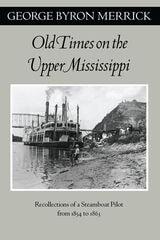
Old Times on the Upper Mississippi
Recollections of a Steamboat Pilot from 1854 to 1863George Byron Merrick
University of Minnesota Press, 2001
A long-awaited new edition of the steamboating classic.
George Byron Merrick chronicles the entire panorama of steamboat life he experienced in the mid-1800s, where he started as a cabin boy and worked up to cub pilot on the mighty Mississippi. Originally published in 1909, Merrick’s narrative matches lively stories about gamblers, shipwrecks, and steamboat races with rich descriptions of river life and steamboat operations.
Fesler-Lampert Minnesota Heritage Series
Old Wives' Tales
Susan M. Dodd
University of Iowa Press, 1984
In these ten varied and keenly rendered tales, Susan Dodd explores the levels of the human heart by leading us through a gallery of feelings, insights, characters, and emotions. Whether writing about a 100-year-old woman in South America, a teenage suicide in Winnetka, a divorced couple meeting by chance, or a pair of lovers listening to the family on the other side of their apartment wall, Dodd places us in a world full of subdued conflict where bonds between loved ones and strangers are tested, broken, and sometimes renewed. Her themes range beyond the regional or contemporary, embracing those moments of loneliness and self-knowledge that confront us all. As the characters meet and separate, wonder and react, we travel with them, exploring the forms of our existence, and the substance of our hearts.
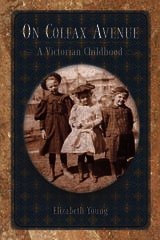
On Colfax Avenue
A Victorian ChildhoodElizabeth Young
University Press of Colorado, 2004

On Time Delivery
The Dog Team Mail CarriersWilliam S. Schneider
University of Alaska Press, 2012

On the Edge of the Auspicious
GENDER AND CASTE IN NEPALMary M. Cameron
University of Illinois Press, 1998
been noticeably absent from ethnographic accounts of the Himalayan region.
Starting from the perspective of lower-caste Hindu women, Mary M. Cameron
offers a long-overdue study of artisans and farmers in western Nepal.
On the Edge of the Auspicious skillfully shows the connections
between caste hierarchy and gender relations leading to domestic, economic,
and religious power of lower-caste women. Situating her study in the history
of land ownership and contemporary family and work relations, Cameron
explains how and why patriarchal ideology associated with high-caste families
in Nepal does not apply to women of lower caste. Drawing on data from
work, family, and religious domains, this ethnography goes further than
other current studies of caste hierarchy in South Asia to show the everyday
material and ideological dimensions of domination and lower-caste people's
resistance to them..
On the Plaza
The Politics of Public Space and CultureBy Setha M. Low
University of Texas Press, 2000
Robert B. Textor Prize for Excellence in Anticipatory Anthropology, American Anthropological Association, 2000
Honorable Mention, Victor Turner Award, Society for Humanistic Anthropology, 2001
Leeds Prize, Society of Urban, National, and Transnational/Global Anthropology, 2001
Friendly gossip, political rallies, outdoor concerts, drugs, shoeshines, and sex-for-sale—almost every aspect of Latin American life has its place and time in the public plaza. In this wide-ranging, multi-disciplinary study, Setha M. Low explores the interplay of space and culture in the plaza, showing how culture acts to shape public spaces and how the physical form of the plaza encodes the social and economic relations within its city.
Low centers her study on two plazas in San José, Costa Rica, with comparisons to public plazas in the United States, Europe, and elsewhere. She interweaves ethnography, history, literature, and personal narrative to capture the ambiance and meaning of the plaza. She also uncovers the contradictory ethnohistories of the European and indigenous origins of the Latin American plaza and explains why the plaza is often a politically contested space.

On the Porch
Life and Music in Terlingua, TexasW. Chase Peeler
University of Texas Press, 2021
In sunbaked Terlingua, Texas (pop., a few hundred), residents joke that there is a musician under every rock. Located ten miles from Mexico in one of the remotest corners of the United States, the town had a recording studio before it had a school, a well-stocked grocery store, or even a water utility. Open jam sessions are a daily ritual, and some songwriters make a living from their craft despite being thousands of miles from New York or Nashville. Why does such a tiny and isolated place ring with singing and guitars?
Based on more than two years of on-the-ground research, On the Porch tells the story of this small but remarkable community. Chase Peeler invites us into the music, introducing us to a cast of characters as unique as the town itself. He reveals how novices and experts perform together—a rarity in contemporary America. He recounts the devastation brought on by a border closure and describes how music is once again uniting people across the Rio Grande. He considers the impact of gentrification in an off-the-grid paradise, and how this threatens to transform a precarious musical ecosystem. On the Porch is a celebration of human musicality, of the role that music plays and can play in our lives, both in Terlingua and beyond.

On the Run in Siberia
Rane Willerslev
University of Minnesota Press, 2012
If I had let myself be ruled by reason alone, I would surely be lying dead somewhere or another in the Siberian frost.
The Siberian taiga: a massive forest region of roughly 4.5 million square miles, stretching from the Ural Mountains to the Bering Sea, breathtakingly beautiful and the coldest inhabited region in the world. Winter temperatures plummet to a bitter 97 degrees below zero, and beneath the permafrost lie the fossilized remains of mammoths, woolly rhinoceroses, and other ice age giants. For the Yukaghir, an indigenous people of the taiga, hunting sable is both an economic necessity and a spiritual experience—where trusting dreams and omens is as necessary as following animal tracks. Since the fall of Communism, a corrupt regional corporation has monopolized the fur trade, forcing the Yukaghir hunters into impoverished servitude.
Enter Rane Willerslev, a young Danish anthropologist who ventures into this frozen land on an idealistic mission to organize a fair-trade fur cooperative with the hunters. From the outset, things go terribly wrong. The regional fur company, with ties to corrupt public officials, proves it will stop at nothing to maintain its monopoly: one of Willerslev’s Yukaghir business partners is arrested on spurious charges of poaching and illegal trading; another drowns mysteriously. When police are sent to arrest him, Willerslev fears for his life, and he and a local hunter flee to a remote hunting lodge even deeper in the icy wilderness. Their situation turns even more desperate right away: they manage to kill a moose but lose the meat to predators and begin to starve, frostbitten and isolated in the frozen taiga.
Thus begins Willerslev’s extraordinary, chilling tale of one year living in exile among Yukaghir hunters in the stark Siberian taiga region. At turns shocking and quietly moving, On the Run in Siberia is a pulse-pounding tale of idealism, political corruption, starvation, and survival (with a timely assist from Vladimir Putin) as well as a striking portrait of the Yukaghirs’ shamanistic tradition and their threatened way of life, a drama unfolding daily in one of the world’s coldest, most enthralling landscapes.
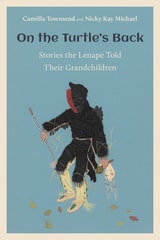
On the Turtle's Back
Stories the Lenape Told Their GrandchildrenCamilla Townsend
Rutgers University Press, 2023
The Lenape tribe, also known as the Delaware Nation, lived for centuries on the land that English colonists later called New Jersey. But once America gained its independence, they were forced to move further west: to Indiana, then Missouri, and finally to the territory that became Oklahoma. These reluctant migrants were not able to carry much from their ancestral homeland, but they managed to preserve the stories that had been passed down for generations.
On the Turtle’s Back is the first collection of Lenape folklore, originally compiled by anthropologist M. R. Harrington over a century ago but never published until now. In it, the Delaware share their cherished tales about the world’s creation, epic heroes, and ordinary human foibles. It features stories told to Harrington by two Lenape couples, Julius and Minnie Fouts and Charles and Susan Elkhair, who sought to officially record their legends before their language and cultural traditions died out. More recent interviews with Lenape elders are also included, as their reflections on hearing these stories as children speak to the status of the tribe and its culture today. Together, they welcome you into their rich and wondrous imaginative world.
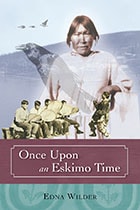
Once Upon an Eskimo Time
Edna Wilder
University of Alaska Press, 2009
Continuing the sacred tradition of her ancestors, in Once Upon an Eskimo Time Edna Wilder retells a year in her Eskimo mother’s life. Wilder eloquently captures the oral storytelling traditions of her people, and she employs descriptions of the weather and harsh climates of Alaska’s Norton Sound to illustrate the hardiness of her mother’s spirit. Family values, subsistence living, and the cycle’s of life form a narrative that captures the now-vanished lifestyle along the Bering Sea.
“Readers of whatever age will enjoy Nedercook’s delightful account of the day-to-day, legends, and beliefs of the ancient Eskimo village of Rocky Point.”—Ames Tribune

One Colonial Woman's World
The Life and Writings of Mehetabel Chandler CoitMichelle Marchetti Coughlin
University of Massachusetts Press, 2012
Michelle Marchetti Coughlin combs through these writings to create a vivid portrait of a colonial American woman and the world she inhabited. Coughlin documents the activities of daily life as well as dramas occasioned by war, epidemics, and political upheaval. Though Coit's opportunities were circumscribed by gender norms of the day, she led a rich and varied life, not only running a household and raising a family, but reading, writing, traveling, transacting business, and maintaining a widespread network of social and commercial connections. She also took a lively interest in the world around her and played an active role in her community.
Coit's long life covered an eventful period in American history, and this book explores the numerous—and sometimes surprising—ways in which her personal history was linked to broader social and political developments. It also provides insight into the lives of countless other colonial American women whose history remains largely untold.
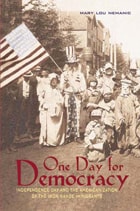
One Day for Democracy
Independence Day and the Americanization of Iron Range ImmigrantsMary Lou Nemanic
Ohio University Press, 2007

One Dog Happy
Molly McNett
University of Iowa Press, 2008
In this award-winning debut collection, Molly McNett couples laugh-out-loud dialogue and wry observation reminiscent of Flannery O’Connor with disquieting strains of dashed hope, troubled sexuality, and disillusionment.
The adults in these stories can seem as hapless and helpless as the younger characters. Two neglected daughters use the language of clothes to cope with their parents’ divorce and their father’s mail-order bride. A young girl’s bizarre sexual fantasies help her gain control over the chaos of her family life. A gang of teenagers accuse a farmer of bestiality. A divorced father tries to create a pony-filled world that might appeal to his daughters. In the title story, Mr. Bob, the minister’s housesitter, loses a dog but finds someone to believe in. And in “Helping,” the darkest story in this amazing collection, Ruthie’s anger conquers her religious faith when she takes care of a severely disabled child.
We meet McNett’s endearing, often foolish characters at a point when their minds are open to manipulation by the people and events around them, and the conclusions they draw are heartbreaking: I am not allowed weakness; life treats people unequally; perhaps there is no God. Yet throughout they find quiet moments of possibility, courage, and a return to faith and comfort.
One Less Car
Bicycling and the Politics of AutomobilityAuthored by Zack Furness
Temple University Press, 2010
Although millions of people in the United States love to ride bicycles for exercise or leisure, statistics show that only 1% of the total U.S. population ride bicycles for transportation—and barely half as many use bikes to commute to work. In his original and exciting book, One Less Car, Zack Furness examines what it means historically, culturally, socioeconomically, and politically to be a bicycle transportation advocate/activist.
Presenting an underground subculture of bike enthusiasts who aggressively resist car culture, Furness maps out the cultural trajectories between mobility, technology, urban space and everyday life. He connects bicycling to radical politics, public demonstrations, alternative media production (e.g., ‘zines), as well as to the development of community programs throughout the world.
One Less Car also positions the bicycle as an object with which to analyze and critique some of the dominant cultural and political formations in the U.S.—and even breaks down barriers of race, class and gender privilege that are interconnected to mobility. For Furness, bicycles not only liberate people from technology, they also support social and environmental justice. So, he asks, Why aren’t more Americans adopting them for their transportation needs?
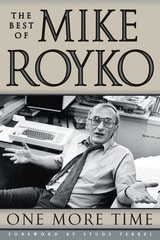
One More Time
The Best of Mike RoykoMike Royko
University of Chicago Press, 1999
"A treasure trove lies between these covers. Royko was in a class by himself. He was a true original."—Ann Landers
"The joy of One More Time is Royko in his own words."—Mary Eileen O'Connell, New York Times Book Review
"Reading a collection of Royko's columns is even more of a pleasure than encountering them one by one, and that is a large remark for he rarely wrote a piece that failed to wake you up with his hard-earned moral wit. Three cheers for Royko!"—Norman Mailer
"Powerful, punchy, amazingly contemporary."—Neil A. Grauer, Cleveland Plain Dealer
"This crackling collection of his own favorite columns as well as those beloved by his fans reminds us just how much we miss the gruff, compassionate voice of Mike Royko."—Jane Sumner, Dallas Morning News
"A marvelous road map through four decades of America."—Elizabeth Taylor, Chicago Tribune Books
"Royko was an expert at finding universal truths in parochial situations, as well as in the larger issues—war and peace, justice and injustice, wealth and poverty—he examined. Think of One More Time as one man's pungent commentary on life in these United States over the last few decades."—Booklist
"Royko was one of the most respected and admired people in the business, by readers and colleagues alike. . . . Savor [his sketches] while you can."—Jonathan Yardley, Washington Post Book World
"Book collections of columns aren't presumed to be worth reading. This one is, whether or not you care about newspapering or Chicago."—Neil Morgan, San Diego Union-Tribune
"A treasure house for journalism students, for would-be writers, for students of writing styles, for people who just like to laugh at the absurdity of the human condition or, as Studs Terkel said, for those who will later seek to learn what it was really like in the 20th century."—Georgie Anne Geyer, Washington Times
"Full of astonishments, and the greatest of these is Royko's technical mastery as a writer."—Hendrik Hertzberg, New Yorker
"A great tribute to an American original, a contrarian blessed with a sense of irony and a way with words."—Bob Minzesheimer, USA Today
"In this posthumous collection of his columns, journalist Royko displays the breezy wit that made him so beloved in the Windy City."—People
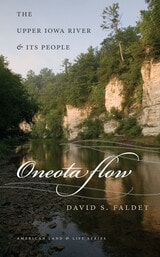
Oneota Flow
The Upper Iowa River and Its PeopleDavid S. Faldet
University of Iowa Press, 2009
Whether profiling the chief of the last hunter-gatherers on the river, an early settler witnessing her first prairie fire and a modern wildlife biologist using fire to manage prairies, the manager of the Granger Farmer’s Co-op Creamery, or a landowner whose bottomlands are continually eaten away by floods, Faldet steadily develops the central idea that people are walking tributaries of the river basin in which they make their homes.
Faldet moves through the history of life along the now-polluted Upper Iowa, always focusing on the ways people depend on the river, the environment, and the resources of the region. He blends contemporary conversations, readings from the historical record, environmental research, and personal experience to show us that the health of the river is best guaranteed by maintaining the biological communities that nurture it. In return, taking care of the Upper Iowa is the best way to take care of our future.

Oppenheimer Is Watching Me
A MemoirJeff Porter
University of Iowa Press, 2007
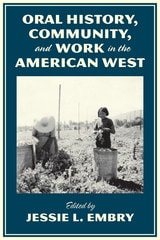
Oral History, Community, and Work in the American West
Edited by Jessie L. Embry
University of Arizona Press, 2013
In many cases occupations brought people together in myriad ways. The Latino workers who picked lemons together in Southern California report that it was baseball and Cinco de Mayo Queen contests that united them. Mormons in Fort Collins, Colorado, say that building a church together bonded them together. In separate essays, African Americans and women describe how they fostered a sense of community in Las Vegas. Native Americans detail the “Indian economy” in Northern California.
As these essays demonstrate, the history of the American West is the story of small towns and big cities, places both isolated and heavily populated. It includes groups whose history has often been neglected. Sometimes, western history has mirrored the history of the nation; at other times, it has diverged in unique ways. Oral history adds a dimension that has often been missing in writing a comprehensive history of the West. Here an array of oral historians—including folklorists, librarians, and public historians—record what they have learned from people who have, in their own ways, made history.
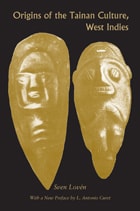
Origins of the Tainan Culture, West Indies
Sven Loven, with a new preface by L. Antonio Curet
University of Alabama Press, 2010
When originally published in German in 1924, this volume was hailed as the first modern, comprehensive archaeological overview of an emerging area of the world. Yes, the Caribbean islands had long been known and owned, occupied, or traded among by the economically advanced nations of the world. However, the original inhabitants—as well as their artifacts, languages, and culture—had been treated by explorers and entrepreneurs alike as either slaves or hindrances to progress, and were used or eliminated. There was no publication that treated seriously the region and the peoples until this work. In the following ten years, additional pertinent publications emerged, along with a request to translate the original into Spanish. Based on those recent publications, Loven decided to update and reissue the work in English, which he thought to be the future international language of scholarship. This work is a classic, with enduring interpretations, broad geographic range, and an eager audience.
Osage Indian Customs and Myths
Louis F. Burns
University of Alabama Press, 2005
Siouan peoples who migrated from the Atlantic coastal region and settled in the central portion of the North American continent long before the arrival of Europeans are now known as Osage. Because the Osage did not possess a written language, their myths and cultural traditions were handed down orally through many generations. With time, only those elements deemed vital were preserved in the stories, and many of these became highly stylized. The resulting verbal recitations of the proper life of an Osage—from genesis myths to body decoration, from star songs to child-naming rituals, from war party strategies to medicinal herbs—constitute this comprehensive volume.
Osage myths differ greatly from the myths of Western Civilization, most obviously in the absence of individual names. Instead, “younger brother,” “the messenger,” “Little Old Men,” or a clan name may serve as the allegorical embodiment of the central player. Individual heroic feats are also missing because group life took precedence over individual experience in Osage culture.
Supplementing the work of noted ethnographer Francis La Flesche who devoted most of his professional life to recording detailed descriptions of Osage rituals, Louis Burns’s unique position as a modern Osage—aware of the white culture’s expectations but steeped in the traditions himself is able to write from an insider’s perspective.
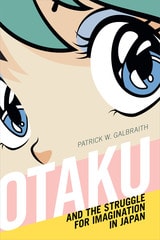
Otaku and the Struggle for Imagination in Japan
Patrick Galbraith
Duke University Press, 2019
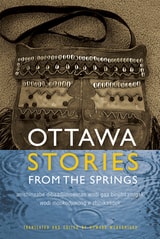
Ottawa Stories from the Springs
Anishinaabe dibaadjimowinan wodi gaa binjibaamigak wodi mookodjiwong e zhinikaadekHoward Webkamigad
Michigan State University Press, 2014
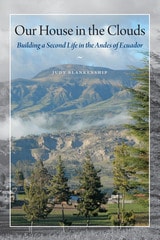
Our House in the Clouds
Building a Second Life in the Andes of EcuadorBy Judy Blankenship
University of Texas Press, 2013
While many baby boomers are downsizing to a simpler retirement lifestyle, photographer and writer Judy Blankenship and her husband Michael Jenkins took a more challenging leap in deciding to build a house on the side of a mountain in southern Ecuador. They now live half the year in Cañar, an indigenous community they came to know in the early nineties when Blankenship taught photography there. They are the only extranjeros (outsiders) in this homely, chilly town at 10,100 feet, where every afternoon a spectacular mass of clouds rolls up from the river valley below and envelopes the town.
In this absorbing memoir, Blankenship tells the interwoven stories of building their house in the clouds and strengthening their ties to the community. Although she and Michael had spent considerable time in Cañar before deciding to move there, they still had much to learn about local customs as they navigated the process of building a house with traditional materials using a local architect and craftspeople. Likewise, fulfilling their obligations as neighbors in a community based on reciprocity presented its own challenges and rewards. Blankenship writes vividly of the rituals of births, baptisms, marriages, festival days, and deaths that counterpoint her and Michael’s solitary pursuits of reading, writing, listening to opera, playing chess, and cooking. Their story will appeal to anyone contemplating a second life, as well as those seeking a deeper understanding of daily life in the developing world.
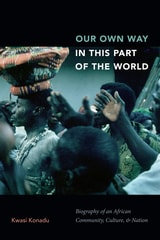
Our Own Way in This Part of the World
Biography of an African Community, Culture, and NationKwasi Konadu
Duke University Press, 2019
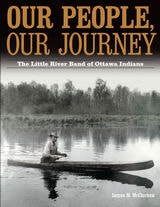
Our People, Our Journey
The Little River Band of Ottawa IndiansJames M. McClurken
Michigan State University Press, 2009
Our People, Our Journey is a landmark history of the Little River Band of Ottawa Indians, a Michigan tribe that has survived to the present day despite the expansionist and assimilationist policies that nearly robbed it of an identity in the late nineteenth century.
In his thoroughly researched chronicle, McClurken documents in words and images every major lineage and family of the Little River Ottawas. He describes the Band's struggles to find land to call its own over several centuries, including the hardships that began with European exploration of what is now the upper Midwest. Although the Little River Ottawas were successful at integrating their economic and cultural practices with those of Europeans, they were forced to cede land in the face of American settlements.
McClurken explains how the Little River Band was forced, in 1858, onto a reservation on the Pere Marquette and Manistee Rivers where they settled with a number of other Ottawa bands. However, the very treaty intended to provide the Grand River Ottawas with a permanent reservation "homeland" eventually allowed non-Indians to acquire title to nearly two-thirds of the land within the reservation by 1880.
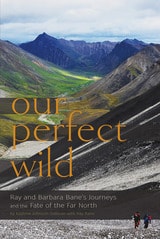
Our Perfect Wild
Ray & Barbara Bane's Journeys and the Fate of Far NorthKaylene Johnson-Sullivan with Ray Bane
University of Alaska Press, 2016
This book tells their story, a tale of dedication and tireless labor in the face of suspicion, resistance, and even violence. At a time when Alaska’s natural bounty remains under threat, Our Perfect Wild shows us an example of the commitment—and love—that will be required to preserve it.

Our Precious Corn
YukwanénsteRebecca M. Webster
Michigan State University Press, 2023

Out Of The Black Patch
Noel Carmack
Utah State University Press, 1999
Effie Marquess Carmack (1885-1974) grew up in the tobacco-growing region of southern Kentucky known as the Black Patch. As an adult she moved to Utah, back to Kentucky, to Arizona, and finally to California. Economic necessity primarily motivated Effie and her husband's moves, but her conversion to the Mormon Church in youth also was a factor. Throughout her life, she was committed to preserving the rural, southern folkways she had experienced as a child. She and other members of her family were folk musicians, at times professionally, and she also became a folk poet and artist, teaching herself to paint. In the 1940s she began writing her autobiography and eventually also completed a verse adaptation of it and an unpublished novel about life in the Black Patch.
Out in Culture
Gay, Lesbian and Queer Essays on Popular CultureCorey K. Creekmur and Alexander Doty, eds.
Duke University Press, 1995
Uniquely accessible, Out in Culture presents such popular writers as B. Ruby Rich, Essex Hemphill, and Michael Musto as well as influential critics such as Richard Dyer, Chris Straayer, and Julia Lesage, on topics ranging from the queer careers of Agnes Moorehead and Pee Wee Herman to the cultural politics of gay drag, lesbian style, the visualization of AIDS, and the black snap! queen experience. Of particular interest are two "dossiers," the first linking essays on the queer content of Alfred Hitchcock’s films, and the second on the production and reception of popular music within gay and lesbian communities. The volume concludes with an extensive bibliography—the most comprehensive currently available—of sources in gay, lesbian, and queer media criticism.
Out in Culture explores the distinctive and original ways in which gays, lesbians, and queers have experienced, appropriated, and resisted the images and artifacts of popular culture. This eclectic anthology will be of interest to a broad audience of general readers and scholars interested in gay and lesbian issues; students of film, media, gender, and cultural studies; and those interested in the emerging field of queer theory.
Contributors. Sabrina Barton, Edith Becker, Rhona J. Berenstein, Nayland Blake, Michelle Citron, Danae Clark, Corey K. Creekmur, Alexander Doty, Richard Dyer, Heather Findlay, Jan Zita Grover, Essex Hemphill, John Hepworth, Jeffrey Hilbert, Lucretia Knapp, Bruce La Bruce, Al LaValley, Julia Lesage, Michael Moon, Michael Musto, B. Ruby Rich, Marlon Riggs, Arlene Stein, Chris Straayer, Anthony Thomas, Mark Thompson, Valerie Traub, Thomas Waugh, Patricia White, Robin Wood
Out in Theory
The Emergence of Lesbian and Gay AnthropologyEdited by Ellen Lewin and William L. Leap
University of Illinois Press, 2002
This compelling collection of essays details the scholarly and personal factors that affected the emergence of lesbian and gay anthropology and speculates on the directions it will take as it continues to grow and diversify. Seeking to legitimize the field's scholarship and address issues in terminology, the essays also define the lesbian and gay anthropology's scope and subject matter and locate factors that separate it from the wider concerns of the profession.
Specific essays track the emergence of lesbian and gay studies in social and cultural anthropology, linguistics, archaeology, and in various areas of anthropological activism. They also consider how feminist anthropology helped define the field and how transgendered experience, queer theory, and race and class studies are promoting new directions of inquiry within lesbian and gay anthropology.
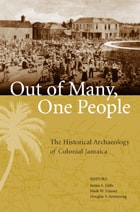
Out of Many, One People
The Historical Archaeology of Colonial JamaicaEdited by James A. Delle, Mark W. Hauser, and Douglas W. Armstrong
University of Alabama Press, 2011
Normal0falsefalsefalseEN-USX-NONEX-NONEMicrosoftInternetExplorer4

Out of the Blue
New Short Fiction from IcelandHelen Mitsios
University of Minnesota Press, 2017
A groundbreaking collection of fiction from Iceland’s best contemporary authors
This extraordinary collection, the first anthology of Icelandic short fiction published in English translation, features work by twenty of Iceland’s most popular and celebrated living authors—including Andri Snær Magnason, Jón Kalman Stefánsson, Kristín Ómarsdóttir, and Auður Jónsdóttir—granddaughter of Halldór Laxness, who won the 1955 Nobel Prize in Literature.
Celebrated in Europe and Scandinavia but less known in the English-speaking world, these writers traverse realms of darkness and light that will be familiar to readers who have fallen under the spell of Scandinavian fiction. While uniquely Icelandic in topography and tenor, with a touch of the island’s supernatural charm, the stories traffic in the enduring and universal complexities of human nature. Here is a fictional universe where the ghosts of Vikings and spirits tread, volcanoes grumble underfoot, and writers trip the Northern Lights fantastic across the landscape of the Icelandic imagination.
At long last, readers can enjoy award-winning stories now expertly rendered into English by the country’s most renowned translators. In “Killer Whale” a father contemplates euthanasia for a terminally ill child, in “Self Portrait” a vacationing family in Spain crosses paths with migrants, in “Escape for Men” a woman searches for an ex-lover in the South of France, and in “The Most Precious Secret” the nature of artists and the art world is mercilessly revealed. Both the Viking myths of Iceland’s forefathers and the cutting-edge modern world of the country today are brilliantly alive in these remarkable and original stories.
This collection is an excursion to an island where almost two million travelers descend yearly on a population of 345 thousand natives. Iceland is the place Björk calls home, the location where Game of Thrones was filmed—a place with open lava fields, glaciers, and iceberg lagoons among other natural wonders that is becoming one of the “hottest” tourist destinations on earth.
Out of the Blue transports readers to Iceland’s timeless and magical island of Vikings and geographical wonders, and it promises to be a seminal collection that will define Icelandic literature in translation for decades to come.
Contributors: Auður Ava Olafsdóttir, Kristín Eiríksdóttir, Þórarinn Eldjárn, Gyrðir Elíasson, Einar Örn Gunnarsson, Ólafur Gunnarsson, Einar Már Guðmundsson, Auður Jónsdóttir, Gerður Kristný, Andri Snær Magnason, Óskar Magnússon, Bragi Ólafsson, Kristín Ómarsdóttir, Óskar Árni Óskarsson, Magnús Sigurðsson, Jón Kalman Stefánsson, Ágúst Borgþór Sverrisson, Guðmundur Andri Thorsson, Þórunn Erlu-Valdimarsdóttir, Rúnar Helgi Vignisson.
Out of the Girls' Room and into the Night
Thisbe Nissen
University of Iowa Press, 1999
Out of the Girls' Room and into the Night is a spirited, offbeat collection of stories, elongated riffs on that thing we call …love. All manner of love stories: thwarted love stories, imaginary love stories, love stories offhand and obsessive, philosophical love stories, erudite and amusing love stories.
“People don't meet because they both like Burmese food,” says one character, “or because someone's sister has a friend who's single and new in town, or because Billy's nose happened to crook just slightly to the left at an angle that made me want to weep…People don't fall in love with each other …they just fall into love.”
Everyone does it: women of fierce independence, men of thin character, rambling Deadheads, gay teenage girls, despondent Peace Corps volunteers, anorexic Broadway theatre dancers, the eager, the grieving, the uncommunicative. Even the confused do it. And they don't just fall in love with each other—they fall in love with certain moments and familiar places, with things as ephemeral as gestures and as evanescent as sunlight.
Quirky, real, idealistic, deluded, bohemian, and true, these are people who can—and often do—fall in love with a pair of ears, August afternoons, saucers of vitamins, New Age carpenters, and dead bumblebees. And if there's something they can teach us, it's how to conceive of alternative worlds and the terror and the exhilaration of venturing outside the confines of the lives we know and making our way into a dark, glittering unknown.
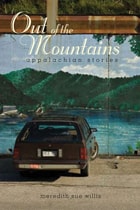
Out of the Mountains
Appalachian StoriesMeredith Sue Willis
Ohio University Press, 2010
Meredith Sue Willis’s Out of the Mountains is a collection of thirteen short stories set in contemporary Appalachia. Firmly grounded in place, the stories voyage out into the conflicting cultural identities that native Appalachians experience as they balance mainstream and mountain identities.
Willis’s stories explore the complex negotiations between longtime natives of the region and its newcomers and the rifts that develop within families over current issues such as mountaintop removal and homophobia. Always, however, the situations depicted in these stories are explored in the service of a deeper understanding of the people involved, and of the place. This is not the mythic version of Appalachia, but the Appalachia of the twenty-first century.
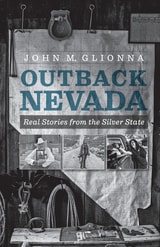
Outback Nevada
Real Stories from the Silver StateJohn M Glionna
University of Nevada Press, 2022
Glionna’s interest in Nevada’s rugged, isolated landscape and the people who choose to live in this often-harsh environment was born of his own wanderings into the “outback.” Through his stories, he shares intimate portraits of rural and small-town lifestyles not many understand. Readers meet men with names like Flash and Mr. Cool; will listen to a cowboy minister preach the word of God to his parishioners; will walk with an antiques dealer from Genoa as he hunts for denim in Nevada’s abandoned nineteenth-century mine shafts; and will learn from an ex-paramedic– turned–coffee-shop–owner who provides Boulder City with a true sense of community. Full of humor, eccentricities, and compassion, these stories reveal the state’s true nature and extend an invitation to get lost “somewhere out there” in the real Nevada.