Results by title
3027 books match the query 'Sociology' and 81 start with o

Obama's Race
The 2008 Election and the Dream of a Post-Racial AmericaMichael Tesler and David O. Sears
University of Chicago Press, 2010
Barack Obama’s presidential victory naturally led people to believe that the United States might finally be moving into a post-racial era. Obama’s Race—and its eye-opening account of the role played by race in the election—paints a dramatically different picture.
The authors argue that the 2008 election was more polarized by racial attitudes than any other presidential election on record—and perhaps more significantly, that there were two sides to this racialization: resentful opposition to and racially liberal support for Obama. As Obama’s campaign was given a boost in the primaries from racial liberals that extended well beyond that usually offered to ideologically similar white candidates, Hillary Clinton lost much of her longstanding support and instead became the preferred candidate of Democratic racial conservatives. Time and again, voters’ racial predispositions trumped their ideological preferences as John McCain—seldom described as conservative in matters of race—became the darling of racial conservatives from both parties. Hard-hitting and sure to be controversial, Obama’s Race will be both praised and criticized—but certainly not ignored.
Obesity among Poor Americans
Is Public Assistance the Problem?Patricia K. Smith
Vanderbilt University Press, 2009
This book investigates the controversial claim by welfare critics that public assistance programs like Food Stamps and the National School Lunch programs contribute to obesity among the poor. The author synthesizes empirical evidence from an array of disciplines--anthropology, economics, epidemiology, medicine, nutrition science, marketing, psychology, public health, sociology, and urban planning--to test this claim and to test whether other causal processes are at work.
With a lucid presentation that makes it a model for applying research to questions of social policy, the book lays out the different hypotheses and the possible causal pathways within each. The four central chapters test whether "public assistance causes obesity," "obesity causes public assistance," "poverty causes both public assistance and obesity," and "Factor X causes both." The factors in the last category that may relate to both public assistance and obesity include stress, disability, and physical abuse.

Observing America’s Jews
Marshall Sklare
Brandeis University Press, 1993
Obsession, Aesthetics, and the Iberian City
The Partial Madness of Modern Urban CultureBenjamin Fraser
Vanderbilt University Press, 2021
This book investigates the social relationships implied in our urban modernity by concentrating on four cities that are in broad strokes representative of the cultural and linguistic heterogeneity of the Iberian peninsula. Each chapter introduces but moves well beyond an identifiable urban area in a given city, noting the cultural obsession implicit in its reconstruction as well as the role of obsession in its artistic representation of the urban environment. These areas are Barcelona’s Eixample district, Madrid’s Linear City, Lisbon’s central Baixa area, and Bilbao’s Seven Streets, or Zazpikaleak. The theme of obsession—which as explored is synonymous with the concept of partial madness—provides a point of departure for understanding the interconnection of both urbanistic and artistic discourses.
Obsession
A HistoryLennard J. Davis
University of Chicago Press, 2008
We live in an age of obsession. Not only are we hopelessly devoted to our work, strangely addicted to our favorite television shows, and desperately impassioned about our cars, we admire obsession in others: we demand that lovers be infatuated with one another in films, we respond to the passion of single-minded musicians, we cheer on driven athletes. To be obsessive is to be American; to be obsessive is to be modern.
But obsession is not only a phenomenon of modern existence: it is a medical category—both a pathology and a goal. Behind this paradox lies a fascinating history, which Lennard J. Davis tells in Obsession. Beginning with the roots of the disease in demonic possession and its secular successors, Davis traces the evolution of obsessive behavior from a social and religious fact of life into a medical and psychiatric problem. From obsessive aspects of professional specialization to obsessive compulsive disorder and nymphomania, no variety of obsession eludes Davis’s graceful analysis.

Occupational Mobility in American Business and Industry, 1928-1952
W. Lloyd Warner and James C. Abegglen
University of Minnesota Press, 1955
Occupational Mobility in American Business and Industry, 1928–1952 was first published in 1955. Minnesota Archive Editions uses digital technology to make long-unavailable books once again accessible, and are published unaltered from the original University of Minnesota Press editions.
Is the American occupational system rigid or flexible? How has it changed in the last twenty-five years? What factors help to influence the selection of business leaders? Questions like these are answered in this comprehensive study of occupational mobility, made by two social scientists at the University of Chicago. The study is based on information about 8,000 executives in the largest business firms of America. The rate of movement of men from various occupational backgrounds into positions of business leadership today is compared with that of 1928, as reported in the well-known study of Taussig and Joslyn, American Business Leaders. Warner and Abegglen present their complete research data, many of the findings in tabular form. The research encompasses all kinds of businesses and industries in every part of the country and persons at all levels of top management.

Odd Couples
Friendships at the Intersection of Gender and Sexual OrientationAnna Muraco
Duke University Press, 2012
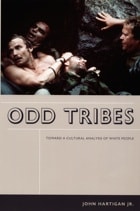
Odd Tribes
Toward a Cultural Analysis of White PeopleJohn Hartigan Jr.
Duke University Press, 2005
Odd Tribes engages debates in history, anthropology, sociology, and cultural studies over how race matters. Hartigan tracks the spread of “white trash” from an epithet used only in the South prior to the Civil War to one invoked throughout the country by the early twentieth century. He also recounts how the cultural figure of “white trash” influenced academic and popular writings on the urban poor from the 1880s through the 1990s. Hartigan’s critical reading of the historical uses of degrading images of poor whites to ratify lines of color in this country culminates in an analysis of how contemporary performers such as Eminem and Roseanne Barr challenge stereotypical representations of “white trash” by claiming the identity as their own. Odd Tribes presents a compelling vision of what cultural studies can be when diverse research methodologies and conceptual frameworks are brought to bear on pressing social issues.
Of Forests and Fields
Mexican Labor in the Pacific NorthwestMario Jimenez Sifuentez
Rutgers University Press, 2016
Just looking at the Pacific Northwest’s many verdant forests and fields, it may be hard to imagine the intense work it took to transform the region into the agricultural powerhouse it is today. Much of this labor was provided by Mexican guest workers, Tejano migrants, and undocumented immigrants, who converged on the region beginning in the mid-1940s. Of Forests and Fields tells the story of these workers, who toiled in the fields, canneries, packing sheds, and forests, turning the Pacific Northwest into one of the most productive agricultural regions in the country.

Of Others Inside
Insanity, Addiction And Belonging in AmericaDarin Weinberg, foreword by Bryan S. Turner
Temple University Press, 2005
Seeking to offer a new sociological understanding of the relationship between social exclusion and mental disability, Of Others Inside considers the general social conditions of homelessness, poverty, and social marginality in the U.S. Weinberg also explores questions about American perceptions of these conditions, and examines in great detail the social reality of mental disability and drug addiction without reducing people's suffering to simple notions of biological fate or social disorder.
Of War and Men
World War II in the Lives of Fathers and Their FamiliesRalph LaRossa
University of Chicago Press, 2011
Fathers in the fifties tend to be portrayed as wise and genial pipe-smokers or distant, emotionless patriarchs. This common but limited stereotype obscures the remarkable diversity of their experiences and those of their children. To uncover the real story of fatherhood during this transformative era, Ralph LaRossa takes the long view—from the attack on Pearl Harbor up to the election of John F. Kennedy—revealing the myriad ways that World War II and its aftermath shaped men.
Offering compelling accounts of people both ordinary and extraordinary, Of War and Men digs deep into the terrain of fatherhood. LaRossa explores the nature and aftereffects of combat, the culture of fear during the Cold War, the ways that fear altered the lives of racial and sexual minorities, and how the civil rights movement affected families both black and white. Overturning some calcified myths, LaRossa also analyzes the impact of suburbanization on fathers and their kids, discovering that living in the suburbs often strengthened their bond. And finally, looking beyond the idealized dad enshrined in TV sitcoms, Of War and Men explores the brutal side of family life in the postwar years. LaRossa’s richly researched book dismantles stereotypes while offering up a fascinating and incisive chronicle of fatherhood in all its complexity.
Office Politics
Computers, Labor, and the Fight for Safety and HealthMogensen, Vernon L
Rutgers University Press, 1996
The desktop computer has transformed office work. Business and social forecasters claimed that the use of video display terminals (VDTs) in the “Office of the Future” would free workers from routine tasks, giving them more time for creative work and chances for career advancement. Office Politics argues that, for many VDT workers––most of whom are nonunionized women in low-paying, dead-end jobs––exactly the opposite has been true. VDTs have been used to routinize office tasks; export work via satellite to low-wage, nonunion offshore offices; to de-skill workers and monitor their productivity. And the nature of the work has led to widespread health and safety problems, including vision, musculoskeletal (repetitive motion), and stress-related illnesses. Many have also charged that the electromagnetic fields (EMFs) emitted by computer terminals are responsible for miscarriages, for birth defects, and for promoting cancer.
As office workers sought to protect themselves against these new occupational health and safety problems, they found little help from organized labor, business, or the government. Office Politics is the first book to explain why. It shows how corporate interests successfully redefined the VDT health and safety crisis as a “comfort” problem, how the government refused to collect data on the true scope of VDT-related illnesses or to regulate Information Age industries, and how labor unions ignored women workers.
Office Politics is key reading for everyone who works at a computer. It will be of special interest to students, academics, and professionals in political science, sociology, occupational and environmental health, business, labor and management issues, women’s studies, computing, and public policy.
Oil and Urbanization on the Pacific Coast
Ralph Bramel Lloyd and the Shaping of the Urban WestMichael R. Adamson
West Virginia University Press, 2018
Oil and Urbanization on the Pacific Coast tells the story of oilman Ralph Bramel Lloyd, a small business owner who drove the development of one of America’s largest oil fields. Lloyd invested his petroleum earnings in commercial real estate—much of it centered around automobiles and the fuel they require—in several western cities, notably Portland, Oregon. Putting the history of extractive industry in dialogue with the history of urban development, Michael R. Adamson shows how energy is woven into the fabric of modern life, and how the “energy capital” of Los Angeles exerted far-flung influence in the US West.
A contribution to the relatively understudied history of small businesses in the United States, Oil and Urbanization on the Pacific Coast explores issues of interest to multiple audiences, such as the competition for influence over urban development waged among local growth machines and outside corporate interests; the urban rivalries of a region; the importance of public capital in mobilizing the commercial real estate sector during the Great Depression and World War II; and the relationships among owners, architects, and contractors in the execution of commercial building projects.
On Addiction
Insights from History, Ethnography, and Critical TheoryDarin Weinberg
Duke University Press, 2024
On Charisma and Institution Building
Selected WritingsMax Weber
University of Chicago Press, 1968
Max Weber on Charisma and Institution Building is a volume in "The Heritage of Sociology," a series edited by Morris Janowitz. Other volumes deal with the writings of George Herbert Mead, William F. Ogburn, Louis Wirth, W. I. Thomas, Robert E. Park, and the Scottish Moralists—Adam Smith, David Hume, Adam Ferguson, and others.
On Civilization, Power, and Knowledge
Selected WritingsNorbert Elias
University of Chicago Press, 1997
This volume is a carefully chosen collection of Elias's most important writings and includes many of his most brilliant ideas. The development of Elias's thinking during the course of his long career is traced along with a discussion of how his work relates to other major sociologists and how the various selections are interconnected. The result is a consistent and stimulating look at one of sociology's founding thinkers.
On Collective Memory
Maurice Halbwachs
University of Chicago Press, 1992
How do we use our mental images of the present to reconstruct our past? Maurice Halbwachs (1877-1945) addressed this question for the first time in his work on collective memory, which established him as a major figure in the history of sociology. This volume, the first comprehensive English-language translation of Halbwach's writings on the social construction of memory, fills a major gap in the literature on the sociology of knowledge.
Halbwachs' primary thesis is that human memory can only function within a collective context. Collective memory, Halbwachs asserts, is always selective; various groups of people have different collective memories, which in turn give rise to different modes of behavior. Halbwachs shows, for example, how pilgrims to the Holy Land over the centuries evoked very different images of the events of Jesus' life; how wealthy old families in France have a memory of the past that diverges sharply from that of the nouveaux riches; and how working class construction of reality differ from those of their middle-class counterparts.
With a detailed introduction by Lewis A. Coser, this translation will be an indispensable source for new research in historical sociology and cultural memory.
Lewis A. Coser is Distinguished Professor of Sociology Emeritus at the State University of New York and Adjunct Professor of Sociology at Boston College.
On Collective Memory
Maurice Halbwachs
University of Chicago Press, 1992
This is an auto-narrated audiobook version of this book.
How do we use our mental images of the present to reconstruct our past? Maurice Halbwachs (1877-1945) addressed this question for the first time in his work on collective memory, which established him as a major figure in the history of sociology. This volume, the first comprehensive English-language translation of Halbwach's writings on the social construction of memory, fills a major gap in the literature on the sociology of knowledge.
Halbwachs' primary thesis is that human memory can only function within a collective context. Collective memory, Halbwachs asserts, is always selective; various groups of people have different collective memories, which in turn give rise to different modes of behavior. Halbwachs shows, for example, how pilgrims to the Holy Land over the centuries evoked very different images of the events of Jesus' life; how wealthy old families in France have a memory of the past that diverges sharply from that of the nouveaux riches; and how working class construction of reality differ from those of their middle-class counterparts.
With a detailed introduction by Lewis A. Coser, this translation will be an indispensable source for new research in historical sociology and cultural memory.
Lewis A. Coser is Distinguished Professor of Sociology Emeritus at the State University of New York and Adjunct Professor of Sociology at Boston College.

On Drugs
David Lenson
University of Minnesota Press, 1995
A critical exploration of the user’s perspective on drug consciousness-now in paperback!
Engaging, articulate, and brilliantly argued, On Drugs is destined to become a revolutionary classic that redefines what it means to be “high.” Calling for the acceptance of a “diversity of consciousness,” Lenson delivers a searing critique of the War on Drugs as an effort based, like all attempts to eradicate “getting high,” on an incomplete understanding of human nature.
In lucid prose, Lenson ventures outside the conventional genres of drug writing and offers a new look at the drug debate from a lost, and often forbidden, point of view: the user’s. Walking a fine line between the antidrug hysteria of the 1980s and an uncritical advocacy of drug use, he describes in provocative detail the experiences and dynamics of drugs of pleasure and desire-from nicotine to marijuana, alcohol to LSD, and caffeine to cocaine.From lotus-eaters to hippies to crackheads, history has shown the state’s inability to legislate the bloodstreams of its citizens. After considering several specific issues associated with drug use-including sex, violence, and money-On Drugs asks what drugs really do and challenges society’s accepted notions of sobriety and addiction. Lenson concludes with his vision of the end of the War on Drugs by questioning the sense in condemning millions of Americans to lives of concealment and deceit.
On Feeling, Knowing, and Valuing
Selected WritingsMax Scheler
University of Chicago Press, 1992
1928) ranks with Max Weber, Edmund Husserl, and Ernst
Troeltsch as being among the most brilliant minds of his
generation. Yet Scheler is now known chiefly for his
philosophy of religion, despite his groundbreaking work in
the sociology of knowledge, the sociology of emotions, and
phenomenological sociology. This volume comprises some of
Scheler's most interesting work—including an analysis of the
role of sentiments in social interaction, a sociology of
knowledge rooted in global social and cultural comparisons,
and a cross-cultural theory of values—and identifies some of
his important contributions to the discussion of issues at
the forefront of the social sciences today.
Editor Harold J. Bershady provides a richly detailed
biographical portrait of Scheler, as well as an incisive
analysis of how his work extends and integrates problems of
theory and method addressed by Durkheim, Weber, and Parsons,
among others.
Harold J. Bershady, professor of sociology at the University
of Pennsylvania, is the author of Ideology and Social
Knowledge and the editor of Social Class and
Democratic Leadership.
Heritage of Sociology series
On Hobos and Homelessness
Nels Anderson
University of Chicago Press, 1998
On Hobos and Homelessness includes Anderson's rich and vibrant ethnographic work of a world of homeless men. He conducted his study on Madison street in Chicago, and we come to intimately know this portion of the 1920s hobo underworld—the harshness of vagrant life and the adventures of young hobos who come to the big city. This selection also includes Anderson's later work on the juvenile and the tramp, the unattached migrant, and the family. Like John Steinbeck's Depression-era observations, Anderson's writings express the memory of those who do not seem entitled to have memory, whose lives were expressed in temporary labor.

On Intersubjectivity and Cultural Creativity
Martin Buber
University of Chicago Press, 1992
Buber's central focus in his sociological work is the relation between social interaction, or intersubjectivity, and the process of human creativity. Specifically, Buber seeks to define the nature and conditions of creativity, the conditions of authentic intersubjective social relations that nurture creativity in society and culture. He attempts to identify situations favorable to creativity that he believes exist to some extent in all cultures, though their fullest development occurs only rarely.
Buber considers the combination of open dialogue between human and human and a dialogue between man and God to be necessary for the crystallization of the common discourse that is essential for holding a free, just, and open society together.
Important for an understanding of Buber's thought, these writings—touching on education, religion, the state, and charismatic leadership—will be of profound value to students of sociology, philosophy, and religion.
On Self and Social Organization
Charles Horton Cooley
University of Chicago Press, 1998
Cooley's work relating self and community is now more relevant than ever to the problems of understanding and directing modern democratic societies. Cooley applied the ideas of pragmatism to developing a systematic way of approaching social action, social change, and social order; he used these interrelated theories to analyze the social problems and cultural crises of the age. According to Cooley, social change is a fragile, interactive process that, due to constantly arising problems of action, requires ongoing scrutiny by the public. This collection of Cooley's best work is an important contribution not only to the history of ideas—especially to the origin of modern sociological theory— but also to the current public debate on civil society, community, and democracy.
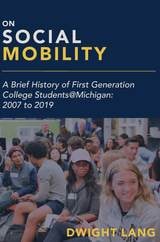
On Social Mobility
A Brief History of First-Generation College Students@Michigan: 2007 to 2019Dwight Lang
Michigan Publishing Services, 2019
Lang describes how working and lower class students openly acknowledge and struggle with challenging experiences on a predominantly middle and upper middle class campus. We appreciate how first generation students are risk takers, boundary crosser, and successful social class immigrants. Resourceful first-gen efforts become the basis of connection and community as students begin their social mobility journeys. Overtime a public story emerges: stories making the invisible visible; stories of courage and persistence; stories of structural changes; a thoughtful student movement that is hard to ignore. We come to better understand the power of shared determination.
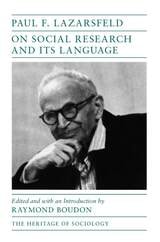
On Social Research and Its Language
Paul F. Lazarsfeld
University of Chicago Press, 1993
Lazarsfeld's systematic criticism of observational, conceptual, and inferential procedures in sociology led to the the formation of universally applied observational and analytical techniques, such as the panel design of observation and contextual and multivariate analysis. His methodology for empirical social research had a profound effect on all the social sciences.
The eighteen essays in On Social Research and Its Language illustrate the diversity of Lazarsfeld's substantive, methodological, and organizational interests. Spanning the years 1933 to 1972, they encompass his own works of social research, as well as writings on methodology and the history and sociology of social research. Articles on methodology—observing, classifying and building typologies, analyzing the relations between variables, qualitative analysis, and macrosociology—form the bulk of the book. In addition, Raymond Boudon provides a revealing biography of Lazarsfeld and his influence on sociology.
These classic writings by a formative figure of modern social science will be an indispensable reference for scholars across the historical and social science disciplines.
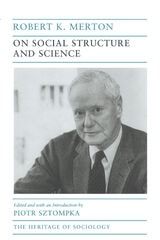
On Social Structure and Science
Robert K. Merton
University of Chicago Press, 1996
This definitive compilation encompasses the breadth and brilliance of his works, from the earliest to the most recent. Merton's foundational writings on social structure and process, on the sociology of science and knowledge, and on the discipline and trajectory of sociology itself are all powerfully represented, as are his autobiographical insights in a fascinating coda. Anchored by Piotr Sztompka's contextualizing introduction, Merton's vast oeuvre emerges as a dynamic and profoundly coherent system of thought, a constant source of vitality and renewal for present and future sociology.
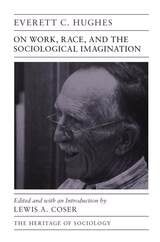
On Work, Race, and the Sociological Imagination
Everett C. Hughes
University of Chicago Press, 1994
On Your Own without a Net
The Transition to Adulthood for Vulnerable PopulationsEdited by D. Wayne Osgood, E. Michael Foster, Constance Flanagan, and Gretchen R
University of Chicago Press, 2005
On Your Own Without a Net documents the special challenges facing seven vulnerable populations during the transition to adulthood: former foster care youth, youth formerly involved in the juvenile justice system, youth in the criminal justice system, runaway and homeless youth, former special education students, young people in the mental health system, and youth with physical disabilities. During adolescence, government programs have been a major part of their lives, yet eligibility for most programs typically ends between the ages of eighteen and twenty-one. This critical volume shows the unfortunate repercussions of this termination of support and points out the issues that must be addressed to improve these young people's chances of becoming successful adults.
On the Fireline
Living and Dying with Wildland FirefightersMatthew Desmond
University of Chicago Press, 2007
A classic early work by the author of Evicted, a close-up look at the lives of wildland firefighters
In this rugged account of a rugged profession, Matthew Desmond explores the heart and soul of the wildland firefighter. Having joined a firecrew in Northern Arizona as a young man, Desmond relates his experiences with intimate knowledge and native ease, adroitly balancing emotion with analysis and action with insight. On the Fireline shows that these firefighters aren’t the adrenaline junkies or romantic heroes as they’re so often portrayed.
An immersion into a dangerous world, On the Fireline is also a sophisticated analysis of a high-risk profession—and a captivating read.
On the Frontier of Adulthood
Theory, Research, and Public PolicyEdited by Richard A. Settersten Jr., Frank F. Furstenberg, and Rubén G. Rumbaut
University of Chicago Press, 2005
This volume considers the nature and consequences of changes in early adulthood by drawing upon a wide variety of historical and contemporary data from the United States, Canada, and Western Europe. Especially dramatic shifts have occurred in the conventional markers of adulthood—leaving home, finishing school, getting a job, getting married, and having children—and in how these experiences are configured as a set. These accounts reveal how the process of becoming an adult has changed over the past century, the challenges faced by young people today, and what societies can do to smooth the transition to adulthood.
"This book is the most thorough, wide-reaching, and insightful analysis of the new life stage of early adulthood."—Andrew Cherlin, Johns Hopkins University
"From West to East, young people today enter adulthood in widely diverse ways that affect their life chances. This book provides a rich portrait of this journey-an essential font of knowledge for all who care about the younger generation."—Glen H. Elder Jr., University of North Carolina at Chapel Hill
"On the Frontier of Adulthood adds considerably to our knowledge about the transition from adolescence to adulthood. . . . It will indeed be the definitive resource for researchers for years to come. Anyone working in the area—whether in demography, sociology, economics, or developmental psychology—will wish to make use of what is gathered here."—John Modell, Brown University
"This is a must-read for scholars and policymakers who are concerned with the future of today's youth and will become a touchpoint for an emerging field of inquiry focused on adult transitions."—Jeanne Brooks-Gunn, Columbia University
On the Heels of Ignorance
Psychiatry and the Politics of Not KnowingOwen Whooley
University of Chicago Press, 2019
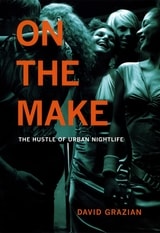
On the Make
The Hustle of Urban NightlifeDavid Grazian
University of Chicago Press, 2007
David Grazian’s riveting tour of downtown Philadelphia and its newly bustling nightlife scene reveals the city as an urban playground where everyone dabbles in games of chance and perpetrates elaborate cons. Entertainment in the city has evolved into a professional industry replete with set designers, stage directors, and method actors whose dazzling illusions tempt even the shrewdest of customers. As entertaining and illuminating as the confessional stories it recounts, On the Make is a fascinating exposé of the smoke and mirrors employed in the city at night.
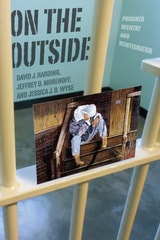
On the Outside
Prisoner Reentry and ReintegrationDavid J. Harding, Jeffrey D. Morenoff, and Jessica J. B. Wyse
University of Chicago Press, 2019
America’s high incarceration rates are a well-known facet of contemporary political conversations. Mentioned far less often is what happens to the nearly 700,000 former prisoners who rejoin society each year. On the Outside examines the lives of twenty-two people—varied in race and gender but united by their time in the criminal justice system—as they pass out of the prison gates and back into the world. The book takes a clear-eyed look at the challenges faced by formerly incarcerated citizens as they try to find work, housing, and stable communities. Standing alongside these individual portraits is a quantitative study conducted by the authors that followed every state prisoner in Michigan who was released on parole in 2003 (roughly 11,000 individuals) for the next seven years, providing a comprehensive view of their postprison neighborhoods, families, employment, and contact with the parole system. On the Outside delivers a powerful combination of hard data and personal narrative that shows why our country continues to struggle with the social and economic reintegration of the formerly incarcerated.
For further information, including an instructor guide and slide deck, please visit: http://ontheoutsidebook.us/home/instructors
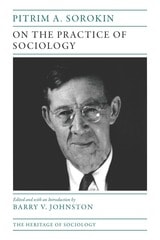
On the Practice of Sociology
Pitirim A. Sorokin
University of Chicago Press, 1998
His early American works opened new vistas in rural sociology, social stratification, and theory. They provided an elegant standard for scientific sociology and won him the founding chairmanship of sociology at Harvard University. A continuous innovator, he next explored the vast expanse of human affairs, and outlined the surfacing crisis of modernity. At the Harvard Research Center for Creative Altruism he developed a blueprint for social reconstruction. Such interests combined with a prophetic and combative style of disagreement drove him to the margins of a discipline hungry for acceptance as a science. In the early1960s, his work was once again recognized, and he became president of the American Sociological Association.
Including essays that range from his early Russian years to his final works in the 60s, this collection provides a much-needed introduction to one of sociology's most controversial thinkers.
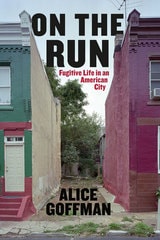
On the Run
Fugitive Life in an American CityAlice Goffman
University of Chicago Press, 2014
Alice Goffman spent six years living in one such neighborhood in Philadelphia, and her close observations and often harrowing stories reveal the pernicious effects of this pervasive policing. Goffman introduces us to an unforgettable cast of young African American men who are caught up in this web of warrants and surveillance—some of them small-time drug dealers, others just ordinary guys dealing with limited choices. All find the web of presumed criminality, built as it is on the very associations and friendships that make up a life, nearly impossible to escape. We watch as the pleasures of summer-evening stoop-sitting are shattered by the arrival of a carful of cops looking to serve a warrant; we watch—and can’t help but be shocked—as teenagers teach their younger siblings and cousins how to run from the police (and, crucially, to keep away from friends and family so they can stay hidden); and we see, over and over, the relentless toll that the presumption of criminality takes on families—and futures.
While not denying the problems of the drug trade, and the violence that often accompanies it, through her gripping accounts of daily life in the forgotten neighborhoods of America's cities, Goffman makes it impossible for us to ignore the very real human costs of our failed response—the blighting of entire neighborhoods, and the needless sacrifice of whole generations.
On the Rural
Economy, Sociology, GeographyHenri Lefebvre
University of Minnesota Press, 2022
A collection of previously untranslated writings by Henri Lefebvre on rural sociology, situating his research in relation to wider Marxist work
On the Rural is the first English collection to translate Lefebvre’s crucial but lesser-known writings on rural sociology and political economy, presenting a wide-ranging approach to understanding the historical and rural sociology of precapitalist social forms, their endurance today, and conditions of dispossession and uneven development.
In On the Rural, Stuart Elden and Adam David Morton present Lefebvre’s key works on rural questions, including the first half of his book Du rural à l’urbain and supplementary texts, two of which are largely unknown conference presentations published outside France. On the Rural offers methodological orientations for addressing questions of economy, sociology, and geography by deploying insights from spatial political economy to decipher the rural as a terrain and stake of capitalist transformation. By doing so, it reveals the production of the rural as a key site of capitalist development and as a space of struggle.
This volume delivers a careful translation—supplemented with extensive notes and a substantive introduction—to cement Lefebvre’s central contribution to the political economy of rural sociology and geography.
On the Verge of Convergence
Social Stratification in Eastern EuropeHenryk Domanski
Central European University Press, 2000
On the Way to Theory
Lawrence Grossberg
Duke University Press, 2024
Once the American Dream
Inner-Ring Suburbs of the Metropolitan United StatesBernadette Hanlon
Temple University Press, 2012
Once the American Dream analyzes this downward trend, examining 5,000 suburbs across 100 different metropolitan areas and census regions in 1980 and 2000. Hanlon defines the suburbs’ geographic boundaries and provides a ranking system for assessing and acting upon inner-ring suburban decline. She also illuminates her detailed statistical analysis with vivid case studies. She demonstrates how other suburbs, particularly those in the outer reaches of cities, flourished during the 1980s and 1990s. Once the American Dream closes with a discussion of policy implications and recommendations for policymakers and planners who deal with suburbs of various stripes.

One Small Farm
Photographs of a Wisconsin Way of LifeCraig Schreiner
Wisconsin Historical Society Press, 2013
“People’s lives are written on the fields of old farms. The rows of the fields are like lines on a page, blank and white in winter, filled in with each year’s story of happiness, disappointment, drought, rain, sun, scarcity, plenty. The chapters accumulate, and people enter and leave the narrative. Only the farm goes on.”—From the Introduction
In One Small Farm, Craig Schreiner’s evocative color photographs capture one family as they maintain the rhythms and routines of small farm life near Pine Bluff, Wisconsin. “Milk in the morning and milk at night. Feed the cows and calves. Plant crops. Grind feed. Chop and bale hay. Cut wood. Clean the barn. Spread manure on the fields. Plow snow and split wood in winter. In spring, pick rocks from the fields. Cultivate corn. Pick corn. Harvest oats and barley. Help calves be born. Milk in the morning and milk at night.”
There’s much more to life on the farm than just chores, of course, and Schreiner captures the rhythms and richness of everyday life on the farm in all seasons, evoking both the challenges and the joys and providing viewers a window into a world that is quickly fading. In documenting the Lamberty family’s daily work and life, these thoughtful photos explore larger questions concerning the future of small farm agriculture, Wisconsin cultural traditions, and the rural way of life.

Online a Lot of the Time
Ritual, Fetish, SignKen Hillis
Duke University Press, 2009
Hillis analyzes forms of ritual and fetishism made possible through second-generation virtual environments such as Second Life and the popular practice of using webcams to “lifecast” one’s life online twenty-four hours a day, seven days a week. Discussing how people create and identify with their electronic avatars, he shows how the customs of virtual-world chat reinforce modern consumer-based subjectivities, allowing individuals to both identify with and distance themselves from their characters. His consideration of web-cam cultures links the ritual of exposing one’s life online to a politics of visibility. Hillis argues that these new “rituals of transmission” are compelling because they provide a seemingly material trace of the actual person on the other side of the interface.
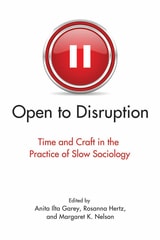
Open to Disruption
Time and Craft in the Practice of Slow SociologyAnita Ilta Garey
Vanderbilt University Press, 2014
Some researchers describe how disruptions prompted them to expand the boundaries of their discipline and invent concepts that could more accurately describe phenomena that previously had no name and no scholarly history. Sometimes scholars themselves caused the disruption as they circled back to work they had considered "done" and allowed the possibility of rethinking earlier findings.
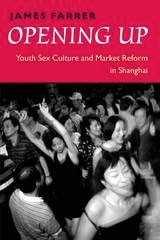
Opening Up
Youth Sex Culture and Market Reform in ShanghaiJames Farrer
University of Chicago Press, 2002
More and more men and women in China these days are having sex before marriage, creating a new youth sex culture based on romance, leisure, and free choice. The Chinese themselves describe these changes as an "opening up" in response to foreign influences and increased Westernization. Farrer explores these changes by tracing the basic elements in talk about sex and sexuality in Shanghai. He then shows how Chinese youth act out the sometimes-contradictory meanings of sex in the new market society. For Farrer, sexuality is a lens through which we can see how China imagines and understands itself in the wake of increased globalization. Through personal storytelling, neighborhood gossip, and games of seduction, young men and women in Shanghai balance pragmatism with romance, lust with love, and seriousness with play, collectively constructing and individually coping with a new culture based on market principles. With its provocative glimpse into the sex lives of young Chinese, then, Opening Up offers something even greater: a thoughtful consideration of China as it continues to develop into an economic superpower.

Opening Windows
Embracing New Perspectives and Practices in Natural Resource Social SciencesKate Sherren
Utah State University Press, 2024
This reflexive book is organized around four key themes: diversity and justice, governance and power, engagement and elicitation, and relationships and place. This is not a complacent volume—chapters point to gaps in conventional scholarship and to how much work remains to be done. Power is a central focus, including the role of cultural and economic power in “participatory” approaches to natural resource management and the biases encoded into the very concepts that guide scholarly and practical work. The chapters include robust literature syntheses, conceptual models, and case studies that provide examples of best practices and recommend research directions to improve and transform natural resource social sciences. An unmistakable spirit of hope is exemplified by findings suggesting positive roles for research in the progress ahead.
Bringing fresh perspectives on the assumptions and interests that underlie and entangle scholarship on natural resource decisionmaking and the justness of its outcomes, Opening Windows is significant for scholars, students, natural resource practitioners, managers and decision makers, and policy makers.
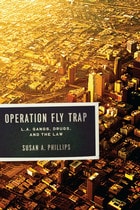
Operation Fly Trap
L. A. Gangs, Drugs, and the LawSusan A. Phillips
University of Chicago Press, 2012
In 2003, an FBI-led task force known as Operation Fly Trap attempted to dismantle a significant drug network in two Bloods-controlled, African American neighborhoods in Los Angeles. The operation would soon be considered an enormous success, noted for the precision with which the task force targeted and removed gang members otherwise entrenched in larger communities. In Operation Fly Trap, Susan A. Phillips questions both the success of this operation and the methods used to conduct it. Based on in-depth ethnographic research with Fly Trap participants, Phillips’s work brings together police narratives, crime statistics, gang cultural histories, and extensive public policy analysis to examine the relationship between state persecution and the genesis of violent social systems.
Crucial to Phillips’s contribution is the presentation of the voices and perspectives of both the people living in impoverished communities and the agents that police them. Phillips positions law enforcement surveillance and suppression as a critical point of contact between citizen and state. She tracks the bureaucratic workings of police and FBI agencies and the language, ideologies, and methods that prevail within them, and shows how gangs have adapted, seeking out new locations, learning to operate without hierarchies, and moving their activities more deeply underground. Additionally, she shows how the targeted efforts of task forces such as Fly Trap wreak sweeping, sustained damage on family members and the community at large. Balancing her roles as even-handed reporter and public scholar, Phillips presents multiple flaws within the US criminal justice system and builds a powerful argument that many law enforcement policies in fact nurture, rather than prevent, violence in American society.
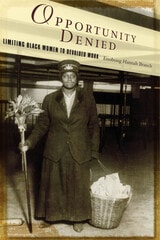
Opportunity Denied
Limiting Black Women to Devalued WorkBranch, Enobong
Rutgers University Press, 2011
Blacks and Whites. Men and Women. Historically, each group has held very different types of jobs. The divide between these jobs was stark—clean or dirty, steady or inconsistent, skilled or unskilled. In such a rigidly segregated occupational landscape, race and gender radically limited labor opportunities, relegating Black women to the least desirable jobs. Opportunity Denied is the first comprehensive look at changes in race, gender, and women’s work across time, comparing the labor force experiences of Black women to White women, Black men and White men. Enobong Hannah Branch merges empirical data with rich historical detail, offering an original overview of the evolution of Black women’s work.
From free Black women in 1860 to Black women in 2008, the experience of discrimination in seeking and keeping a job has been determinedly constant. Branch focuses on occupational segregation before 1970 and situates the findings of contemporary studies in a broad historical context, illustrating how inequality can grow and become entrenched over time through the institution of work.
Opting Out
Losing the Potential of America's Young Black EliteMaya A. Beasley
University of Chicago Press, 2011
Opting Out
Women Messing with Marriage around the WorldJoanna Davidson
Rutgers University Press, 2023
Opting for Elsewhere
Lifestyle Migration in the American Middle ClassBrian A. Hoey
Vanderbilt University Press, 2014
Ordinary Injustice
Rascuache Lawyering and the Anatomy of a Criminal CaseAlfredo Mirandé
University of Arizona Press, 2023
Building from author Alfredo Mirandé’s earlier work Rascuache Lawyer, the account is told by “The Professor,” who led a pro bono rascuache legal defense team comprising the professor, a retired prosecutor, and student interns, working without a budget, office, paralegals, investigators, or support staff. The book is a must-read for anyone interested in race, gender, and criminal injustice and will appeal not only to law scholars and social scientists but to lay readers interested in ethnographic field research, Latinx communities, and racial disparities in the legal system.
The case is presented as a series of letters to the author’s fictional alter-ego, Fermina Gabriel, an accomplished lawyer and singer. This narrative device allows the author to present the case as it happens, relaying the challenges and complexities as they occur and drawing the reader in.
While Ordinary Injustice deals with important, complicated legal issues and questions that arise in criminal defense work and looks at the case from the time of Juan’s arrest to the preliminary hearing, indictment, pretrial motions, and attempts to obtain a negotiated plea, it is written in nontechnical and engaging language that makes law accessible to the lay reader.