Results by title
74 books match the query 'Sociology, Urban' and 2 start with o
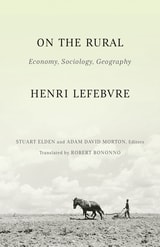
On the Rural
Economy, Sociology, GeographyHenri Lefebvre
University of Minnesota Press, 2022
A collection of previously untranslated writings by Henri Lefebvre on rural sociology, situating his research in relation to wider Marxist work
On the Rural is the first English collection to translate Lefebvre’s crucial but lesser-known writings on rural sociology and political economy, presenting a wide-ranging approach to understanding the historical and rural sociology of precapitalist social forms, their endurance today, and conditions of dispossession and uneven development.
In On the Rural, Stuart Elden and Adam David Morton present Lefebvre’s key works on rural questions, including the first half of his book Du rural à l’urbain and supplementary texts, two of which are largely unknown conference presentations published outside France. On the Rural offers methodological orientations for addressing questions of economy, sociology, and geography by deploying insights from spatial political economy to decipher the rural as a terrain and stake of capitalist transformation. By doing so, it reveals the production of the rural as a key site of capitalist development and as a space of struggle.
This volume delivers a careful translation—supplemented with extensive notes and a substantive introduction—to cement Lefebvre’s central contribution to the political economy of rural sociology and geography.
Organizing Strangers
Poor Families in Guatemala CityBy Bryan R. Roberts
University of Texas Press, 1973
Bryan Roberts’ study of two poor neighborhoods of Guatemala City is an important contribution to the understanding of the urban social and power organization of underdeveloped countries. It is the first major study of any Central American urban population.
Organizing Strangers gives an account of how poor people cope with an unstable and mobile urban environment, and case material is provided on the emergence of collective action among them. Several themes that are crucial to understanding the significance of urban growth in the underdeveloped world are explored: the impact of city life on rural migrants, the relationship between living in cities and the development of class consciousness, and the changing significance of personal relationships as a means of organizing social and economic life.
Guatemala City’s rapid growth and low level of industrialization created a keen competition for jobs and available living space and inhibited the development of cohesive residential groupings. Thus the poor found themselves living and working with people who were mostly strangers. Trust is difficult to create in such an environment, and the absence of trust affected the capacity of the poor to organize themselves.
While the poor were integrated into city life, the manner of their integration exposed them to greater exploitation than if they were truly socially isolated or marginal. Bryan Roberts analyzes a variety of formally organized voluntary associations involving the poor and concludes that such associations are essentially means by which middle- and upper-status groups seek to negotiate order among the poor.
The problems faced by these poor families are due less to their own incapacities or inactivity than to the effects of economic and political relationships that exploit them locally, nationally, and even internationally. A major conclusion of this study is that the uncertainties in the relationships among poor people and between them and other social groups are the underlying causes of a general political and economic instability.