Results by title
247 books match the query 'South Africa' and 6 start with o

Of Morsels and Marvels
Maryse Condé
Seagull Books, 2019
In Of Morsels and Marvels, Condé takes us on a literary journey around places she has travelled to in India, Indonesia, and South Africa. She highlights the tastes and culinary traditions that are fascinating examples of a living museum. Such places, Condé explains, provide important insights into lesser-known aspects of contemporary life. One anecdote illustrates what becomes of the standard Antillean dishes of fish stew and goat curry by two Antilleans who own a restaurant in Sydney, Australia. Cuisine changes not only according to the individual cook but also adapts to foreign skies under which it is created. The author also recounts personal memories of her lifelong relationship with cooking, such as when Adélia, her family’s servant, wrongly blames little Maryse for mixing raisins with fish and using her imagination in the kitchen.
Blending travel with gastronomy, this enchanting volume from the winner of the 2018 Alternative Nobel Prize will delight all who marvel at the wonders of the kitchen or seek to taste the world.
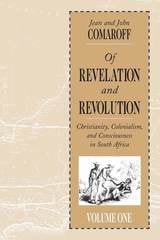
Of Revelation and Revolution, Volume 1
Christianity, Colonialism, and Consciousness in South AfricaJean Comaroff and John L. Comaroff
University of Chicago Press, 1991
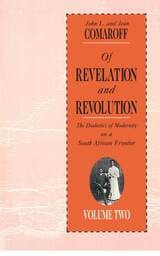
Of Revelation and Revolution, Volume 2
The Dialectics of Modernity on a South African FrontierJohn L. Comaroff and Jean Comaroff
University of Chicago Press, 1997
The Comaroffs trace many of the major themes of twentieth-century South African history back to these formative encounters. The relationship between the British evangelists and the Southern Tswana engendered complex exchanges of goods, signs, and cultural markers that shaped not only African existence but also bourgeois modernity "back home" in England. We see, in this volume, how the colonial attempt to "civilize" Africa set in motion a dialectical process that refashioned the everyday lives of all those drawn into its purview, creating hybrid cultural forms and potent global forces which persist in the postcolonial age.
This fascinating study shows how the initiatives of the colonial missions collided with local traditions, giving rise to new cultural practices, new patterns of production and consumption, new senses of style and beauty, and new forms of class distinction and ethnicity. As noted by reviewers of the first volume, the Comaroffs have succeeded in providing a model for the study of colonial encounters. By insisting on its dialectical nature, they demonstrate that colonialism can no longer be seen as a one-sided relationship between the conquering and the conquered. It is, rather, a complex system of reciprocal determinations, one whose legacy is very much with us today.
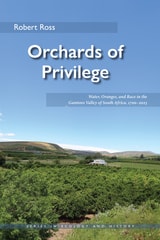
Orchards of Privilege
Water, Oranges, and Race in the Gamtoos Valley of South Africa, 1700–2023Robert Ross
Ohio University Press, 2025
This study of the Gamtoos River floodplain in South Africa’s Eastern Cape Province traces its transformation from an eighteenth-century natural landscape of thick bush into an agricultural zone now threatened by climate change. The first half of the book explains how missionaries from the London Missionary Society and residents of the Hankey Mission Station introduced irrigation, turning the area into a community of small-scale farmers. Despite early failures, by 1849 they had constructed South Africa’s first major irrigation tunnel and aqueduct. However, conflicts between the missionaries and residents led to the loss of communal lands to privatization, which ultimately impoverished the local farmers. The second half explores efforts to develop the valley for large-scale agriculture, addressing challenges like drought, flash floods, and saline water. By the mid-twentieth century, Afrikaners dominated the area, benefiting from the construction in 1970 of the Kouga Dam, which provided fresh water for the floodplain. This led to the rise of a wealthy white farming community, sustained by apartheid policies and labor from the “Coloured” and African populations. In the early twenty-first century, however, this prosperity has become threatened by severe droughts linked to global climate change. In view of these historical transformations, the Gamtoos River floodplain exemplifies the complex interplay between human ambition, environmental challenges, and sociopolitical forces.
Out in Africa
LGBT Organizing in Namibia and South AfricaAshley Currier
University of Minnesota Press, 2012
Visibility matters to activists—to their social and political relevance, their credibility, their influence. But invisibility matters, too, in times of political hostility or internal crisis. Out in Africa is the first to present an intimate look at how Namibian and South African lesbian, gay, bisexual, and transgender (LGBT) organizations have cultivated visibility and invisibility as strategies over time. As such, it reveals the complexities of the LGBT movements in both countries as these organizations make use of Western terminology and notions of identity to gain funding even as they work to counter the perception that they are “un-African.”
Different sociopolitical conditions in Namibia and South Africa affected how activists in each country campaigned for LGBT rights between 1995 and 2006. Focusing on this period, Ashley Currier shows how, in Namibia, LGBT activists struggled against ruling party leaders’ homophobic rhetoric and how, at the same time, black LGBT citizens of South Africa, though enjoying constitutional protections, greater visibility, and heightened activism, nonetheless confronted homophobic violence because of their gender and sexual nonconformity.
As it tells the story of the evolving political landscape in postapartheid Namibia and South Africa, Out in Africa situates these countries’ movements in relation to developments in pan-African LGBT organizing and offers broader insights into visibility as a social movement strategy rather than simply as a static accomplishment or outcome of political organizing.
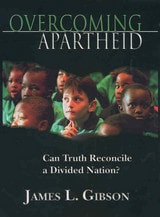
Overcoming Apartheid
Can Truth Reconcile a Divided Nation?James L. Gibson
Russell Sage Foundation, 2004