Results by title
206 books match the query 'Study & Teaching' and 5 start with o
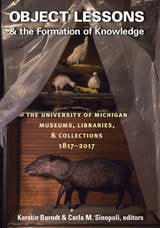
Object Lessons and the Formation of Knowledge
The University of Michigan Museums, Libraries, and Collections 1817–2017Kerstin Barndt and Carla M. Sinopoli, editors
University of Michigan Press, 2017

Open House
Essays on Community in Literary ArtsEdited by Kristina Marie Darling
Tupelo Press, 2025
This book offers a practical guide to building community, fostering collaboration, and inspiring generosity through the creative arts. This collection of original essays features an accomplished roster of contributors with backgrounds in diverse fields, including literary translation, magazine editing, publishing, higher education, and curriculum design. By featuring successful writers who represent such a wide range of skillsets and career paths, this book helps students envision themselves as leaders in the university and well beyond its boundaries.
In a cultural moment where graduates often seek meaningful careers outside of academia, this essay collection also offers an introduction to alt-ac career paths and the unique opportunities for effecting social change in these roles. Focusing on techniques that have broad applications for high school teachers, nonprofit leaders, community outreach organizations, and college classrooms, each chapter includes an original essay from a contemporary writer, editor, or nonprofit leader in the arts, culminating in a set of exercises for individuals and groups, which focus on empathy, citizenship, and community stewardship.
Contributors include Traci Brimhall, Chris Campanioni, Wendy Chen, Kristina Marie Darling, Ming Lauren Holden, John James, Dean Rader, and Zach Savich.
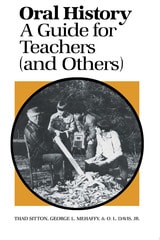
Oral History
A Guide for Teachers (and Others)By Thad Sitton, George L. Mehaffy, and O.L. Davis, Jr.
University of Texas Press, 1983
More than a mode of gathering information about the past, oral history has become an international movement. Historians, folklorists, and other educational and religious groups now recognize the importance of preserving the recollections of people about the past. The recorded memories of famous and common folk alike provide a vital complement to textbook history, bringing the past to life through the stories of those who lived it.
Oral History is designed to introduce teachers, students, and interested individuals to the techniques, problems, and pleasures of collecting oral history. The authors, themselves experienced educators, examine the uses of oral history in the classroom, looking at a wide range of projects that have been attempted and focusing on those that have succeeded best.
Besides suggesting many possible projects, they discuss the necessary hardware and its use: recording equipment and procedures, interview outlines and preliminary research, photography and note-taking in the field, transcription and storage of information, legal forms, and more. For the teacher, the authors offer helpful advice on training students to be sensitive interviewers in both formal and informal situations.
How can oral histories collected in the classroom be put to use? The authors discuss their uses within the curriculum; in projects such as oral history archives, publications such as the popular Foxfire books, and other media productions; and in researching current community problems. Useful appendixes survey a variety of reference tools for the oral historian and describe in detail how a Foxfire-concept magazine may be developed.
Order and History, Volume 5 (CW18)
In Search of OrderEric Voegelin, Edited & Intro by Ellis Sandoz
University of Missouri Press, 2000
In Search of Order brings to a conclusion Eric Voegelin's masterwork, Order and History. Voegelin conceived Order and History as "a philosophical inquiry concerning the principal types of order of human existence in society and history as well as the corresponding symbolic forms." In previous volumes, Voegelin discussed the imperial organizations of the ancient Near East and their existence in the form of the cosmological myth; the revelatory form of existence in history, developed by Moses and the prophets of the Chosen People; the polis, the Hellenic myth, and the development of philosophy as the symbolism of order; and the evolution of the great religions, especially Christianity.
This final volume of Order and History is devoted to the elucidation of the experience of transcendence that Voegelin discussed in earlier volumes. He aspires to show in a theoretically acute manner the exact nature of transcendental experiences. Voegelin's philosophical inquiry unfolds in the historical context of the great symbolic enterprise of restating man's humanity under the horizon of the modern sciences and in resistance to the manifold forces of our age that deform human existence. His stature as one of the major philosophical forces of the twentieth century clearly emerges from these concluding pages. In Search of Order deepens and clarifies the meditative movement that Voegelin, now in reflective distance to his own work, sees as having been operative throughout his search.
Because of Voegelin's death, on January 19, 1985, In Search of Order is briefer than it otherwise might have been; however, the theoretical presentation that he had set for himself is essentially completed here. Just as this volume serves Voegelin well in his striking analyses of Hegel, Hesiod, and Plato, it will serve as a model for the reader's own efforts in search of order.
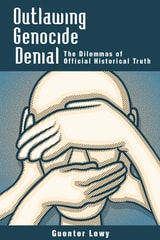
Outlawing Genocide Denial
The Dilemmas of Official Historical TruthGuenter Lewy
University of Utah Press, 2014
Holocaust denial can be viewed as another form of hatred against the Jews and preventing it can be understood as a form of warding off hate speech. Germany has made it a crime punishable by law. Other European countries have similar laws. While the rationale for such laws seems reasonable, Lewy asks readers to look again and to consider carefully the dangers that these laws could present. His discussion neither dismisses the ramifications of genocide denial nor justifies it; he instead looks closely at the possible risks of government-enforced interpretations of history.
Outlawing genocide denial sets a precedent of allowing governments to dictate historical truth and how events should be interpreted. Such government restrictions can be counterproductive in a democratic society which values freedom of speech. Lewy examines these and related ideas through the analysis of historical and current examples. He posits his own conclusion but leaves it up to readers to view the evidence and arguments and form their own opinions.