Results by title
270 books match the query 'Technology' and 5 start with o
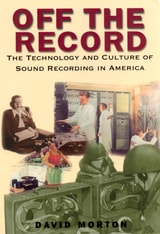
Off the Record
The Technology and Culture of Sound Recording in AmericaMorton, David
Rutgers University Press, 1999
David L. Morton examines the process of invention, innovation, and diffusion of communications technology, using the history of sound recording as the focus. Off the Record demonstrates how the history of both the hardware and the ways people used it is essential for understanding why any particular technology became a fixture in everyday life or faded into obscurity. Morton’s approach to the topic differs from most previous works, which have examined the technology’s social impact, but not the reasons for its existence. Recording culture in America emerged, Morton writes, not through the dictates of the technology itself but in complex ways that were contingent upon the actions of users.
Each of the case studies in the book emphasizes one of five aspects of the culture of recording and its relationship to new technology, at the same time telling the story of sound recording history. One of the misconceptions that Morton hopes to dispel is that the only important category of sound recording involves music. Unique in his broad-based approach to sound technology, the five case studies that Morton investigates are :- The phonograph record
- Recording in the radio business
- The dictation machine
- The telephone answering machine, and
- Home taping

Operation Valhalla
Writings on War, Weapons, and MediaFriedrich Kittler. Edited and translated by Ilinca Iurascu, Geoffrey Winthrop-Young, and Michael Wutz
Duke University Press, 2021
Osiris, Volume 21
Global Power Knowledge: Science and Technology in International AffairsEdited by John Krige and Kai-Henrik Barth
University of Chicago Press, 2006

Osiris, Volume 24
National Identity: The Role of Science and TechnologyEdited by Carol E. Harrison and Ann Johnson
University of Chicago Press, 2009

Out of the Pits
Traders and Technology from Chicago to LondonCaitlin Zaloom
University of Chicago Press, 2006
From New York to Singapore, from Chicago to London, the trading floors of the world’s financial markets are icons of global capitalism. Images of them are used on the news all the time—traders burying their heads in their hands when the market is down, their arms flailing in a frenzy when fortunes are rising—to convey the current state of the economy. But these marketplaces, and the cultural life that sustains them, are dissolving into the ether of the digital age: powerful financial institutions are shutting down the trading pits, replacing face-to-face exchanges with an electronic network where traders sit, face to screen, finger to mouse, and compete in a global arena made up of digits and charts.
Out of the Pits considers the implications of this sea change for everyone involved, from the traders and brokers to the market as a whole. Caitlin Zaloom takes us down to the floor at the Chicago Board of Trade and into a digital dealing room in the City of London. Drawing on her own firsthand experiences as a clerk and a trader and on her unusual access to these key sites of global finance, she explainshow changes at the world’s leading financial exchanges have transformed economic cultures and the craft of speculation; how people and places are responding to the digital transition; how traders are remaking themselves to compete in the contemporary marketplace; and how brokers, business managers, and software designers are collaborating to build new financial markets.
A penetrating and richly detailed account of how cities, culture, and technology shape everyday life in the new global economy, Out of the Pits will be must reading for business buffs or anyone who has ever wondered how financial markets work.