248 books match the query 'Theology' and 7 start with o
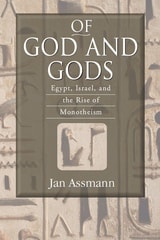
cover of Of God and Gods: Egypt, Israel, and the Rise of Monotheism

Of God and Gods

Egypt, Israel, and the Rise of Monotheism

Jan Assmann

University of Wisconsin Press, 2008

For thousands of years, our world has been shaped by biblical monotheism. But its hallmark—a distinction between one true God and many false gods—was once a new and radical idea. Of God and Gods explores the revolutionary newness of biblical theology against a background of the polytheism that was once so commonplace.
    Jan Assmann, one of the most distinguished scholars of ancient Egypt working today, traces the concept of a true religion back to its earliest beginnings in Egypt and describes how this new idea took shape in the context of the older polytheistic world that it rejected. He offers readers a deepened understanding of Egyptian polytheism and elaborates on his concept of the “Mosaic distinction,” which conceives an exclusive and emphatic Truth that sets religion apart from beliefs shunned as superstition, paganism, or heresy.
    Without a theory of polytheism, Assmann contends, any adequate understanding of monotheism is impossible.

Best Books for General Audiences, selected by the American Association of School Librarians, and Best Books for Special Interests, selected by the Public Library Association
[more]
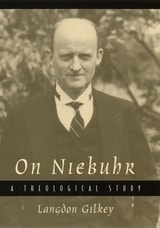
cover of On Niebuhr: A Theological Study

On Niebuhr

A Theological Study

Langdon Gilkey

University of Chicago Press, 2001
Langdon Gilkey's insightful, engaging book offers a detailed—and not uncritical—examination of one of the most influential American theologians of the twentieth century.
[more]
cover of On the Formation of the Clergy

On the Formation of the Clergy

Bleeded Hrabanus Maurus

Catholic University of America Press, 2023
Among the intellectuals of the Carolingian Renaissance of the ninth century, few are as prolific and influential as Hrabanus Maurus (c.780-856), a monk and abbot of the monastery of Fulda and then archbishop of Mainz. Most famous among modern authors as the putative author of the hymn “Come, Holy Ghost,” Hrabanus was highly esteemed by generations of medieval intellectuals, including Dante, who located the archbishop among St. Bonaventure’s cohort in the sphere of the Sun. This volume presents for the first time in English translation Hrabanus’s pedagogical masterpiece On the Formation of Clergy (De institutione clericorum). Unveiled on the Feast of All Saints in 819, at the dedication of the great Salvator basilica, Hrabanus’ work addresses the most important focuses of the Carolingian Renaissance: education and ecclesiastical reform. The treatise promotes a careful balance between classical training and Christian ethics and features the robust pedagogy of the early medieval monastic curriculum. At points it even offers glimpses into the energetic environment of Fulda’s classrooms. On the Formation of Clergy also supplies a program for ecclesiastical reform. It provides readers with a primer on ecclesiastical hierarchy and liturgy, providing glosses on church offices and explanations of important church activities. Hrabanus divided his opus into three books. Book One explains Holy Orders. It lays out the distinctions between clergy and laity, enumerates the ranks of the priesthood, describes clerical vesture, and explores the sacraments. Book Two examines priestly life. It considers ascetic disciplines appropriate for priests at different grades, describes expected prayer routines, and identifies important doctrinal teachings and principal liturgical feasts. Book Three treats biblical studies and preaching. It lays out a curriculum for the liberal arts, connects the liberal arts to catechetics and homiletics, and integrates academic study with moral instruction. On the Formation of Clergy was widely read throughout the Middle Ages. Beyond its impact on the Carolingian Renaissance, the treatise guided legal analysis in Gratian’s Decretum, supplied examples for Peter Lombard’s Sentences, and is cited by theological titans from Rupert of Deutz to Thomas Aquinas to Gabriel Biel.
[more]
cover of On the Motive of the Incarnation

On the Motive of the Incarnation

Dylan The Salmanticenses

Catholic University of America Press, 2019
The Catholic University of America Press is pleased to announce a new series, Early Modern Catholic Sources, edited by Ulrich L. Lehner and Trent Pomplun. This series – the only one of its kind – will provide translations of early modern Catholic texts of theological interest written between 1450 and 1800. The first volume in this series is On the Motive of the Incarnation, the first English translation of the seventeenth-century Discalced Carmelites at the University of Salmanca treatise on the motive of the Incarnation. Originally intended for students of their order, it became a major contribution to broader theological discourse. In this treatise, they defend the assertion that God intended Christ’s Incarnation essentially as a remedy for sin, such that if Adam had not sinned Christ would not have become incarnate, and that, at the same time, God intended all other works of nature and grace for the sake of Christ at their end. The Salmanticenses’ position thus combines elements of the Franciscan and Dominican traditions, stemming from the thought of Blessed John Duns Scotus and Saint Thomas Aquinas. This treatise is an exhaustive effort to show how the Scotistic emphasis on the primacy of Christ as the first willed and intended by God can be articulated within a Thomistic framework that acknowledges the contingency of the Incarnation on the need for redemption. In addition to the translation, the volume will include a brief introduction and extensive notes for theologians, historians, and students.
[more]
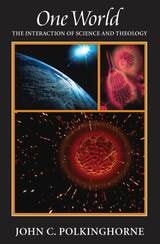
cover of One World: The Interaction of Science and Theology

One World

The Interaction of Science and Theology

John C. Polkinghorne

Templeton Press, 2007
Both science and religion explore aspects of reality, providing "a basis for their mutual interaction as they present their different perspectives onto the one world of existent reality," Polkinghorne argues. In One World, he develops his thesis through an examination of the nature of science, the nature of the physical world, the character of theology, and the modes of thought in science and theology. He identifies "points of interaction" and points of potential conflict between science and religion. Along the way, he discusses creation, determinism, prayer, miracles, and future life, and he explains his rejection of scientific reductionism and his defense of natural theology.
[more]
cover of Origen: Spirit and Fire

Origen

Spirit and Fire

Hans Urs von Balthasar

Catholic University of America Press, 1984

[more]
cover of Orthodoxy: A Modern Denomination

Orthodoxy

A Modern Denomination

Joshua Shanes

Rutgers University Press, 2027

Orthodox Judaism is often perceived simply as the continuation of pre-modern Jewish tradition. In fact, Orthodoxy represents a diverse range of self-conscious attempts to promote new forms of Jewishness that are cast as unchanging over time, filling an urgent need in an age of constant change. In the midst of a tumultuous era, marked by the new values of Enlightenment, Orthodoxy emerged as a new term and movement, struggling to gain stability in a world of conflict and adaptation. Quite unlike its public reputation, Orthodoxy does not convey fixity; rather, it is an elastic term that embraces different and evolving sub-groups of Jews who do not necessarily embrace each other as they struggle to police their boundaries.  

In this first comprehensive history of Orthodoxy, Joshua Shanes argues that Orthodox Jews are not traditional, but traditionalist. As the great historian Jacob Katz explained, traditionalists consciously attempt to recreate a pre-modern system in a new context and with decidedly modern tools, and in an environment that does not take its values as self-evident or authoritative. Even beyond the ritual and theological innovations of Orthodoxy – which are many - its awareness that other options are available produces a counter-intuitive break between Orthodoxy and the world it seeks to perpetuate.

This book traces the emergence and evolution of the term “Orthodoxy” in Judaism and the communities that claimed it, from Western and Central Europe into Eastern Europe, America, Israel and other parts of the Jewish Diaspora. It unpacks an intriguing historical irony: how a traditional culture evolved into a voluntary religio-political community maintained by a determined minority that viewed itself as the sole carriers of Jewish authenticity in the modern world.

[more]