Results by title
303 books match the query 'Time' and 14 start with o
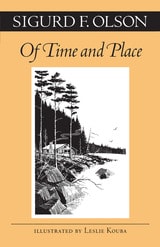
Of Time And Place
Sigurd F. Olson
University of Minnesota Press, 1998
Olson’s final work, available in paperback for the first time.
Of Time and Place is a legacy from one of the best-loved nature writers of our time. In this, his last book completed just before his death, Sigurd F. Olson guides readers through his wide-ranging memories of a lifetime dedicated to the preservation of the wilderness. Like his other best-selling books, Of Time and Place is filled with beauty, adventure, and wonder.
Olson recalls his many friendships of trail and woods and portage, his favorite campsites, the stories behind the artifacts and mementos hanging in his cabin at Listening Point. Whether he is remembering canoe trips with his friends, admiring the playful grace of the otter, or pondering the Earth’s great cycles of climatic change, these moving and evocative essays reaffirm Olson’s stature as one of the greatest nature writers of this century.
Of Time and the Enterprise
North American Family Farm Management in a Context of Resource MarginalityJohn Bennett
University of Minnesota Press, 1982
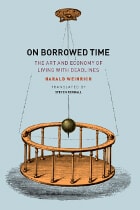
On Borrowed Time
The Art and Economy of Living with DeadlinesHarald Weinrich
University of Chicago Press, 2008
Weinrich’s analysis of the roots of the word time connects it to the temples of the skull, demonstrating that humans first experienced time in the beating of their pulses. Tracing this corporeal perception of time across literary, religious, and philosophical works, Weinrich concludes that time functions as a kind of sixth sense—the crucial sense that enables the other five.
Written with Weinrich’s customary narrative elegance, On Borrowed Time is an absorbing—and, fittingly, succinct—meditation on life’s inexorable brevity.
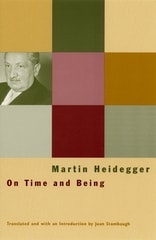
On Time and Being
Martin Heidegger
University of Chicago Press, 2002
"This collection may well vie with Vom Wesen des Grundes and Identität and Differenz as definitive statements of Heidegger's ontology."—Library Journal
"The title of the English translation is that of the lead essay, the highly celebrated lecture which Heidegger gave in 1962 and which bears the same title as the never published 'third division' of the 'first half' of Being and Time. This lecture is perhaps the most significant document to be added to the Heideggerian corpus since the Letter of Humanism. . . . Stambaugh's translation is superb."—Stanley O. Hoerr and staff, The Review of Metaphysics
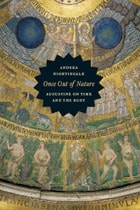
Once Out of Nature
Augustine on Time and the BodyAndrea Nightingale
University of Chicago Press, 2011

Once Upon a Time in Texas
A Liberal in the Lone Star StateBy David Richards
University of Texas Press, 2002
Once upon a time in Texas...there were liberal activists of various stripes who sought to make the state more tolerant and more tolerable. David Richards was one of them. In this fast-paced, often humorous memoir, he remembers the players, the strategy sessions, the legal and political battles, and the wins and losses that brought significant gains in civil rights, voter rights, labor law, and civil liberties to the people of Texas from the 1950s to the 1990s.
In his work as a lawyer, Richards was involved in cases covering voters' rights, school finance reform, and a myriad of civil liberties and free speech cases. In telling these stories, he vividly evokes the "glory days" of Austin liberalism, when a who's who of Texas activists plotted strategy at watering holes such as Scholz Garden and the Armadillo World Headquarters. Likewise, he offers vivid portraits of liberal politicians from Ralph Yarborough to Ann Richards (his former wife), progressive journalists such as Molly Ivins and the Texas Observer staff, and the hippies, hellraisers, and musicians who all challenged Texas's conservative status quo.
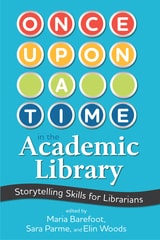
Once Upon a Time in the Academic Library
Storytelling Skills for LibrariansMaria Barefoot
American Library Association, 2022
Academic librarians can apply storytelling in the same way that teachers, entertainers, lawyers, and businesspeople have done for centuries, as education within information literacy instruction and as communication in the areas of reference, outreach, management, assessment, and more. Once Upon a Time in the Academic Library explores applications of storytelling across academic librarianship in three sections:
- The Information Literacy Classroom
- The Stacks
- Physical and Virtual Library Spaces
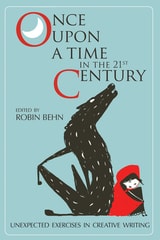
Once Upon a Time in the Twenty-First Century
Unexpected Exercises in Creative WritingEdited by Robin Behn
University of Alabama Press, 2020
Inspiring writers through creativity, experimentation, and unexpected discovery.
Once Upon a Time in the Twenty-First Century: Unexpected Exercises in Creative Writing is a unique creative writing text that will appeal to a wide range of readers and writers—from grade nine through college and beyond. Successful creative writers from numerous genres constructed these exercises, including poetry, fiction, and creative nonfiction to one-act plays, song lyrics, genre fiction, travel guides, comics and beyond. The exercises use a broad range of creative approaches, aesthetics, and voices, all with an emphasis on demystifying the writing process and having fun.
Editor Robin Behn has divided the book into three writing sections: Genres and Forms, Sources and Methods, and Style and Subject. In each section, Behn offers a brief introduction which explains how to get started and specific ways to develop one’s writing. Each introduction is followed by extensive exercises that draw on literature from classic to contemporary, as well as other art forms and popular culture. Examples range from Flannery O’Connor and Langston Hughes to Allen Ginsberg and Gertrude Stein, from Jamaica Kincaid and James Joyce to Arlo Guthrie and Harryette Mullen. Integrated within the exercises are apt examples of student writings that have emerged from actual use of the exercises in both the classroom and in writing groups. The book concludes with general advice and direction on how to get published.
Based on years of hands-on experiences in the teaching of creative writing in high schools, colleges, and after-school writing clubs, this volume of exercises offers inestimable value to students and teachers in the traditional classroom, as well as a growing number of homeschoolers, those who are part of a writing club or group, and independent writers and learners of all ages.
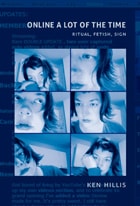
Online a Lot of the Time
Ritual, Fetish, SignKen Hillis
Duke University Press, 2009
Hillis analyzes forms of ritual and fetishism made possible through second-generation virtual environments such as Second Life and the popular practice of using webcams to “lifecast” one’s life online twenty-four hours a day, seven days a week. Discussing how people create and identify with their electronic avatars, he shows how the customs of virtual-world chat reinforce modern consumer-based subjectivities, allowing individuals to both identify with and distance themselves from their characters. His consideration of web-cam cultures links the ritual of exposing one’s life online to a politics of visibility. Hillis argues that these new “rituals of transmission” are compelling because they provide a seemingly material trace of the actual person on the other side of the interface.
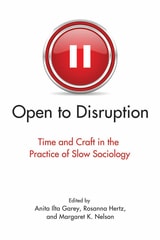
Open to Disruption
Time and Craft in the Practice of Slow SociologyAnita Ilta Garey
Vanderbilt University Press, 2014
Some researchers describe how disruptions prompted them to expand the boundaries of their discipline and invent concepts that could more accurately describe phenomena that previously had no name and no scholarly history. Sometimes scholars themselves caused the disruption as they circled back to work they had considered "done" and allowed the possibility of rethinking earlier findings.
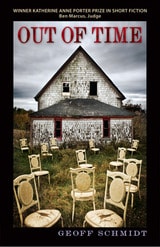
Out of Time
Geoff Schmidt
University of North Texas Press, 2011
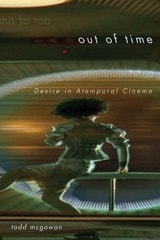
Out of Time
Desire in Atemporal CinemaTodd McGowan
University of Minnesota Press, 2010
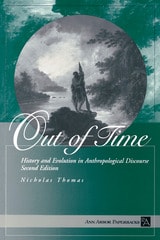
Out of Time
History and Evolution in Anthropological DiscourseNicholas Thomas
University of Michigan Press, 1996
Despite the enormous amount of work that has attempted to combine historical and anthropological approaches in recent years, few books have outlined the underlying premises that make integration of the two fields difficult. In Out of Time, Nicholas Thomas argues that a "historical perspective" cannot simply be added to conventional anthropology, which systematically takes ethnography "out of time." Drawing examples from the Polynesian anthropological literature, he points to discredited social evolutionary ideas that have persisted even after apparently dramatic theoretical shifts and to the need to take seriously sources that anthropologists have previously dismissed. When it was first published in 1989, Out of Time generated much-needed discussion on the appropriate models for historical anthropology. Thomas considered that both the historical structuralism of Marshall Sahlins and neo-Marxist regional systems theory had failed to transcend crucial limitations of conventional anthropology. Yet they provided elements of a more stimulating and critical perspective, which would also take account of contemporary political developments in the Pacific region. For this second edition, Thomas has added an afterword that reflects on the book's initial reception and brings its critique up to date. He suggests a need to historicize the professionalization of anthropology as a discipline to understand shifts in practice and the need to acknowledge the historical specificity and limits of all forms of cultural knowledge, whether "Western" or indigenous. Out of Time will be a useful text for graduate courses in anthropology, history, and cultural studies. "This book displays rare integrity: Thomas' intellectual stance toward the theoretical approaches of others is fully consistent with his own discursive practices." --Contemporary Pacific.

oh orchid o’clock
Endi Bogue Hartigan
Omnidawn, 2023
This collection speaks the language of the clock as a living instrument, exposing the sensory impacts of our obsession with time. In oh orchid o’clock, lyrics wind through histories like a nervous system through a body. The poems speak to how we let our days become over-clocked, over-transactional, and over-weaponed. With an instrumental sensibility, Endi Bogue Hartigan investigates what it is to be close to time—collective time, with its alarms and brutalities, and bodily time, intricate and familial. She considers how can we be both captured and complicit within systems of measurement, and she invites us to imagine how to break from, create, or become immune to them. Her poems use language to expose the face of the clock to reveal how gears press against interconnecting systems—economic, capitalist, astronomical, medical, governmental, and fantastical.