Results by title
1185 books match the query 'Travel' and 37 start with o
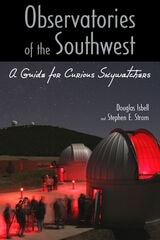
Observatories of the Southwest
A Guide for Curious SkywatchersDouglas Isbell and Stephen E. Strom
University of Arizona Press, 2009
Douglas Isbell and Stephen Strom, both intimately involved in southwestern astronomy, have written a practical guide to the major observatories of the region for those eager to learn what modern telescopes are doing, to understand the role each of these often quirky places has played in advancing our understanding of the cosmos, and hopefully to visit and see the tools of the astronomer up close. For each observatory, the authors describe its history, highlights of its contributions to astronomy—with an emphasis on recent results—and information for visitors. Also included are wide-ranging interviews with astronomers closely associated with each site.
Observatories covered range from McDonald in Texas to Palomar in California, with significant outposts in between: Arizona’s Kitt Peak National Observatory southwest of Tucson, the Lowell Observatory in Flagstaff, and the Whipple Observatory outside Amado; and New Mexico’s Very Large Array near Socorro and Sacramento Peak close to Sunspot. In addition to describing these established institutions, they also take a look ahead to the most powerful ground-based telescope in the world just beginning to operate at full power on Mount Graham in Safford, Arizona.
With more than three dozen illustrations, Observatories of the Southwest is accessible to amateur astronomers, tourists, students, and teachers—anyone fascinated with the contributions that astronomy has made to deepening our understanding of humanity’s place in the universe, whether exploring the solar system from Lowell Observatory or studying the birth of stars using the army of giant radio telescopes at the Very Large Array. This book aims to inspire visits to these sites by illuminating the major scientific questions being pursued every clear night beneath the dark skies of the Southwest and the amazing machinery that makes these pursuits possible.
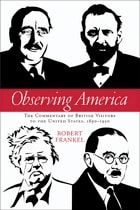
Observing America
The Commentary of British Visitors to the United States, 1890–1950Robert Frankel
University of Wisconsin Press, 2006
Robert Frankel examines the New World experiences of these commentators and the books they wrote about America. He also probes similar writings by other prominent observers from the British Isles, including Beatrice Webb, Rudyard Kipling, and George Bernard Shaw. The result is a book that offers keen insights into America’s national identity in a time of vast political and cultural change.
Of Walking in Ice
Munich-Paris, 23 November–14 December 1974Werner Herzog
University of Minnesota Press, 2015
In late November 1974, filmmaker Werner Herzog received a phone call from Paris delivering some terrible news. German film historian, mentor, and close friend Lotte Eisner was seriously ill and dying. Herzog was determined to prevent this and believed that an act of walking would keep Eisner from death. He took a jacket, a compass, and a duffel bag of the barest essentials, and wearing a pair of new boots, set off on a three-week pilgrimage from Munich to Paris through the deep chill and snowstorms of winter.
Of Walking in Ice is Herzog’s beautifully written, much-admired, yet often-overlooked diary account of that journey. Herzog documents everything he saw and felt on his quest to his friend’s bedside, from poetic descriptions of the frozen landscape and harsh weather conditions to the necessity of finding shelter in vacant or abandoned houses and the intense loneliness of his solo excursion.
Includes, for the first time, Werner Herzog’s 1982 “Tribute to Lotte Eisner” upon her receipt of the Helmut Käutner Prize
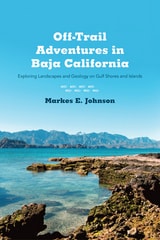
Off-Trail Adventures in Baja California
Exploring Landscapes and Geology on Gulf Shores and IslandsMarkes E. Johnson
University of Arizona Press, 2014
Off-Trail Adventures in Baja California describes—and maps and illustrates—nine hikes along outcrops on islands and peninsular shores where geography, geology, and ecology meet in singular ways. Each spot tells a story about the nature of the place—the cumulative effects of millions of years of natural forces at work. During the course of his long teaching career, Markes E. Johnson has hiked much of Baja California, often with students in tow. He brings a lifetime of study to his simple descriptions of the stories that are revealed by looking closely at natural phenomena framed by rocks and fossils.
This hiking guide offers a wealth of stories that seem to encompass everything, and can clearly communicate Johnson’s deep understanding of how our planet’s ecosystems function. Whether you like to hike with your boots on or from the comfort of your favorite chair, this book is a must-have for anyone who has visited or hopes to visit Baja California’s Gulf Coast.
Official Guide to Texas State Parks and Historic Sites
New EditionLaurence Parent
University of Texas Press, 2024
The essential guide to Texas’s state parks and historic sites.
Updated with a new park, Palo Pinto Mountains State Park west of Forth Worth; new historic sites; and scores of beautiful new photographs, the Official Guide to Texas State Parks has all the essential information organized by geographical regions to help you plan your great Texas adventure. The only complete resource of its kind on Texas, Laurence Parent’s Official Guide to Texas State Parks is the trusted source, with more than sixty-five thousand copies sold over the past thirty years.
Praise for Previous Editions
“Texas state-park fans should be thrilled. . . . Official Guide to Texas State Parks is the ultimate book detailing Texas’s state parks.”—Dallas Morning News
“This book will make you want to hit the road to visit the natural splendor of Texas.”—Houston Chronicle
“It’s good enough for a coffee table or a campfire. The Official Guide to Texas State Parks gives you sleek photography, maps, narratives, and loads of information.”—Southern Living
“The newly updated Official Guide to Texas State Parks and Historic Sites . . . has beautiful color photographs and insights on camping, fishing, horseback riding, and other recreational opportunities around the state.”—Texas Journey
Oktoberfest in Brazil
Domestic Tourism, Sensescapes, and German Brazilian IdentityAudrey Ricke
University of Alabama Press, 2023
An immersive ethnography uncovering how sensory experience, tourism, and heritage performance shape German Brazilian identity across local, national, and transnational landscapes.
Oktoberfest in Brazil: Domestic Tourism, Sensescapes, and German Brazilian Identity is one of the first ethnographies to analyze the tourism industry based on German cultural heritage in southern Brazil. Southern Brazil’s booming domestic tourism industry draws more than 500,000 people to events such as the Oktoberfest in Blumenau. Ricke investigates domestic tourism as sensescapes, focusing on the multiple and layered meanings associated with tourism’s sensory experiences and interactions. The author also introduces the “economy of aesthetics” as a new framework to capture how the sensescapes associated with domestic tourism are intertwined in the negotiation of ethnic, national, and transnational identities. These sensescapes also intersect with discourses on class and race, which are examined as well.
Oktoberfest in Brazil leads readers on a tour through German Brazilian home gardens, folk dance performances, and the largest Oktoberfest in Brazil. These sensory-rich spaces of interaction provide access to different perspectives and types of identity negotiation at multiple levels from the local to the transnational. Ricke illustrates how the emotions and sensory experiences of these sensescapes associated with German cultural heritage function as a means for German Brazilians to negotiate senses of belonging as Brazilians as well as their ethnic and transnational identities.
This book also provides historical and contemporary insights into the politics of citizenship associated with cultural heritage. As politics become more polarized, the need to analyze different ways of communicating through sensory experiences increases. The unique contribution of the economy of aesthetics framework is its ability to capture the influential power of sensory experience in the negotiation of identity and senses of belonging and citizenship more broadly. It provides new insights into how and why some sensory experiences within domestic tourism foster belonging and identity while other experiences reinforce social distinctions and national divisions.
Old Blue's Road
A Historian's Motorcycle Journeys in the American WestJames Whiteside
University Press of Colorado, 2014
In 2005, Whiteside bought a Harley Davidson Heritage Softail, christened it “Old Blue,” and set off on a series of far-reaching motorcycle adventures. Over six years he traveled more than 15,000 miles. Part travelogue and part historical tour, this book takes the reader along for the ride. Whiteside’s travels to the Pacific Northwest, Yellowstone, Dodge City, Santa Fe, Wounded Knee, and many other locales prompt consideration of myriad topics—the ongoing struggle between Indian and mainstream American culture, the meaning of community, the sustainability of the West's hydraulic society, the creation of the national parks system, the Mormon experience in Utah, the internment of Japanese Americans during World War II, and more.
Delightfully funny and insightful, Old Blue’s Road links the colorful history and vibrant present from Whiteside’s unique vantage point, recognizing and reflecting on the processes of change that made the West what it is today. The book will interest the general reader and western historian alike, leading to new appreciation for the complex ways in which the American West's past and present come together.
Old Calabria
Norman Douglas
Northwestern University Press, 1996
Old Deseret Live Stock Company
A Stockman's MemoirW. Dean Frischknecht
Utah State University Press, 2008
In the high country of the northern Wasatch Mountains, lies what is left of one of the West’s largest ranches. Deseret Live Stock Company was reputed at various times to be the largest private landholder in Utah and the single biggest producer of wool in the world. The ranch began as a sheep operation, but as it found success, it also ran cattle. Incorporated in the 1890s by a number of northern Utah ranchers who pooled their resources, the company was at the height of successful operations in the mid-twentieth century when a young Dean Frischknecht, bearing a recent degree in animal science, landed the job of sheep foreman. In his memoir he recounts in detail how Deseret managed huge herds of livestock, vast lands, and rich wildlife and recalls through lively anecdotes how stockmen and their families lived and worked in the Wasatch Mountains and Skull Valley’s desert wintering grounds.
Old Heart Of Nevada
Ghost Towns And Mining Camps Of Elko CountyShawn Hall
University of Nevada Press, 1998
Elko County, in the old heart of Nevada, is rich in historic sites, many of them hitherto uncharted and some verging on disappearing. For the first time, historian Shawn Hall identifies and locates the ghost towns and old mining camps of Elko County and recounts their colorful histories. Following a guidebook format, Hall divides the county into five easily accessible regions, then lists the historic sites within each region and provides directions to reach them. He offers a brief history of each site as well as a description of its extant structures and their present condition. The result is a lively compilation of local history and mining and ranching lore that records the dramatic past of Nevada’s northeast corner, its pioneers and prospectors, its towns and mines, its outlaws, ranchers, merchants, mining concerns, and civic leaders. The book offers never-before available information about the old heart of Nevada and the people who settled there. It will be of enduring value to tourists and weekend explorers, historic preservationists, and all those interested in the history and artifacts of this region.
Old Puglia
A Cultural Companion to South-Eastern ItalyDesmond Seward and Susan Mountgarret
Haus Publishing, 2016
On The Ho Chi Minh Trail
The Blood Road, The Women Who Defended It, The LegacySherry Buchanan
Asia Ink, 2020
Offering both a personal and historical exploration of the Ho Chi Minh Trail, this book highlights the critical role the Trail and the young women soldiers who helped build and defend it played in the Vietnam War. Accompanied by two traveling companions, Sherry Buchanan winds her way from Hanoi in the north to Ho Chi Minh City, formerly Saigon, in the south. Driving through the spectacular scenery of Vietnam and Laos, she encounters locations from the Truong Son mountains, the Phong Nha Caves, ancient citadels, and Confucian temples to the Khmer Temple of Wat Phu at the western-most point of the Trail in Laos.
Buchanan records her interactions—both scheduled and spontaneous—with those who experienced the Vietnam War firsthand. She listens to the women who defended the Trail roads against the greatest bombing campaign in modern times, walks through minefields with the demolition teams hunting for unexploded ordnance, and meets American veterans who have returned to Vietnam with an urge to “do something.” Buchanan weaves informative, and often humorous, tales from her journey with excerpts from the accounts of others, situating the locations she visits in their historical and political context. On the Ho Chi Minh Trail brings together geography, history, and personal accounts to reveal the scale of the tragedy, its harmful legacies, and our memory of it. Buchanan challenges American exceptionalism and calls for redress for those harmed by US military actions during the Vietnam War and America’s subsequent wars.
On The Rim
Looking for the Grand CanyonMark Neumann
University of Minnesota Press, 2001
Why do nearly five million people travel to the Grand Canyon each year? Mark Neumann answers this question with a book as compelling as the panoramic vistas of the canyon. In On the Rim, he describes how the Grand Canyon became an internationally renowned tourist attraction and cultural icon, and delves into the meanings the place holds for the individuals who live, work, and travel there.
Weaving history, ethnography, documentary photography, and autobiography, Neumann exposes the roots—the personal and social dimensions—of America’s pursuit of leisure. He shows how people visiting the Grand Canyon create their own experiences, even while they are affected by one hundred years of social history and cultural expectations. On the Rim examines the lines between progress and nostalgia, science and spirituality, nature and culture, authenticity and mass production, and work and leisure—all of which crisscross the tourist experience.
To support his argument, Neumann uses evidence from tourist registers and Park Service records, first-person narratives, interviews, and scenes from television shows, Hollywood movies, and popular novels. Heavily illustrated with historical and contemporary photographs, the narrative shifts back and forth between early descriptions of the canyon and modern tourist stories, the past illuminating the present at every step.
From Albert Einstein’s visit and the hunt for the fugitive Danny Horning to the everyday experiences of local Native Americans, park rangers, and vacationing families, Neumann reminds us that every trip to the Grand Canyon is a complex journey, fueled by shared expectations but always open to the possibility of surprise. On the Rim is a multilayered, nuanced study of the place and its many visitors.
On the Bullet Train with Emily Brontë
Wuthering Heights in JapanJudith Pascoe
University of Michigan Press, 2017
In this and in her previous book, The Sarah Siddons Audio Files, Pascoe’s engaging narrative innovates a new scholarly form involving immersive research practice to attempt a cross-cultural version of reader-response criticism. On the Bullet Train with Emily Brontë will appeal to scholars in the fields of 19th-century British literature, adaptation studies, and Japanese literary history.
On the Run in Siberia
Rane Willerslev
University of Minnesota Press, 2012
If I had let myself be ruled by reason alone, I would surely be lying dead somewhere or another in the Siberian frost.
The Siberian taiga: a massive forest region of roughly 4.5 million square miles, stretching from the Ural Mountains to the Bering Sea, breathtakingly beautiful and the coldest inhabited region in the world. Winter temperatures plummet to a bitter 97 degrees below zero, and beneath the permafrost lie the fossilized remains of mammoths, woolly rhinoceroses, and other ice age giants. For the Yukaghir, an indigenous people of the taiga, hunting sable is both an economic necessity and a spiritual experience—where trusting dreams and omens is as necessary as following animal tracks. Since the fall of Communism, a corrupt regional corporation has monopolized the fur trade, forcing the Yukaghir hunters into impoverished servitude.
Enter Rane Willerslev, a young Danish anthropologist who ventures into this frozen land on an idealistic mission to organize a fair-trade fur cooperative with the hunters. From the outset, things go terribly wrong. The regional fur company, with ties to corrupt public officials, proves it will stop at nothing to maintain its monopoly: one of Willerslev’s Yukaghir business partners is arrested on spurious charges of poaching and illegal trading; another drowns mysteriously. When police are sent to arrest him, Willerslev fears for his life, and he and a local hunter flee to a remote hunting lodge even deeper in the icy wilderness. Their situation turns even more desperate right away: they manage to kill a moose but lose the meat to predators and begin to starve, frostbitten and isolated in the frozen taiga.
Thus begins Willerslev’s extraordinary, chilling tale of one year living in exile among Yukaghir hunters in the stark Siberian taiga region. At turns shocking and quietly moving, On the Run in Siberia is a pulse-pounding tale of idealism, political corruption, starvation, and survival (with a timely assist from Vladimir Putin) as well as a striking portrait of the Yukaghirs’ shamanistic tradition and their threatened way of life, a drama unfolding daily in one of the world’s coldest, most enthralling landscapes.
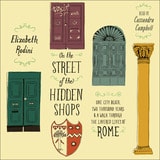
On the Street of the Hidden Shops
One City Block, Two Thousand Years, and a Walk Through the Layered Lives of RomeElizabeth Rodini
University of Chicago Press, 2026
Delve into Rome’s lost history through the stories of a single city block.
Cutting through the heart of Rome is Via delle Botteghe Oscure, a time-worn street named for the mysterious “shops” said to run beneath it. History lies thick here, a museum atop a convent atop ancient ruins; layered in are traces of artisans and poets, pilgrims and saints, a Fascist deportation, a communist coffee bar, a political assassination, and shopkeepers, too. These stories all rest upon a single city block, the same place where, in 13 BCE, the triumphal Roman general Lucius Cornelius Balbus built a monumental theater complex in his own honor.
Elizabeth Rodini’s On the Street of the Hidden Shops digs deep into this corner of the city, uncovering a set of surprising, often poignant narratives that range across two thousand years. For as the walls of Balbus’s compound decayed and the neighborhood was rebuilt, this block would come to shelter Romans from all walks of life: the daughters of local prostitutes, an earnest young man in search of a bride, an entrepreneur determined to preserve the city’s colorful dialect, a Jewish family recently liberated from the nearby Ghetto, and a band of idealistic archaeologists unearthing a long-forgotten past, as well as a gifted baker, a medieval donkey, and a Renaissance ghost. Their stories survive in archives and artifacts but also in the enduring power of rumor and legend.
On the Street of the Hidden Shops invites us on a captivating journey to one place across many centuries. Its tight urban focus reveals a Rome most visitors miss, while uncovering some of the many Romes that have been largely lost to history.
On the Street of the Hidden Shops
One City Block, Two Thousand Years, and a Walk Through the Layered Lives of RomeElizabeth Rodini
University of Chicago Press, 2026
Delve into Rome’s lost history through the stories of a single city block.
Cutting through the heart of Rome is Via delle Botteghe Oscure, a time-worn street named for the mysterious “shops” said to run beneath it. History lies thick here, a museum atop a convent atop ancient ruins; layered in are traces of artisans and poets, pilgrims and saints, a Fascist deportation, a communist coffee bar, a political assassination, and shopkeepers, too. These stories all rest upon a single city block, the same place where, in 13 BCE, the triumphal Roman general Lucius Cornelius Balbus built a monumental theater complex in his own honor.
Elizabeth Rodini’s On the Street of the Hidden Shops digs deep into this corner of the city, uncovering a set of surprising, often poignant narratives that range across two thousand years. For as the walls of Balbus’s compound decayed and the neighborhood was rebuilt, this block would come to shelter Romans from all walks of life: the daughters of local prostitutes, an earnest young man in search of a bride, an entrepreneur determined to preserve the city’s colorful dialect, a Jewish family recently liberated from the nearby Ghetto, and a band of idealistic archaeologists unearthing a long-forgotten past, as well as a gifted baker, a medieval donkey, and a Renaissance ghost. Their stories survive in archives and artifacts but also in the enduring power of rumor and legend.
On the Street of the Hidden Shops invites us on a captivating journey to one place across many centuries. Its tight urban focus reveals a Rome most visitors miss, while uncovering some of the many Romes that have been largely lost to history.
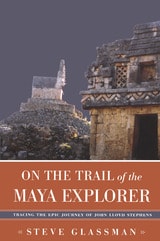
On the Trail of the Maya Explorer
Tracing the Epic Journey of John Lloyd StephensSteve Glassman
University of Alabama Press, 2003
A Mesoamerican travel book from two perspectives and two centuries.
In 1839 John Lloyd Stephens, then 31 years old, and his traveling companion, artist Frederick Catherwood, disappeared into the vast rain forest of eastern Guatemala. They had heard rumors that remains of a civilization of incomparable artistic and cultural merit were moldering in the steamy lowland jungles. They braved Indian uprisings, road agents, heat, and biting insects to eventually encounter what is today known as the lost civilization of the Maya.
In 1841 Stephens published Incidents of Travel in Central America, Chiapas, and Yucatan to instant acclaim with both American and international audiences. His conversational style was fresh and crisp and his subject matter, the search for lost cities on the Central American isthmus, was romantic and adventurous. Stephens's book has been characterized as the "great American nonfiction narrative of the 19th century." Indeed, what Stephens wrote about the Maya makes a major contribution to Maya studies.
Steve Glassman retraces Stephens's route, visiting the same archaeological sites, towns, markets, and churches and meeting along the way the descendants of those people Stephens described, from mestizo en route to the cornfields to town elders welcoming the Norte Americanos. Glassman's work interlaces discussion of the history, natural environment, and architecture of the region with descriptions of the people who live and work there. Glassman compares his 20th-century experience with Stephens's 19th-century exploration, gazing in awe at the same monumental pyramids, eating similar foods, and avoiding the political clashes that disrupt the governments and economies of the area.
Stephens's books are still widely available, but his importance to literary professionals has been overlooked. With this new travelogue, Glassman reaffirms Stephens's reputation and brings his work to wider critical and public attention.
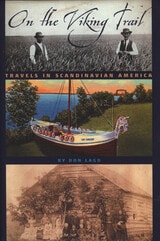
On the Viking Trail
Travels in Scandinavian AmericaDon Lago
University of Iowa Press, 2004
When his father developed Alzheimer’s disease, Don Lago realized that the stories and traditions of his Swedish ancestors would be lost along with the rest of his father’s memories. Haunted by this inevitable tragedy, Lago set out to fight back against forgetting by researching and reclaiming his long-lost Scandinavian roots.
Beginning his quest with a visit to his ancestral home of Gränna, Sweden, Lago explores all facets of Scandinavian America—Swedish, Danish, Finnish, Norwegian, and Icelandic—along the way. He encounters Icelanders living in the Utah desert, a Titanic victim buried beneath a gigantic Swedish coffee pot in Iowa, an Arkansas town named after the famous Swedish opera singer Jenny Lind, a real-life Legoland in southern California, and other unique remnants of America’s Scandinavian past. Visits to Sigurd Olson’s legendary cabin on the banks of Burntside Lake in the Boundary Waters of Minnesota and Carl Sandburg’s birthplace in Galesburg, Illinois, further provide Lago with an acute sense of the Scandinavian values that so greatly influenced, and continue to influence, American society.
More than just a travel memoir, On the Viking Trail places Scandinavian immigrants and their history within the wider sweep of American culture. Lago’s perceptive eye and amusing tales remind readers of all ethnic backgrounds that to truly appreciate America one must never forget its immigrant past.
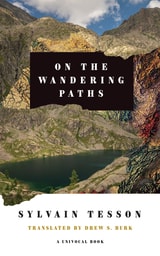
On the Wandering Paths
Sylvain Tesson
University of Minnesota Press, 2022
A walking journey through France’s vast interior becomes a meditation on both personal recovery and the role of history in the present—more than 425,000 copies sold in France
After a free-climbing accident lands him in a coma and a hospital for four months, the French writer Sylvain Tesson makes a promise to himself: if he’s ever able to walk again, he will traverse the entire country of France on foot.
Part literary adventure, part philosophical reflection on our contemporary consumer culture, On the Wandering Paths takes us deep into the heart of what Tesson terms France’s “hyperrural” zones. Tracing the obscure paths peasants once followed throughout the countryside, Tesson embarks on a three-month journey of solitude and personal contemplation as he walks along vast stretches of mountain ranges and rivers, encountering ancient Roman stone bridges and walkways, the French Foreign Legion, pagan prayer sites, Provençal villages, and the majestic Mont-Saint-Michel. Connecting deeply with the places he visits, his experiences inspire reflection on the essential need to disengage from the digital and immerse oneself in natural beauty.
Rich with humor, historical insight, and literary power, On the Wandering Paths is both a meditation on the act of recovery and a potent recognition of the traces of our past in the present. Asking us to reassess our values and our relationship to the land, Tesson’s exquisite chronicle through landscapes that continue to resist urbanization and technology is a thoughtful—and thought-provoking—glimpse into a poet’s adventurous life. Les Chemins de Pierre, a film based on the book starring Jean Dujardin, is due to release in 2022.
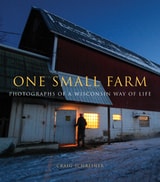
One Small Farm
Photographs of a Wisconsin Way of LifeCraig Schreiner
Wisconsin Historical Society Press, 2013
“People’s lives are written on the fields of old farms. The rows of the fields are like lines on a page, blank and white in winter, filled in with each year’s story of happiness, disappointment, drought, rain, sun, scarcity, plenty. The chapters accumulate, and people enter and leave the narrative. Only the farm goes on.”—From the Introduction
In One Small Farm, Craig Schreiner’s evocative color photographs capture one family as they maintain the rhythms and routines of small farm life near Pine Bluff, Wisconsin. “Milk in the morning and milk at night. Feed the cows and calves. Plant crops. Grind feed. Chop and bale hay. Cut wood. Clean the barn. Spread manure on the fields. Plow snow and split wood in winter. In spring, pick rocks from the fields. Cultivate corn. Pick corn. Harvest oats and barley. Help calves be born. Milk in the morning and milk at night.”
There’s much more to life on the farm than just chores, of course, and Schreiner captures the rhythms and richness of everyday life on the farm in all seasons, evoking both the challenges and the joys and providing viewers a window into a world that is quickly fading. In documenting the Lamberty family’s daily work and life, these thoughtful photos explore larger questions concerning the future of small farm agriculture, Wisconsin cultural traditions, and the rural way of life.
One Way
BERNARD DADIE OBSERVES AMERICABernard Binlin Dadié
University of Illinois Press, 1994
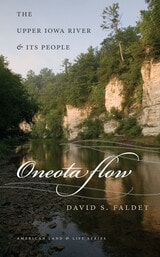
Oneota Flow
The Upper Iowa River and Its PeopleDavid S. Faldet
University of Iowa Press, 2009
Whether profiling the chief of the last hunter-gatherers on the river, an early settler witnessing her first prairie fire and a modern wildlife biologist using fire to manage prairies, the manager of the Granger Farmer’s Co-op Creamery, or a landowner whose bottomlands are continually eaten away by floods, Faldet steadily develops the central idea that people are walking tributaries of the river basin in which they make their homes.
Faldet moves through the history of life along the now-polluted Upper Iowa, always focusing on the ways people depend on the river, the environment, and the resources of the region. He blends contemporary conversations, readings from the historical record, environmental research, and personal experience to show us that the health of the river is best guaranteed by maintaining the biological communities that nurture it. In return, taking care of the Upper Iowa is the best way to take care of our future.
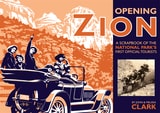
Opening Zion
A Scrapbook of the National Park's First Official TouristsJohn Clark
University of Utah Press, 2010
When Melissa Clark purchased a box of old scrapbooks online, she knew only that she had bought something relating to the University of Utah and Zion Park. What came in the mail was much more than she had expected. Instead of random mementos, two albums arrived full of photographs and newspaper clippings dating to 1920 that document a trip made by six young women from the University of Utah into the newly formed Zion National Park. Part of a promotional campaign developed by the Los Angeles and Salt Lake Railroad to advertise its national park shuttle service, the women entered Zion Canyon as its first offical tourists. When Melissa bought those timeworn scrapbooks she found a forgotten treasure: the opening of Zion.
With text by John Clark, the scrapbooks are now the basis of a one-of-a-kind publication. Part fashion spread, part adventure guide, and all Utah cultural treasure, Opening Zion is a stunning visual record of the park. Remarkably detailed black-and-white photographs show the young adventurers scrambling over rocky outcrops, pondering the dizzying height of Zion's sheer walls, and singing camp songs by the campfire. We are introduced anew to the "gigantic grandeur" of Zion National Park. As one of the women wrote, "One can think only beautiful thoughts amid such splendor."

Organ Pipe
Life on the EdgeText by Carol Ann Bassett; Photographs by Michael Hyatt
University of Arizona Press, 2004
A terrain where one learns to pay attention to the details: the tracks of a sidewinder in the sand, the tiny eggs of a cactus wren, the flash of a vermilion flycatcher against the azure sky.
Organ Pipe Cactus National Monument lies in southwestern Arizona on the Mexican border. It is an isolated park that for Carol Ann Bassett has long been a place of solitude—a silent refuge where she often camped out alone to capture the natural rhythms of the desert. Photographer Michael Hyatt hiked through Organ Pipe to visually document its subtle beauty in the Ajo Mountains and the valley of the Ajo, and at Quitobaquito, a rare desert oasis.
Few visitors may brave Organ Pipe during summer, when the temperature can reach 120 degrees, but for Bassett and Hyatt the searing heat is but a harbinger of rain, when normally dry arroyos surge with rust-colored water and desert tarantulas come out to mate. Bassett introduces readers to Organ Pipe’s cultural heritage as well: Spanish missionaries, Anglo settlers, and the Tohono O’odham and the Hia Ced O’odham people who still travel there to gather cactus fruit during Hasan Bakmasad, "saguaro moon." She also considers the changes taking place throughout the park, including the onrush of immigrants passing through in search of better lives in the United States.
This small, lyrical book is a sensitive reflection on the heart of the Sonoran Desert. It reminds us of the beauty to be found in unexpected places—and of our intimate connection with the wild.
Orientations
An Anthology of European Travel Writing on EuropeWendy Bracewell
Central European University Press, 2009
Oscar Wilde in America
The InterviewsEdited by Matthew Hofer and Gary Scharnhorst
University of Illinois Press, 2013
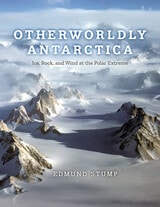
Otherworldly Antarctica
Ice, Rock, and Wind at the Polar ExtremeEdmund Stump
University of Chicago Press, 2024
The interior of Antarctica is an utterly pristine wilderness, a desolate landscape of ice, wind, and rock; a landscape so unfamiliar as to seem of another world. This place has been known to only a handful of early explorers and the few scientists fortunate enough to have worked there. Edmund Stump is one of the lucky few. Having climbed, photographed, and studied more of the continent-spanning Transantarctic Mountains than any other person on Earth, this geologist, writer, and photographer is uniquely suited to share these alien sights.
With stories of Stump’s forty years of journeys and science, Otherworldly Antarctica contains 130 original color photographs, complemented by watercolors and sketches by artist Marlene Hill Donnelly. Over three chapters—on the ice, the rock, and the wind—we meet snowy paths first followed during Antarctica’s Heroic Age, climb the central spire of the Organ Pipe Peaks, peer into the crater of the volcanic Mount Erebus, and traverse Liv Glacier on snowmobile, while avoiding fatal falls into the blue interiors of hidden crevasses. Along the way, we see the beauty of granite, marble, and ice-cored moraines, meltwater ponds, lenticular clouds, icebergs, and glaciers. Many of Stump’s breathtaking images are aerial shots taken from the planes and helicopters that brought him to the interior. More were shot from vantages gained by climbing the mountains he studied. Some were taken from the summits of peaks. Many are of places no one had set foot before—or has since. All seem both permanent and precarious, connecting this otherworld to our fragile own.
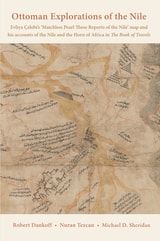
Ottoman Explorations of the Nile
Evliya Çelebi’s Map of the Nile and The Nile Journeys in the Book of Travels (Seyahatname)Robert Dankoff, Nuran Tezcan, and Michael D. Sheridan
Gingko, 2018
Evliya Çelebi’s account of his Nile journeys, in the tenth volume of his Book of Travels (Seyahatname), has been known to the scholarly world since 1938, when that volume was first published. The map, held in the Vatican Library, has been studied since at least 1949. Numerous new critical editions of both the map and the text have been published over the years, each expounding upon the last in an attempt to reach a definitive version. The Ottoman Explorations of the Nile provides a more accurate translation of the original travel account. Furthermore, the maps themselves are reproduced in greater detail and vivid color, and there are more cross-references to the text than in any previous edition. This volume gives equal weight and attention to the two parts that make up this extraordinary historical document, allowing readers to study the map or the text independently, while also using each to elucidate and accentuate the details of the other.
Our First Family’s Home
The Ohio Governor’s Residence and Heritage GardenMary Alice Mairose
Ohio University Press, 2008
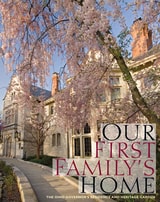
This richly illustrated volume tells the story of thehome that has served as Ohio’s executive residence since 1957, and of the nine governors and their families who have lived in the house. Our First Family’s Home offers the first complete history of the residence and garden that represent Ohio to visiting dignitaries and the citizens of the state alike. Once in a state of decline, the house has been lovingly restored and improved by itsresidents. Development of the Ohio Heritage Garden has increased the educational potential of the house and has sparked an interest in the preservation of native plant species. Looking toward the future, the Residence is also taking the lead in promoting environmental issues such as solar powerand green energy.
Photographs by award-winning environmental photographer Ian Adams and botanical art by Dianne McElwain showcase the beauty of the home’s architecture and the myriad of native plants that grace the three acres on which the Residence stands. Dianne McElwain is a member of the American Society of Botanical Artists in New York. Her botanical paintings have won numerous awards and are found in prestigious collections throughout the United States.
Essays highlight the Jacobethan Revival architecture and the history of the home. The remaining pieces cover the garden and include an intimate tour of the Heritage Garden, which was inspired by Ohio’s diverse landscape. Finally, former Governor Ted Strickland and First Lady Frances Strickland discuss the increasing focus on green energy at the Governor’s Residence and First Lady Emerita Hope Taft explains how native plants can help sustain the environment.
Our National Parks
John Muir
University of Wisconsin Press, 2026
Our National Parks is a guidebook supreme, an exciting introduction to Yosemite and several other magnificent parks by the man who, more than any other person, helped create them. After this fast-paced trip with Muir, past visitors to the parks will want to revisit them with new insights, and those who have never wandered these trails will not rest until they have done so.
The book was originally published in 1901, its ten essays having previously appeared as articles in the Atlantic Monthly. Muir wrote them with a single purpose—to entice people, by his descriptions, to come to the parks, to see and enjoy them. If enough people did so, reasoned Muir, they would surely love the wilderness as he did, and the parks would be preserved.
Muir carried out his public relations mission with remarkable success. Every page of this book carries his unbridled and irresistible enthusiasm. Our National Parks is part reminiscence, part philosophy, and mostly enticing description. It is all vintage Muir.
Although the book treats Yellowstone, Sequoia, General Grant, and other national parks of the Western U.S., Muir devotes the bulk of the work to his first love—Yosemite, settled into the heart of the Sierra Nevada. The concluding essay is an impassioned plea to save American forests.
All visitors to the great western national parks—and all who will one day visit them—will be captivated by Muir’s descriptions. The grandeur of this wilderness is reflected in the very spirit of John Muir. Both shine through every page of this remarkable book. Richard F. Fleck’s introduction and Todd Johnson’s foreword for the 125th anniversary edition place Muir’s life and legacy in the environmental movement of the United States in context and reveal how our need for nature and our responsibility to public lands remain as important as ever.

Our Story in Many Voices
The Alaska State Museum Catalog and GuideCharles Wohlforth
University of Alaska Press, 2025
Charles Wohlforth provides three major text sections—an introduction to Alaska, a summary of the museum exhibits, and a history of the exhibit development process—before the catalog of art and artifacts. Richly illustrated and presenting perspectives from Native and non-Native peoples, the book enhances visits to the museum and helps visitors recall and process their experiences, as well as broaden their general understanding of the state.
There is no single history of Alaska. Understanding the place and its peoples can be achieved only by viewing the multiple, complex, and even contradictory ways different people and groups perceive Alaska. Rather than present an official view of the state, Our Story in Many Voices contains independent and critical perspectives that use the extraordinary resources of the museum to consider Alaska’s most challenging cultural issues, reaching toward understanding and reconciliation.
Outback Nevada
Real Stories from the Silver StateJohn M Glionna
University of Nevada Press, 2022
Glionna’s interest in Nevada’s rugged, isolated landscape and the people who choose to live in this often-harsh environment was born of his own wanderings into the “outback.” Through his stories, he shares intimate portraits of rural and small-town lifestyles not many understand. Readers meet men with names like Flash and Mr. Cool; will listen to a cowboy minister preach the word of God to his parishioners; will walk with an antiques dealer from Genoa as he hunts for denim in Nevada’s abandoned nineteenth-century mine shafts; and will learn from an ex-paramedic– turned–coffee-shop–owner who provides Boulder City with a true sense of community. Full of humor, eccentricities, and compassion, these stories reveal the state’s true nature and extend an invitation to get lost “somewhere out there” in the real Nevada.
Outside Influence
Photography in Colorado, 1945–1995Rupert Jenkins
University Press of Colorado, 2025
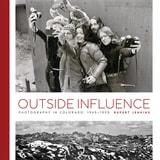
Outside Influence: Photography in Colorado, 1945–1995 is the first detailed account of the state’s history of post–World War II expressive photography. The title “Outside Influence” alludes to the historic presence of the natural landscape as subject and to the transformative impact of out-of-state artists and educators. Their arrival in Colorado beginning in the 1960s galvanized interpretive photography by introducing innovative concepts, nontraditional materials, and emergent digital technologies to students, peers, and their audience-at-large.
Throughout the book’s nine chapters, Rupert Jenkins contextualizes Colorado photography’s postwar development with a social, political, and cultural abstract that encompasses national events and trends, the emerging presence of women and photographers of color, and institutional leadership. Drawing from more than 120 personal interviews, he identifies the medium’s principal in-state creators, mentors, and advocates from the modernist era of film processing to the emergence of interdisciplinary digital practice. Jenkins answers fundamental questions about the people and work of this era: Who generated this significant body of innovative, noncommercial photographic work? Where did they come from? Who inspired them, and who in turn did they inspire?
As Eric Paddock, curator of photography at the Denver Art Museum, discusses in his foreword, by looking at the schools, workshops, galleries, and museums that supported these artists, Jenkins stresses the importance of collaboration and community to any successful venture. Crucially, in examining the lives and careers of photographers like Robert Adams, Walter Chappell, Albert Chong, Cherie Hiser, Barbara Houghton, Winter Prather, Mark Sink, Melanie Walker, Myron Wood, and numerous others, Outside Influence seeks to affirm the medium’s legacy within Colorado’s fine arts canon.
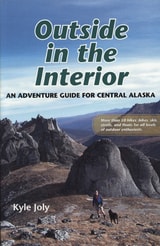
Outside in the Interior
An Adventure Guide for Central AlaskaKyle Joly
University of Alaska Press, 2007
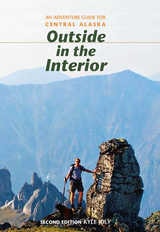
Outside in the Interior
An Adventure Guide for Central Alaska, Second EditionKyle Joly
University of Alaska Press, 2007
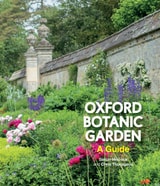
Oxford Botanic Garden
A GuideSimon Hiscock and Chris Thorogood
Bodleian Library Publishing, 2019
This guide explores Oxford Botanic Garden’s many historic and innovative features, from the walled garden to the waterlily pool, the greenhouses, the rock garden, the water garden and “Lyra’s bench,” made famous in Philip Pullman’s beloved His Dark Materials series. It also gives a detailed explanation of the Garden’s medicinal and taxonomic beds and special plant collections. Lavishly illustrated with specially-commissioned photographs, this book not only provides a fascinating historical overview but also offers a practical guide to Oxford Botanic Garden and its work today. Featuring a map of the site and a historic timeline, this book is a beautiful souvenir of the birthplace of botanical science in the UK.