Results by title
1882 books match the query 'Criticism and interpretation' and 55 start with o
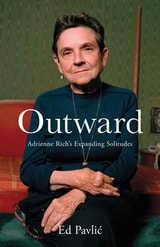
Outward
Adrienne Rich’s Expanding SolitudesEd Pavlic
University of Minnesota Press, 2021
The first scholarly study of Adrienne Rich’s full career examines the poet through her developing approach to the transformative potential of relationships
Adrienne Rich is best known as a feminist poet and activist. This iconic status owes especially to her work during the 1970s, while the distinctive political and social visions she achieved during the second half of her career remain inadequately understood. In Outward, poet, scholar, and novelist Ed Pavlić considers Rich’s entire oeuvre to argue that her most profound contribution in poems is her emphasis on not only what goes on “within us” but also what goes on “between us.” Guided by this insight, Pavlić shows how Rich’s most radical work depicts our lives—from the public to the intimate—in shared space rather than in owned privacy.
Informed by Pavlić’s friendship and correspondence with Rich, Outward explores how her poems position visionary possibilities to contend with cruelty and violence in our world. Employing an innovative framework, Pavlić examines five kinds of solitude reflected in Rich’s poems: relational solitude, social solitude, fugitive solitude, dissident solitude, and radical solitude. He traces the importance of relationships to her early writing before turning to Rich’s explicitly antiracist and anticapitalist work in the 1980s, which culminates with her most extensive sequence, “An Atlas of the Difficult World.” Pavlić concludes by examining the poet’s twenty-first century work and its depiction of relationships that defy historical divisions based on region, race, class, gender, and sexuality.
A deftly written engagement in which one poet works within the poems of another, Outward reveals the development of a major feminist thinker in successive phases as Rich furthers her intimate and erotic, social and political reach. Pavlić illuminates Rich’s belief that social divisions and the power of capital inform but must never fully script our identities or our relationships to each other.
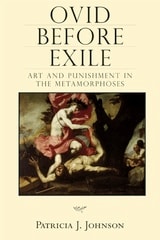
Ovid before Exile
Art and Punishment in the MetamorphosesPatricia J. Johnson
University of Wisconsin Press, 2007
Patricia J. Johnson demonstrates how the production of art—specifically poetry—changed dramatically during the reign of Augustus. By Ovid’s final decade in Rome, the atmosphere for artistic work had transformed, leading to a drop in poetic production of quality. Johnson shows how Ovid, in the episodes of artistic creation that anchor his Metamorphoses, responded to his audience and commented on artistic circumstances in Rome.
Oyvind Fahlstrom
The Art of WritingSergio Bessa
Northwestern University Press, 2008
Fahlstrom (1928-76) created a body of work as profoundly political as it is aesthetic, spanning two tumultuous decades in the avant-garde and comprising concrete poetry, manifestos, plays, performance, filmmaking, paintings, multiple prints, sculpture, and installations. Bessa focuses on how Fahlstrom's early experiments with concrete poetry influenced his later works in the visual arts and offers close readings of his seminal work Bord, his painting series Ade-Ledic-Nander, his interactive painting The Planetarium, and his radio play Birds in Sweden.
Ozu and the Ethics of Indeterminacy
Daisuke Miyao
Duke University Press, 2026

Ozu’s Anti-Cinema
Yoshida Kiju; Translated by Daisuke Miyao & Kyoko Hirano
University of Michigan Press, 2003