Results by title
2706 books match the query 'European' and 56 start with o
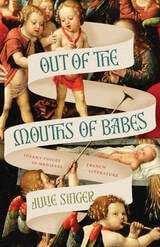
Out of the Mouths of Babes
Infant Voices in Medieval French LiteratureJulie Singer
University of Chicago Press, 2025
A wide-ranging study of the rich questions raised by speaking infants in medieval French literature.
Medieval literature is full of strange moments when infants (even fetuses) speak. In Out of the Mouths of Babes, Julie Singer explores the unsettling questions raised by these events, including What is a person? Is speech fundamental to our humanity? And what does it mean, or what does it matter, to speak truth to power?
Singer contends that descriptions of baby talk in medieval French literature are far from trivial. Through treatises, manuals, poetry, and devotional texts, Singer charts how writers imagined infants to speak with an authority untainted by human experience. What their children say, then, offers unique insight into medieval hopes for universal answers to life’s deepest wonderings.
[more]
Ovid's Causes
Cosmogony and Aetiology in the MetamorphosesK. Sara Myers
University of Michigan Press, 1994
Ovid’s Causes offers a new reassessment of the poet’s longest and most difficult poem, the Metamorphoses. This poem has long been denied epic stature because of its stylistic and thematic diversity. K. Sara Myers demonstrates that the poem must be understood as the inheritor and interpreter of the Roman tradition of cosmological epic. She situates the poem in the traditions and conventions of Roman poetry and considers the ways in which it both fulfills and overturns the expectations of the epic genre.
The first and final chapters of this book examine the scientific and cosmological framework of the poem. Ovid’s juxtaposition of scientific and mythological explanations is an aspect of his sophisticated manipulation of truth and fiction, and of the claims of philosophical poetry and mythological poetry.
This illuminating study presents much useful material for students of Roman poetry or of Greek literary influences that profoundly influenced its development. Students and scholars of ancient poetical traditions will likewise find much of interest.
[more]
Ovid's Literary Loves
Influence and Innovation in the AmoresBarbara Weiden Boyd
University of Michigan Press, 1997
Ovid's poetry has in recent years enjoyed a remarkable renaissance: in particular, there has been a surge of interest in the Heroides, the Fasti, and his exile poetry. Ovid's Literary Loves, by Barbara Weiden Boyd, reopens the Amores for the modern reader. The volume establishes a context for the recent reception of the Amores, and proposes an alternative approach to the collection by discussing recent trends in the discussion of imitation in Roman poetry. A premise basic to most Ovidian studies has been that the Amores are not only imitative, but parodic, both of the elegiac genre writ large and of Propertius in particular. In contrast, Boyd emphasizes the many nonelegiac, non-Propertian features of the collection. Ovid's irony and its consequences are also discussed with special attention to the narrative structure of the three books.
Boyd's thoughtful approach to imitation in Latin poetry brings into prominence the formative role played by Virgil in shaping Ovid's "poetic memory," even in the Amores. The detailed examination of Ovidian extended similes shows how the poet exploits the literary past precisely in order to free himself from generic restraint and to expand the narrow horizons of elegy. Boyd argues that this paradox is the essence of Ovidian poetics.
Ovid's Literary Loves is an imaginative approach to imitation in Latin poetry and makes a significant contribution to current discussions of the subject. This is one of the first contemporary scholarly monographs on the Amores, and it will find a large and welcoming audience of Latinists at all levels of study.
Barbara Weiden Boyd is Associate Professor of Classics, Bowdoin College, Brunswick, Maine.
[more]
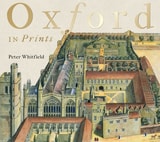
Oxford in Prints
1675-1900Peter Whitfield
Bodleian Library Publishing, 2016
For more than three centuries, Oxford has served as a source of inspiration for fine illustrated books and engraved prints. These works hold an important place in the historical record of the city, showing its identity to be deeply rooted in history while also chronicling Oxford’s development through the architecture of its most beautiful college and university buildings.
With Oxford in Prints, Peter Whitfield has assembled a rich selection of more than seventy illustrations and prints that offer a portrait of Oxford before it became the modern city it is today. Seventeenth-century prints by David Loggan show the medieval origins of Oxford University already overlaid by Tudor and Stuart buildings. Eighteenth-century editions of the Oxford Almanack depict a city dominated by neoclassical ideas. By the nineteenth-century, illustrations in the Almanack had an increasingly romantic feel, with buildings against a natural background of the river, trees, and sky. Each illustration or print is accompanied by an insightful description, including salient historical features.
With Oxford in Prints, Peter Whitfield has assembled a rich selection of more than seventy illustrations and prints that offer a portrait of Oxford before it became the modern city it is today. Seventeenth-century prints by David Loggan show the medieval origins of Oxford University already overlaid by Tudor and Stuart buildings. Eighteenth-century editions of the Oxford Almanack depict a city dominated by neoclassical ideas. By the nineteenth-century, illustrations in the Almanack had an increasingly romantic feel, with buildings against a natural background of the river, trees, and sky. Each illustration or print is accompanied by an insightful description, including salient historical features.
[more]
Oxford in Quotations
Compiled by Violet Moller
Bodleian Library Publishing, 2014
Oxford is one of the world’s great cities—a source of inspiration to generations of poets, novelists, journalists, and commentators who have visited or called it home. Be it praise or colorful invective, everyone, it seems, has something to say about the city and this slender volume—filled with wise, witty, and sometimes scandalous quotes—presents the full range of impressions it has made.
Oxford, “City of Dreaming Spires,” earns high marks from Hillaire Belloc, who writes that “there are few greater temptations on earth than to stay permanently at Oxford . . . and to read all the books in the Bodleian.” But it is also, according to Anthony Trollope, “the most dangerous place to which a young man can be sent.” And none other than Max Beerbohm blames it for making him insufferable.
For fans, foes, and those planning a trip to the city in the hopes of forming an opinion, this collection will be welcomed.
[more]
Oyvind Fahlstrom
The Art of WritingSergio Bessa
Northwestern University Press, 2008
Oyvind Fahltstrom: The Art of Writing serves as both an informative and entertaining introduction to the Brazilian-born Swedish poet-artist, one of the mid-twentieth century's most intriguing cultural figures, and as a valuable critical analysis of some of his most important works.
Fahlstrom (1928-76) created a body of work as profoundly political as it is aesthetic, spanning two tumultuous decades in the avant-garde and comprising concrete poetry, manifestos, plays, performance, filmmaking, paintings, multiple prints, sculpture, and installations. Bessa focuses on how Fahlstrom's early experiments with concrete poetry influenced his later works in the visual arts and offers close readings of his seminal work Bord, his painting series Ade-Ledic-Nander, his interactive painting The Planetarium, and his radio play Birds in Sweden.
Fahlstrom (1928-76) created a body of work as profoundly political as it is aesthetic, spanning two tumultuous decades in the avant-garde and comprising concrete poetry, manifestos, plays, performance, filmmaking, paintings, multiple prints, sculpture, and installations. Bessa focuses on how Fahlstrom's early experiments with concrete poetry influenced his later works in the visual arts and offers close readings of his seminal work Bord, his painting series Ade-Ledic-Nander, his interactive painting The Planetarium, and his radio play Birds in Sweden.
[more]