Results by title
3390 books match the query 'Fiction' and 91 start with o
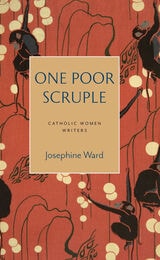
One Poor Scruple
Josephine Ward
Catholic University of America Press, 2022

One Winter Up North
John Owens
University of Minnesota Press, 2022
A picture-book journey through the Boundary Waters Canoe Area Wilderness in winter, snowshoeing the frozen lakes and silent forest with family, encountering the wonders of northern wildlife in the cold season
In winter the Boundary Waters, way up north in Minnesota, is not the same place you canoed last summer—but still it beckons and welcomes you. Grab a pack, strap on snowshoes, make a path (Oh! they take some getting used to!), and venture out across the frozen lakes and through the snowy woods. The vast wintery world here is so still and quiet, you might think you’re all alone—but no! Who made these tracks? A deer? A hare? A fox? And far off there’s a musher, making tracks with his sled dogs.
It’s a magical place. The bright sun brilliant on the snow, the sparkling silence—wait, is that a wolf calling? Try to answer! And when the dark descends, the stars and pine trees holding up the night, your nose gets cold and it’s back to camp, to your warm winter tent, where Father feeds the stove with wood you gathered, Mother snuggles into her big sleeping bag, and you curl up in the fire’s glow and know that in your dreams and memories you will return again and again to this one winter up north.
A wintery adventure that unfolds in pictures, John Owens’s delightful book gives readers a chance to discover—or rediscover—another season full of wonder in the Boundary Waters Canoe Area Wilderness.
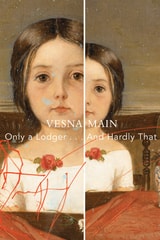
Only a Lodger . . . And Hardly That
A Fictional AutobiographyVesna Main
Seagull Books, 2019
In “The Eye/I,” we meet someone called She, who obsessively tells the story of her childhood and adolescence to an unnamed narrator. “The Acrobat” is a sequence of prose poems, written in the style of magic realism, which tell the story of Maria and her life-changing adolescent encounter with a flying circus performer. The female protagonist of the first section narrates “The Dead,” describing the secret life of a grandfather she never truly knew and his unusual habit of sending family members anonymous parcels of carefully chosen books. In “The Poet,” she examines four family photographs in order to piece together a story of her other grandfather, the husband of Maria. The final section, “The Suitor,” is a first-person narrative told by Mr. Gustav Otto Wagner, an older man who hoped to marry Maria but was ultimately turned down.
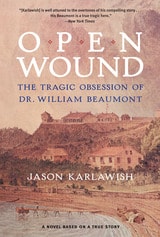
Open Wound
The Tragic Obsession of Dr. William BeaumontJason Karlawish
University of Michigan Press, 2013
A shotgun misfires inside the American Fur Company store in Northern Michigan, and Alexis St. Martin's death appears imminent. It's 1822, and, as the leaders of Mackinac Island examine St. Martin's shot-riddled torso, they decide not to incur a single expense on behalf of the indentured fur trapper. They even go so far as to dismiss the attention of U.S. Army Assistant Surgeon William Beaumont, the frontier fort's only doctor.
Beaumont ignores the orders and saves the young man's life. What neither the doctor nor his patient understands—yet—is that even as Beaumont's care of St. Martin continues for decades, the motives and merits of his attention are far from clear. In fact, for what he does to his patient, Beaumont will eventually stand trial and be judged.
Rooted deeply in historic fact, Open Wound artfully fictionalizes the complex, lifelong relationship between Beaumont and his illiterate French Canadian patient. The young trapper's injury never completely heals, leaving a hole into his stomach that the curious doctor uses as a window to understand the mysteries of digestion. Eager to rise up from his humble origins and self-conscious that his medical training occurred as an apprentice to a rural physician rather than at an elite university, Beaumont seizes the opportunity to experiment upon his patient's stomach in order to write a book that he hopes will establish his legitimacy and secure his prosperity. As Jason Karlawish portrays him, Beaumont, always growing hungrier for more wealth and more prestige, personifies the best and worst aspects of American ambition and power.
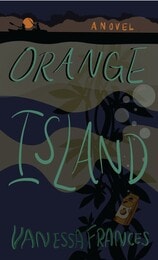
Orange Island
A NovelVanessa Frances
University of Alabama Press, 2026
A mysterious death, a techno-dystopian backdrop, a crumbling climate. A young woman searches for answers in this meditative, lyrical thriller.
In 2060 Orlando, FL, the state’s corruption festers amid unpredictable storms and climate upheaval, plunging society into a desperate eat the rich struggle for survival. As the world crumbles around her, 23-year-old Savannah fights to secure the bare essentials—drinkable water, dwindling food rations, and coveted orange juice. With only her father to rely on, Savannah navigates a world where tech reigns over humanity; and healthcare, climate-controlled housing, and life-saving news alerts are a privilege for the wealthy elite. Everything changes the day she stumbles upon her late sister's journal. Grief morphs into determination as she learns about her sister’s involvement in a pharmaceutical project that could revolutionize medicine for all.
Armed with this knowledge, Savannah holds the key to completing her sister's work. Will she have the courage to do so? Or will fear and despair shackle her to a fate worse than death?

Orders of Protection
Jenn Hollmeyer
University of North Texas Press, 2019
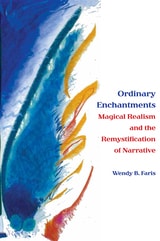
Ordinary Enchantments
Magical Realism and the Remystification of NarrativeWendy B. Faris
Vanderbilt University Press, 2004
Faris argues that by combining realistic representation with fantastic elements so that the marvelous seems to grow organically out of the ordinary, magical realism destabilizes the dominant form of realism based on empirical definitions of reality, gives it visionary power, and thus constitutes what might be called a "remystification" of narrative in the West. Noting the radical narrative heterogeneity of magical realism, the author compares its cultural role to that of traditional shamanic performance, which joins the worlds of daily life and that of the spirits. Because of that capacity to bridge different worlds, magical realism has served as an effective decolonizing agent, providing the ground for marginal voices, submerged traditions, and emergent literatures to develop and create masterpieces. At the same time, this process is not limited to postcolonial situations but constitutes a global trend that replenishes realism from within.
In addition to describing what many consider to be the progressive cultural work of magical realism, Faris also confronts the recent accusation that magical realism and its study as a global phenomenon can be seen as a form of commodification and an imposition of cultural homogeneity. And finally, drawing on the narrative innovations and cultural scenarios that magical realism enacts, she extends those principles toward issues of gender and the possibility of a female element within magical realism.

Oregon Detour
Nard Jones
Oregon State University Press, 1990
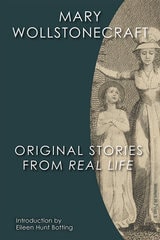
Original Stories from Real Life
With Conversations Calculated to Regulate the Affections, and Form the Mind to Truth and GoodnessMary Wollstonecraft. Edited by Valerie Hotchkiss. Illustrated by William Blake. Introduction by Eileen Hunt Botting.
University of Illinois Press, 2016
This beautiful facsimile of the 1791 edition includes the original illustrations by William Blake. A commentary by Eileen Hunt Botting puts the text in context and hints at influences on Wollstonecraft's daughter Mary Shelley and the pedagogical philosophy behind Shelley's novel Frankenstein.
Like all volumes in the Women in Print series, Original Stories from Real Life is provided as an open access book and downloads to a wide variety of platforms and online e-readers.

Origins
Reiner Schürmann
Diaphanes, 2016
Originally published in French in 1976, Origins was the winner of the coveted Prix Broquette-Gonin of the Académie Francaise. In close collaboration with the author, this meticulously crafted translation was created in the early 1990s, but Schürmann’s premature death in 1993 prevented its publication process and, as a result, one of the most important literary accounts of the conflicted process of coming to terms with the Holocaust and Germany’s Nazi past has been unavailable to English readers until now. Candid and frank, filled with fury and caustic sarcasm, Origins offers insight into a generation caught between disappointment and rage, alignment and rebellion, guilt and obsession with the past.
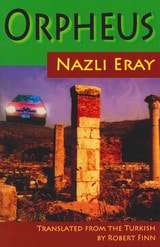
Orpheus
By Nazli Eray
University of Texas Press, 2006
Robert Finn's translation of Turkish author Nazli Eray's Orphée makes available to the English-language reader a rewriting of the myth from the perspective of Eurydice, the wife of Orpheus. Eray's surrealistic version takes place in a hot resort town in contemporary Turkey. The setting of an archaeological dig gives a connection to the past and literally to the underworld. Found in the dig is a statue of the Roman emperor Hadrian, who proceeds to offer an unusual perspective on modern life and values through mysterious letters carried by a messenger pigeon. Eray also comments on modernity, as the city of Ankara emerges as a character in the novel's fantasy. Set in junta-ruled Turkey of the 1980s, the novel takes its place as a crucial slice of Turkish literary history.
Resonating with haunting references to the film Last Tango in Paris, the novel evolves as a mystery story with a humorous bent. Thus Eray illuminates her insatiable curiosity about other cultures, particularly those of the West. Finally, the style of the translation is simple and clear, with crisp dialogue. Sibel Erol, professor of Turkish literature at New York University, has written an introduction that places this fantastic plot in a literary context, as well as in understandable terms that relate to the reality of today's Turkey.
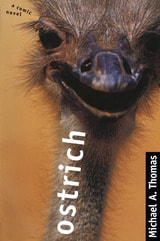
Ostrich
(A Comic Novel)Michael A. Thomas
University of Nevada Press, 2000
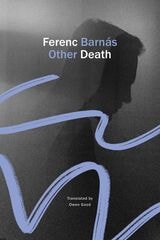
Other Death
EllipsisFerenc Barnás
Seagull Books, 2025
In Other Death, we are thrown into the chaotic life of a forty-year-old university lecturer who is experiencing a sudden, complete psychological and existential breakdown. Afternoons disappear and years chop and change in confusion as he wanders the streets searching for work. Homelessness, alcoholism, and hate are on the rise in 1990s Budapest as symptoms of the regime change. Images flash up from other lives: a Boer pointing a shotgun in Johannesburg, bodies heaped up in the downtown area, a Volkswagen campervan parked by an empty phone box in Switzerland. As he encounters new and historic traumas embedded in the lives and the buildings around him, the unnamed narrator struggles to grasp any coherent identity. It’s only when he starts to work as a gallery attendant, observing the interactions between viewer and artwork, light and space, that he embarks on the slow healing routine towards clarity.
In Barnás’s semi-autobiographical novel, meditations on trauma and urban space, image and observation, and spiritual friendships echo the writings of W. G. Sebald and Thomas Bernhard. Like Vertigo meets The Bell Jar, the magnetic language of Other Death draws the reader into the murky workings of a mind severely afflicted.
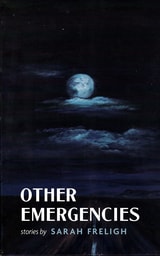
Other Emergencies
StoriesSarah Freligh
Moon City Press, 2025
The “other emergencies” experienced by Sarah Freligh’s characters range from mildly disruptive to life-altering. In “All That Water,” a college dropout struggling with addiction forges an unlikely alliance with a bank teller following a botched robbery. In “Aftershocks,” a writer grieving the loss of her support dog is haunted by the memory of what she witnessed on 9/11. In “Happenstance,” two women from different backgrounds form a tenuous connection over the shared experience of their histories. And in “Heaven,” a detective and a high school girl navigate the fraught terrain in the days following a mass shooting in a small town. Ultimately the stories in Other Emergencies revolve around the resilience of people and the capacity for authentic connection in times of great change.
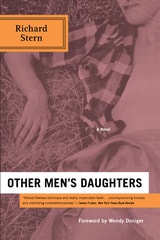
Other Men's Daughters
Richard Stern
Northwestern University Press, 2004
One reviewer writes, "I...was struck not simply by its psychological depth but particularly by the combination of toughness and tenderness through which romantic love was represented and discussed. The lack of sentimentality (in a novel about the refusal to live a life without love) was immensely important to me...and is likely ...to be immensely important ...today."

Other People's Mail
An Anthology of Letter StoriesEdited & Intro by Gail Pool
University of Missouri Press, 2000
While the art and craft of letter writing have declined in this century, letter stories have thrived. Cast as love letters and Dear John letters, as thank-you notes and suicide notes, as memos, letters to the editor, and exchanges with the United States Post Office, examples of epistolary fiction have been published by the hundreds, among them the work of many of our most notable authors. Why has this form of fiction writing remained so popular? As Gail Pool answers, "Who, after all, is immune to the seduction of reading other people's mail?"
Although epistolary fiction enjoyed its greatest popularity in the eighteenth and nineteenth centuries, a time when letters were central to daily life, this style of writing has a decidedly postmodern air. Letter stories are about communication, and they are effective in framing our modern concerns: the struggle to find meaningful stories, relationships, and lives amid the social and moral disarray of the era and the blurred boundaries between fact and fiction, artist and audience, private and public domains. These are the themes of our time, and the themes of the stories in Other People's Mail.
Offering seventeen stories written by a culturally diverse group of authors, Other People's Mail represents what letter tales, at their best, can do. They may be written from the Canadian wilderness, a private school in Geneva, a concentration camp, or beyond the grave. They may be comic or satirical, poignant or tragic, but all are united in their distinctive format.
The first collection of its kind, Other People's Mail is a unique and important anthology. Pool's highly informative introduction explores the nature of letter fiction, and her individual preface to each story provides background information on both the author and the tale. A select listing additional letter stories rounds out the anthology. Literature and writing instructors in search of a fresh approach to stories and readers looking for an anthology with a lively theme will enjoy this collection.
Othermindedness
The Emergence of Network CultureMichael Joyce
University of Michigan Press, 2001
Michael Joyce's new collection continues to examine the connections between the poles of art and instruction, writing and teaching in the form of what Joyce has called theoretical narratives, pieces that are both narratives of theory and texts in which theory often takes the form of narrative. His concerns include hypertext and interactive fiction, the geography of cyberspace, and interactive film, and Joyce here searches out the emergence of network culture in spaces ranging from the shifting nature of the library to MOOs and other virtual spaces to life along a river.
While in this collection Joyce continues to be one of our most lyrical, wide-ranging, and informed cultural critics and theorists of new media, his essays exhibit an evolving distrust of unconsidered claims for newness in the midst of what Joyce calls "the blizzard of the next," as well as a recurrent insistence upon grounding our experience of the emergence of network culture in the body.
Michael Joyce is Associate Professor of English, Vassar College. He is author of a number of hypertext fictions on the web and on disk, most notably Afternoon: A Story.
His previous books are Of Two Minds: Hypertext Pedagogy and Poetics and Moral Tale and Meditations: Technological Parables and Refractions.
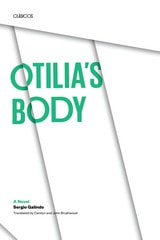
Otilia's Body
A NovelBy Sergio Galindo
University of Texas Press, 1994
From reviews of the Spanish edition:
"...among the best works that Mexican fiction has produced."
—Héctor Gally, Sábado
"With homely features, but with a body so shapely and exciting that it sets men (priests included) aflame throughout the novel, with an incandescent voluptuousness and delightful amorality (surely explosive in the conservative Mexican society of her time and place) ...Otilia Rauda could be the protagonist of a Greek tragedy or of a soap opera made of improbable happenings and as many turns of fate as there are chapters used to tell the story of her life."
—Jorge Ruffinelli, Punto y Aparte
Winner of Mexico's prestigious Xavier Villaurrutia prize in 1986, Otilia Rauda is here translated into English for the first time as Otilia's Body. Widely considered Sergio Galindo's best work, the novel dramatizes a sexually liberated woman's obsession with an outlaw lover, played against the backdrop of Mexican history from 1910 to 1940. A fine example of "intimist" fiction, Otilia's Body is noteworthy for its penetratingly described characters who transcend time and place to become universally recognizable.
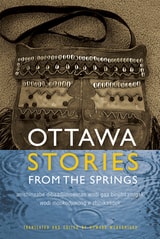
Ottawa Stories from the Springs
Anishinaabe dibaadjimowinan wodi gaa binjibaamigak wodi mookodjiwong e zhinikaadekHoward Webkamigad
Michigan State University Press, 2014
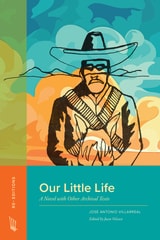
Our Little Life
A Novel with Other Archival TextsBy José Antonio Villarreal, edited by Juan Velasco
Lever Press, 2025
Our Little Life offers a much longer version of the Pocho story that extends a further 100 pages into the postwar period and follows Richard Rubio’s return from war and the changing shape of Mexican-American life in the 1940s. This newly discovered manuscript reveals Villarreal’s attention to Rubio’s struggles with PTSD and his efforts to depict a community and a family’s struggles with identity, belonging, and survival in postwar California. Our Little Life is an important work of archival recovery that sheds new light on Villarreal’s authorship and his place not only in Mexican-American literature but in the twentieth-century American literary canon.
This first publication of Our Little Life includes a scholarly introduction that places this unpublished novel in the landscape of contemporary Mexican-American literary studies and offers a brilliant examination of how novels grow and change. The volume also includes materials from the Villarreal Special Collection that recontextualize the writer’s vision, editing, and marketing of this and later novels. Our Little Life will be of interest not only to everyone in Mexican-American literary studies, but also to scholars of postwar America, women and gender studies, LGBTQ studies, ethnic studies, and migration and border studies.
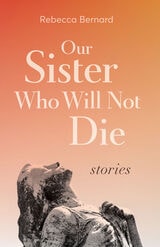
Our Sister Who Will Not Die
StoriesRebecca Bernard
The Ohio State University Press, 2022
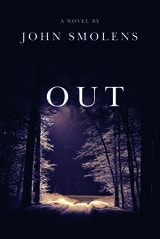
Out
John Smolens
Michigan State University Press, 2019
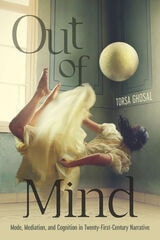
Out of Mind
Mode, Mediation, and Cognition in Twenty-First-Century NarrativeTorsa Ghosal
The Ohio State University Press, 2021
Out of Mind makes a compelling case for understanding narrative forms and cognitive-scientific frameworks as co-emergent and cross-pollinating. To this end, Ghosal harnesses narrative theory, multimodality studies, cognitive sciences, and disability studies to track competing perspectives on remembering, reading, and sense of place and self. Through new readings of the works of Kamila Shamsie, Aleksandar Hemon, Mark Haddon, Lance Olsen, Steve Tomasula, Jonathan Safran Foer, and others, Out of Mind generates unique insights into literary imagination’s influence on how we think and perceive amid twenty-first-century social, technological, and environmental changes.
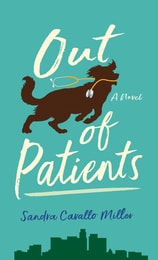
Out of Patients
A NovelSandra Cavallo Miller
University of Nevada Press, 2022
As she embarks on her year’s journey, Norah grapples with a medical practice that is experiencing a concerning loss of income. She is supervising two medical students, one whose shyness hampers his development and another whose arrogance and contempt for family medicine creates major friction at the clinic. Norah’s life is further complicated by her elderly mother, a feisty 86-year-old living in Sun City, who once rejoiced at Woodstock and recently partied at Burning Man. Troubled by a shadow in their past, both women find themselves on a quest for self-worth in their shifting worlds. Norah also must cope with the end of an unhappy, long-term relationship with an aspiring, but deadbeat, novelist.
Supported by her steadfast dog, a misfit veterinarian, and a thoughtful radiologist, Norah wrestles through a surprising assortment of obstacles, sometimes amusing and sometimes dreadful, on her way to making a decision about her future.
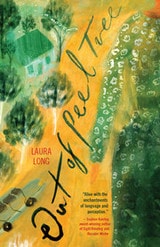
Out of Peel Tree
Laura Long
West Virginia University Press, 2014
Moving through time and space, Out of Peel Tree unfolds the patterns of an Appalachian sensibility that reverberate everywhere: a fatalism balanced by humor and flinty, hard-won hope, an appreciation for the surprises of the everyday, and a search for love and home amid strange and familiar places and people.
This innovative debut novel reveals the lives of a far-flung contemporary Appalachian family through a web of delicate turning points. A child discovers a grandmother she never knew has died. A runaway teen schemes to start a new life in Texas. A man on parole falls hopelessly in love with a shoplifter. A woman receives a letter about her husband’s other wife. An old woman confronts a burglar with the help of her ghost-husband.
United by a connection to their matriarch, these characters search at home and beyond to make a fresh sense of their changing lives. As a novel in stories, Out of Peel Tree brings a new lyricism to the page and a new voice to American and Appalachian literature—a voice deeply inflected by the beauty of the natural world and by working-class grit.
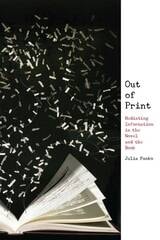
Out of Print
Mediating Information in the Novel and the BookJulia Panko
University of Massachusetts Press, 2020
This innovative study chronicles how the print book has fared as both novelists and the burgeoning profession of information science have grappled with unprecedented quantities of data across the twentieth and twenty-first centuries. As the novel's archival project took a critical turn from realism to an investigation of the structures, possibilities, and ideologies of information media, novelists have considered ideas about how data can best be collected and stored. Julia Panko pairs case studies from information history with close readings of modernist works such as James Joyce's Ulysses and Virginia Woolf's Orlando and contemporary novels from Jonathan Safran Foer, Stephen King, and Mark Z. Danielewski that emphasize their own informational qualities and experiment with the aesthetic potential of the print book.
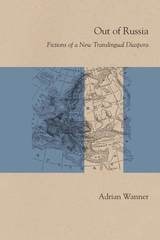
Out of Russia
Fictions of a New Translingual DiasporaAdrian Wanner
Northwestern University Press, 2011
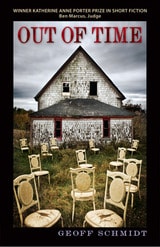
Out of Time
Geoff Schmidt
University of North Texas Press, 2011
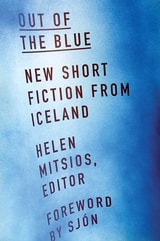
Out of the Blue
New Short Fiction from IcelandHelen Mitsios
University of Minnesota Press, 2017
A groundbreaking collection of fiction from Iceland’s best contemporary authors
This extraordinary collection, the first anthology of Icelandic short fiction published in English translation, features work by twenty of Iceland’s most popular and celebrated living authors—including Andri Snær Magnason, Jón Kalman Stefánsson, Kristín Ómarsdóttir, and Auður Jónsdóttir—granddaughter of Halldór Laxness, who won the 1955 Nobel Prize in Literature.
Celebrated in Europe and Scandinavia but less known in the English-speaking world, these writers traverse realms of darkness and light that will be familiar to readers who have fallen under the spell of Scandinavian fiction. While uniquely Icelandic in topography and tenor, with a touch of the island’s supernatural charm, the stories traffic in the enduring and universal complexities of human nature. Here is a fictional universe where the ghosts of Vikings and spirits tread, volcanoes grumble underfoot, and writers trip the Northern Lights fantastic across the landscape of the Icelandic imagination.
At long last, readers can enjoy award-winning stories now expertly rendered into English by the country’s most renowned translators. In “Killer Whale” a father contemplates euthanasia for a terminally ill child, in “Self Portrait” a vacationing family in Spain crosses paths with migrants, in “Escape for Men” a woman searches for an ex-lover in the South of France, and in “The Most Precious Secret” the nature of artists and the art world is mercilessly revealed. Both the Viking myths of Iceland’s forefathers and the cutting-edge modern world of the country today are brilliantly alive in these remarkable and original stories.
This collection is an excursion to an island where almost two million travelers descend yearly on a population of 345 thousand natives. Iceland is the place Björk calls home, the location where Game of Thrones was filmed—a place with open lava fields, glaciers, and iceberg lagoons among other natural wonders that is becoming one of the “hottest” tourist destinations on earth.
Out of the Blue transports readers to Iceland’s timeless and magical island of Vikings and geographical wonders, and it promises to be a seminal collection that will define Icelandic literature in translation for decades to come.
Contributors: Auður Ava Olafsdóttir, Kristín Eiríksdóttir, Þórarinn Eldjárn, Gyrðir Elíasson, Einar Örn Gunnarsson, Ólafur Gunnarsson, Einar Már Guðmundsson, Auður Jónsdóttir, Gerður Kristný, Andri Snær Magnason, Óskar Magnússon, Bragi Ólafsson, Kristín Ómarsdóttir, Óskar Árni Óskarsson, Magnús Sigurðsson, Jón Kalman Stefánsson, Ágúst Borgþór Sverrisson, Guðmundur Andri Thorsson, Þórunn Erlu-Valdimarsdóttir, Rúnar Helgi Vignisson.
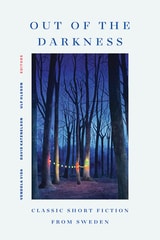
Out of the Darkness
Classic Short Fiction from SwedenVendela Vida
University of Minnesota Press, 2026
A treasure chest of stories by Swedish authors from the 1880s to the 1950s, many appearing for the first time in English
In the late nineteenth century, Swedish romanticism gave way to vibrant new literary styles that flourished through the 1950s. Out of the Darkness is the first anthology to bring the short fiction of this golden age of Swedish literature to English readers, celebrating the country’s rich literary tradition and several of its most renowned authors. The stories in this volume (many in entirely new translations, and most never before published in English) reflect the arc of the short story in Sweden, from realism to symbolism to modernist experimentation, and stand as lyrical exemplars of the creativity and depth of Swedish literature.
Some stories explore themes of crime and refuge, others ask what makes life meaningful, and some challenge sexual and social constructs of their time. All are fueled by shadows—of evil, madness, or fate, eerie fantasy or grim reality. Including internationally famous authors like August Strindberg, Stig Dagerman, and Nobel laureate Selma Lagerlöf, Out of the Darkness also features writing by influential women such as Victoria Benedictsson and Agnes von Krusenstjerna, who are less familiar to English readers. A showcase of stylistic virtuosity and incisive social commentary, Out of the Darkness at last brings this remarkable period of Swedish prose into the light.
Contributors: Victoria Benedictsson, Hjalmar Bergman, Karin Boye, Stig Dagerman, Thorsten Jonsson, Agnes von Krusenstjerna, Selma Lagerlöf, August Strindberg, Hjalmar Söderberg.
Retail e-book files for this title are screen-reader friendly.
Out of the Girls' Room and into the Night
Thisbe Nissen
University of Iowa Press, 1999
Out of the Girls' Room and into the Night is a spirited, offbeat collection of stories, elongated riffs on that thing we call …love. All manner of love stories: thwarted love stories, imaginary love stories, love stories offhand and obsessive, philosophical love stories, erudite and amusing love stories.
“People don't meet because they both like Burmese food,” says one character, “or because someone's sister has a friend who's single and new in town, or because Billy's nose happened to crook just slightly to the left at an angle that made me want to weep…People don't fall in love with each other …they just fall into love.”
Everyone does it: women of fierce independence, men of thin character, rambling Deadheads, gay teenage girls, despondent Peace Corps volunteers, anorexic Broadway theatre dancers, the eager, the grieving, the uncommunicative. Even the confused do it. And they don't just fall in love with each other—they fall in love with certain moments and familiar places, with things as ephemeral as gestures and as evanescent as sunlight.
Quirky, real, idealistic, deluded, bohemian, and true, these are people who can—and often do—fall in love with a pair of ears, August afternoons, saucers of vitamins, New Age carpenters, and dead bumblebees. And if there's something they can teach us, it's how to conceive of alternative worlds and the terror and the exhilaration of venturing outside the confines of the lives we know and making our way into a dark, glittering unknown.
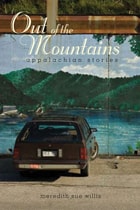
Out of the Mountains
Appalachian StoriesMeredith Sue Willis
Ohio University Press, 2010
Meredith Sue Willis’s Out of the Mountains is a collection of thirteen short stories set in contemporary Appalachia. Firmly grounded in place, the stories voyage out into the conflicting cultural identities that native Appalachians experience as they balance mainstream and mountain identities.
Willis’s stories explore the complex negotiations between longtime natives of the region and its newcomers and the rifts that develop within families over current issues such as mountaintop removal and homophobia. Always, however, the situations depicted in these stories are explored in the service of a deeper understanding of the people involved, and of the place. This is not the mythic version of Appalachia, but the Appalachia of the twenty-first century.
Out the Summerhill Road
A NovelJane Roberts Wood
University of North Texas Press, 2010
Outer Stars
Kirsten Sundberg Lunstrum
University of North Texas Press, 2025
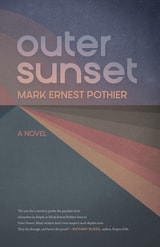
Outer Sunset
Mark Ernest Pothier
University of Iowa Press, 2023
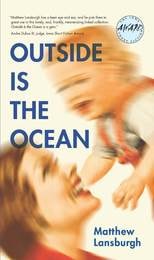
Outside Is the Ocean
Matthew Lansburgh
University of Iowa Press, 2017
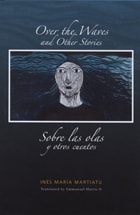
Over the Waves and Other Stories / Sobre las olas y otros cuentos
A Bilingual EditionInés María Martiatu
Swan Isle Press, 2009
The history of the Caribbean, as part of the African diaspora, is reflected in the textures of life in Cuba, its music, rituals and myths, the Church and Santería, past and present. While race is unquestionably fundamental to the stories, they are at the same time rooted in the universality of the human experience. The vantage is that of an unflinching, yet compassionate observer of society—one who simultaneously turns an introspective mirror on the complicated layers of self.
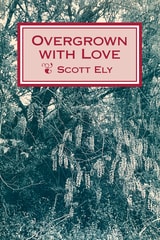
Overgrown with Love
Scott Ely
University of Arkansas Press, 1993
Lead short story featured in 1993 Best American Short Stories
A wide variety of characters saunter, stalk, run, and sometimes hide in these lively stories about contemporary Southerners. Their experiences revolve around the way life is felt and the way it is lived, reflecting a gap between the plans we make for ourselves and the way things actually turn out. From the jungles of Vietnam to the bayous of Louisiana, from the French countryside to Vicksburg, Mississippi, Ely’s stories reveal how human beings’ unpredictable, unconscious motivations will have their say no matter what steps are taken to silence them.
Certain shadows fall over all the characters—especially the shadows of the Vietnam experience and the struggle between a traditional Southern heritage and the conflicting ideals of contemporary society. The characters in Ely’s stories seem powerless to defend themselves against the ever-changing expectations of a modern life, and yet they gain a new humanity and depth when, with dignity, they embrace their limitations.
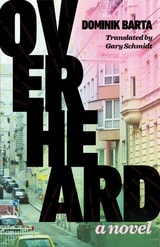
Overheard
Dominik Barta, Translated by Gary Schmidt
University of Wisconsin Press, 2025
Overheard is set in Vienna in the mid-2010s, a time of significant social change and political conflict, with tens of thousands of Middle Eastern refugees arriving and protests taking place over a café’s expulsion of two women who greeted each other with a kiss. Kurt is gay, but his best friend is not. He’s a sympathetic listener, leading him—and the reader—to revisit and reevaluate assumptions.
Originally published as Tür an Tür, Dominik Barta’s novel is a page-turner filled with humor, insight, and a suspenseful plot. Overheard combines visions of an idealized past and a longed-for future to create a present that we all want to inhabit.
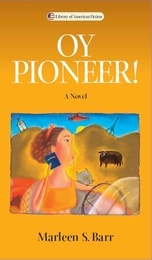
Oy Pioneer!
A NovelMarleen S. Barr
University of Wisconsin Press, 2003
What would happen if a feminist Jewish wit and scholar invaded David Lodge’s territory? Marleen S. Barr, herself a pioneer in the feminist criticism of science fiction, provides a giddily entertaining answer in this feisty novel. Oy Pioneer! follows professor Sondra Lear as she makes her inimitable way through a world of learning—at times fantastic, at times all too familiar, often hilarious, and always compulsively interesting.
As if Mel Brooks and Erica Jong had joined forces to recreate Sex and the City for the intellectual set, the story is a heady mix of Jewish humor, feminist insight, and academic satire. Lear is a tenured radical and a wildly ambitious intellectual, but is subject nonetheless to the husband-hunting imperatives of her Jewish mother. Her adventures expand narrative parameters according to Barr’s term "genre fission."
Mixing elements of science fiction, fantasy, ethnic comedy, satire, and authentic experience of academic life, Oy Pioneer! is uncommonly fun—a Jewish feminist scholar’s imaginative text boldly going where no academic satire has gone before—and bringing readers along for an exhilarating ride.
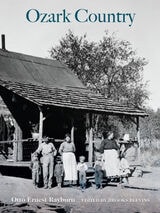
Ozark Country
Otto Ernest Rayburn
University of Arkansas Press, 2021
Published just days before America’s entry into World War II, Ozark Country is Otto Ernest Rayburn’s love letter to his adopted region. One of several chronicles of the Ozarks that garnered national attention during the Depression and war years, when many Americans craved stories about people and places seemingly untouched by the difficulties of the times, Rayburn’s colorful tour takes readers from the fictional village of Woodville into the backcountry of a region teeming with storytellers, ballad singers, superstitions, and home remedies.
Rayburn’s tales—fantastical, fun, and unapologetically romantic—portray a world that had already nearly disappeared by the time they were written. Yet Rayburn’s depiction of the Ozarks resonates with notions of the region that have persisted in the American consciousness ever since.