Results by title
2817 books match the query 'Nature' and 82 start with o

One Winter Up North
John Owens
University of Minnesota Press, 2022
A picture-book journey through the Boundary Waters Canoe Area Wilderness in winter, snowshoeing the frozen lakes and silent forest with family, encountering the wonders of northern wildlife in the cold season
In winter the Boundary Waters, way up north in Minnesota, is not the same place you canoed last summer—but still it beckons and welcomes you. Grab a pack, strap on snowshoes, make a path (Oh! they take some getting used to!), and venture out across the frozen lakes and through the snowy woods. The vast wintery world here is so still and quiet, you might think you’re all alone—but no! Who made these tracks? A deer? A hare? A fox? And far off there’s a musher, making tracks with his sled dogs.
It’s a magical place. The bright sun brilliant on the snow, the sparkling silence—wait, is that a wolf calling? Try to answer! And when the dark descends, the stars and pine trees holding up the night, your nose gets cold and it’s back to camp, to your warm winter tent, where Father feeds the stove with wood you gathered, Mother snuggles into her big sleeping bag, and you curl up in the fire’s glow and know that in your dreams and memories you will return again and again to this one winter up north.
A wintery adventure that unfolds in pictures, John Owens’s delightful book gives readers a chance to discover—or rediscover—another season full of wonder in the Boundary Waters Canoe Area Wilderness.
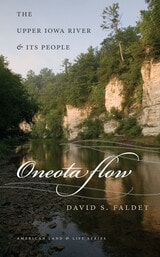
Oneota Flow
The Upper Iowa River and Its PeopleDavid S. Faldet
University of Iowa Press, 2009
Whether profiling the chief of the last hunter-gatherers on the river, an early settler witnessing her first prairie fire and a modern wildlife biologist using fire to manage prairies, the manager of the Granger Farmer’s Co-op Creamery, or a landowner whose bottomlands are continually eaten away by floods, Faldet steadily develops the central idea that people are walking tributaries of the river basin in which they make their homes.
Faldet moves through the history of life along the now-polluted Upper Iowa, always focusing on the ways people depend on the river, the environment, and the resources of the region. He blends contemporary conversations, readings from the historical record, environmental research, and personal experience to show us that the health of the river is best guaranteed by maintaining the biological communities that nurture it. In return, taking care of the Upper Iowa is the best way to take care of our future.
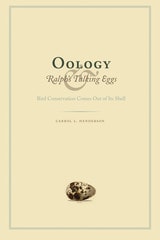
Oology and Ralph's Talking Eggs
Bird Conservation Comes Out of Its ShellBy Carrol L. Henderson
University of Texas Press, 2007
Before modern binoculars and cameras made it possible to observe birds closely in the wild, many people collected eggs as a way of learning about birds. Serious collectors called their avocation "oology" and kept meticulous records for each set of eggs: the bird's name, the species reference number, the quantity of eggs in the clutch, the date and location where the eggs were collected, and the collector's name. These documented egg collections, which typically date from the nineteenth and early twentieth centuries, now provide an important baseline from which to measure changes in the numbers, distribution, and nesting patterns of many species of birds.
In Oology and Ralph's Talking Eggs, Carrol L. Henderson uses the vast egg collection of Ralph Handsaker, an Iowa farmer, as the starting point for a fascinating account of oology and its role in the origins of modern birdwatching, scientific ornithology, and bird conservation in North America. Henderson describes Handsaker's and other oologists' collecting activities, which included not only gathering bird eggs in the wild but also trading and purchasing eggs from collectors around the world. Henderson then spotlights sixty of the nearly five hundred bird species represented in the Handsaker collection, using them to tell the story of how birds such as the Snowy Egret, Greater Prairie Chicken, Atlantic Puffin, and Wood Duck have fared over the past hundred years or so since their eggs were gathered. Photos of the eggs and historical drawings and photos of the birds illustrate each species account. Henderson also links these bird histories to major milestones in bird conservation and bird protection laws in North America from 1875 to the present.
Open Horizons
Sigurd F. Olson
University of Minnesota Press, 1998
Olson’s inspirational life story, told in his own words, now available in paperback.
Sigurd Olson’s love affair with the wilderness began in a stream near his house in Wisconsin-he caught his first trout there with a tamarack wand, black thread, and a grasshopper as bait. Open Horizons is his autobiography, and in it he recounts a life lived on and for the land, from the wonder of boyhood fishing expeditions to decades-long conservation battles.
Writing always with the sensitive, lyric prose that characterizes his works, Olson recalls his pioneering youth on a remote Wisconsin farm, his summers as a wilderness canoe guide, and his thousands of miles of travel through the wilds of this country and Canada. “Open Horizons is the story of the unknowns I have discovered, and gone through,” he writes. While telling his story, Olson makes a compelling case for preserving the wilderness. He puts forth his own life as an example of how nature can have a spiritual effect on the human soul, and proposes diligence on behalf of those who fight to conserve our forests, wetlands, and dunes. “If we can move into an open horizon where we can live in our modern world with ancient dreams that have always stirred us, then our work will have been done.”ISBN 0-8166-3037-2 Paper $14.95256 pages 12 line drawings 5 1/2 x 8 1/4 SeptemberFesler-Lampert Minnesota Heritage Book SeriesTranslation inquiries: University of Minnesota Press
Open the Door
The Life and Music of Betty CarterWilliam R. Bauer
University of Michigan Press, 2003
This book looks at Betty Carter's contribution to the music world and delves behind the scenes to show Carter's growth as a businesswoman who took charge of her career.
Drawing upon revealing interviews with Carter, the author shows how ever-changing shifts in the music industry affected the singer's life and influenced her music. Bauer shows through his analysis of her musical examples how Carter absorbed various musical influences, from Sarah Vaughan and Billie Holiday to Miles Davis, and made them her own. From her apprenticeship with Gladys Hampton, Carter grew to become a shrewd dealer who learned to do her own contracting, A&R, and marketing and distribution. By chronicling one of jazz's great singers and composers, the book sheds light on how early jazz musicians got their work to the public and how this process has changed during the past fifty years.
Opening Windows
Embracing New Perspectives and Practices in Natural Resource Social SciencesKate Sherren
Utah State University Press, 2024
This reflexive book is organized around four key themes: diversity and justice, governance and power, engagement and elicitation, and relationships and place. This is not a complacent volume—chapters point to gaps in conventional scholarship and to how much work remains to be done. Power is a central focus, including the role of cultural and economic power in “participatory” approaches to natural resource management and the biases encoded into the very concepts that guide scholarly and practical work. The chapters include robust literature syntheses, conceptual models, and case studies that provide examples of best practices and recommend research directions to improve and transform natural resource social sciences. An unmistakable spirit of hope is exemplified by findings suggesting positive roles for research in the progress ahead.
Bringing fresh perspectives on the assumptions and interests that underlie and entangle scholarship on natural resource decisionmaking and the justness of its outcomes, Opening Windows is significant for scholars, students, natural resource practitioners, managers and decision makers, and policy makers.
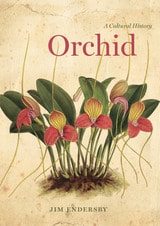
Orchid
A Cultural HistoryJim Endersby
University of Chicago Press, 2016
Following the stories of orchids throughout history, Jim Endersby divides our attraction to them into four key themes: science, empire, sex, and death. When it comes to empire, for instance, orchids are a prime example of the exotic riches sought by Europeans as they shaped their plans for colonization. He also reveals how Charles Darwin’s theory of evolution became intimately entangled with the story of the orchid as he investigated their methods of cross-pollination. As he shows, orchids—perhaps because of their extraordinarily diverse colors, shapes, and sizes—have also bloomed repeatedly in films, novels, plays, and poems, from Shakespeare to science fiction, from thrillers to elaborate modernist novels.
Featuring many gorgeous illustrations from the collection of the Royal Botanic Gardens, Kew, Orchid: A Cultural History tells, for the first time, the extraordinary story of orchids and our prolific interest in them. It is an enchanting tale not only for gardeners and plant collectors, but anyone curious about the flower’s obsessive hold on the imagination in history, cinema, literature, and more.
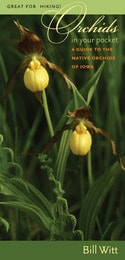
Orchids in Your Pocket
A Guide to the Native Orchids of Iowa (10-pack)Bill Witt
University of Iowa Press, 2006
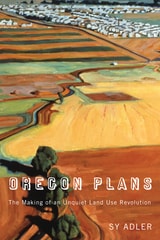
Oregon Plans
The Making of an Unquiet Land Use RevolutionSy Adler
Oregon State University Press, 2012
"Adler's story is about unusual conditions, purposeful action, dynamic personalities, and the messiness of democratic and bureaucratic processes. His conclusions reveal much about how Oregonians defined liveability in the late twentieth century." —William L. Lang, from the Preface

Organ Pipe
Life on the EdgeText by Carol Ann Bassett; Photographs by Michael Hyatt
University of Arizona Press, 2004
A terrain where one learns to pay attention to the details: the tracks of a sidewinder in the sand, the tiny eggs of a cactus wren, the flash of a vermilion flycatcher against the azure sky.
Organ Pipe Cactus National Monument lies in southwestern Arizona on the Mexican border. It is an isolated park that for Carol Ann Bassett has long been a place of solitude—a silent refuge where she often camped out alone to capture the natural rhythms of the desert. Photographer Michael Hyatt hiked through Organ Pipe to visually document its subtle beauty in the Ajo Mountains and the valley of the Ajo, and at Quitobaquito, a rare desert oasis.
Few visitors may brave Organ Pipe during summer, when the temperature can reach 120 degrees, but for Bassett and Hyatt the searing heat is but a harbinger of rain, when normally dry arroyos surge with rust-colored water and desert tarantulas come out to mate. Bassett introduces readers to Organ Pipe’s cultural heritage as well: Spanish missionaries, Anglo settlers, and the Tohono O’odham and the Hia Ced O’odham people who still travel there to gather cactus fruit during Hasan Bakmasad, "saguaro moon." She also considers the changes taking place throughout the park, including the onrush of immigrants passing through in search of better lives in the United States.
This small, lyrical book is a sensitive reflection on the heart of the Sonoran Desert. It reminds us of the beauty to be found in unexpected places—and of our intimate connection with the wild.

Origins of the National Forests
Harold K. Steen, ed.
Duke University Press, 1992
The national forests are a major source of wood, water, minerals, forage, animal life and habitat, and wilderness. Yet questions of who controls and who benefits from the resources have posed problems and conflicts from the origins of the Forest Service to the present. Based on a 1991 Forest History Society conference, the essays collected here discuss a range of important topics surrounding our national forests, including the relationship between the federal and state systems that regulate the forests; the privately owned lands within the forests that are governed by federal statutes, state laws, and county ordinances; the ill-defined rights of those who lived on the land long before it was a national forest and were forced off the land; and the effect of early policymaking decisions made within the framework of the emerging Conservation Movement.
Contributors. Ron Arnold, Pamela A. Conners, Mary S. Culpin, Stanley Dempsey, Peter Gillis, Donn E. Headley, Robert L. Hendricks, Stephen Larrabee, Patricia Nelson Limerick, Dennis L. Lynch, Michael McCarthy, Char Miller, Joseph A. Miller, James Muhn, Kevin Palmer, Donald Pisani, John F. Reiger, William Rowley, Michael Ryan, William E. Shands, Harold K. Steen, Richard White, Gerald W. Williams
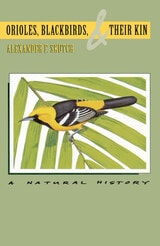
Orioles, Blackbirds, and Their Kin
A Natural HistoryAlexander F. Skutch
University of Arizona Press, 1996
The least known of these species are perhaps best known to Alexander Skutch, who has studied birds in a Costa Rican tropical valley for more than half a century. In this fascinating book the first devoted exclusively to the icterids—he combines his own observations with those of other naturalists to provide a comparative natural history and biology of this remarkable family of birds. Devoting a separate chapter to each major group or genus, he delineates the outstanding characteristics of each and includes observations of little-studied tropical species such as caciques and oropendolas.
Orioles, Blackbirds, and Their Kin is an eminently readable natural history in the classic style. Enhanced by 31 scratchboard illustrations, this book will delight nature enthusiasts everywhere with its fascinating exposition of avian diversity. Because so much of the published information on the icterids is widely scattered, Skutch's painstaking compilation has created a valuable reference work that will provide students and researchers with a wealth of new insights into the tropical members of this New World family.

Osiris, Volume 12
Women, Gender, and Science: New DirectionsEdited by Sally Gregory Kohlstedt and Helen Longino
University of Chicago Press, 1997
Osiris, Volume 15
Nature and Empire: Science and the Colonial EnterpriseEdited by Roy MacLeod
University of Chicago Press, 2001
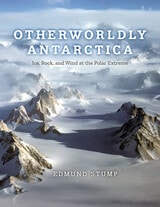
Otherworldly Antarctica
Ice, Rock, and Wind at the Polar ExtremeEdmund Stump
University of Chicago Press, 2024
The interior of Antarctica is an utterly pristine wilderness, a desolate landscape of ice, wind, and rock; a landscape so unfamiliar as to seem of another world. This place has been known to only a handful of early explorers and the few scientists fortunate enough to have worked there. Edmund Stump is one of the lucky few. Having climbed, photographed, and studied more of the continent-spanning Transantarctic Mountains than any other person on Earth, this geologist, writer, and photographer is uniquely suited to share these alien sights.
With stories of Stump’s forty years of journeys and science, Otherworldly Antarctica contains 130 original color photographs, complemented by watercolors and sketches by artist Marlene Hill Donnelly. Over three chapters—on the ice, the rock, and the wind—we meet snowy paths first followed during Antarctica’s Heroic Age, climb the central spire of the Organ Pipe Peaks, peer into the crater of the volcanic Mount Erebus, and traverse Liv Glacier on snowmobile, while avoiding fatal falls into the blue interiors of hidden crevasses. Along the way, we see the beauty of granite, marble, and ice-cored moraines, meltwater ponds, lenticular clouds, icebergs, and glaciers. Many of Stump’s breathtaking images are aerial shots taken from the planes and helicopters that brought him to the interior. More were shot from vantages gained by climbing the mountains he studied. Some were taken from the summits of peaks. Many are of places no one had set foot before—or has since. All seem both permanent and precarious, connecting this otherworld to our fragile own.

Our Energy Future
Lincoln Davies
University of Utah Press, 2025
In Our Energy Future, Lincoln Davies shines a bright light on the challenges the transition presents, including energy equity, political partisanship, the need for holistic solutions, and adaptability in the face of change. Our Energy Future makes the case for why the United States’ current transition to clean energy provides our world with something we so desperately need today: hope.
Our National Parks
John Muir
University of Wisconsin Press, 1981
The book, long out of print, was originally published in 1901, its ten essays having previously appeared as articles in the Atlantic Monthly. Muir wrote them with a single purpose—to entice people, by his descriptions, to come to the parks, to see and enjoy them. If enough people did so, reasoned Muir, they would surely love the wilderness as he did, and the parks would be preserved.
Muir carried out his public relations mission with remarkable success. Every page of this book carries his unbridled and irresistible enthusiasm. Our National Parks is part reminiscence, part philosophy, and mostly enticing description. It is all vintage Muir.
Although the book treats Yellowstone, Sequoia, General Grant, and other national parks of the Western U.S., Muir devotes the bulk of the work to his first love—Yosemite, settled into the heart of the Sierra Nevada. Indeed, six of the book’s chapters are devoted to Yosemite, treating the forests, wild gardens, fountains and streams, animals, and birds of the park. The concluding essay is an impassioned plea to save American forests.
All visitors to the great western national parks—and all who will one day visit them—will be captivated by Muir’s descriptions. The grandeur of this wilderness is reflected in the very spirit of John Muir. Both shine through every page of this remarkable book.
Our National Parks
John Muir
University of Wisconsin Press, 2026
Our National Parks is a guidebook supreme, an exciting introduction to Yosemite and several other magnificent parks by the man who, more than any other person, helped create them. After this fast-paced trip with Muir, past visitors to the parks will want to revisit them with new insights, and those who have never wandered these trails will not rest until they have done so.
The book was originally published in 1901, its ten essays having previously appeared as articles in the Atlantic Monthly. Muir wrote them with a single purpose—to entice people, by his descriptions, to come to the parks, to see and enjoy them. If enough people did so, reasoned Muir, they would surely love the wilderness as he did, and the parks would be preserved.
Muir carried out his public relations mission with remarkable success. Every page of this book carries his unbridled and irresistible enthusiasm. Our National Parks is part reminiscence, part philosophy, and mostly enticing description. It is all vintage Muir.
Although the book treats Yellowstone, Sequoia, General Grant, and other national parks of the Western U.S., Muir devotes the bulk of the work to his first love—Yosemite, settled into the heart of the Sierra Nevada. The concluding essay is an impassioned plea to save American forests.
All visitors to the great western national parks—and all who will one day visit them—will be captivated by Muir’s descriptions. The grandeur of this wilderness is reflected in the very spirit of John Muir. Both shine through every page of this remarkable book. Richard F. Fleck’s introduction and Todd Johnson’s foreword for the 125th anniversary edition place Muir’s life and legacy in the environmental movement of the United States in context and reveal how our need for nature and our responsibility to public lands remain as important as ever.
Our National Parks and the Search for Sustainability
By Bob R. O'Brien
University of Texas Press, 1999
"Yosemite Valley in July of 1967 would have had to be seen to be believed. There was never an empty campsite in the valley; you had to create a space for yourself in a sea of cars, tents, and humanity.... The camp next to ours had fifty people in it, with rugs hung between the trees, incense burning, and a stereo set going full volume."
Scenes such as this will probably never be repeated in Yosemite or any other national park, yet the urgent problem remains of balancing the public's desire to visit the parks with the parks' need to be protected from too many people and cars and too much development. In this book, longtime park visitor and professional geographer Bob O'Brien explores the National Park Service's attempt to achieve "sustainability"—a balance that allows as many people as possible to visit a park that is kept in as natural a state as possible.
O'Brien details methods the NPS has used to walk the line between those who would preserve vast tracts of land for "no use" and those who would tap the Yellowstone geysers to generate electricity. His case studies of six western "crown jewel" parks show how rangers and other NPS employees are coping with issues that impact these cherished public landscapes, including visitation, development, and recreational use.
Our Neck of the Woods
Exploring Minnesota's Wild PlacesDaniel J. Philippon
University of Minnesota Press, 2009
What are the odds of finding Minnesota's tiniest orchid? Why take a Breathalyzer test to study frogs? How does ice fishing warm the heart? Who would live in such a cold, lean region? Our Neck of the Woods takes on these and other urgent (and sometimes quirky) questions, showcasing writers' own experiences in the best-loved places in Minnesota, including the North Shore, Lake Bemidji, the western prairies and grasslands, the Boundary Waters, and the Mesabi Iron Range.
The outdoor experiences described here range from sweeping natural history observations to adventurous tales of coming-of-age camping and hunting trips. We follow notable writers and conservationists Sigurd F. Olson, Paul Gruchow, Bill Holm, Jan Zita Grover, Greg Breining, Laurie Allmann, and many others as they descend a frozen river toward Lake Superior, explore a crystalline palace at minus 20 degrees, and trace a family's history along the Mississippi River. Writing on such themes as embracing winter, making camp, and finding wildness even amid development, these authors tell of hunting, fishing, birding, canoeing, and other great outdoor activities that help define what it means to be Minnesotan.
Drawn from the pages of Minnesota Conservation Volunteer magazine-published by the Department of Natural Resources since 1940-these writings evoke a strong sense of place and suggest that the outdoor experiences we share with others come to mean the most to us. With rich observations and spirited tales, Our Neck of the Woods beckons Minnesotans to work, play, and explore in the natural places close to their homes and hearts.
Our Oldest Task
Making Sense of Our Place in NatureEric T. Freyfogle
University of Chicago Press, 2017
Passionate and pragmatic, extraordinarily well read and eloquent, Freyfogle details a host of forces that have produced our self-defeating ethos of human exceptionalism. It is this outlook, he argues, not a lack of scientific knowledge or inadequate technology, that is the primary cause of our ecological predicament. Seeking to comprehend both the multifaceted complexity of contemporary environmental problems and the zeitgeist as it unfolds, Freyfogle explores such diverse topics as morality, the nature of reality (and the reality of nature), animal welfare, social justice movements, and market politics. The result is a learned and inspiring rallying cry to achieve balance, a call to use our knowledge to more accurately identify the dividing line between living in and on the world and destruction. “To use nature,” Freyfogle writes, “but not to abuse it.”
Our Once and Future Planet
Restoring the World in the Climate Change CenturyPaddy Woodworth
University of Chicago Press, 2013
But that paints an unbalanced—and overly disheartening—picture of what’s going on with environmental stewardship today. There are success stories, and Our Once and Future Planet delivers a fascinating account of one of the most impressive areas of current environmental experimentation and innovation: ecological restoration. Veteran investigative reporter Paddy Woodworth has spent years traveling the globe and talking with people—scientists, politicians, and ordinary citizens—who are working on the front lines of the battle against environmental degradation. At sites ranging from Mexico to New Zealand and Chicago to Cape Town, Woodworth shows us the striking successes (and a few humbling failures) of groups that are attempting to use cutting-edge science to restore blighted, polluted, and otherwise troubled landscapes to states of ecological health—and, in some of the most controversial cases, to particular moments in historical time, before widespread human intervention. His firsthand field reports and interviews with participants reveal the promise, power, and limitations of restoration.
Ecological restoration alone won’t solve the myriad problems facing our environment. But Our Once and Future Planet demonstrates the role it can play, and the hope, inspiration, and new knowledge that can come from saving even one small patch of earth.

Our Planet
How much more can Earth take?Jill Jäger
Haus Publishing, 2009
Our Roots Run Deep as Ironweed
Appalachian Women and the Fight for Environmental JusticeShannon Elizabeth Bell
University of Illinois Press, 2013
Motivated by a deeply rooted sense of place and community, Appalachian women have long fought against the damaging effects of industrialization. In this collection of interviews, sociologist Shannon Elizabeth Bell presents the voices of twelve Central Appalachian women, environmental justice activists fighting against mountaintop removal mining and its devastating effects on public health, regional ecology, and community well-being.
Each woman narrates her own personal story of injustice and tells how that experience led her to activism. The interviews--many of them illustrated by the women's "photostories"--describe obstacles, losses, and tragedies. But they also tell of new communities and personal transformations catalyzed through activism. Bell supplements each narrative with careful notes that aid the reader while amplifying the power and flow of the activists' stories. Bell's analysis outlines the relationship between Appalachian women's activism and the gendered responsibilities they feel within their families and communities. Ultimately, Bell argues that these women draw upon a broader "protector identity" that both encompasses and extends the identity of motherhood that has often been associated with grassroots women's activism. As protectors, the women challenge dominant Appalachian gender expectations and guard not only their families but also their homeplaces, their communities, their heritage, and the endangered mountains that surround them.
30% of the proceeds from the sale of this book will be donated to organizations fighting for environmental justice in Central Appalachia.
Our Threatened Oceans
Stefan Rahmstorf
Haus Publishing, 2009
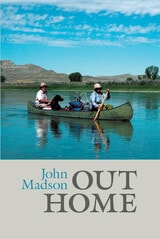
Out Home
John Madson
University of Iowa Press, 1979
Writing always with the knowledge that he was witnessing the end of the wilderness, of the outdoor home that nourished him, Madson brings a brilliant energy to these tough, unsentimental tales. “A strong place puts a mark on all that lives there, and the mark may outlast the place itself. Prairie people are like their western meadowlarks, seeming to be the same as their eastern relatives, but with a different song.” In his song about the “play of wind on tallgrasses, with the land running beneath a towering sky,” we hear the voice that went on to give us the magic of Where the Sky Began.
Editor Michael McIntosh, one of the nation’s foremost experts on shotguns, has written a short introduction to this first paperback edition of these ageless wilderness tales.
Out of Nature
Why Drugs from Plants Matter to the Future of HumanityKara Rogers
University of Arizona Press, 2012
About half of all species under threat of extinction in the world today are plants. The loss of plant biodiversity is disturbing for many reasons, but especially because it is a reflection of the growing disconnect between humans and nature. Plants have been used for millennia in traditional systems of healing and have held a significant place in drug development for Western medicine as well. Despite the recent dominance of synthetic drug production, natural product discovery remains the backbone of drug development. As the diversity of life on Earth is depleted and increasing numbers of species become lost to extinction, we continue to lose opportunities to achieve advances in medicine.
Through stories of drug revelation in nature and forays into botany, human behavior, and conservation, Kara Rogers sheds light on the multiple ways in which humans, medicine, and plants are interconnected. With accessible and engaging writing, she explores the relationships between humans and plants, relating the stories of plant hunters of centuries past and examining the impact of human activities on the environment and the world's biodiversity. Rogers also highlights the role that plant-based products can play in encouraging conservation and protecting the heritage and knowledge of indigenous peoples.
Out of Nature provides a fresh perspective on modern drug innovation and its relationship with nature. The book delves into the complexity of biophilia—the innate human attraction to life in the natural world—and suggests that the reawakening of this drive is fundamental to expanding conservation efforts and improving medicine. Rogers's examination of plants, humans, and drug discovery also conveys a passionate optimism for the future of biodiversity and medicine. Including a collection of hand-drawn maps and plant illustrations created by the author, this well-researched narrative will inspire as well as inform.
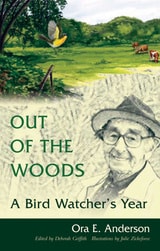
Out of the Woods
A Bird Watcher’s YearOra E. Anderson
Ohio University Press, 2007
Out of the Woods: A Bird Watcher’s Year is a journey through the seasons and a joyous celebration of growing old. In fifty-nine essays and poems, Ora E. Anderson, birder, bird carver, naturalist, and nature writer, reveals the insights and recollections of a keen-eyed observer of nature, both human and avian. The essays follow the rivers and creeks, the highways and little-known byways of Appalachia, and along the way we become nearly as familiar with its numerous bird, plant, and animal species as with the author himself.
These are not the memories of a single year, however, but of a long lifetime spent immersed in the natural world. Out of the Woods, presented with humor and passion, is an account of a well-lived, productive, and satisfying life. The essays offer an intimate portrait of a half century of Anderson's life on his beloved old farm (more nearly a nature preserve), where he lived in harmony with birds and nature and followed the rhythm of the seasons. We are invited to share the joys—and the disappointments and sorrows—inherent in such a life.
Generously illustrated with Julie Zickefoose’s detailed and evocative drawings, this book will delight bird watchers, artists, naturalists, backyard gardeners, and anyone who is ever tempted to take a rutted, overgrown path just to see where it leads.
Out of the Woods
Seeing Nature in the EverydayJulia Corbett
University of Nevada Press, 2018
Have you ever wondered about society’s desire to cultivate the perfect lawn, why we view some animals as “good” and some as “bad,” or even thought about the bits of nature inside everyday items–toothbrushes, cell phones, and coffee mugs? In this fresh and introspective collection of essays, Julia Corbett examines nature in our lives with all of its ironies and contradictions by seamlessly integrating personal narratives with morsels of highly digestible science and research. Each story delves into an overlooked aspect of our relationship with nature—insects, garbage, backyards, noise, open doors, animals, and language—and how we cover our tracks.
With a keen sense of irony and humor and an awareness of the miraculous in the mundane, Julia recognizes the contradictions of contemporary life. She confronts the owner of a high-end market who insists on keeping his doors open in all temperatures. Takes us on a trip to a new mall with a replica of a trout stream that once flowed nearby. The phrase “out of the woods” guides us through layers of meaning to a contemplation of grief, remembrance, and resilience.
Out of the Woods leads to surprising insights into the products, practices, and phrases we take for granted in our everyday encounters with nature and encourages us all to consider how we might re-value or reimagine our relationships with nature in our everyday lives.
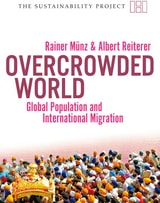
Overcrowded World?
Global Population and International MigrationRainer Münz
Haus Publishing, 2009
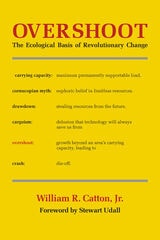
Overshoot
The Ecological Basis of Revolutionary ChangeWilliam R. Catton, Jr.
University of Illinois Press, 1980
A calm but unflinching realist, Catton suggests that we cannot stop this wave - for we have already overshot the Earth's capacity to support so huge a load. He contradicts those scientists, engineers, and technocrats who continue to write optimistically about energy alternatives. Catton asserts that the technological panaceas proposed by those who would harvest from the seas, harness the winds, and farm the deserts are ignoring the fundamental premise that "the principals of ecology apply to all living things." These principles tell us that, within a finite system, economic expansion is not irreversible and population growth cannot continue indefinitely. If we disregard these facts, our sagging American Dream will soon shatter completely.
Owls, Caves and Fossils
Predation, Preservation and Accumulation of Small Mammal Bones in Caves, with an Analysis of the Pleistocene Cave Faunas From Westbury-Sub-Mendip, Somerset, U.K.Peter Andrews
University of Chicago Press, 1990