Results by title
18284 books match the query 'United States' and 384 start with o

Opening Zion
A Scrapbook of the National Park's First Official TouristsJohn Clark
University of Utah Press, 2010
When Melissa Clark purchased a box of old scrapbooks online, she knew only that she had bought something relating to the University of Utah and Zion Park. What came in the mail was much more than she had expected. Instead of random mementos, two albums arrived full of photographs and newspaper clippings dating to 1920 that document a trip made by six young women from the University of Utah into the newly formed Zion National Park. Part of a promotional campaign developed by the Los Angeles and Salt Lake Railroad to advertise its national park shuttle service, the women entered Zion Canyon as its first offical tourists. When Melissa bought those timeworn scrapbooks she found a forgotten treasure: the opening of Zion.
With text by John Clark, the scrapbooks are now the basis of a one-of-a-kind publication. Part fashion spread, part adventure guide, and all Utah cultural treasure, Opening Zion is a stunning visual record of the park. Remarkably detailed black-and-white photographs show the young adventurers scrambling over rocky outcrops, pondering the dizzying height of Zion's sheer walls, and singing camp songs by the campfire. We are introduced anew to the "gigantic grandeur" of Zion National Park. As one of the women wrote, "One can think only beautiful thoughts amid such splendor."
Opening the Doors
The Desegregation of the University of Alabama and the Fight for Civil Rights in TuscaloosaB. J. Hollars
University of Alabama Press, 2013

Opening the Ozarks
A Historical Geography of Missouri's Ste. Genevieve District, 1760-1830Walter A. Schroeder
University of Missouri Press, 2002
The study begins with the French Creole settlement at Old Ste. Genevieve in the middle of the eighteenth century. It describes the movement of the French into the Ozark hills during the rest of that century and continues with that of the American immigrants into Upper Louisiana after 1796, ending with the Americanization of the district after the Louisiana Purchase. Walter Schroeder examines the cultural transition from a French society, operating under a Spanish administration, to an American society in which French, Indians, and Africans formed minorities.
Schroeder used thousands of French- and Spanish-language documents, including the Archives of the Indies in Seville, Spain, as well as documents from Ste. Genevieve and St. Louis to gather his information. He also utilized thousands of land records from the American period, including deeds of land sales and sales from the public domain, and plats from both the Spanish and American periods. In addition, Schroeder performed years of fieldwork and perused aerial photography of the area, interviewing residents and searching for vestiges of the past in the landscape.
As the only study to deal with the cradle of Missouri and the first trans-Mississippi expansion of the Anglo-American frontier, Opening the Ozarks will be invaluable to anyone interested in America’s geographical history, particularly that of Missouri.

Opera and its Voices in Utah
Walter Rudolph
Utah State University Press, 2018
The Arrington Lecture series, established by one of the twentieth-century West's most distinguished historians, Leonard Arrington, has become a leading forum for prominent historians to address topics related to Mormon history. Utah State University hosts the Leonard J. Arrington Mormon History Lecture Series through the Merrill-Cazier Library Special Collections and Archives department.

Opera for Everyone
The Industry's Experiments with American Opera in the Digital AgeMegan Steigerwald Ille
University of Michigan Press, 2024
Opera on the Road
Traveling Opera Troupes in the United States, 1825-60Katherine K. Preston
University of Illinois Press, 1993
Operation Fly Trap
L. A. Gangs, Drugs, and the LawSusan A. Phillips
University of Chicago Press, 2012
In 2003, an FBI-led task force known as Operation Fly Trap attempted to dismantle a significant drug network in two Bloods-controlled, African American neighborhoods in Los Angeles. The operation would soon be considered an enormous success, noted for the precision with which the task force targeted and removed gang members otherwise entrenched in larger communities. In Operation Fly Trap, Susan A. Phillips questions both the success of this operation and the methods used to conduct it. Based on in-depth ethnographic research with Fly Trap participants, Phillips’s work brings together police narratives, crime statistics, gang cultural histories, and extensive public policy analysis to examine the relationship between state persecution and the genesis of violent social systems.
Crucial to Phillips’s contribution is the presentation of the voices and perspectives of both the people living in impoverished communities and the agents that police them. Phillips positions law enforcement surveillance and suppression as a critical point of contact between citizen and state. She tracks the bureaucratic workings of police and FBI agencies and the language, ideologies, and methods that prevail within them, and shows how gangs have adapted, seeking out new locations, learning to operate without hierarchies, and moving their activities more deeply underground. Additionally, she shows how the targeted efforts of task forces such as Fly Trap wreak sweeping, sustained damage on family members and the community at large. Balancing her roles as even-handed reporter and public scholar, Phillips presents multiple flaws within the US criminal justice system and builds a powerful argument that many law enforcement policies in fact nurture, rather than prevent, violence in American society.
Operation Homecoming
Iraq, Afghanistan, and the Home Front, in the Words of U.S. Troops and Their Families, Updated Editionedited by Andrew Carroll
University of Chicago Press, 2008
“One of the chanted mantras of our time is, ‘But I support the troops.’ Terrific. Now read Operation Homecoming to find out who they are, what they think, feel, want, have learned, won and lost in Iraq and Afghanistan.”—Daniel Henninger, Wall Street Journal
“This anthology is the honest voice of war. . . . In the end, they are all one voice, a voice we must hear, and must not forget.”—Jeff Shaara
“These voices are stirring, chilling, and unforgettable.”—Bobbie Ann Mason
“[Captures] what journalists cannot, no matter how close they get—firsthand accounts from the warriors and the families they leave behind.”—Chicago Tribune
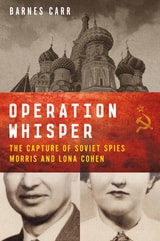
Operation Whisper
The Capture of Soviet Spies Morris and Lona CohenBarnes Carr
University Press of New England, 2016
Opioid Reckoning
Love, Loss, and Redemption in the Rehab StateAmy C. Sullivan
University of Minnesota Press, 2021
Examines the complexity and the humanity of the opioid epidemic
America’s opioid epidemic continues to ravage families and communities, despite intense media coverage, federal legislation, criminal prosecutions, and harm reduction efforts to prevent overdose deaths. More than 450,000 Americans have died from opioid overdoses since the late 1990s. In Opioid Reckoning, Amy C. Sullivan explores the complexity of the crisis through firsthand accounts of people grappling with the reverberating effects of stigma, treatment, and recovery.
Nearly everyone in the United States has been touched in some way by the opioid epidemic, including the author and her family. Sullivan uses her own story as a launching point to learn how the opioid epidemic challenged longstanding recovery protocols in Minnesota, a state internationally recognized for pioneering addiction treatment. By centering the voices of many people who have experienced opioid use, treatment, recovery, and loss, Sullivan exposes the devastating effects of a one-size-fits-all approach toward treatment of opioid dependency. Taking a clear-eyed, nonjudgmental perspective of every aspect of these issues—drug use, parenting, harm reduction, medication, abstinence, and stigma—Opioid Reckoning questions current treatment models, healthcare inequities, and the criminal justice system. Sullivan also imagines a future where anyone suffering an opioid-use disorder has access to the individualized care, without judgment, available to those with other health problems.
Opioid Reckoning presents a captivating look at how the state that invented “rehab” addresses the challenges of the opioid epidemic and its overdose deaths while also taking readers into the intimate lives of families, medical and social work professionals, grassroots activists, and many others impacted by the crisis who contribute their insights and potential solutions. In sharing these stories and chronicling their lessons, Sullivan offers a path forward that cultivates empathy, love, and hope for anyone affected by chaotic drug use and its harms.

Oppenheimer Is Watching Me
A MemoirJeff Porter
University of Iowa Press, 2007
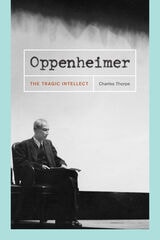
Oppenheimer
The Tragic IntellectCharles Thorpe
University of Chicago Press, 2007
Opposing Ambitions
Gender and Identity in an Alternative OrganizationSherryl Kleinman
University of Chicago Press, 1996
In Opposing Ambitions we meet the members of Renewal as individuals; learn about the differences in power, prestige, and respect they are accorded; why they talked endlessly about money; and how they related to each other. Kleinman shows how members' attempts to see themselves as unconventional, but also as serious operators of a legitimate health care organization, led them to act in ways that undermined their egalitarian goals. She draws out the lessons Renewal offers for understanding the problems women face in organizations, the failure of social movements to live up to their ideals, and how it is possible for progressives to avoid reproducing the inequalities they claim to oppose.

Opposing Poetries
Part One: Issues and InstitutionsHank Lazer
Northwestern University Press, 1996
Volume One examines the shift in the governing assumptions of contemporary poetic practice. Lazer inspects the key critical works addressing poetries in the 1980s and 1990s, as well as the political and aesthetic impact of modern critics, poetry reading programs, and of the publishing industry and libraries on contemporary poetic practice.
Opposing Poetries
Part Two: ReadingsHank Lazer
Northwestern University Press, 1996
In Volume Two, Lazer presents a series of sustained readings of important experimental texts. Included are the poets Susan Howe, Lyn Hejinian, Bruce Andrews, and James Sherry. Lazer places these poets in the context of contemporary literary theory, and inspects both the successes and failures of said theory to interpret these works.
Opposing the Second Corps at Antietam
The Fight for the Confederate Left and Center on America's Bloodiest DayMarion V. Armstrong, Jr.
University of Alabama Press, 2016
A definitive guide to the Confederate army’s primary engagements at the epic Battle of Antietam
With a tally of more than five thousand killed, twenty thousand wounded, and three thousand missing, the Battle of Antietam made September 17, 1862, the deadliest day of combat in American history. In Opposing the Second Corps at Antietam, Antietam scholar Marion V. Armstrong Jr. completes his magisterial study of Antietam begun in Unfurl Those Colors! by examining Robert E. Lee’s leadership at the climactic battle in the Confederate invasion of Union territory.
Eminent Civil War historians consider Antietam the turning point of the war. Hoping to maintain the initiative they had gained at the Second Battle of Bull Run, Confederate leaders looked to a stunning victory on Northern soil to sour Northern sentiment on the war as well as to coax European powers to recognize the fledgling Confederacy. Having examined McClellan’s command and role at Antietam in Unfurl Those Colors!, Armstrong now recounts in riveting detail Lee’s command decisions and their execution in the field, drawing on a superlative collection of first-person accounts by Confederate veterans to narrate the cataclysmic struggle between Lee and McClellan.
Armstrong sets the stage with a lively recap of the political and military events leading up to the early fall of 1862 and foreshadowing the conflagration to come on September 17. Each chapter then traces a critical section of the battle, the fight for the West Woods and the bloody engagement of the Sunken Road. Armstrong augments this collection with an exceptional set of maps, which will be valued by scholars, readers, and visitors to the battlefield. These unique maps delineate troop movements in intervals as brief as fifteen minutes, bringing to life the fluid, mutable lines that characterize the glory and horror of Antietam.
Either together with Unfurl Those Colors! or as a stand-alone account of the Confederate side of the battle, Opposing the Second Corps at Antietam provides the fullest possible understanding of the experience of Confederate soldiers at Antietam.
Opposition and Intimidation
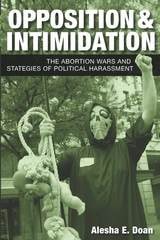
The Abortion Wars and Strategies of Political HarassmentAlesha E. Doan
University of Michigan Press, 2007
The abortion fight has long been a crucible of political tactics, with both sides employing strategies ranging from litigation to civil disobedience to outright violence. Anti-abortion activists have arguably been more tactically innovative than their pro-choice peers. Opposition and Intimidation looks at how their use of political harassment fits—or doesn't—with more conventional political efforts in the struggle over abortion.
Alesha Doan's insightful interviews and observations powerfully portray anti-abortion activists' relationship to the objects of their protest. Her portrait is augmented by thorough quantitative analysis of harassment's role within the movement's multitiered strategy—a strategy that Doan shows has forced a decline in the availability and popularity of abortions. Using her unique study of the anti-abortion movement as a model, Doan extends her findings to propose a novel and valuable theory of the new politics of harassment.
"An interesting and sophisticated account. Seamlessly weaves narrative and analysis, tying local action to national strategy. Explores uncharted territory in the abortion controversy and expands our understanding of political action."
—Deborah R. McFarlane, University of New Mexico
"For 40 years, abortion politics have been endlessly fascinating to American scholars and journalists alike because they generate unique political phenomena that challenge traditional theories of political behavior. In this book, Doan goes straight to the heart of the matter by describing, evaluating, and explaining one of the most characteristic and complex of these phenomena—political harassment. In a well-written narrative that weaves qualitative and quantitative data, she gives us the first scholarly look at this political tactic, whose relevance and use go well beyond American abortion politics."
—Chris Mooney, University of Illinois at Springfield
"The book contributes to political theory and knowledge by adding new empirical data gathered from interviews with those in the front lines of the struggle over abortion. The author refines and develops a category of unconventional political participation—political harassment of nongovernmental actors—and explains why it is particularly effective in undermining the rights of women seeking abortions, as well as the rights of abortion service providers."
—Nikki R. Van Hightower, Texas A&M University
Alesha E. Doan is Assistant Professor of Political Science at the University of Kansas.
Oppositional Consciousness
The Subjective Roots of Social ProtestEdited by Jane J. Mansbridge and Aldon Morris
University of Chicago Press, 2001
Each essay employs a recent historical case to demonstrate how oppositional consciousness actually worked in the experience of a subordinate group. Based on participant observation and interviews, chapters focus on the successful social movements of groups such as African Americans, people with disabilities, sexually harassed women, Chicano workers, and AIDS activists. Ultimately, Oppositional Consciousness sheds new light on the intricate mechanisms that drive the important social movements of our time.
Contributors: Naomi Braine, Sharon Groch, Fredrick C. Harris, Jane Mansbridge, Anna-Maria Marshall, Aldon Morris, Marc Simon Rodriguez, Brett C. Stockdill, Lori G. Waite
Optimism at All Costs
Black Attitudes, Activism, and Advancement in Obama's AmericaLessie B. Branch
University of Massachusetts Press, 2018
Lessie B. Branch confronts the tension between black Americans' economic realities and the hope many felt for the future, looking at survey data alongside the rhetoric of leading black figures, including President Obama. This disparity has caused a dangerous resistance to social activism, as discourses of optimism privilege individual success over the need for collective action. Branch sees the emergence of the Black Lives Matter movement as a constructive change in this dynamic. As Americans continue to grapple with complicated questions of race and progress in classrooms, in the media, and in legislatures, this short, provocative book will inform and enrich these important discussions.
Opting Out
Losing the Potential of America's Young Black EliteMaya A. Beasley
University of Chicago Press, 2011
Opting for Elsewhere
Lifestyle Migration in the American Middle ClassBrian A. Hoey
Vanderbilt University Press, 2014

Oracles of Empire
Poetry, Politics, and Commerce in British America, 1690-1750David S. Shields
University of Chicago Press, 1990
British America's poetry of empire was dominated by three issues: mercantilism's promise that civilization and wealth would be transmitted from London to the provinces; the debate over the extent of metropolitan prerogatives in law and commerce when they obtruded upon provincial rights and interests; and the argument that Britain's imperium pelagi was an ethical empire, because it depended upon the morality of trade, while the empires of Spain and France were immoral empires because they were grounded upon conquest. In discussing these issues, Shields provides a virtual anthology of poems long lost to students of American literature.
Oral Arguments and Coalition Formation on the U.S. Supreme Court
A Deliberate DialogueRyan C. Black, Timothy R. Johnson, and Justin Wedeking
University of Michigan Press, 2014
The U.S. Supreme Court, with its controlled, highly institutionalized decision-making practices, provides an ideal environment for studying coalition formation. The process begins during the oral argument stage, which provides the justices with their first opportunity to hear one another's attitudes and concerns specific to a case. This information gathering allows them eventually to form a coalition.
In order to uncover the workings of this process, the authors analyze oral argument transcripts from every case decided from 1998 through 2007 as well as the complete collection of notes kept during oral arguments by Justice Lewis F. Powell and Justice Harry A. Blackmun. Both justices clearly monitored their fellow justices' participation in the discussion and used their observations to craft opinions their colleagues would be likely to support. This study represents a major step forward in the understanding of coalition formation, which is a crucial aspect of many areas of political debate and decision making.
Oral History, Community, and Work in the American West
Edited by Jessie L. Embry
University of Arizona Press, 2013
In many cases occupations brought people together in myriad ways. The Latino workers who picked lemons together in Southern California report that it was baseball and Cinco de Mayo Queen contests that united them. Mormons in Fort Collins, Colorado, say that building a church together bonded them together. In separate essays, African Americans and women describe how they fostered a sense of community in Las Vegas. Native Americans detail the “Indian economy” in Northern California.
As these essays demonstrate, the history of the American West is the story of small towns and big cities, places both isolated and heavily populated. It includes groups whose history has often been neglected. Sometimes, western history has mirrored the history of the nation; at other times, it has diverged in unique ways. Oral history adds a dimension that has often been missing in writing a comprehensive history of the West. Here an array of oral historians—including folklorists, librarians, and public historians—record what they have learned from people who have, in their own ways, made history.
Oratorical Culture in Nineteenth-Century America
Transformations in the Theory and Practice of RhetoricGregory Clark and S. Michael Halloran
Southern Illinois University Press, 1993
Gregory Clark and S. Michael Halloran bring together nine essays that explore change in both the theory and the practice of rhetoric in the nineteenth-century United States.
In their introductory essay, Clark and Halloran argue that at the beginning of the nineteenth century, rhetoric encompassed a neoclassical oratorical culture in which speakers articulated common values to establish consensual moral authority that directed community thought and action. As the century progressed, however, moral authority shifted from the civic realm to the professional, thus expanding participation in the community as it fragmented the community itself. Clark and Halloran argue that this shift was a transformation in which rhetoric was reconceived to meet changing cultural needs.
Part I examines the theories and practices of rhetoric that dominated at the beginning of the century. The essays in this section include "Edward Everett and Neoclassical Oratory in Genteel America" by Ronald F. Reid, "The Oratorical Poetic of Timothy Dwight" by Gregory Clark, "The Sermon as Public Discourse: Austin Phelps and the Conservative Homiletic Tradition in Nineteenth-Century America" by Russel Hirst, and "A Rhetoric of Citizenship in Nineteenth-Century America" by P. Joy Rouse.
Part 2 examines rhetorical changes in the culture that developed during that century. The essays include "The Popularization of Nineteenth-Century Rhetoric: Elocution and the Private Learner" by Nan Johnson, "Rhetorical Power in the Victorian Parlor: Godey’s Lady’s Book and the Gendering of Nineteenth-Century Rhetoric" by Nicole Tonkovich, "Jane Addams and the Social Rhetoric of Democracy" by Catherine Peaden, "The Divergence of Purpose and Practice on the Chatauqua: Keith Vawter’s Self-Defense" by Frederick J.Antczak and Edith Siemers, and "The Rhetoric of Picturesque Scenery: A Nineteenth-Century Epideictic" by S. Michael Halloran.

Ordered West
The Civil War Exploits of Charles A. CurtisAlan D. Gaff
University of North Texas Press, 2017

Ordinary Abortion
Reproductive Choice in Twenty-First-Century Women’s WritingMary Thompson
The Ohio State University Press, 2026
The Supreme Court’s Dobbs v. Jackson (2022) decision, which erased the constitutional right to abortion, abruptly redramatized access in the United States. Yet twenty-first-century literature written before Dobbs reflects a landscape in which abortion appears as an undramatic, routine part of women’s lives. In Ordinary Abortion, Mary Thompson argues that many contemporary women writers depict abortion as a commonplace decision intertwined with health, education, career, sexuality, relationships, family-making, and motherhood.
Drawing on American poetry, fiction, nonfiction, memoir, and dystopian writing, Ordinary Abortion examines how ideas about abortion circulate through literature and how literary forms, in turn, shape readers’ understandings of reproduction and politics. Thompson traces new plots, characters, narrative strategies, and genres emerging around birth control, unplanned pregnancy, termination, and family formation. These works reveal renewed thematic attention to abortion’s relationship with motherhood and mother-loss, neoliberal pressures, stratified reproduction, masculinity, violence, care work, and disability.
Ultimately, Ordinary Abortion shows that abortion literature extends far beyond stories centered on crisis or choice. Instead, twenty-first-century women’s writing reveals a quiet, pervasive truth: Abortion has long been woven into everyday American life, normalized in ways that public discourse has often failed to acknowledge.

Ordinary Affects
Kathleen Stewart
Duke University Press, 2007
Stewart refrains from positing an overarching system—whether it’s called globalization or neoliberalism or capitalism—to describe the ways that economic, political, and social forces shape individual lives. Instead, she begins with the disparate, fragmented, and seemingly inconsequential experiences of everyday life to bring attention to the ordinary as an integral site of cultural politics. Ordinary affect, she insists, is registered in its particularities, yet it connects people and creates common experiences that shape public feeling. Through this anecdotal history—one that poetically ponders the extremes of the ordinary and portrays the dense network of social and personal connections that constitute a life—Stewart asserts the necessity of attending to the fleeting and changeable aspects of existence in order to recognize the complex personal and social dynamics of the political world.

Ordinary Injustice
Rascuache Lawyering and the Anatomy of a Criminal CaseAlfredo Mirandé
University of Arizona Press, 2023
Building from author Alfredo Mirandé’s earlier work Rascuache Lawyer, the account is told by “The Professor,” who led a pro bono rascuache legal defense team comprising the professor, a retired prosecutor, and student interns, working without a budget, office, paralegals, investigators, or support staff. The book is a must-read for anyone interested in race, gender, and criminal injustice and will appeal not only to law scholars and social scientists but to lay readers interested in ethnographic field research, Latinx communities, and racial disparities in the legal system.
The case is presented as a series of letters to the author’s fictional alter-ego, Fermina Gabriel, an accomplished lawyer and singer. This narrative device allows the author to present the case as it happens, relaying the challenges and complexities as they occur and drawing the reader in.
While Ordinary Injustice deals with important, complicated legal issues and questions that arise in criminal defense work and looks at the case from the time of Juan’s arrest to the preliminary hearing, indictment, pretrial motions, and attempts to obtain a negotiated plea, it is written in nontechnical and engaging language that makes law accessible to the lay reader.
Ordinary Lives
Platoon 1005 and the Vietnam WarW. Ehrhart
Temple University Press, 1999
Twenty-seven years after basic training. Ehrhart began what became a five-year search for the men of his platoon. Who were these men alongside whom he trained? Why had they joined the Marines at a time when being sent to war and of the country that sent them to fight it? What does the Corps mean to them? What Ehrhart learned offers an extraordinary window into the complexities of the Vietnam Generation and the United States of America then and now.
Based on supporting materials from military records and family members as well as interviews -- some of which Ehrhart held in such active secondary roles as dairy farmhand, fishing companion, and impromptu guest at a family wedding -- this book records the more-than-30-year journey that each man took after his boot-camp graduation on August 12, 1966. Photos of the men, both then and now, accompany the profiles. Their stories are diverse, but as Ehrhart says, "It was, in short, history, and each of these men was and is a part of that history....There are, no doubt, scoundrels and liars and losers among these men, but as a group they have mostly impressed me with their decency and their loyalty and their hard work and their perseverance in the face of hardships and hurdles, the everyday obstacles that make ordinary lives extraordinary."
Ordinary Lives
Recovering Deaf Social History through the American CensusEric C. Nystrom and R. A. R. Edwards
University of Massachusetts Press, 2024
The collective social history of deaf people in America has yet to be written. While scholars have focused their attention on residential schools for the deaf, leaders in the deaf community, and prominent graduates of these institutions, the lives of “ordinary” deaf individuals have been largely overlooked.
Employing the methods of social history, such as the use of digital history techniques and often-ignored sources like census records, Eric C. Nystrom and R. A. R. Edwards recover the lived experiences of everyday deaf people in late nineteenth century America. Ordinary Lives captures the stories of deaf women and men, both Black and white, describing their family lives, networks of support, educational experiences, and successes and hardships. In this pioneering “deaf social history,” Edwards and Nystrom reconstruct the biographies of a wider range of deaf individuals to tell a richer, more nuanced, and more inclusive history of the larger American deaf community.
Ordinary Meaning
A Theory of the Most Fundamental Principle of Legal InterpretationBrian G. Slocum
University of Chicago Press, 2015
Legal interpretation is built around one key question: by what standard should legal texts be interpreted? The traditional doctrine is that words should be given their “ordinary meaning”: words in legal texts should be interpreted in light of accepted standards of communication. Yet often, courts fail to properly consider context, refer to unsuitable dictionary definitions, or otherwise misconceive how the ordinary meaning of words should be determined. In this book, Brian Slocum builds his argument for a new method of interpretation by asking glaring, yet largely ignored, questions. What makes one particular meaning the “ordinary” one, and how exactly do courts conceptualize the elements of ordinary meaning? Ordinary Meaning provides a much-needed, revised framework, boldly instructing those involved with the law in how the components of ordinary meaning should properly be identified and developed in our modern legal system.

Ordinary Medicine
Extraordinary Treatments, Longer Lives, and Where to Draw the LineSharon R. Kaufman
Duke University Press, 2015

Ordinary Poverty
A Little Food and Cold StorageWilliam DiFazio
Temple University Press, 2005
In this trenchant and groundbreaking work, DiFazio presents the results of welfare reform—from ending entitlements to diminished welfare benefits—through the eyes and voices of those who were most directly affected by it. Ordinary Poverty concludes with a program to guarantee universal rights to a living wage as a crucial way to end poverty. Ultimately, DiFazio articulates the form a true poor people's movement would take—one that would link the interests of all social movements with the interests of ending poverty.
Ordinary Queerness in American Modernism
Jess Shollenberger
The Ohio State University Press, 2025

Ordinary Trauma
A MemoirJennifer Sinor
University of Utah Press, 2017
Finalist for the 15 Bytes Book Award for Creative Nonfiction
Interview with Tom Williams at Access Utah

Oregon Archaeology
Melvin C. Aikens
Oregon State University Press, 2011
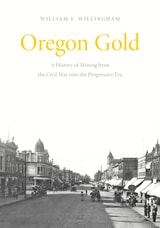
Oregon Gold
A History of Mining from the Civil War into the Progressive EraWilliam F. Willingham
Oregon State University Press, 2025
Following the discovery of gold in 1862 at Auburn and Canyon City, new communities and prospects were established in eastern Oregon. Just as the lure of free land attracted homesteaders and livestock raisers in search of new opportunities, so did the possibility of finding wealth in gold and silver throughout the region. Based on exhaustive research and a wealth of sources—federal census and mining records, newspapers, mining periodicals, county land records, maps, and federal government reports—Oregon Gold offers a comprehensive study of mining in Oregon between 1862 and 1910. From carefully examining the eastern portion of the state to exploring the economic expansion and political development of Portland, William Willingham highlights what is unique about the Oregon gold mining experience and places Oregon’s precious metal mining in the context of mining throughout the American West.
Willingham shows how mining was an important aspect of the state’s history, far greater than has been traditionally understood. He provides special attention and analysis to the role Chinese miners played in the story of eastern Oregon mining and to the demographic makeups of two major mining communities, Susanville and Granite, that thrived during the period. The attention to detail and thorough reporting in Oregon Gold will captivate both scholars and general readers interested in western mining and Oregon history during the nineteenth century.
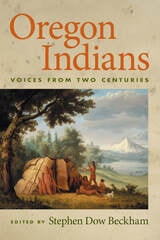
Oregon Indians
Voices from Two CenturiesStephen Dow Beckham
Oregon State University Press, 2006
In this deeply researched volume, Stephen Dow Beckham brings together commentary by Native Americans about the events affecting their lives in Oregon. Now available in paperback for the first time, this volume presents first-person accounts of events threatening, changing, and shaping the lives of Oregon Indians, from “first encounters” in the late eighteenth century to modern tribal economies.
The book's seven thematic sections are arranged chronologically and prefaced with introductory essays that provide the context of Indian relations with Euro-Americans and tightening federal policy. Each of the nearly seventy documents has a brief introduction that identifies the event and the speakers involved. Most of the book's selections are little known. Few have been previously published, including treaty council minutes, court and congressional testimonies, letters, and passages from travelers’ journals.
Oregon Indians opens with the arrival of Euro-Americans and their introduction of new technology, weapons, and diseases. The role of treaties, machinations of the Oregon volunteers, efforts of the US Army to protect the Indians but also subdue and confine them, and the emergence of reservation programs to “civilize” them are recorded in a variety of documents that illuminate nineteenth-century Indian experiences.
Twentieth-century documents include Tommy Thompson on the flooding of the Celilo Falls fishing grounds in 1942, as well as Indian voices challenging the "disastrous policy of termination," the state's prohibition on inter-racial marriage, and the final resting ground of Kennewick Man. Selections in the book's final section speak to the changing political atmosphere of the late twentieth century, and suggest that hope, rather than despair, became a possibility for Oregon tribes.

Oregon
There and Back in 1877Wallis Nash
Oregon State University Press, 1976

Ores to Metals
The Rocky Mountain Smelting IndustryJames E. Fell
University Press of Colorado, 2009
Although mining holds more of the glamour for those in and interested in the minerals industry, smelters have continuously played a critical role in the industry’s evolution since their introduction in Colorado in the 1860s. At that time, miners desperately needed new technology to recover gold and silver from ores resistant to milling. Beginning as small independent enterprises, progressing to larger integrated firms working in urban centers, and finally following a trend toward mergers, the entire industry was absorbed into one large holding company—the American Smelting and Refining Company. Over time, fortunes were won and lost, business success was converted to political success, and advances were made in science and metallurgy. Drawing on archival material, Fell expertly presents the triumphs and troubles of the entrepreneurs who built one of the great industries of the West.

Organ Transplantation Policy
James F. Blumstein and Frank A. Sloan, eds.
Duke University Press, 1989
A June 1988 symposium at Vanderbilt University gathered leaders in a wide variety of fields to synthesize the current state of knowledge concerning organ transplantation policy and to access policy options. Collected here are the revised papers presented at that symposium; also included is one influential earlier paper on the same topic. Together, they constitute a major contribution to the debate on organ transplantation policy and its moral, legal, financial, and political implications.

Organizational State
Social Choice: In National Policy DomainsEdward O. Laumann
University of Wisconsin Press, 1987
But this says nothing about politics. Professor Lauman and Knoke have asked, in this book, how policies were made, in the period 1977-1980, in the areas of energy and health. The question is a very different one from the question of how the positions of president and Congress are filled.
Organizations, Civil Society, and the Roots of Development
Edited by Naomi R. Lamoreaux and John Joseph Wallis
University of Chicago Press, 2017
The contributions to Organizations, Civil Society, and the Roots of Development seek to answer this question through an exploration of how developing nations throughout the eighteenth and nineteenth centuries, including the United States, United Kingdom, France, and Germany, made the transition to allowing their citizens the right to form organizations. The transition, contributors show, was not an easy one. Neither political changes brought about by revolution nor subsequent economic growth led directly to open access. In fact, initial patterns of change were in the opposite direction, as political coalitions restricted access to specific organizations for the purpose of maintaining political control. Ultimately, however, it became clear that these restrictions threatened the foundation of social and political order. Tracing the path of these modern civil societies, Organizations, Civil Society, and the Roots of Development is an invaluable contribution to all interested in today’s developing countries and the challenges they face in developing this organizational capacity.
Organize Your Library!
Developing the Collective Power of Library WorkersAngelo Moreno, Kelly McElroy, Meredith Kahn, and Emily Drabinski
American Library Association, 2025
Interest in unions and the real, day-to-day benefits they secure for employees is on the rise—including among library workers, who are beginning to realize that on their own they have little leverage. But with a union they have the power of numbers, and their working conditions are decided by a collectively negotiated agreement rather than by the malleable judgement of an individual administrator or library board. This handbook will equip readers with the knowledge, skills, and strategies necessary for organizing and maintaining a union at their library. Peppered throughout by illuminating stories from successful library union leaders and members, this book
- discusses why library workers need unions and explores some of the benefits that a collective bargaining agreement can assure, such as job security, increased salaries, codification of the rules for overtime pay and time off, and protection from harassment by patrons;
- explains why a contract won't limit employees' autonomy;
- walks readers through how to launch a union drive, including the basics of talking with co-workers, combating apathy and fear, and running a campaign;
- offers an overview of the steps involved in building a new union, from forming an organizing committee to getting recognition and setting up a governance structure;
- sketches out the key issues relating to contracts, the details of bargaining and negotiation, and arbitration;
- lays out approaches and strategies for dealing with supervisors and administrators in the context of your union work, including effective communication between labor and management, contract enforcement, and handling bad behavior such as unfair labor practices and retaliation;
- gives advice on pursuing changes in your workplace in a right-to-work state;
- explores the constructive roles that bosses can play to support the union efforts of the workers who organize them; and
- provides an Action Plan at the end of each chapter with suggested readings, questions for reflection, and activities designed to help deepen your knowledge, broaden your network, and practice important skills.
Organized Agriculture and the Labor Movement before the UFW
Puerto Rico, Hawai’i, CaliforniaBy Dionicio Nodín Valdés
University of Texas Press, 2011
Puerto Rico, Hawai'i, and California share the experiences of conquest and annexation to the United States in the nineteenth century and mass organizational struggles by rural workers in the twentieth. Organized Agriculture and the Labor Movement before the UFW offers a comparative examination of those struggles, which were the era's longest and most protracted campaigns by agricultural workers, supported by organized labor, to establish a collective presence and realize the fruits of democracy.
Dionicio Nodín Valdés examines critical links between the earlier conquests and the later organizing campaigns while he corrects a number of popular misconceptions about agriculture, farmworkers, and organized labor. He shows that agricultural workers have engaged in continuous efforts to gain a place in the institutional life of the nation, that unions succeeded before the United Farm Workers and César Chávez, and that the labor movement played a major role in those efforts. He also offers a window into understanding crucial limitations of institutional democracy in the United States, and demonstrates that the widespread lack of participation in the nation's institutions by agricultural workers has not been due to a lack of volition, but rather to employers' continuous efforts to prevent worker empowerment.
Organized Agriculture and the Labor Movement before the UFW demonstrates how employers benefitted not only from power and wealth, but also from imperialism in both its domestic and international manifestations. It also demonstrates how workers at times successfully overcame growers' advantages, although they were ultimately unable to sustain movements and gain a permanent institutional presence in Puerto Rico and California.
Organized Crime in Chicago
Beyond the MafiaRobert M. Lombardo
University of Illinois Press, 2013
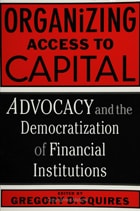
Organizing Access To Capital
Advocacy And The Democratizationedited by Gregory D. Squires
Temple University Press, 2003

Organizing Dixie
Alabama's Workers in the Industrial EraPhilip Taft
University of Alabama Press, 2007
"As befits a state in which coal, iron, and steel were the bulwarks of its industrial sector, Taft stresses that history of unionism among coal miners and iron and steel workers. Here we learn much about the experiences of the United Mine Workers of America and the Steel Workers Organizing Committee—United Steelworkers of America in the Deep South. Yet Taft does not neglect the history of other Alabama workers. Building tradesmen, railroad employees, textile millhands, and Gadsden’s rubber workers all appear in the pages of this book. Here we have the most complete and modern history of a state labor movement in the South written from the perspective of its institutional leaders." —American Historical Review
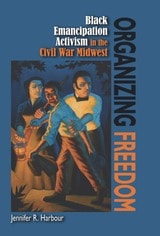
Organizing Freedom
Black Emancipation Activism in the Civil War MidwestJennifer R. Harbour
Southern Illinois University Press, 2020
Despite banning slavery, Illinois and Indiana share an antebellum history of severely restricting rights for free black people while protecting the rights of slaveholders. Nevertheless, as Harbour shows, black Americans settled there, and in a liminal space between legal slavery and true freedom, they focused on their main goals: creating institutions like churches, schools, and police watches; establishing citizenship rights; arguing against oppressive laws in public and in print; and, later, supporting their communities throughout the Civil War.
Harbour’s sophisticated gendered analysis features black women as being central to the seeking of emancipated freedom. Her distinct focus on what military service meant for the families of black Civil War soldiers elucidates how black women navigated life at home without a male breadwinner at the same time they began a new, public practice of emancipation activism. During the tumult of war, Midwestern black women negotiated relationships with local, state, and federal entities through the practices of philanthropy, mutual aid, religiosity, and refugee and soldier relief.
This story of free black people shows how the ideal of equality often competed against reality in an imperfect nation. As they worked through the sluggish, incremental process to achieve abolition and emancipation, Midwestern black activists created a unique regional identity.