Results by title
22277 books match the query 'Social Science' and 455 start with o

Open Wound
The Long View of Race in AmericaWilliam McKee Evans
University of Illinois Press, 2009
Open Your Hand
Teaching as a Jew, Teaching as an AmericanIlana M. Blumberg
Rutgers University Press, 2019
Open to Disruption
Time and Craft in the Practice of Slow SociologyAnita Ilta Garey
Vanderbilt University Press, 2014
Some researchers describe how disruptions prompted them to expand the boundaries of their discipline and invent concepts that could more accurately describe phenomena that previously had no name and no scholarly history. Sometimes scholars themselves caused the disruption as they circled back to work they had considered "done" and allowed the possibility of rethinking earlier findings.
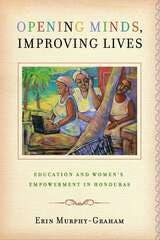
Opening Minds, Improving Lives
Education and Women's Empowerment in HondurasErin Murphy-Graham
Vanderbilt University Press, 2012
Empowering women through education has become a top priority of international development efforts. Erin MurphyGraham draws on more than a decade of qualitative research to examine the experiences of Juanita and eighteen other women who participated in the SAT program. Their narratives suggest the simple yet subtle ways education can spark the empowerment process, as well as the role of men and boys in promoting gender equality.
Drawing on indepth interviews and classroom observation in Honduras and Uganda, MurphyGraham shows the potential of the SAT program to empower women through expanded access and improved quality of secondary education in Latin America and Africa. An appendix provides samples of the classroom lessons.
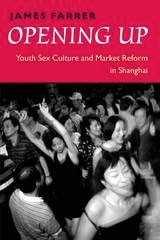
Opening Up
Youth Sex Culture and Market Reform in ShanghaiJames Farrer
University of Chicago Press, 2002
More and more men and women in China these days are having sex before marriage, creating a new youth sex culture based on romance, leisure, and free choice. The Chinese themselves describe these changes as an "opening up" in response to foreign influences and increased Westernization. Farrer explores these changes by tracing the basic elements in talk about sex and sexuality in Shanghai. He then shows how Chinese youth act out the sometimes-contradictory meanings of sex in the new market society. For Farrer, sexuality is a lens through which we can see how China imagines and understands itself in the wake of increased globalization. Through personal storytelling, neighborhood gossip, and games of seduction, young men and women in Shanghai balance pragmatism with romance, lust with love, and seriousness with play, collectively constructing and individually coping with a new culture based on market principles. With its provocative glimpse into the sex lives of young Chinese, then, Opening Up offers something even greater: a thoughtful consideration of China as it continues to develop into an economic superpower.
Opening Windows
Embracing New Perspectives and Practices in Natural Resource Social SciencesKate Sherren
Utah State University Press, 2024
This reflexive book is organized around four key themes: diversity and justice, governance and power, engagement and elicitation, and relationships and place. This is not a complacent volume—chapters point to gaps in conventional scholarship and to how much work remains to be done. Power is a central focus, including the role of cultural and economic power in “participatory” approaches to natural resource management and the biases encoded into the very concepts that guide scholarly and practical work. The chapters include robust literature syntheses, conceptual models, and case studies that provide examples of best practices and recommend research directions to improve and transform natural resource social sciences. An unmistakable spirit of hope is exemplified by findings suggesting positive roles for research in the progress ahead.
Bringing fresh perspectives on the assumptions and interests that underlie and entangle scholarship on natural resource decisionmaking and the justness of its outcomes, Opening Windows is significant for scholars, students, natural resource practitioners, managers and decision makers, and policy makers.

Opera and its Voices in Utah
Walter Rudolph
Utah State University Press, 2018
The Arrington Lecture series, established by one of the twentieth-century West's most distinguished historians, Leonard Arrington, has become a leading forum for prominent historians to address topics related to Mormon history. Utah State University hosts the Leonard J. Arrington Mormon History Lecture Series through the Merrill-Cazier Library Special Collections and Archives department.

Opera for Everyone
The Industry's Experiments with American Opera in the Digital AgeMegan Steigerwald Ille
University of Michigan Press, 2024

Opera, Sex and Other Vital Matters
Paul Robinson
University of Chicago Press, 2002
The essays on opera gathered here explore how masterpieces like Fidelio and The Magic Flute reflect the intellectual currents of their day. Be it the work of Verdi or Mozart, Wagner or Strauss, Robinson compels us to search for meaning not just in the lyrics of opera but also in the music. In melody, not libretto, we are more likely to discern key historical complexities and appreciate the way opera transcends language and time. The essays on sexuality, meanwhile, are ruminative, funny, and even moving. At one moment, Robinson measures whether homosexuality is the result of destiny or free choice. In another, he shares a touching exchange of letters with a gay student in the process of coming out. The final essays that encompass "other vital matters" find Robinson at his most incisive. Whether defending Freud as the most influential thinker of the twentieth century, attacking the dreaded use of semicolons, reflecting on his own mortality, or even meditating on the nature of cats, Sex, Opera, and Other Vital Matters is an eclectic work that will appeal to any reader interested in the continuing relevance of ideas to life.

Opera
The Undoing of WomenCatherine Clement
University of Minnesota Press, 1999
An incisive and impassioned examination of women’s treatment in opera.
Catherine Clément analyzes the plots of over thirty prominent operas-Otello and Siegfried to Madame Butterfly and The Magic Flute-through the lenses of feminism and literary theory to unveil the negative messages about women in stories familiar to every opera listener.
Operation Fly Trap
L. A. Gangs, Drugs, and the LawSusan A. Phillips
University of Chicago Press, 2012
In 2003, an FBI-led task force known as Operation Fly Trap attempted to dismantle a significant drug network in two Bloods-controlled, African American neighborhoods in Los Angeles. The operation would soon be considered an enormous success, noted for the precision with which the task force targeted and removed gang members otherwise entrenched in larger communities. In Operation Fly Trap, Susan A. Phillips questions both the success of this operation and the methods used to conduct it. Based on in-depth ethnographic research with Fly Trap participants, Phillips’s work brings together police narratives, crime statistics, gang cultural histories, and extensive public policy analysis to examine the relationship between state persecution and the genesis of violent social systems.
Crucial to Phillips’s contribution is the presentation of the voices and perspectives of both the people living in impoverished communities and the agents that police them. Phillips positions law enforcement surveillance and suppression as a critical point of contact between citizen and state. She tracks the bureaucratic workings of police and FBI agencies and the language, ideologies, and methods that prevail within them, and shows how gangs have adapted, seeking out new locations, learning to operate without hierarchies, and moving their activities more deeply underground. Additionally, she shows how the targeted efforts of task forces such as Fly Trap wreak sweeping, sustained damage on family members and the community at large. Balancing her roles as even-handed reporter and public scholar, Phillips presents multiple flaws within the US criminal justice system and builds a powerful argument that many law enforcement policies in fact nurture, rather than prevent, violence in American society.

Operation Mind
A Brief Documentary Account of the House Committee on Un-American Activities. And Why It Matters Now.Natalie Zemon Davis and Elizabeth Douvan
Disobedience Press, 2025
The 2025 reprint of Operation Mind offers a foreword by comparatist Silke-Maria Weineck, an essay by historian Alan Wald connecting Operation Mind’s history of McCarthyism with present-day attacks on academic freedom, and a new (2023) introduction to the text by Natalie Zemon Davis.

Operation Valhalla
Writings on War, Weapons, and MediaFriedrich Kittler. Edited and translated by Ilinca Iurascu, Geoffrey Winthrop-Young, and Michael Wutz
Duke University Press, 2021
Opioid Reckoning
Love, Loss, and Redemption in the Rehab StateAmy C. Sullivan
University of Minnesota Press, 2021
Examines the complexity and the humanity of the opioid epidemic
America’s opioid epidemic continues to ravage families and communities, despite intense media coverage, federal legislation, criminal prosecutions, and harm reduction efforts to prevent overdose deaths. More than 450,000 Americans have died from opioid overdoses since the late 1990s. In Opioid Reckoning, Amy C. Sullivan explores the complexity of the crisis through firsthand accounts of people grappling with the reverberating effects of stigma, treatment, and recovery.
Nearly everyone in the United States has been touched in some way by the opioid epidemic, including the author and her family. Sullivan uses her own story as a launching point to learn how the opioid epidemic challenged longstanding recovery protocols in Minnesota, a state internationally recognized for pioneering addiction treatment. By centering the voices of many people who have experienced opioid use, treatment, recovery, and loss, Sullivan exposes the devastating effects of a one-size-fits-all approach toward treatment of opioid dependency. Taking a clear-eyed, nonjudgmental perspective of every aspect of these issues—drug use, parenting, harm reduction, medication, abstinence, and stigma—Opioid Reckoning questions current treatment models, healthcare inequities, and the criminal justice system. Sullivan also imagines a future where anyone suffering an opioid-use disorder has access to the individualized care, without judgment, available to those with other health problems.
Opioid Reckoning presents a captivating look at how the state that invented “rehab” addresses the challenges of the opioid epidemic and its overdose deaths while also taking readers into the intimate lives of families, medical and social work professionals, grassroots activists, and many others impacted by the crisis who contribute their insights and potential solutions. In sharing these stories and chronicling their lessons, Sullivan offers a path forward that cultivates empathy, love, and hope for anyone affected by chaotic drug use and its harms.
Opium in the Balkans
Cultivation, Processing, and Trade during the Interwar PeriodVladan Jovanović
Central European University Press, 2025
Macedonian raw opium was a highly sought-after pharmaceutical raw material. This book focuses on its cultivation and production, and the trafficking of opium-based narcotics. Vladan Jovanović offers fresh insight into a neglected and marginalized subject, tracing and contextualizing both the licit and the illicit processing and trade of opium alkaloids from the Western Balkans through Turkey, and on to the rest of the world between the two World Wars.
His approach is to explore the subject both from the top down, involving the League of Nations and politicians and diplomats, as well as from the bottom up, through the analysis of the activities of smugglers, police, and ordinary people who participated in the production and distribution of opium. The author describes the process of relocating the illegal processing industry from Turkey and Bulgaria to Yugoslavia. He insightfully shows the implicit continuity of relations between the former Ottoman Empire and the newly constituted Yugoslav state in the form of bilateral political agreements.
He pays special attention to the illegal activities within the legal pharmaceutical industry and also exposes the role of criminal networks, which he situates in the appropriate political and social context. The exploration of this sensitive historical subject extends to other Balkan countries, along with Turkey, Western Europe, and the United States.
Opportunity Denied
Limiting Black Women to Devalued WorkBranch, Enobong
Rutgers University Press, 2011
Blacks and Whites. Men and Women. Historically, each group has held very different types of jobs. The divide between these jobs was stark—clean or dirty, steady or inconsistent, skilled or unskilled. In such a rigidly segregated occupational landscape, race and gender radically limited labor opportunities, relegating Black women to the least desirable jobs. Opportunity Denied is the first comprehensive look at changes in race, gender, and women’s work across time, comparing the labor force experiences of Black women to White women, Black men and White men. Enobong Hannah Branch merges empirical data with rich historical detail, offering an original overview of the evolution of Black women’s work.
From free Black women in 1860 to Black women in 2008, the experience of discrimination in seeking and keeping a job has been determinedly constant. Branch focuses on occupational segregation before 1970 and situates the findings of contemporary studies in a broad historical context, illustrating how inequality can grow and become entrenched over time through the institution of work.
Opposing Ambitions
Gender and Identity in an Alternative OrganizationSherryl Kleinman
University of Chicago Press, 1996
In Opposing Ambitions we meet the members of Renewal as individuals; learn about the differences in power, prestige, and respect they are accorded; why they talked endlessly about money; and how they related to each other. Kleinman shows how members' attempts to see themselves as unconventional, but also as serious operators of a legitimate health care organization, led them to act in ways that undermined their egalitarian goals. She draws out the lessons Renewal offers for understanding the problems women face in organizations, the failure of social movements to live up to their ideals, and how it is possible for progressives to avoid reproducing the inequalities they claim to oppose.
Opposition and Intimidation
The Abortion Wars and Strategies of Political HarassmentAlesha E. Doan
University of Michigan Press, 2007
The abortion fight has long been a crucible of political tactics, with both sides employing strategies ranging from litigation to civil disobedience to outright violence. Anti-abortion activists have arguably been more tactically innovative than their pro-choice peers. Opposition and Intimidation looks at how their use of political harassment fits—or doesn't—with more conventional political efforts in the struggle over abortion.
Alesha Doan's insightful interviews and observations powerfully portray anti-abortion activists' relationship to the objects of their protest. Her portrait is augmented by thorough quantitative analysis of harassment's role within the movement's multitiered strategy—a strategy that Doan shows has forced a decline in the availability and popularity of abortions. Using her unique study of the anti-abortion movement as a model, Doan extends her findings to propose a novel and valuable theory of the new politics of harassment.
"An interesting and sophisticated account. Seamlessly weaves narrative and analysis, tying local action to national strategy. Explores uncharted territory in the abortion controversy and expands our understanding of political action."
—Deborah R. McFarlane, University of New Mexico
"For 40 years, abortion politics have been endlessly fascinating to American scholars and journalists alike because they generate unique political phenomena that challenge traditional theories of political behavior. In this book, Doan goes straight to the heart of the matter by describing, evaluating, and explaining one of the most characteristic and complex of these phenomena—political harassment. In a well-written narrative that weaves qualitative and quantitative data, she gives us the first scholarly look at this political tactic, whose relevance and use go well beyond American abortion politics."
—Chris Mooney, University of Illinois at Springfield
"The book contributes to political theory and knowledge by adding new empirical data gathered from interviews with those in the front lines of the struggle over abortion. The author refines and develops a category of unconventional political participation—political harassment of nongovernmental actors—and explains why it is particularly effective in undermining the rights of women seeking abortions, as well as the rights of abortion service providers."
—Nikki R. Van Hightower, Texas A&M University
Alesha E. Doan is Assistant Professor of Political Science at the University of Kansas.

Opposition by Imitation
The Economics of Italian Anti-Mafia ActivismChristina Jerne
University of Minnesota Press, 2025
Defying the mafia with everyday acts of resistance
For more than 150 years, Italy has been home to a resilient and evolving resistance against the pervasive influence of mafias. While these criminal organizations are renowned for their vast international business enterprises, the collective actions taken to oppose them are less known. In Opposition by Imitation, Christina Jerne explores anti-mafia activism, revealing how ordinary people resist, counter, and prevent criminal economies from proliferating.
Drawing on ethnographic fieldwork among anti-mafia alliances in Campania, Sicily, and other parts of Italy, Jerne details a particular aspect of mafia activities: providing cash relief and other forms of patronage to individuals and groups. Her research shows how activism has evolved to imitate this sustaining role. Activists are increasingly challenging mafia control both by creating alternative economies—from producing food that interrupts mafia labor practices to organizing tourism that supports anti-mafia hospitality—and by subversively adopting business tactics similar to the mafia’s to compete with their social influence and legitimacy. Exposing the political implications of this mimetic opposition, Jerne points to its potential impact on crime prevention and criminalization, both in Italy and globally.
Opposition by Imitation shows how these modern-day Robin Hoods are redefining collective action, taking what was controlled by the mafias and returning it to the collective. This contentious economic turn, against the backdrop of broader social movements, reveals significant political possibilities afforded by imitative opposition.
Retail e-book files for this title are screen-reader friendly with images accompanied by short alt text and/or extended descriptions.
Opting Out
Losing the Potential of America's Young Black EliteMaya A. Beasley
University of Chicago Press, 2011
Opting Out
Women Messing with Marriage around the WorldJoanna Davidson
Rutgers University Press, 2023
Opting for Elsewhere
Lifestyle Migration in the American Middle ClassBrian A. Hoey
Vanderbilt University Press, 2014

Oral History and Delinquency
The Rhetoric of CriminologyJames Bennett
University of Chicago Press, 1981

Oral History of the Yavapai
Mike Harrison and John Williams; Edited by Sigrid Khera and Carolina C. Butler
University of Arizona Press, 2015
Although Harrison and Williams have since passed away, their voices shine through the pages of this book and the history of their people remains to be passed along and shared. Thanks to the efforts of Scottsdale, Arizona, resident and Orme Dam activist Carolina Butler, this important document is being made available to the public for the first time.
Oral History of the Yavapai offers a wide range of information regarding the Yavapai people, from creation beliefs to interpretations of historical events and people. Harrison and Williams not only relate their perspectives on the relationship between the “White people” and the Native American peoples of the Southwest, but they also share stories about prayers, songs, dreams, sacred places, and belief systems of the Yavapai.

Oral Literature, Gender, and Precedence in East Timor
Metaphysics in NarrativeDavid Hicks
National University of Singapore Press, 2020
Oral Patterns of Performance
Story and SongBarre Toelken
Utah State University Press, 2003
To many Native American cultures, songs and stories are dramatic enactments of reality, and words bring reality into existence. In this chapter from his award-winning book, The Anguish of Snails, Toelken thoughtfully approaches a number of stories from Native American traditions, discussing how narratives can be touchstones of shared values among closely associated traditional people and how songs and stories go far beyond an evening's entertainment or "lessons” about life. A traditional narrative can be a culturally structured way of thinking and of experiencing the patterns that make culture real.
Oral Tradition and the Internet
Pathways of the MindJohn Miles Foley
University of Illinois Press, 2012
challenging the default medium of the linear book and page and all that they entail, Oral Tradition and the Internet shows readers that there are large, complex, wholly viable, alternative
worlds of media-technology out there--if only they are willing to explore, to think outside the usual, culturally constructed categories. This "brick-and-mortar" book exists as an extension of
The Pathways Project (http://pathwaysproject.org), an open-access online suite of chapter-nodes, linked websites, and multimedia all dedicated to exploring and demonstrating the
dynamic relationship between oral tradition and Internet technology

Orange Parades
The Politics of Ritual, Tradition and ControlDominic Bryan
Pluto Press, 2000
Oratory in Native North America
William M. Clements
University of Arizona Press, 2002
Here is a rich documentation of oratory dating from the earliest records: Benjamin Franklin's publication of treaty proceedings with the Six Nations of the Iroquois; the travel narratives of John Lawson, who visited Carolina Indians in the early 1700s; accounts of Jesuit missionary Pierre De Smet, who evangelized to Northern Plains Indians in the nineteenth century; and much more. The book also includes full texts of several orations. These texts are comprehensive documents that report not only the contents of the speeches but the entirety of the delivery: the textures, situations, and contexts that constitute oratorical events. While there are valid concerns about the reliability of early recorded oratory given the prejudices of those recording them, Clements points out that we must learn what we can from that record.
He extends the thread unwoven in his earlier study Native American Verbal Art to show that the long history of textualization of American Indian oral performance offers much that can reward the reader willing to scrutinize the entirety of the texts. By focusing on this one genre of verbal art, he shows us ways in which the sources are—and are not—valuable and what we must do to ascertain their value. Oratory in Native North America is a panoramic work that introduces readers to a vast history of Native speech while recognizing the limitations in premodern reporting. By guiding us through this labyrinth, Clements shows that with understanding we can gain significant insight not only into Native American culture but also into a rich storehouse of language and performance art.
Orchards of Privilege
Water, Oranges, and Race in the Gamtoos Valley of South Africa, 1700–2023Robert Ross
Ohio University Press, 2025
This study of the Gamtoos River floodplain in South Africa’s Eastern Cape Province traces its transformation from an eighteenth-century natural landscape of thick bush into an agricultural zone now threatened by climate change. The first half of the book explains how missionaries from the London Missionary Society and residents of the Hankey Mission Station introduced irrigation, turning the area into a community of small-scale farmers. Despite early failures, by 1849 they had constructed South Africa’s first major irrigation tunnel and aqueduct. However, conflicts between the missionaries and residents led to the loss of communal lands to privatization, which ultimately impoverished the local farmers. The second half explores efforts to develop the valley for large-scale agriculture, addressing challenges like drought, flash floods, and saline water. By the mid-twentieth century, Afrikaners dominated the area, benefiting from the construction in 1970 of the Kouga Dam, which provided fresh water for the floodplain. This led to the rise of a wealthy white farming community, sustained by apartheid policies and labor from the “Coloured” and African populations. In the early twenty-first century, however, this prosperity has become threatened by severe droughts linked to global climate change. In view of these historical transformations, the Gamtoos River floodplain exemplifies the complex interplay between human ambition, environmental challenges, and sociopolitical forces.

Ordering Customs
Ethnographic Thought in Early Modern VeniceKathryn Taylor
University of Delaware Press, 2023

Ordinary Abortion
Reproductive Choice in Twenty-First-Century Women’s WritingMary Thompson
The Ohio State University Press, 2026
The Supreme Court’s Dobbs v. Jackson (2022) decision, which erased the constitutional right to abortion, abruptly redramatized access in the United States. Yet twenty-first-century literature written before Dobbs reflects a landscape in which abortion appears as an undramatic, routine part of women’s lives. In Ordinary Abortion, Mary Thompson argues that many contemporary women writers depict abortion as a commonplace decision intertwined with health, education, career, sexuality, relationships, family-making, and motherhood.
Drawing on American poetry, fiction, nonfiction, memoir, and dystopian writing, Ordinary Abortion examines how ideas about abortion circulate through literature and how literary forms, in turn, shape readers’ understandings of reproduction and politics. Thompson traces new plots, characters, narrative strategies, and genres emerging around birth control, unplanned pregnancy, termination, and family formation. These works reveal renewed thematic attention to abortion’s relationship with motherhood and mother-loss, neoliberal pressures, stratified reproduction, masculinity, violence, care work, and disability.
Ultimately, Ordinary Abortion shows that abortion literature extends far beyond stories centered on crisis or choice. Instead, twenty-first-century women’s writing reveals a quiet, pervasive truth: Abortion has long been woven into everyday American life, normalized in ways that public discourse has often failed to acknowledge.

Ordinary Affects
Kathleen Stewart
Duke University Press, 2007
Stewart refrains from positing an overarching system—whether it’s called globalization or neoliberalism or capitalism—to describe the ways that economic, political, and social forces shape individual lives. Instead, she begins with the disparate, fragmented, and seemingly inconsequential experiences of everyday life to bring attention to the ordinary as an integral site of cultural politics. Ordinary affect, she insists, is registered in its particularities, yet it connects people and creates common experiences that shape public feeling. Through this anecdotal history—one that poetically ponders the extremes of the ordinary and portrays the dense network of social and personal connections that constitute a life—Stewart asserts the necessity of attending to the fleeting and changeable aspects of existence in order to recognize the complex personal and social dynamics of the political world.

Ordinary Genomes
Science, Citizenship, and Genetic IdentitiesKaren-Sue Taussig
Duke University Press, 2009
Ordinary Injustice
Rascuache Lawyering and the Anatomy of a Criminal CaseAlfredo Mirandé
University of Arizona Press, 2023
Building from author Alfredo Mirandé’s earlier work Rascuache Lawyer, the account is told by “The Professor,” who led a pro bono rascuache legal defense team comprising the professor, a retired prosecutor, and student interns, working without a budget, office, paralegals, investigators, or support staff. The book is a must-read for anyone interested in race, gender, and criminal injustice and will appeal not only to law scholars and social scientists but to lay readers interested in ethnographic field research, Latinx communities, and racial disparities in the legal system.
The case is presented as a series of letters to the author’s fictional alter-ego, Fermina Gabriel, an accomplished lawyer and singer. This narrative device allows the author to present the case as it happens, relaying the challenges and complexities as they occur and drawing the reader in.
While Ordinary Injustice deals with important, complicated legal issues and questions that arise in criminal defense work and looks at the case from the time of Juan’s arrest to the preliminary hearing, indictment, pretrial motions, and attempts to obtain a negotiated plea, it is written in nontechnical and engaging language that makes law accessible to the lay reader.
Ordinary Lives
Recovering Deaf Social History through the American CensusEric C. Nystrom and R. A. R. Edwards
University of Massachusetts Press, 2024
The collective social history of deaf people in America has yet to be written. While scholars have focused their attention on residential schools for the deaf, leaders in the deaf community, and prominent graduates of these institutions, the lives of “ordinary” deaf individuals have been largely overlooked.
Employing the methods of social history, such as the use of digital history techniques and often-ignored sources like census records, Eric C. Nystrom and R. A. R. Edwards recover the lived experiences of everyday deaf people in late nineteenth century America. Ordinary Lives captures the stories of deaf women and men, both Black and white, describing their family lives, networks of support, educational experiences, and successes and hardships. In this pioneering “deaf social history,” Edwards and Nystrom reconstruct the biographies of a wider range of deaf individuals to tell a richer, more nuanced, and more inclusive history of the larger American deaf community.

Ordinary Poverty
A Little Food and Cold StorageWilliam DiFazio
Temple University Press, 2005
In this trenchant and groundbreaking work, DiFazio presents the results of welfare reform—from ending entitlements to diminished welfare benefits—through the eyes and voices of those who were most directly affected by it. Ordinary Poverty concludes with a program to guarantee universal rights to a living wage as a crucial way to end poverty. Ultimately, DiFazio articulates the form a true poor people's movement would take—one that would link the interests of all social movements with the interests of ending poverty.

Ordinary Reactions to Extraordinary Events
Edited by Ray B. Browne and Arthur B. Neal
University of Wisconsin Press, 2001

Ordinary and Extraordinary Harms in the City
A Green Criminological AnalysisKajsa Lundberg
Rutgers University Press, 2026
This book, based on original research in Melbourne, Australia, explores the spatial politics of urban expansion both upwards and outwards as the city continues to colonize non-urban areas around its fringes. The everyday decisions and tools bound up in urban growth accelerate a malign colonization of land, resources, air and water, thereby exacerbating a broad variety of social and environmental harms. In addition to the quotidian nature of urban growth, this book also explores the ‘crisis’ in the form of extreme fire events in urban areas. Moving between local planning and national and international climate change mitigation policies and approaches, this book highlights various 'necropolicies’ - policies causing harm and death to more-than-human populations. Such death-bound policies are the result of neoliberal urban development, fueled by state-corporate relations and prosperity concerns. In sum, this book connects green and urban criminology, urban studies and planning to reveal how ordinary and extraordinary challenges are entangled in urban design, harm and, most importantly, imagining alternative futures and cities.

Oregon Archaeology
Melvin C. Aikens
Oregon State University Press, 2011

Oregon Indians
Voices from Two CenturiesStephen Dow Beckham
Oregon State University Press, 2006
In this deeply researched volume, Stephen Dow Beckham brings together commentary by Native Americans about the events affecting their lives in Oregon. Now available in paperback for the first time, this volume presents first-person accounts of events threatening, changing, and shaping the lives of Oregon Indians, from “first encounters” in the late eighteenth century to modern tribal economies.
The book's seven thematic sections are arranged chronologically and prefaced with introductory essays that provide the context of Indian relations with Euro-Americans and tightening federal policy. Each of the nearly seventy documents has a brief introduction that identifies the event and the speakers involved. Most of the book's selections are little known. Few have been previously published, including treaty council minutes, court and congressional testimonies, letters, and passages from travelers’ journals.
Oregon Indians opens with the arrival of Euro-Americans and their introduction of new technology, weapons, and diseases. The role of treaties, machinations of the Oregon volunteers, efforts of the US Army to protect the Indians but also subdue and confine them, and the emergence of reservation programs to “civilize” them are recorded in a variety of documents that illuminate nineteenth-century Indian experiences.
Twentieth-century documents include Tommy Thompson on the flooding of the Celilo Falls fishing grounds in 1942, as well as Indian voices challenging the "disastrous policy of termination," the state's prohibition on inter-racial marriage, and the final resting ground of Kennewick Man. Selections in the book's final section speak to the changing political atmosphere of the late twentieth century, and suggest that hope, rather than despair, became a possibility for Oregon tribes.

Organic Coffee
Sustainable Development by Mayan FarmersMaria Elena Martinez-Torres
Ohio University Press, 2006
Maria Elena Martinez-Torres explains how Mayan farmers have built upon their ethnic networks to make a crucial change in their approach to agriculture. Taking us inside Chiapas, Mexico's poorest state and scene of the 1994 Zapatista uprising, she examines the anatomy of the ongoing organic coffee boom and the fair-trade movement. The organic coffee boom arose as very poor farmers formed cooperatives, revalued their ethnic identity, and improved their land through organic farming. The result has been significant economic benefits for their families and ecological benefits for the future sustainability of agriculture in the region.
Organic Coffee refutes the myth that organic farming is less productive than chemical-based agriculture and gives us reasons to be hopeful for indigenous peoples and peasant farmers
Organisational Anthropology
Doing Ethnography in and Among Complex OrganisationsEdited by Christina Garsten and Anette Nyqvist
Pluto Press, 2013
Organisational Anthropology, newly published in paperback, is a pioneering analysis of doing ethnographic fieldwork in different types of complex organisations. The book focuses on the process of initiating contact, establishing rapport and gaining the trust of the organisation's members.
The contributors work from the premise that doing fieldwork in an organisation shares essential characteristics with fieldwork in more ‘classical’ anthropological environments, but that it also poses some particular challenges to the ethnographer. These include the ideological or financial interests of the organisations, protection of resources and competition between organisations.
Organisational Anthropology brings together and highlights crucial aspects of doing anthropology in contemporary complex settings, and will have wide appeal to students, researchers and academics in anthropology and organisation studies.

Organised Crime and Migration
Criminal Groups, Corruption and the Displacement Crisis in Central America and MexicoVictorie Knox
University of London Press, 2026
Organized criminal groups have been involved in the abuse of migrants and people-smuggling in Mexico for many years. A displacement crisis has emerged as people with different potential protection needs flee a complex mix of factors in Central America, from violence and threats from criminal gangs, persecution by state actors, gender violence, and hate crime to the impact of climate change, natural disasters, and entrenched inequality and poverty.
Drawing on original interview material with key informants speaking in their professional capacity and with migrants and refugees during their journey, the book analyzes organized crime’s role in provoking human displacement and the abuse of migrants, reflecting on state responsibility, the role of policy, corruption, and impunity in perpetuating abuse, and the implications for human rights. In doing so, it provides a new understanding of the likely consequences of implementing or externalizing migration policy in regions affected by endemic criminal violence and corruption globally.

Organizational State
Social Choice: In National Policy DomainsEdward O. Laumann
University of Wisconsin Press, 1987
But this says nothing about politics. Professor Lauman and Knoke have asked, in this book, how policies were made, in the period 1977-1980, in the areas of energy and health. The question is a very different one from the question of how the positions of president and Congress are filled.
Organize
Timon Beyes
University of Minnesota Press, 2019
A pioneering systematic inquiry into—and mapping of—the field of media and organization
Media organize things into patterns and relations. As intermediaries among people and between people and worlds, media shape sociotechnical orders. At the same time, media are organized: while they condition different organizational forms and processes, they, too, are formed and can be re-formed. This intimate relation of media and organizing is timeless. Yet arguably, digital media technologies repose the question of organization—and thus of power and domination, control and surveillance, disruption and emancipation. Bringing together leading media thinkers and organization theorists, this book interrogates organization as an effect and condition of media. How can we understand the recursive relation between media and organization? How can we think, explore, critique, and perhaps alter the organizational bodies and scripts that shape contemporary life?
Organize will be of interest to scholars and students of new and old media, social organization, and technology. Moreover, the dialogical form of these essays provides a concise and path-breaking view on the recursive relation between technological media and social organization. The book therefore establishes and maps “media and organization” as a highly relevant field of inquiry, appealing to those with a critical interest in the technological conditioning of the social.
Organized Agriculture and the Labor Movement before the UFW
Puerto Rico, Hawai’i, CaliforniaBy Dionicio Nodín Valdés
University of Texas Press, 2011
Puerto Rico, Hawai'i, and California share the experiences of conquest and annexation to the United States in the nineteenth century and mass organizational struggles by rural workers in the twentieth. Organized Agriculture and the Labor Movement before the UFW offers a comparative examination of those struggles, which were the era's longest and most protracted campaigns by agricultural workers, supported by organized labor, to establish a collective presence and realize the fruits of democracy.
Dionicio Nodín Valdés examines critical links between the earlier conquests and the later organizing campaigns while he corrects a number of popular misconceptions about agriculture, farmworkers, and organized labor. He shows that agricultural workers have engaged in continuous efforts to gain a place in the institutional life of the nation, that unions succeeded before the United Farm Workers and César Chávez, and that the labor movement played a major role in those efforts. He also offers a window into understanding crucial limitations of institutional democracy in the United States, and demonstrates that the widespread lack of participation in the nation's institutions by agricultural workers has not been due to a lack of volition, but rather to employers' continuous efforts to prevent worker empowerment.
Organized Agriculture and the Labor Movement before the UFW demonstrates how employers benefitted not only from power and wealth, but also from imperialism in both its domestic and international manifestations. It also demonstrates how workers at times successfully overcame growers' advantages, although they were ultimately unable to sustain movements and gain a permanent institutional presence in Puerto Rico and California.
Organized Crime in Chicago
Beyond the MafiaRobert M. Lombardo
University of Illinois Press, 2013
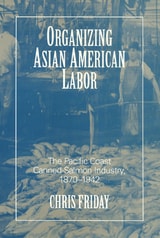
Organizing Asian-American Labor
The Pacific Coast Canned-Salmon Industry, 1870-1942Chris Friday
Temple University Press, 1995
Between 1870 and 1942, successive generations of Asians and Asian Americans—predominantly Chinese, Japanese, and Filipino—formed the predominant body of workers in the Pacific Coast canned-salmon industry.
This study traces the shifts in the ethnic and gender composition of the cannery labor market from its origins through it decline and examines the workers' creation of work cultures and social communities. Resisting the label of cheap laborer, these Asian American workers established formal and informal codes of workplace behavior, negotiated with contractors and recruiters, and formed alliances to organize the workforce.
Whether he is discussing Japanese women workers' sharing of child-care responsibilities or the role of Filipino workers in establishing the Cannery and Field Workers Union, Chris Friday portrays Asian and Asian American workers as people who, while enduring oppressive restrictions, continually attempted to shape their own lives.
In the series Asian American History and Culture, edited by Sucheng Chan, David Palumbo-Liu, Michael Omi, K. Scott Wong, and Linda Trinh Võ.
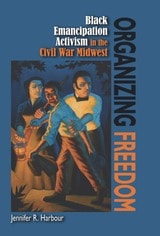
Organizing Freedom
Black Emancipation Activism in the Civil War MidwestJennifer R. Harbour
Southern Illinois University Press, 2020
Despite banning slavery, Illinois and Indiana share an antebellum history of severely restricting rights for free black people while protecting the rights of slaveholders. Nevertheless, as Harbour shows, black Americans settled there, and in a liminal space between legal slavery and true freedom, they focused on their main goals: creating institutions like churches, schools, and police watches; establishing citizenship rights; arguing against oppressive laws in public and in print; and, later, supporting their communities throughout the Civil War.
Harbour’s sophisticated gendered analysis features black women as being central to the seeking of emancipated freedom. Her distinct focus on what military service meant for the families of black Civil War soldiers elucidates how black women navigated life at home without a male breadwinner at the same time they began a new, public practice of emancipation activism. During the tumult of war, Midwestern black women negotiated relationships with local, state, and federal entities through the practices of philanthropy, mutual aid, religiosity, and refugee and soldier relief.
This story of free black people shows how the ideal of equality often competed against reality in an imperfect nation. As they worked through the sluggish, incremental process to achieve abolition and emancipation, Midwestern black activists created a unique regional identity.