Results by title
3258 books match the query 'Art' and 209 start with p
POG vol 3 num 1
The University of Chicago Press
University of Chicago Press Journals, 2020

PUNK! Las Américas Edition
Edited by Olga Rodríguez-Ulloa, Rodrigo Quijano, and Shane Greene
Intellect Books, 2022
This book interrogates the dominant vision of punk—particularly its white masculine protagonists and deep Anglocentrism—by analyzing punk as a critical lens into the disputed territories of “America,” a term that hides the heterogeneous struggles, global histories, hopes, and despairs of late twentieth- and early twenty-first-century experience. Compiling academic essays and punk paraphernalia (including interviews, zines, poetry, and visual segments) into a single volume, the book explores punk life through its multiple registers: vivid musical dialogues, excessive visual displays, and underground literary expression.
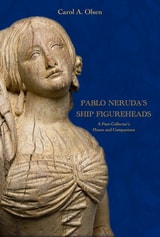
Pablo Neruda's Ship Figureheads
A Poet-Collector's Muses and CompanionsCarol A. Olsen, Foreword by Fernando Sáez Garcia
University of Alabama Press, 2025
Unlock the stories of Pablo Neruda’s rare nineteenth-century carved-wood ship figurehead collection in Chile, why they mattered in his tumultuous life, and how we benefit from them now.
Poet Pablo Neruda’s nineteenth-century ship figurehead collection in Chile is one of the most significant in the world. Containing carved wood images of dramatically postured men and women, these figures are now better understood due to years of research, a willingness to challenge Neruda’s ever-changing stories about them, and a realization that the names Neruda chose for his figureheads perhaps had more to do with his life than theirs. The rhythm and beauty of Neruda’s worn wood figures is counterpoint to his own tumultuous life as an author, politician, and communist dissident.
Collecting ship figureheads was central to Neruda’s passion for owning things made of wood, a material he said was his best friend, and for standing out among others as he gradually built the public persona that helped move him toward winning the Nobel Prize in Literature. With his choir of immobilized figureheads stationed upright in his living room and facing the Pacific Ocean, Neruda was surrounded by dramatic images from the sea that ignited his most powerful feelings.
The nineteenth century saw figureheads on the bows of ships of sail and steam, yet when a figurehead was lost or removed, its history soon disappeared. The significant ship figureheads that Neruda avidly collected preserve that history and reveal new dimensions concerning his life and work. Each year, his collection is viewed by thousands of visitors to the Pablo Neruda Foundation’s house museum at Isla Negra.
Paint and Canvas
A Life of T. C. SteeleRachel Berenson Perry
Indiana Historical Society Press, 2011
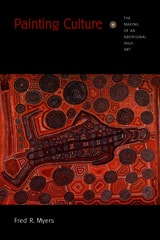
Painting Culture
The Making of an Aboriginal High ArtFred R. Myers
Duke University Press, 2002
Painting Culture describes in detail the actual practice of painting, insisting that such a focus is necessary to engage directly with the role of the art in the lives of contemporary Aboriginals. The book includes a unique local art history, a study of the complete corpus of two painters over a two-year period. It also explores the awkward local issues around the valuation and sale of the acrylic paintings, traces the shifting approaches of the Australian government and key organizations such as the Aboriginal Arts Board to the promotion of the work, and describes the early and subsequent phases of the works’ inclusion in major Australian and international exhibitions. Myers provides an account of some of the events related to these exhibits, most notably the Asia Society’s 1988 "Dreamings" show in New York, which was so pivotal in bringing the work to North American notice. He also traces the approaches and concerns of dealers, ranging from semi-tourist outlets in Alice Springs to more prestigious venues in Sydney and Melbourne.
With its innovative approach to the transnational circulation of culture, this book will appeal to art historians, as well as those in cultural anthropology, cultural studies, museum studies, and performance studies.
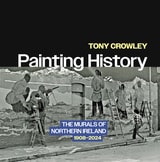
Painting History
The Murals of Northern Ireland, 1908–2024Tony Crowley
Amherst College Press, 2025
In Painting History, Tony Crowley provides a detailed analysis of the complex tradition of muralism in the context of the history that produced it, with particular attention given to the cultural politics of this remarkable form. The book also raises and discusses a series of theoretical questions about murals and muralism that transcend Northern Ireland: issues of propriety and legality, form and content, authority and censorship. The work ends with a consideration of the future of the murals in a still polarized but changing region.
Painting Paranoia
Cold War Art and Anti-CommunismJulia Tatiana Bailey
University of Illinois Press, 2026
Based on extensive archival research conducted in the United States and Russia, this manuscript contributes to the political history of twentieth-century American art and the revisionist history of cultural diplomacy in the Cold War by charting the politicization of myths of Soviet art. It reveals how those with control over the reception of art in the United States built and sustained a strategy of othering towards Socialist Realism, presents the rhetoric of Soviet artistic otherness in the context of debates surrounding the concept of American art, and reclaims the post-war history of American Social Realism.
Painting Publics
Transnational Legal Graffiti Scenes as Spaces for EncounterCaitlin Frances Bruce
Temple University Press, 2019
Public art is a form of communication that enables spaces for encounters across difference. These encounters may be routine, repeated, or rare, but all take place in urban spaces infused with emotion, creativity, and experimentation. In Painting Publics, Caitlin Bruce explores how various legal graffiti scenes across the United States, Mexico, and Europe provide diverse ways for artists to navigate their changing relationships with publics, institutions, and commercial entities.
Painting Publics draws on a combination of interviews with more than 100 graffiti writers as well as participant observation, and uses critical and rhetorical theory to argue that graffiti should be seen as more than counter-cultural resistance. Bruce claims it offers resources for imagining a more democratic city, one that builds and grows from personal relations, abandoned or under-used spaces, commercial sponsorship, and tacit community resources. In the case of Mexico, Germany, and France, there is even some state support for the production and maintenance of civic education through visual culture.
In her examination of graffiti culture and its spaces of inscription, Bruce allows us to see moments where practitioners actively reckon with possibility.
Painting Texas History to 1900
By Sam D. Ratcliffe
University of Texas Press, 1992
Certificate of Commendation, American Association for State and Local History, 1994
T. R. Fehrenbach Book Award, Texas Historical Commission, 1992
San Antonio Conservation Society Citation, 1993
Dramatic historical events have frequently provided subject matter for artists, particularly in pre-twentieth-century Texas, where works portraying historical, often legendary, events and individuals predominated. Until now, however, these paintings of Texas history have never received the kind of study given to historical, fictional, and film versions of the same events. Painting Texas History to 1900 fills this gap with an interdisciplinary approach that explores these paintings both as works of art and as historical documents.
The author examines the works of more than forty artists, including Henry McArdle, Theodore Gentilz, Robert Onderdonk, William Huddle, Frederic Remington, Friedrich Richard Petri, Arthur T. Lee, Seth Eastman, Sarah Hardinge, Frank Reaugh, W. G. M. Samuel, Carl G. von Iwonski, and Julius Stockfleth. He places each work within its historical and cultural context to show why such subject matter was chosen, why it was depicted in a particular way, and why such a depiction gained popular acceptance. For example, paintings of heroic events of the Texas Revolution were especially popular in the years following the Civil War, when, in Ratcliffe's view, Texans needed such images to assuage the loss of the war and the humiliation of Reconstruction.
Though the paintings cut across traditional art history categories—from the pictographs of early historic Indians to European-inspired oil paintings—they are bound together by their artists' intent for them to function as historically evocative documents. With their visual narratives of events that characterized all of America's westward expansion—Indian encounters, military battles, farming, ranching, surveying, and the closing of the frontier—these works add an important chapter to the story of the American West.
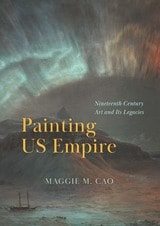
Painting US Empire
Nineteenth-Century Art and Its LegaciesMaggie M. Cao
University of Chicago Press, 2024
Painting US Empire is the first book to offer a synthetic account of art and US imperialism around the globe in the nineteenth century. In this work, art historian Maggie M. Cao crafts a nuanced portrait of nineteenth-century US painters’ complicity with and resistance to ascendant US imperialism, offering eye-opening readings of canonical works, landscapes of polar expeditions and tropical tourism, still lifes of imported goods, genre paintings, and ethnographic portraiture. Revealing how the US empire was “hidden in plain sight” in the art of this period, Cao examines artists including Frederic Edwin Church and Winslow Homer who championed and expressed ambivalence toward the colonial project. She also tackles the legacy of US imperialism, examining Euro-American painters of the past alongside global artists of the present. Pairing each chapter with reflections on works by contemporary anticolonial artists including Tavares Strachan, Nicholas Galanin, and Yuki Kihara, Cao addresses important contemporary questions around representation, colonialism, and indigeneity. This book foregrounds an underacknowledged topic in the study of nineteenth-century US art and illuminates the ongoing ecological and economic effects of the US empire.
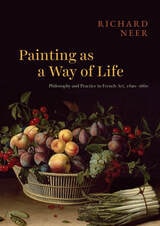
Painting as a Way of Life
Philosophy and Practice in French Art, 1620–1660Richard Neer
University of Chicago Press, 2025
In this wide-ranging study, Richard Neer shows how French painters of the seventeenth century developed radically new ways to connect art, perception, and ethics. Cutting across traditional boundaries of classicism and realism, Neer addresses four case studies: Nicolas Poussin, renowned for marrying ancient philosophy and narrative painting; Louise Moillon, who pioneered French still life in the 1630s; Georges de La Tour, a painter of intense and introspective nocturnes; and the Brothers Le Nain, specialists in genre and portraiture who inspired Courbet, Manet, and other painters of modern life. Setting these artists in dialogue with Montaigne, Descartes, Pascal, and others, ranging from the studios of Rome to the streets of Paris, this book provides fresh accounts of essential artworks—some well-known, others neglected—and new ways to approach the relation of art, theory, and daily life.
Painting in Excess
Kyiv's Art Revival, 1985-1993Olena Martynyuk
Rutgers University Press, 2022
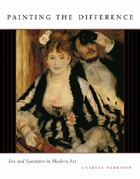
Painting the Difference
Sex and Spectator in Modern ArtCharles Harrison
University of Chicago Press, 2005
Arguing that the representation of women in art was crucial to the character of modernity, Harrison traces the history of female subjects as they began to gaze out of the picture to confront and engage their viewers. Combining sweeping conceptual history with telling investigations into the details of particular paintings, Painting the Difference deciphers the implications of sexual difference for the development of nineteenth- and twentieth-century art. Harrison shows how artists, reflecting the underlying anxieties of the time about gender, used female subjects' gazes both to create a sexualized relationship between these subjects and their viewers, and to simultaneously question that relationship. In considering works by artists such as Renoir, Manet, Degas, Cézanne, Picasso, and Matisse, as well as Rothko, Warhol, Cindy Sherman, and many more, Harrison incorporates elements of cultural criticism and social history into his arguments, and generous color illustrations permit the reader to test Harrison's claims against the works on which they are based. Rich with detail and compelling analysis, Painting the Difference offers cutting-edge interpretation grounded in the reality of magnificent works of art.
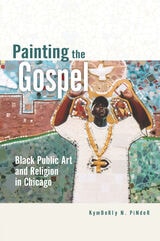
Painting the Gospel
Black Public Art and Religion in ChicagoKymberly Pinder
University of Illinois Press, 2016
Painting the Gospel includes maps and tour itineraries that allow readers to make conceptual, historical, and geographical connections among the works.

Painting the Maya Universe
Royal Ceramics of the Classic PeriodDorie Reents-Budet
Duke University Press, 1994
Painting the Maya Universe is the first publication to present a definitive translation of the hieroglyphic texts painted on these objects. With many glyphs deciphered here for the first time, this analysis reveals much about how these vessels were perceived and used by the Maya, their owners’ names, and, in several cases, the names of the artists who created them. This information is combined with archaeological and other data, including nuclear chemical analyses, to correlate painting styles with specific Maya sites.
Published in conjunction with Duke University Museum of Art and an exhibition touring the United States, Painting the Maya Universe presents an astonishing visual record as well as a monumental scholarly achievement. With photographs by Justin Kerr, the foremost photographer of pre-Columbian art, it includes over 90 unique full-color rollout photographs, each showing the entire surface of an object in a single frame. The book also addresses the questions and controversy regarding the loss of information that occurs when objects are removed from their archaeological context to become part of public and private collections.
Painting the Maya Universe will energize discussion of Maya pottery, hieroglyphic texts, and iconography. Its photographs, a lasting resource on this great painting tradition, will stimulate and delight the eye. It is a breakthrough in art history and Latin American scholarship that will enrich general readers and scholars alike.
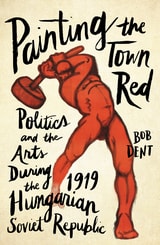
Painting the Town Red
Politics and the Arts During the 1919 Hungarian Soviet RepublicBob Dent
Pluto Press, 2018
Painting, History and Meaning
Sites of TimeCraig Staff
Intellect Books, 2020
This compelling new study considers contemporary painting’s relationship with time and with events, ideas, and paintings from the past. Following French philosopher Jean-François Lyotard’s determination of painting as entailing a series of temporal sites, Painting, History and Meaning examines works that tendentiously engage with aspects and events derived from the past. Craig Staff explores art that has encompassed strategies of excavation, anachronism, and memorialization, examining key works by artists including Dana Schutz, Tomma Abts, Gerhard Richter, Marlene Dumas, Johannes Phokela, and Taus Makhacheva. A scholarly examination of contemporary painting through an innovative interdisciplinary research methodology, this fascinating study illuminates the complex relationship between art and history.

Paintings from Mughal India
Andrew Topsfield
Bodleian Library Publishing, 2008
One of the great kingdoms of human history, the Mughal empire is now lost to the relentless sweep of time. But the wealth of art treasures the Mughals left behind is nonetheless a lasting testament to the sumptuousness of their culture. Among the most notable vestiges of their art are the lush miniature paintings of Mughal imperial life, and Andrew Topsfield explores a rich array of these painted works in Paintings from Mughal India.
Between the sixteenth and eighteenth centuries, the Mughal emperors presided over a flourishing cultural renaissance, and these miniature paintings vividly depict the splendor of this period. Topsfield examines the paintings’ unique blend of Indian, Islamic, and Persian styles and analyzes their varied subjects—ranging from hunting, royal banquets, and other scenes of imperial life to legendary tales, mythic deities, and battles. Among the paintings featured in the book’s vibrant reproductions are works created between the reign of Akbar and the fall of Shah Jehanan—an era considered to be the height of Mughal painting—and illustrations from the celebrated Baharistan manuscript of 1595. A fascinating and gorgeously illustrated study, Paintings from Mughal India will be an invaluable resource for all art scholars and anyone interested in the legacy of the Mughal Empire.
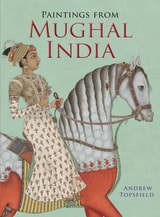
Paintings from Mughal India
Andrew Topsfield
Bodleian Library Publishing, 2008
Andrew Topsfield examines these paintings that bear the influence of Indian, Islamic, and Persian styles and portray a variety of subjects, from hunting, royal banquets, and other scenes of imperial life to legends, battles, and mythic deities. Among the paintings featured in the book’s vibrant reproductions are illustrations from the celebrated Baharistan manuscript of 1595 and works created between the reign of Akbar and the fall of Shah Jahan in 1658—an era considered to be the height of Mughal art. For this new edition, Topsfield has made corrections and revisions reflecting new research.
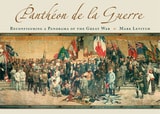
Panthéon De La Guerre
Reconfiguring a Panorama of the Great WarMark Levitch
University of Missouri Press, 2006
Paper and Light
Luminous DrawingsJulian Brooks
J. Paul Getty Trust, The, 2024
The treatment of light and shadow is one of the building blocks of drawing. From techniques such as highlights and reserves, to material selection and the creation of translucent tracing paper, to the use of light as a medium for viewing artworks, artists for hundreds of years have found innovative and dazzling ways to create light on a sheet of paper.
This publication examines the central relationship between paper and light in the world of drawings in western European art from the Renaissance to the twentieth century. Focusing on drawings from the collection of the J. Paul Getty Museum, as well as works from the British Museum, Musée du Louvre, and others, and featuring masterful works by such artists as Parmigianino, Leonardo da Vinci, Nicolas Poussin, Odilon Redon, Edgar Degas, and Georges Seurat, Paper and Light will entice readers to look longer and more closely at drawings, deriving an even deeper appreciation for the skill and labor that went into them.
This volume is published to accompany an exhibition on view at the J. Paul Getty Museum at the Getty Center from October 15, 2024, to January 19, 2025.
Para-Sites
A Casebook against Cynical ReasonEdited by George E. Marcus
University of Chicago Press, 2000
These cases challenge the condition of cynicism that has been the favored mode of characterizing the mind-set of intellectuals and professionals, comfortable in their lives of middle-class consumption and work. In their effort to establish para-sites of critical awareness parallel to the levels of political and economic power at which they function, these subjects suggest that those who lead ordinary lives of modest power and privilege might not be parasites in relation to the systems they serve, but may be creating unique and independent critical perspectives.
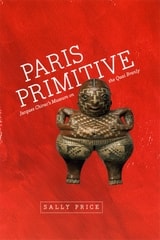
Paris Primitive
Jacques Chirac's Museum on the Quai BranlySally Price
University of Chicago Press, 2007
Paris Primitive recounts the massive reconfiguration of Paris’s museum world that resulted from Chirac’s dream, set against a backdrop of personal and national politics, intellectual life, and the role of culture in French society. Along with exposing the machinations that led to the MQB’s creation, Sally Price addresses the thorny questions it raises about the legacy of colonialism, the balance between aesthetic judgments and ethnographic context, and the role of institutions of art and culture in an increasingly diverse France. Anyone with a stake in the myriad political, cultural, and anthropological issues raised by the MQB will find Price’s account fascinating.
Paris and the Art of Transposition
Early Twentieth Century Sino-French EncountersAngie Chau
University of Michigan Press, 2023
While previous studies of Chinese modernism have focused on how Western modernist aesthetics were adapted or translated to the Chinese context, Angie Chau does the opposite by turning to Paris in the Chinese imaginary and discussing the literary and visual artwork of five artists who moved between France and China: the painter Chang Yu, the poet Li Jinfa, the art critic Fu Lei, the painter Pan Yuliang, and the writer Xu Xu. Chau draws the idea of transposition from music theory where it refers to shifting music from one key or clef to another, or to adapting a song originally composed for one instrument to be played by another. Transposing transposition to the study of art and literature, Chau uses the term to describe a fluid and strategic art practice that depends on the tension between foreign and familiar, new and old, celebrating both novelty and recognition—a process that occurs when a text gets placed into a fresh context.
Paris in Despair
Art and Everyday Life under Siege (1870-1871)Hollis Clayson
University of Chicago Press, 2002
But the crisis did not halt artistic production, as some have suggested. In fact, Clayson argues that the siege actually encouraged innovation, fostering changed attitudes and new approaches to representation among a wide variety of artists as they made art out of their individual experiences of adversity and change—art that has not previously been considered within the context of the siege. Clayson focuses especially on Rosa Bonheur, Edgar Degas, Jean-Alexandre-Joseph Falguière, Edouard Manet, and Henri Regnault, but she also covers a host of other artists, including Ernest Barrias, Gustave Courbet, Edouard Detaille, Pierre Puvis de Chavannes, Albert Robida, and James Tissot. Paris in Despair includes more than two hundred color and black-and-white images of works by these artists and others, many never before published.
Using the visual arts as an interpretive lens, Clayson illuminates the wide range of issues at play during the siege and thereafter, including questions of political and cultural identity, artistic masculinity and femininity, public versus private space, everyday life and modernity, and gender and class roles in military and civilian society. For anyone concerned with these issues, or with nineteenth-century French art in general, Paris in Despair will be a landmark work.
Paris on the Potomac
The French Influence on the Architecture and Art of Washington, D.C.Cynthia R. Field
Ohio University Press, 2007
In 1910 John Merven Carrère, a Paris-trained American architect, wrote, “Learning from Paris made Washington outstanding among American cities.” The five essays in Paris on the Potomac explore aspects of this influence on the artistic and architectural environment of Washington, D.C., which continued long after the well-known contributions of Peter Charles L’Enfant, the transplanted French military officer who designed the city’s plan.
Isabelle Gournay’s introductory essay provides an overview and examines the context and issues involved in three distinct periods of French influence: the classical and Enlightenment principles that prevailed from the 1790s through the 1820s, the Second Empire style of the 1850s through the 1870s, and the Beaux-Arts movement of the early twentieth century. William C. Allen and Thomas P. Somma present two case studies: Allen on the influence of French architecture, especially the Halle aux Blés, on Thomas Jefferson’s vision of the U.S. Capitol; and Somma on David d’Angers’s busts of George Washington and the Marquis de Lafayette. Liana Paredes offers a richly detailed examination of French-inspired interior decoration in the homes of Washington’s elite in the late nineteenth and early twentieth centuries. Cynthia R. Field concludes the volume with a consideration of the influence of Paris on city planning in Washington, D.C., including the efforts of the McMillan Commission and the later development of the Federal Triangle complex.
The essays in this collection, the latest addition to the series Perspectives on the Art and Architectural History of the United States Capitol, originated in a conference held by the U.S. Capitol Historical Society in 2002 at the French Embassy’s Maison Française.
Parthian Pottery from Seleucia on the Tigris
Neilson C. Debevoise
University of Michigan Press, 1934
Partisan Canons
Anna Brzyski, ed.
Duke University Press, 2007
Focusing on various moments from the seventeenth century to the present, the contributors cover a broad geographic terrain, encompassing the United States, France, Germany, the Netherlands, Poland, Taiwan, and South Africa. Among the essays are examinations of the working and reworking of a canon by an influential nineteenth-century French critic, the limitations placed on what was acceptable as canonical in American textbooks produced during the Cold War, the failed attempt to define a canon of Rembrandt’s works, and the difficulties of constructing an artistic canon in parts of the globe marked by colonialism and the imposition of Eurocentric ideas of artistic value. The essays highlight the diverse factors that affect the production of art canons: market forces, aesthetic and political positions, nationalism and ingrained ideas concerning the cultural superiority of particular groups, perceptions of gender and race, artists’ efforts to negotiate their status within particular professional environments, and the dynamics of art history as an academic discipline and discourse. This volume is a call to historicize canons, acknowledging both their partisanship and its implications for the writing of art history.
Contributors. Jenny Anger, Marcia Brennan, Anna Brzyski, James Cutting, Paul Duro, James Elkins, Barbara Jaffee, Robert Jensen, Jane C. Ju, Monica Kjellman-Chapin, Julie L. McGee, Terry Smith, Linda Stone-Ferrier, Despina Stratigakos
Partitioning Bazaar Art
Popular Visual Culture of India and Pakistan around 1947Yousuf Saeed
Seagull Books, 2023
How did inexpensive posters influence nationalism in the decades leading up to and succeeding the Partition of the Indian subcontinent in 1947? If mechanically reproduced images that occupy public spaces reflect the aesthetics of the “masses,” what can a critical interpretation of subcontinental popular visual culture in the mid-twentieth century reveal about the formation of communal identities?
In this essay, Yousuf Saeed studies the selective deification of leaders fighting for Indian independence. He highlights the biased representation within the domain of “patriotic” posters of the time and the evolving portrayal of religious minority communities in India’s popular print culture over subsequent decades. Also charts the turn popular print culture took in post-Partition Pakistan, Saeed focuses on the country’s thriving industry of Sufi-saint posters. Partitioning Bazaar Art is a timely exploration of how nationalism can be defined through popular imagery.
Passion of the Reel
Cinematic versus Modernist Political Fictions in CameroonJean-Olivier Tchouaffe
Intellect Books, 2015

Passionate Discontent
Creativity, Gender, and French Symbolist ArtPatricia Mathews
University of Chicago Press, 2000
Art historian Patricia Mathews traverses the artistic, social, and scientific discourses of fin-de-siècle France in order to illuminate the Symbolist construction of a feminized aesthetic that nonetheless excluded female artists from its realm. Along the way, Mathews proffers important new readings of the art of such Symbolists as Gauguin, van Gogh and Moreau, as well as that of their female contemporaries Camille Claudel and Suzanne Valadon. Passionate Discontent is an important contribution to art historical and women's studies.
Past Disquiet
Artists, International Solidarity and Museums in ExileEdited by Kristine Khouri and Rasha Salti
Museum of Modern Art in Warsaw, 2018
Past and Future Presence
Approaches for Implementing XR Technology in Humanities and Art EducationLissa Crofton-Sleigh and Brian Beams, editors
Amherst College Press, 2024
Past for the Eyes
East European Representations of Communism in Cinema and Museums After 1989Oksana Sarkisova
Central European University Press, 2008
Pastiche, Fashion, and Galanterie in Chardin’s Genre Subjects
Looking SmartPaula Radisich
University of Delaware Press, 2014
Published by University of Delaware Press. Distributed worldwide by Rutgers University Press.
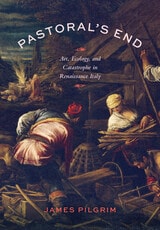
Pastoral’s End
Art, Ecology, and Catastrophe in Renaissance ItalyJames Pilgrim
University of Chicago Press, 2026
In the sixteenth century, Italian artist Jacopo Bassano painted pictures of herdsmen and animals moving through dark and muddy landscapes. But he also participated in the agricultural development of the region in which he lived, producing topographical maps of local mountains and forests, inventing new methods of drainage and irrigation, and studying the latest techniques of crop rotation and fertilization. The relationship between Bassano’s rustic art and his participation in environmental transformation has, however, never been explored.
One of the first studies of Italian Renaissance art to grapple with the connections between visual culture and the environment, Pastoral’s End explores this crucial, formative relationship. James Pilgrim looks at Bassano’s career holistically, demonstrating how his involvement in a world marked by agricultural expansion, industrialization, resource extraction, environmental degradation, social transformation, and radical philosophical development informed his paintings of country life. Introducing new archival and visual evidence of Bassano’s knowledge of hydrology, agronomy, husbandry, and architecture, Pastoral’s End argues that he transformed the more placid rustic imagery of previous Renaissance artists into visions of dangerous ecological instability.
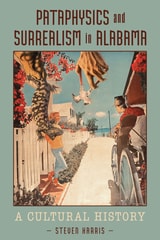
Pataphysics and Surrealism in Alabama
A Cultural HistorySteven Harris
University of Alabama Press, 2026
An exploration of the surrealist artists, musicians, and performers who forged a unique experimental arts community in Alabama
Pataphysics and Surrealism in Alabama: A Cultural History is the first book to uncover a remarkable chapter in American experimental art, music, dance and writing, tracing the activities of a creative group known as Raudelunas, the music collective Transcendprovisation, and the surrealist association initially called Glass Veal: a series of interrelated artistic and cultural movements that originated in Tuscaloosa and Birmingham, Alabama, during the 1970s. Drawing on extensive archival research and firsthand accounts, including interviews with twenty-six participants in these groups, sound recordings, publications, and other primary sources, Steven Harris traces the history of a vibrant creative community that began when three University of Alabama students started improvising music together and encouraged others to join them.
From these sessions emerged a dynamic network of performers and artists whose work challenged conventional boundaries between disciplines. Inspired by musical improvisation, surrealism, and pataphysics, participants embraced spontaneity and absurdity as they developed a positive expression of creativity that was both uniquely Southern and sharply distinctive from the dominant culture that surrounded them.
Harris situates these movements within broader histories of Alabama, Dada, pataphysics, surrealism, and improvised music and dance while charting their lasting influence on the artists who participated in them. Featuring a timeline of major events, biographies of key members, and an anthology of representative writings, Pataphysics and Surrealism in Alabama is an essential contribution to the history of American experimental culture.

Patchwork
Iowa Quilts and QuiltersJacqueline Andre Schmeal
University of Iowa Press, 2003
Patron to Painter
Elizabethan Programs for Five Allegorical PaintingsDavid Evett
Arizona Center for Medieval and Renaissance Studies, 2020
Patterns in Nature
Why the Natural World Looks the Way It DoesPhilip Ball
University of Chicago Press, 2016
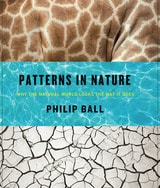
Unlike the patterns we create in technology, architecture, and art, natural patterns are formed spontaneously from the forces that act in the physical world. Very often the same types of pattern and form – spirals, stripes, branches, and fractals, say—recur in places that seem to have nothing in common, as when the markings of a zebra mimic the ripples in windblown sand. That’s because, as Patterns in Nature shows, at the most basic level these patterns can often be described using the same mathematical and physical principles: there is a surprising underlying unity in the kaleidoscope of the natural world. Richly illustrated with 250 color photographs and anchored by accessible and insightful chapters by esteemed science writer Philip Ball, Patterns in Nature reveals the organization at work in vast and ancient forests, powerful rivers, massing clouds, and coastlines carved out by the sea.
By exploring similarities such as those between a snail shell and the swirling stars of a galaxy, or the branches of a tree and those of a river network, this spectacular visual tour conveys the wonder, beauty, and richness of natural pattern formation.
Paul Klee
His Work and ThoughtMarcel Franciscono
University of Chicago Press, 1991
Paul Klee
The Visible and the LegibleAnnie Bourneuf
University of Chicago Press, 2015
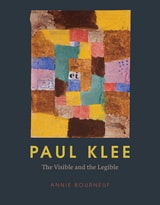
Bourneuf argues that Klee joined these elements to invite a manner of viewing that would unfold in time, a process analogous to reading. From his elaborate titles to the small scale he favored to his metaphoric play with materials, Klee created forms that hover between the pictorial and the written. Through his unique approach, he subverted forms of modernist painting that were generally seen to threaten slow, contemplative viewing. Tracing the fraught relations among seeing, reading, and imagining in the early twentieth century, Bourneuf shows how Klee reconceptualized abstraction at a key moment in its development.
Pay for Your Pleasures
Mike Kelley, Paul McCarthy, Raymond PettibonCary Levine
University of Chicago Press, 2013

Peasants, Warriors, and Wives
Popular Imagery in the ReformationKeith Moxey
University of Chicago Press, 2004
Peindre contre le crime
Thomas Kirchner
Diaphanes, 2020
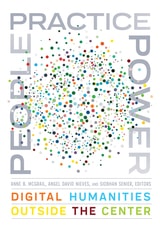
People, Practice, Power
Digital Humanities outside the CenterAnne B. McGrail
University of Minnesota Press, 2021
An illuminating volume of critical essays charting the diverse territory of digital humanities scholarship
The digital humanities have traditionally been considered to be the domain of only a small number of prominent and well-funded institutions. However, through a diverse range of critical essays, this volume serves to challenge and enlarge existing notions of how digital humanities research is being undertaken while also serving as a kind of alternative guide for how it can thrive within a wide variety of institutional spaces.
Focusing on the complex infrastructure that undergirds the field of digital humanities, People, Practice, Power examines the various economic, social, and political factors that shape such academic endeavors. The multitude of perspectives comprising this collection offers both a much-needed critique of the existing structures for digital scholarship and the means to generate broader representation within the field.
This collection provides a vital contribution to the realm of digital scholarly research and pedagogy in acknowledging the role that small liberal arts colleges, community colleges, historically black colleges and universities, and other underresourced institutions play in its advancement. Gathering together a range of voices both established and emergent, People, Practice, Power offers practitioners a self-reflexive examination of the current conditions under which the digital humanities are evolving, while helping to open up new sustainable pathways for its future.
Contributors: Matthew Applegate, Molloy College; Taylor Arnold, U of Richmond; Eduard Arriaga, U of Indianapolis; Lydia Bello, Seattle U; Kathi Inman Berens, Portland State U; Christina Boyles, Michigan State U; Laura R. Braunstein, Dartmouth College; Abby R. Broughton; Maria Sachiko Cecire, Bard College; Brennan Collins, Georgia State U; Kelsey Corlett-Rivera, U of Maryland; Brittany de Gail, U of Maryland; Madelynn Dickerson, UC Irvine Libraries; Nathan H. Dize, Vanderbilt U; Quinn Dombrowski, Stanford U; Ashley Sanders Garcia, UCLA; Laura Gerlitz; Erin Rose Glass; Kaitlyn Grant; Margaret Hogarth, Claremont Colleges; Maryse Ndilu Kiese, U of Alberta; Pamella R. Lach, San Diego State U; James Malazita, Rensselaer Polytechnic Institute; Susan Merriam, Bard College; Chelsea Miya, U of Alberta; Jamila Moore Pewu, California State U, Fullerton; Urszula Pawlicka-Deger, Aalto U, Finland; Jessica Pressman, San Diego State U; Jana Remy, Chapman U; Roopika Risam, Salem State U; Elizabeth Rodrigues, Grinnell College; Dylan Ruediger, American Historical Association; Rachel Schnepper, Wesleyan U; Anelise Hanson Shrout, Bates College; Margaret Simon, North Carolina State U; Mengchi Sun, U of Alberta; Lauren Tilton, U of Richmond; Michelle R. Warren, Dartmouth College.
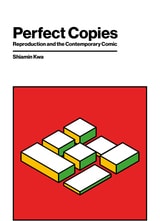
Perfect Copies
Reproduction and the Contemporary ComicShiamin Kwa
Rutgers University Press, 2023
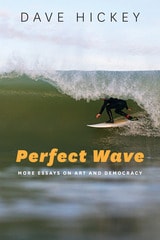
Perfect Wave
More Essays on Art and DemocracyDave Hickey
University of Chicago Press, 2017
When Dave Hickey was twelve, he rode the surfer’s dream: the perfect wave. And, like so many things in life we long for, it didn’t quite turn out—he shot the pier and dashed himself against the rocks of Sunset Cliffs in Ocean Beach, which nearly killed him.
Hickey went on to develop a career as one of America’s foremost critical iconoclasts, a trusted no-nonsense voice commenting on the worlds of art and culture. Perfect Wave brings together essays on a wide range of subjects from throughout Hickey’s career, displaying his breadth of interest and powerful insight into what makes art work, or not, and why we care. With Hickey as our guide, we travel to Disneyland and Vegas, London and Venice. We discover the genius of Karen Carpenter and Waylon Jennings, learn why Robert Mitchum matters more than Jimmy Stewart, and see how the stillness of Antonioni speaks to us today. Never slow to judge—or to surprise us in doing so—Hickey relates his wincing disappointment in the later career of his early hero Susan Sontag and shows us the appeal to our commonality that we’ve been missing in Norman Rockwell.
Bookended by previously unpublished personal essays that offer a new glimpse into Hickey’s own life—including the aforementioned conclusion to his surfing career—Perfect Wave is a welcome addition to the Hickey canon.
Perform, Repeat, Record
Live Art in HistoryEdited by Amelia Jones and Adrian Heathfield
Intellect Books, 2012
Performance
Diana Taylor
Duke University Press, 2016