Results by title
167 books match the query 'Artists, Architects, Photographers' and 11 start with p
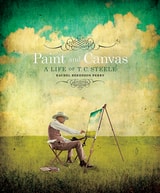
Paint and Canvas
A Life of T. C. SteeleRachel Berenson Perry
Indiana Historical Society Press, 2011
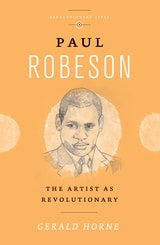
Paul Robeson
The Artist as RevolutionaryGerald Horne
Pluto Press, 2015
“A fine, taut analysis of the great African American athlete, singer, actor, and political activist.”
—Choice, Highly Recommended
Paul Robeson should be remembered today as the forerunner of Malcolm X, Dr. Martin Luther King, Jr. and Muhammad Ali. He sacrificed his fame and fortune a performer and athlete in order to fight for the rights of African Americans during the time of Jim Crow and U.S. Apartheid.
A world-famous singer and actor, a trained lawyer, an early star of American professional football and a polyglot who spoke over a dozen languages: these could be the crowning achievements of a life well-lived. Yet for Paul Robeson the higher calling of social justice led him to abandon both the NFL and Hollywood and become one of the most important political activists of his generation, a crusader for freedom and equality who battled both Jim Crow and US Senator Joseph McCarthy during the communist witch hunt of the 1950s.
In Paul Robeson: The Artist as Revolutionary, Gerald Horne discovers within Robeson's remarkable and revolutionary life the story of the twentieth century's great political struggles: against racism, against colonialism, against poverty—and for international socialism. Chapters include:
*”The Best Known American in the World"
*Rising Revolutionary
*From Moscow to Madrid
*"Black Stalin"?
*Robeson: Primary Victim of the "Blacklist"
*Triumph—and Tragedy
*Death of a Revolutionary
In the Introduction, Horne writes: “Paul Robeson—activist, artist, athlete—experienced a dramatic rise and fall, perhaps unparalleled in U.S. history. From mingling with the elite of London society and Hollywood in the 1930s, by the time he died in 1976, he was a virtual recluse in a plain abode in a working-class neighborhood of Philadelphia. What helps to explicate this tragic art of his life is a fateful decision he made when fascism was rising: he threw in his lot with those battling for socialism and decide to sacrifice his thriving artistic career on behalf of the struggle against Jim Crow—or U.S. apartheid.”
This critical and searching biography provides an opportunity for readers to comprehend the triumphs and tragedies of the revolutionary progressive movement of which Paul Robeson was not just a part, but perhaps its most resonant symbol.
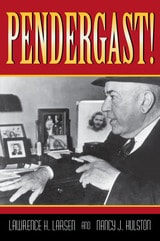
Pendergast!
Lawrence H. Larsen and Nancy J. Hulston
University of Missouri Press, 1997
Born in St. Joseph, Missouri, in 1872, Tom Pendergast moved to Kansas City around 1890 to work for his brother James, founder of the Pendergast "Goat" faction in Kansas City Democratic politics. In 1911, Pendergast became head of the Goats, and over the next fifteen years he created a powerful political machine that used illegal voting and criminal enforcers to gain power. Following a change in the city charter in 1925, Pendergast took control of Kansas City and ran it as his own personal business. In the 1930s, he received over $30 million annually from gambling, prostitution, and narcotics, putting him in the big leagues of American civic corruption. He also wielded great power in the National Democratic Party and started Harry S. Truman on the road to the presidency.
In this well-balanced biography, the authors examine Pendergast's rise to power, his successes as a political leader, his compassion for the destitute, and his reputation for keeping his word. They also examine Pendergast's character development and how his methods became more and more ruthless. Pendergast had no use for ideology in his "invisible government"—only votes counted.
In 1937 and 1938 the federal government broke the back of Pendergast's machine, convicting 259 of his campaign aides for vote fraud. In 1939 Pendergast, who was believed to be the largest bettor on horse racing in the United States, was jailed for income tax evasion, and he died in disgrace in 1945.
An insightful and comprehensive biography, Pendergast! will surely serve for years to come as the most thorough investigation of the life and infamous career of Tom Pendergast.
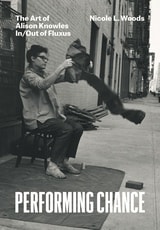
Performing Chance
The Art of Alison Knowles In/Out of FluxusNicole L. Woods
University of Chicago Press, 2026
Alison Knowles stands out as the sole female artist among the founders of Fluxus, yet she has remained an enigmatic, underrecognized figure in the history of art. Performing Chance fills a gap in the record, bringing to light Knowles’s transformative body of work as it evolved from abstract painting in the late 1950s, to silkscreens, print media, and performance in the early 1960s, to groundbreaking works in digital poetry, acoustical art, and large-scale installations in the late 1960s-70s.
Through her access to previously unpublished archival materials and direct interviews with the artist, Nicole L. Woods provides close readings of pivotal works, disclosing the ways Knowles instituted formal tactics that moved beyond modernist painting, championed principles of indeterminacy and chance, and fostered sociopolitical consciousness. Situating Knowles’s innovations in various media within the distinct cultural contexts of Wiesbaden, London, Paris, New York City, and Los Angeles, Performing Chance brings this key artist back to her rightful place as a leader of the postwar avant-garde and provides a nuanced history of the role of women artists in Fluxus and beyond.
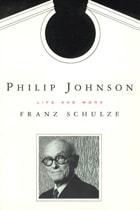
Philip Johnson
Life and WorkFranz Schulze
University of Chicago Press, 1996
The only child of a wealthy Midwestern family, Philip Johnson was a millionaire by the time he graduated from Harvard, and in 1932 he helped stage the historic International Style exhibition at the Museum of Modern Art. A patron of the arts and a political activists who flirted with the politics of Hitler, Huey Long, and Father Coughlin, he went on to create controversial and historical structures such as the Glass House, the Roofless Church, the AT & T Building, the Crystal Cathedral, and many more. Johnson's personal charms paired with his manipulative ploys—like his "borrowing" of designs—shine through in this biography.
Drawing on Johnson's correspondence, personal photographs, and speeches, and on interviews with his friends and contemporaries, Schulze fills the biography with fascinating information on the architect's family, travels, friends and lovers, and his many buildings and spaces themselves.
Franz Schulze is a professor of art at Lake Forest College. He is the author of Fantastic Images: Chicago Art since 1945, One Hundred Years of Chicago Architecture, and Mies van der Rohe: A Critical Biography.
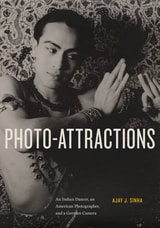
Photo-Attractions
An Indian Dancer, an American Photographer, and a German CameraAjay Sinha
Rutgers University Press, 2022
Art historian Ajay Sinha uses these hitherto unpublished photographs and archival research to raise provocative and important questions about photographic technology, colonial histories, race, sexuality and transcultural desires. Challenging the assumption that Gopal was merely objectified by Van Vechten’s Orientalist gaze, he explores the ways in which the Indian dancer co-authored the photos. In Sinha’s reading, Van Vechten’s New York studio becomes a promiscuous contact zone between world cultures, where a “photo-erotic” triangle is formed between the American photographer, Indian dancer, and German camera.
A groundbreaking study of global modernity, Photo-Attractions brings scholarship on American photography, literature, race and sexual economies into conversation with work on South Asian visual culture, dance, and gender. In these remarkable historical documents, it locates the pleasure taken in cultural difference that still resonates today.
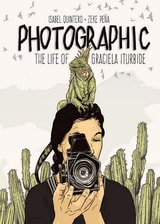
Photographic
The Life of Graciela IturbideIsabel Quintero
J. Paul Getty Trust, The, 2021
Renowned Mexican photographer Graciela Iturbide was born in Mexico City in 1942, the oldest of thirteen children. When tragedy strikes Graciela as a young mother, she turns to photography for solace and understanding.
From then on Graciela embarks on a photographic journey that takes her throughout her native Mexico, from the Sonora Desert to Juchitán to Frida Kahlo’s bathroom, and then to the United States, India, and beyond.
Photographic is a symbolic, poetic, and deeply personal graphic biography of this iconic photographer. Graciela’s journey will excite young adults and budding photographers, who will be inspired by her resolve, talent, and curiosity.
Ages twelve and up
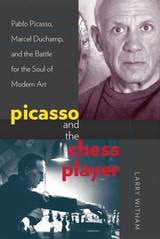
Picasso and the Chess Player
Pablo Picasso, Marcel Duchamp, and the Battle for the Soul of Modern ArtLarry Witham
University Press of New England, 2013
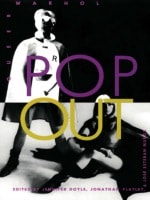
Pop Out
Queer WarholJennifer Doyle, Jonathan Flatley, and Jose Esteban Muñoz, eds.
Duke University Press, 1996
Written from the perspectives of art history, critical race theory, psychoanalysis, feminist theory, cinema studies, and social and literary theory, these essays consider Warhol in various contexts and within the history of the communities in which he figured. The homoerotic subjects, gay audiences, and queer contexts that fuel a certain fascination with Warhol are discussed, as well as Batman, Basquiat, and Valerie Solanas. Taken together, the essays in this collection depict Warhol’s career as a practical social reflection on a wide range of institutions and discourses, including those, from the art world to mass culture, that have almost succeeded in sanitizing his work and his image.
Contributors. Jennifer Doyle, Jonathan Flatley, Marcie Frank, David E. James, Mandy Merck, Michael Moon, José Esteban Muñoz, Eve Kosofsky Sedgwick, Brian Selsky, Sasha Torres, Simon Watney, Thomas Waugh
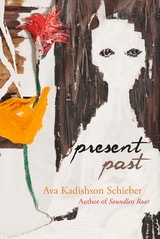
Present Past
Ava Kadishson Schieber
Northwestern University Press, 2016
The focus of Present Past is her life after the Shoah. Rejecting stereotypes of survivors as traumatized or broken, Schieber is stark yet exuberant, formidable yet nuanced. The woman who emerges in Schieber’s Present Past is a multifaceted, heterogeneous figure—poet, artist, and survivor. In it, she plays the passionate observer who dispassionately curates the kaleidoscopic memories of her tumultuous personal and professional life in Belgrade, Prague, Tel Aviv, New York, and Chicago.
Organized into thirteen chapters, each a blend of images, poems, and narrative, this moving new work offers myriad points of entry to readers of these genres, those fascinated in the relationship between the Holocaust and art, as well as readers interested in memory and survivorship.
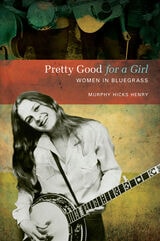
Pretty Good for a Girl
Women in BluegrassMurphy Henry
University of Illinois Press, 2013