Results by title
428 books match the query 'Authorship' and 15 start with p
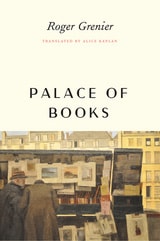
Palace of Books
Roger Grenier
University of Chicago Press, 2014
With Palace of Books, he invites us to explore the domain of literature, its sweeping vistas and hidden recesses. Engaging such fundamental questions as why people feel the need to write, or what is involved in putting one’s self on the page, or how a writer knows she’s written her last sentence, Grenier marshals apposite passages from his favorite writers: Chekhov, Baudelaire, Proust, James, Kafka, Mansfield and many others. Those writers mingle companionably with tales from Grenier’s half-century as an editor and friend to countless legendary figures, including Albert Camus, Romain Gary, Milan Kundera, and Brassai,.
Grenier offers here a series of observations and quotations that feel as spontaneous as good conversation, yet carry the lasting insights of a lifetime of reading and thinking. Palace of Books is rich with pleasures and surprises, the perfect accompaniment to old literary favorites, and the perfect introduction to new ones.
Paracritical Hinge
Essay, Talks, Notes, InterviewsNathaniel Mackey
University of Iowa Press, 2018
Paracritical Hinge is a collection of varied yet interrelated pieces highlighting Nathaniel Mackey’s multifaceted work as writer and critic. It embraces topics ranging from Walt Whitman’s interest in phrenology to the marginalization of African American experimental writing; from Kamau Brathwaite’s “calibanistic” language practices to Federico García Lorca’s flamenco aesthetic of duende and its continuing repercussions; from H. D.’s desert measure and coastal way of knowing to the altered spatial disposition of Miles Davis’s trumpet sound; from Robert Duncan’s serial poetics to diasporic syncretism; from the lyric poem’s present-day predicaments to gnosticism. Offering illuminating commentary on these and other artists including Amiri Baraka, Mississippi Fred McDowell, Wilson Harris, Jack Spicer, John Coltrane, Jay Wright, and Bob Kaufman, Paracritical Hinge also sheds light on Mackey’s own work as a poet, fiction writer, and editor.

Passion and Craft
CONVERSATIONS WITH NOTABLE WRITERSEdited by Bonnie Lyons and Bill Oliver
University of Illinois Press, 1998
Craft go beyond the merely autobiographical, revealing that, despite
their differences, they share passionate devotion and discipline for their
craft.
Included are Richard Ford, winner in 1995 of both the Pulitzer Prize
and the PEN/Faulkner Award; Gina Berriault, 1997 winner of the National
Book Critics Circle Award; Bobbie Ann Mason; T. Coraghessan Boyle; Rick
Bass; Leonard Michaels; Christopher Tilghman; Thom Jones; Julia Alvarez;
Andre Dubus; Jayne Anne Phillips; and Tobias Wolff.
Their comments will interest readers devoted to their novels and stories,
other writers, and aspiring writers.
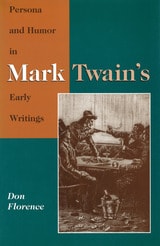
Persona and Humor in Mark Twain's Early Writings
Don Florence
University of Missouri Press, 1995
In Persona and Humor in Mark Twain's Early Writings, Don Florence explains that Samuel Clemens did more than use the borrowed name of Mark Twain to sign his writings. He also developed a separate identity, or persona, becoming "a literary personality in his own right."
Challenging mainstream Twain criticism on many fronts, Florence focuses exclusively on Twain's early writings. He demonstrates how Twain evolved in his early narratives into the "Mark Twain" we now recognize. Florence maintains that this process was evolutionary: Although Twain might have been dependent on Clemens for the initial experiences, they become Twain's experiences, necessary for his development as a persona. Traditionally, critics of Twain have been preoccupied with dualities, but Florence sees this emphasis upon polarities as an oversimplification. He argues that much of Twain's humor strives to shape more and more of the world, giving Twain multiple narrative voices and letting him be inclusive, not exclusive.
Finally, this study asserts that there is more continuity to Mark Twain's career than has been generally recognized. Many Twain scholars have argued that Twain's later writings are radically different from his earlier writings because of their emphasis upon illusion and dream. Florence argues that the preoccupation with illusion and fantasy is scarcely new. Whether Twain's mood is exuberant or dark, he emphasizes subjectivity over objectivity, the dominance of fantasy, the creative powers of humor, and his ability as persona to determine what we consider "reality." Florence contends that Twain's early writings show Mark Twain gradually evolving into a masterfully comic persona.
Jargon-free and eloquently written, Persona and Humor in Mark Twain's Early Writings provides a fascinating look at Mark Twain's developing genius and will be a welcome addition to Twain literature.
Personally Speaking
Experience as Evidence in Academic DiscourseCandace Spigelman
Southern Illinois University Press, 2004
Responding to contemporary discussion about using personal accounts in academic writing, Personally Speaking: Experience as Evidence in Academic Discourse draws on classical and current rhetorical theory, feminist theory, and relevant examples from both published writers and first-year writing students to illustrate the advantages of blending experiential and academic perspectives.
Candace Spigelman examines how merging personal and scholarly worldviews produces useful contradictions and contributes to a more a complex understanding in academic writing. This rhetorical move allows for greater insights than the reading or writing of experiential or academic modes separately does. Personally Speaking foregrounds the semi-fictitious nature of personal stories and the rhetorical possibilities of evidence as Spigelman provides strategies for writing instructors who want to teach personal academic argument while supplying practical mechanisms for evaluating experiential claims.
The volume seeks to complicate and intensify disciplinary debates about how compositionists should write for publication and what kinds of writing should be taught to composition students. Spigelman not only supplies evidence as to why the personal can count as evidence but also relates how to use it effectively by including student samples that reflect particular features of personal writing. Finally, she lays the groundwork to move narrative from its current site as confessional writing to the domain of academic discourse.
Philosophy, Writing, and the Character of Thought
John T. Lysaker
University of Chicago Press, 2018
Philosophy’s relation to the act of writing is John T. Lysaker’s main concern in Philosophy, Writing, and the Character of Thought. Whether in Plato, Montaigne, Nietzsche, Wittgenstein, or Derrida, philosophy has come in many forms, and those forms—the concrete shape philosophizing takes in writing—matter. Much more than mere adornment, the style in which a given philosopher writes is often of crucial importance to the point he or she is making, part and parcel of the philosophy itself.
Considering how writing influences philosophy, Lysaker explores genres like aphorism, dialogue, and essay, as well as logical-rhetorical operations like the example, irony, and quotation. At the same time, he shows us the effects of these rhetorical devices through his own literary experimentation. In dialogue with such authors as Benjamin, Cavell, Emerson, and Lukács, he aims to revitalize philosophical writing, arguing that philosophy cannot fulfill its intellectual and cultural promise if it keeps to professional articles and academic prose. Instead, philosophy must embrace writing as an essential, creative activity, and deliberately reform how it approaches its subject matter, readership, and the evolving social practices of reading and reflection.
Plato, Derrida, and Writing
Jasper Neel
Southern Illinois University Press, 1988
Winner, Mina P. Shaughnessy Prize
Achieving the remarkable feat of linking composition theory, deconstruction, and classical rhetoric, this book has been admirably summarized by the theorist G. Douglas Atkins, who writes: "This lively and engaging, informed and informative book constitutes an important contribution. Though its ‘field’ is most obviously composition, composition theory, and pedagogy, part of its importance derives from the way it transcends disciplinary boundaries to bear on writing in general. . . I know of no book that so fully and well discusses, and evaluates, the implications of deconstruction for composition and pedagogy. That [it] goes ‘beyond deconstruction,’ rather than merely ‘applying’ it, increases its importance and signals a clear contribution to the understanding of writing."
Jasper Neel analyzes the emerging field of composition studies within the epistemological and ontological debate over writing precipitated by Plato, who would have us abandon writing entirely, and continued by Derrida, who argues that all human beings are written. This book offers a three-part exploration of that debate. In the first part, a deconstructive reading of Plato’s Phaedrus, Neel shows the elaborate sleight-of-hand that Plato must employ as he uses writing to engage in a semblance of spoken dialogue.
The second part describes Derrida’s theory of writing and presents his famous argument that "the history of truth, of the truth of truth, has always been. . .the debasement of writing, and its repression outside full speech." A lexicon of nine Derridean terms, the key to his theory of writing, is also included. At the end of this section, Neel turns deconstruction against itself, demonstrating that Derridean analysis collapses of its own weight.
The concluding section of the book juxtaposes the implications of Platonic and Derridean views of writing, warning that Derrida’s approach may lock writing inside philosophy. The conclusion suggests that writing may be liberated from philosophical judgment by turning to Derrida’s predecessors, the sophists, particularly Protagoras and Gorgias. Drawing on Protagoras’s idea of strong discourse, Neel shows that sophistry is the foundation of democracy: "Strong discourse is public discourse, which, though based on probability and not truth, remains persuasive over a long period of time to a great number of people. This publicly tested discourse exists only among competitors, never alone, but its ability to remain persuasive even when surrounded by other discourses enables the ideas of democracy to emerge and then keeps democracy alive."
Poe's Critical Theory
THE MAJOR DOCUMENTSEdgar Allan Poe
University of Illinois Press, 2007
This edition shows that what is consistent in Poe is not any single theory. Rather, always present are wit, playfulness, concern for the strong effect, a bin of recyclable allusions, anecdotes and quotations, and a writer’s discipline. His writing on theory is of a piece with his fiction, poetry, and journalism. The Levines explain how these pieces also tie in tightly to the social, political, economic, and technological history of the world in which Poe lived.
Poets on Teaching
A SourcebookJoshua Marie Wilkinson
University of Iowa Press, 2010
In response to a lack of source works for wide-ranging approaches to teaching poetry, award-winning poet Joshua Marie Wilkinson has gathered ninety-nine micro-essays for poets, critics, and scholars who teach and for students who wish to learn about the many ways poets think about how a poem comes alive from within—and beyond—a classroom. Not narrowly concerned with how to read poetry or how to write poetry, by virtue of their central concern with teaching poetry, the essays in this fresh and innovative volume address both reading and writing and give teachers and students useful tools for the classroom and beyond.
Divided into four sections—“Reflections / Poetics,” “Exercises / Praxis,” “New Approaches to Poetry Courses and Methodology,” and “Talks / Directives”—Poets on Teaching provides practical, intelligent advice. “Reflections / Poetics” encompasses the most expansive approaches to teaching poetry, where poets reflect variously on what teachers can cultivate in their classrooms. “Exercises / Praxis” consists of hands-on approaches to reading and, especially, writing poems. “New Approaches to Poetry Courses and Methodology” features essays on rethinking specific courses, offering new ideas for course design and pedagogy. “Talks / Directives” contains a series of more informal and conversational discussions geared toward becoming a stronger reader, writer, teacher, and student of poetry. Poets on Teaching will be required reading for new and experienced teachers alike.
Kazim Ali, Rae Armantrout, Hadara Bar-Nadav, Dan Beachy-Quick, Bruce Beasley, Claire Becker, Jaswinder Bolina, Jenny Boully, Joel Brouwer, Lily Brown, Laynie Browne, Stephen Burt, Julie Carr, Joshua Clover, Matthew Cooperman, Oliver de la Paz, Linh Dinh, Ben Doller, Sandra Doller, Julie Doxsee, Lisa Fishman, Graham Foust, John Gallaher, Forrest Gander, C. S. Giscombe, Peter Gizzi, Lara Glenum, Kenneth Goldsmith, Johannes Göransson, Noah Eli Gordon, Arielle Greenberg, Richard Greenfield, Sarah Gridley, Anthony Hawley, Terrance Hayes, Eric Hayot, Brian Henry, Brenda Hillman, Jen Hofer, Paul Hoover, Christine Hume, Brenda Iijima, Lisa Jarnot, Kent Johnson, Bhanu Kapil, Karla Kelsey, Aaron Kunin, Quraysh Ali Lansana, Dorothea Lasky, Sueyeun Juliette Lee, Ada Limón, Timothy Liu, Sabrina Orah Mark, Dawn Lundy Martin, Kristi Maxwell, Joyelle McSweeney, Christina Mengert, Albert Mobilio, K. Silem Mohammad, Fred Moten, Jennifer Moxley, Laura Mullen, Sawako Nakayasu, Aimee Nezhukumatathil, Hoa Nguyen, Jena Osman, D. A. Powell, Kristin Prevallet, Bin Ramke, Jed Rasula, Srikanth Reddy, Barbara Jane Reyes, Boyer Rickel, Elizabeth Robinson, Martha Ronk, Emily Rosko, Prageeta Sharma, Evie Shockley, Eleni Sikelianos, Richard Siken, Ron Silliman, Tracy K. Smith, Juliana Spahr, Sasha Steensen, Peter Streckfus, Cole Swensen, Michael Theune, Tony Trigilio, Spring Ulmer, Karen Volkman, Catherine Wagner, G. C. Waldrep, Mark Wallace, Tyrone Williams, Mark Yakich, Jake Adam York, Stephanie Young, Timothy Yu, Matthew Zapruder, Andrew Zawacki, and Rachel Zucker
Politics and Scholarship
Feminist Academic Journals and the Production of KnowledgePatrice McDermott
University of Illinois Press, 1994
-- J'nana Morse Sellery, coauthor of Elizabeth Bowen: A Bibliography
Poor Things
How Those with Money Depict Those without ItLennard J. Davis
Duke University Press, 2024
Producing Ancient Scripture
Joseph Smith's Translation Projects in the Development of Mormon ChristianityEdited by Michael Hubbard MacKay, Mark Ashurst-McGee, and Brian M. Hauglid
University of Utah Press, 2020
This collaborative volume is the first to study Joseph Smith’s translation projects in their entirety. In this carefully curated collection, experts contribute cutting-edge research and incisive analysis. The chapters explore Smith’s translation projects in focused detail and in broad contexts, as well as in comparison and conversation with one another. Authors approach Smith’s sacred texts historically, textually, linguistically, and literarily to offer a multidisciplinary view. Scrupulous examination of the production and content of Smith’s translations opens new avenues for understanding the foundations of Mormonism, provides insight on aspects of early American religious culture, and helps conceptualize the production and transmission of sacred texts.
Professional Academic Writing in the Humanities and Social Sciences
Susan Peck MacDonald
Southern Illinois University Press, 1994
In Professional Academic Writing in the Humanities and Social Sciences, Susan Peck MacDonald tackles important and often controversial contemporary questions regarding the rhetoric of inquiry, the social construction of knowledge, and the professionalization of the academy. MacDonald argues that the academy has devoted more effort to analyzing theory and method than to analyzing its own texts. Professional texts need further attention because they not only create but are also shaped by the knowledge that is special to each discipline. Her assumption is that knowledge-making is the distinctive activity of the academy at the professional level; for that reason, it is important to examine differences in the ways the professional texts of subdisciplinary communities focus on and consolidate knowledge within their fields.
Throughout the book, MacDonald stresses her conviction that academics need to do a better job of explaining their text-making axioms, clarifying their expectations of students at all levels, and monitoring their own professional practices. MacDonald’s proposals for both textual and sentence-level analysis will help academic professionals better understand how they might improve communication within their professional communities and with their students.
Proofs of Genius
Collected Editions from the American Revolution to the Digital AgeAmanda Gailey
University of Michigan Press, 2015
Proust's Deadline
Christine M. Cano
University of Illinois Press, 2006
Marcel Proust’s multivolume masterpiece, À la recherche du temps perdu, began to appear in 1913. Over the next fifty years, it gained a reputation as one of the greatest literary works of the twentieth century. But the novel’s classic image as a completed work was later shattered by the discovery of unpublished drafts, and the “war of the Prousts” has kept scholars arguing over its definitive form ever since.
Christine M. Cano’s Proust’s Deadline presents a concise history of the publishing and reception of À la recherche du temps perdu, and sorts out the most important issues that have arisen from the ensuing debates about the text. She ultimately shows how this quintessential “book about time” tells another story about time’s passage: the story of Proust’s mortal confrontation with the temporality of writing, publishing, and reading.