Results by title
279 books match the query 'Biblical Criticism & Interpretation' and 16 start with p
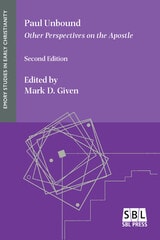
Paul Unbound
Other Perspectives on the ApostleMark D. Given
SBL Press, 2022
"As long as there are readers of Paul, there will be always be other perspectives."
The essays in this second edition of Paul Unbound: Other Perspectives on the Apostle provide introductions to Paul's relationship to and views on the Roman Empire, first-century economic stratification, his opponents, ethnicity, the law, Judaism, women, and Greco-Roman rhetoric. Contributors Warren Carter, Charles H. Cosgrove, A. Andrew Das, Steven J. Friesen, Mark D. Given, Deborah Krause, Mark D. Nanos, and Jerry L. Sumney have added addendums to their original essays and updated the bibliography to take into account scholarship produced in the decade since the publication of the first edition. The collection provides essential background and sets out new directions for study useful to students of the New Testament and Paul's letters.
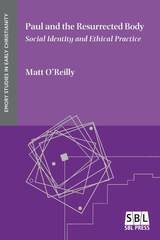
Paul and the Resurrected Body
Social Identity and Ethical PracticeMatt O'Reilly
SBL Press, 2020
A new reading of Pauline theology, ethics, and eschatology grounded in social-identity theory and sociorhetorical criticism
Readers often think of Paul’s attitude toward the resurrection of the body in individual terms: a single body raised as the climax of an individual’s salvation. In Paul and the Resurrected Body: Social Identity and Ethical Practice, Matt O’Reilly makes the case that, for Paul, the social dimension of future bodily resurrection is just as important, if not more so. Through a close reading of key texts in the letters to the Corinthians, Romans, and Philippians, O’Reilly argues that resurrection is integral to Paul’s understanding of Christian social identity. In Paul’s theological reasoning, a believer’s hope for the future depends on being identified as part of the people of God who will be resurrected.
Features
- A clarification of the eschatological basis for Paul’s ethical expectations
- Exploration of the social significance of Paul’s theological reasoning
- An integration of ancient rhetorical theory with contemporary social-identity theory
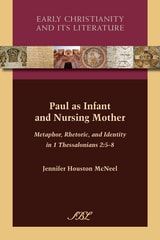
Paul as Infant and Nursing Mother
Metaphor, Rhetoric, and Identity in 1 ThessaJennifer Houston McNeel
SBL Press, 2014
Explore the significance of maternal metaphors in the writings of a first-century male missionary and theologian
Paul employed metaphors of childbirth or breastfeeding in four out of the seven undisputed epistles. In this book, McNeel uses cognitive metaphor theory and social identity analysis to examine the meaning and function of these maternal metaphors. She asserts that metaphors carry cognitive content and that they are central to how humans process information, construct reality, and shape group identity.
Features:
- A focus on “identity” as the way in which people understand themselves in relation to one another, to society, and to those perceived as outsiders
- Examination of metaphor as part of Paul’s rhetorical strategy
- Integration of the work of philosopher Max Black with the work of cognitive linguists George Lakoff and Mark Johnson
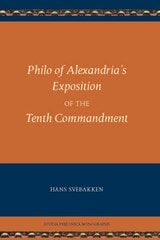
Philo of Alexandria's Exposition on the Tenth Commandment
Hans Svebakken
SBL Press, 2012
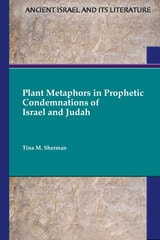
Plant Metaphors in Prophetic Condemnations of Israel and Judah
Tina M. Sherman
SBL Press, 2023
Tina M. Sherman offers a first-of-its-kind, detailed analysis of prophetic passages that depict people as plants—from grasses and grains to fruit trees and grapevines—examining how the biblical authors exploited these metaphors to portray the condemnation and punishment of Israel and Judah in terms of the everyday work of crop farming and plant husbandry. Additionally, she explores how the prophetic authors employed plant imagery to construct national identities that emphasize the people’s collective responsibility for the kingdoms’ fate. Plant Metaphors in Prophetic Condemnations of Israel and Judah demonstrates the usefulness of combining conceptual metaphor theory with aspects of frame semantics in the analysis of patterns of thought and expression in biblical metaphor.
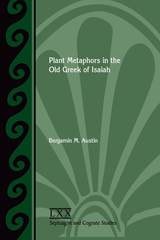
Plant Metaphors in the Old Greek of Isaiah
Benjamin M. Austin
SBL Press, 2019
A thorough analysis of metaphor translation techniques used in Isaiah
In this study Benjamin M. Austin analyzes all the plant metaphors in Isaiah and classifies them according to the metaphor translation techniques used by the Septuagint translator. Austin illustrates how the translator took the context of each metaphor into account and demonstrates how the natural features of the plants under discussion at times influenced their translation. He argues that the translator tried to render metaphors vividly and with clarity, sometimes adjusting them to match the experience of his audience living in Egypt. Austin also examines metaphors in terms of their vehicles (the objects of comparison), so that the translation of similar metaphors can be compared.
Features
- A comparison of the Masoretic Text to the Septuagint and Targum
- A classification of metaphor translation strategies
- An introduction to the Hellenistic and the Jewish conception of metaphors
Postcolonial Perspectives in African Biblical Interpretations
Musa W. Dube
SBL Press, 2012
Postcolonialism and the Hebrew Bible
The Next StepRoland Boer
SBL Press, 2013
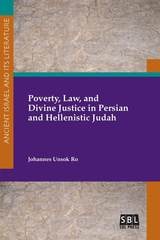
Poverty, Law, and Divine Justice in Persian and Hellenistic Judah
Johannes Unsok Ro
SBL Press, 2018
A view of Persian and Hellenistic Judean communities through theological and socioeconomic lenses
Johannes Unsok Ro employs philological, historical, and sociological approaches to investigate the close connections between socioeconomic structures, social inequality, and theological developments in the Judean communities in Persian- and Hellenistic-era Palestine. Ro contends that competing points of view from communities of lay returnees, priestly returnees, and communities of resident Judeans and Samaritans were juxtaposed within the Hebrew Bible, which took shape during the postexilic period. By exploring issues such as the relationship between the shaping of the canon and literacy in the Judean community, the term strangers in the biblical law codes, the socioeconomic structures of Judean communities reflected in the biblical law codes, the development of the theological concept of divine punitive justice, the piety of the poor in certain psalms, and the concept of poverty in the Dead Sea Scrolls, Ro illustrates that the communities behind each text and its redactions can be ascertained through sociological and theological lenses.
Features
- Demonstration that a theology of the poor materialized orally among the poor but found written expression among Levites
- Insight into the socioeconomic and theological concerns of the authorial groups behind various biblical law codes
- A case that biblical “poverty” sometimes refers to humility and a theologically reflected consciousness of lowliness toward God
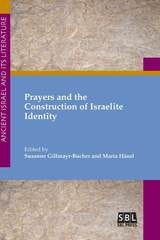
Prayers and the Construction of Israelite Identity
Susanne Gillmayr-Bucher
SBL Press, 2019
Substantial insights into various identity discourses reflected in the biblical prayers
This collection of essays from an international group of scholars focuses on how biblical prayers of the Persian and early Hellenistic periods shaped identity, evoked a sense of belonging to specific groups, and added emotional significance to this affiliation. Contributors draw examples from different biblical texts, including Genesis, Samuel, Kings, Chronicles, Ezra and Nehemiah, Psalms, Jonah, and Daniel.
Features
- Thorough study of prayers that play a key role for a biblical book’s (re)construction of the people’s history and identity
- An examination of ways biblical figures are remodeled by their prayers by introducing other, sometimes even contradictory, discourses on identity
- An exploration of different ways in which psalms from postexilic times shaped, reflected, and modified identity discourses
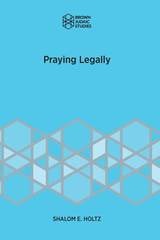
Praying Legally
Shalom E. Holtz
SBL Press, 2019
Explore the lengthy history of legal metaphors in ancient prayer
In biblical and other ancient Near Eastern sources, prayer is an opportunity to make one’s case before divine judges. Prayers were formulated using courtroom or trial language, including demands for judgment, confessions, and accusations. The presence of these legal concepts reveals ancient Near Eastern thoughts about what takes place when one prays. Holtz highlights legal concepts that appear in prayers, including the motif of the speakers' oppression in Psalms the possibility of countersuit against God through prayer, and divine attention and inattention as legal responses. By reading ancient prayers together with legal texts, this book shows how speakers took advantage of prayer as an opportunity to have their day in the divine court and even sue against divine injustice.
Features
- Identification of legal vocabulary and concepts that appear in ancient prayers
- Analysis of legal metaphors in prayer examples in Akkadian and postbiblical rabbinic texts
- Interpretations of trial records and texts from Psalms and Lamentations

Priests and Cults in the Book of the Twelve
Lena-Sofia Tiemeyer
SBL Press, 2016
Key essays that explore a range of attitudes toward clergy and ritual
This book discusses the depictions of the cult and its personnel in the twelve prophetic books commonly referred to as the Book of the Twelve or the Minor Prophets. The articles in the volume explore the following questions: How did these prophetic writers envision the priests and the Levites? What did they think about the ritual aspects of ancient Israelite faith, including not only the official temple cult in Jerusalem but also cultic expressions outside the capital? What, in their views, characterized a faithful priest and what should the relationship be between his cultic performance and the ways in which he lived his life? How does the message of each individual author fit in with the wider Israelite traditions? Finally, who were these prophetic authors, in which historical contexts did they live and work, and what stylistic tools did they use to communicate their message?
Features:
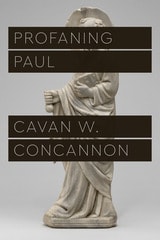
Profaning Paul
Cavan W. Concannon
University of Chicago Press, 2021
The letters of Paul have been used to support and condone a host of evils over the span of more than two millennia: racism, slavery, imperialism, misogyny, and anti-Semitism, to name a few. Despite, or in some cases because of, this history, readers of Paul have felt compelled to reappropriate his letters to fit liberal or radical politics, seeking to set right the evils done in Paul’s name. Starting with the language of excrement, refuse, and waste in Paul’s letters, Profaning Paul looks at how Paul’s “shit” is recycled and reconfigured. It asks why readers, from liberal Christians to academic biblical scholars to political theorists and philosophers, feel compelled to make Paul into a hero, mining his words for wisdom. Following the lead of feminist, queer, and minoritized scholarship, Profaning Paul asks what would happen if we stopped recycling Paul’s writings. By profaning the status of his letters as sacred texts, we might open up new avenues for imagining political figurations to meet our current and coming political, economic, and ecological challenges.
Prophets Male and Female
Gender and Prophecy in the Hebrew Bible, the Eastern Mediterranean, and theJonathan Stökl
SBL Press, 2013
Psalm Studies, Volume 1
Sigmund Mowinckel
SBL Press, 2014
Sigmund Mowinckel is widely recognized as one of the leading forces in Psalms research during the twentieth century. Indeed, the culmination of Mowinckel’s thought and work, The Psalms in Israel’s Worship, continues to play a significant role in Psalms scholarship today. Not as well known are the seminal studies that prepared the ground for Mowinckel’s later work, the six Psalmenstudien that are translated here into English for the first time. In these studies Mowinckel explores with care and in detail such topics as: “'Awen and the Psalms of Individual Lament”; “YHWH’s Enthronement Festival and the Origin of Eschatology”; “Cultic Prophecy and Prophetic Psalms”; “The Technical Terms in the Psalm Superscriptions”; “Blessing and Curse in Israel’s Cult and Psalmody”; and “The Psalmists.” Anyone interested in Psalms study, especially the possible role of the New Year’s enthronement festival within Israel’s cult and its relation to the Psalter, will find much to consider in these classic works.
Psalm Studies, Volume 2
Sigmund Mowinckel
SBL Press, 2014
Sigmund Mowinckel is widely recognized as one of the leading forces in Psalms research during the twentieth century. Indeed, the culmination of Mowinckel’s thought and work, The Psalms in Israel’s Worship, continues to play a significant role in Psalms scholarship today. Not as well known are the seminal studies that prepared the ground for Mowinckel’s later work, the six Psalmenstudien that are translated here into English for the first time. In these studies Mowinckel explores with care and in detail such topics as: “'Awen and the Psalms of Individual Lament”; “YHWH’s Enthronement Festival and the Origin of Eschatology”; “Cultic Prophecy and Prophetic Psalms”; “The Technical Terms in the Psalm Superscriptions”; “Blessing and Curse in Israel’s Cult and Psalmody”; and “The Psalmists.” Anyone interested in Psalms study, especially the possible role of the New Year’s enthronement festival within Israel’s cult and its relation to the Psalter, will find much to consider in these classic works.