Results by title
211 books match the query 'Blacks' and 7 start with p

Pan–African American Literature
Signifyin(g) Immigrants in the Twenty-First CenturyLi, Stephanie
Rutgers University Press, 2018
The twenty-first century is witnessing a dynamic broadening of how blackness signifies both in the U.S. and abroad. Literary writers of the new African diaspora are at the forefront of exploring these exciting approaches to what black subjectivity means. Pan-African American Literature is dedicated to charting the contours of literature by African born or identified authors centered around life in the United States. The texts examined here deliberately signify on the African American literary canon to encompass new experiences of immigration, assimilation and identification that challenge how blackness has been previously conceived. Though race often alienates and frustrates immigrants who are accustomed to living in all-black environments, Stephanie Li holds that it can also be a powerful form of community and political mobilization.
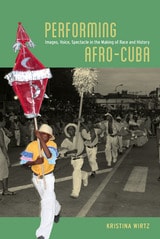
Performing Afro-Cuba
Image, Voice, Spectacle in the Making of Race and HistoryKristina Wirtz
University of Chicago Press, 2014
Wirtz analyzes a variety of performances and the ways they construct Cuban racial and historical imaginations. She offers a sophisticated view of performance as enacting diverse revolutionary ideals, religious notions, and racial identity politics, and she outlines how these concepts play out in the ongoing institutionalization of folklore as an official, even state-sponsored, category. Employing Bakhtin’s concept of “chronotopes”—the semiotic construction of space-time—she examines the roles of voice, temporality, embodiment, imagery, and memory in the racializing process. The result is a deftly balanced study that marries racial studies, performance studies, anthropology, and semiotics to explore the nature of race as a cultural sign, one that is always in process, always shifting.
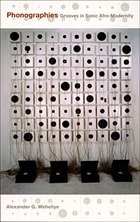
Phonographies
Grooves in Sonic Afro-ModernityAlexander G. Weheliye
Duke University Press, 2005
Weheliye surveys literature, film, and music to focus on engagements with recorded sound. He offers substantial new readings of canonical texts by W. E. B. Du Bois and Ralph Ellison, establishing dialogues between these writers and popular music and film ranging from Louis Armstrong’s voice to DJ mixing techniques to Darnell Martin’s 1994 movie I Like It Like That. Looking at how questions of diasporic belonging are articulated in contemporary black musical practices, Weheliye analyzes three contemporary Afro-diasporic musical acts: the Haitian and African American rap group the Fugees, the Afro- and Italian-German rap collective Advanced Chemistry, and black British artist Tricky and his partner Martina. Phonographies imagines the African diaspora as a virtual sounding space, one that is marked, in the twentieth century and twenty-first, by the circulation of culture via technological reproductions—records and tapes, dubbing and mixing, and more.
Physics of Blackness
Beyond the Middle Passage EpistemologyMichelle M. Wright
University of Minnesota Press, 2015
What does it mean to be Black? If Blackness is not biological in origin but socially and discursively constructed, does the meaning of Blackness change over time and space? In Physics of Blackness: Beyond the Middle Passage Epistemology, Michelle M. Wright argues that although we often explicitly define Blackness as a “what,” it in fact always operates as a “when” and a “where.”
By putting lay discourses on spacetime from physics into conversation with works on identity from the African Diaspora, Physics of Blackness explores how Middle Passage epistemology subverts racist assumptions about Blackness, yet its linear structure inhibits the kind of inclusive epistemology of Blackness needed in the twenty-first century. Wright then engages with bodies frequently excluded from contemporary mainstream consideration: Black feminists, Black queers, recent Black African immigrants to the West, and Blacks whose histories may weave in and out of the Middle Passage epistemology but do not cohere to it.
Physics of Blackness takes the reader on a journey both known and unfamiliar—from Isaac Newton’s laws of motion and gravity to the contemporary politics of diasporic Blackness in the academy, from James Baldwin’s postwar trope of the Eiffel Tower as the site for diasporic encounters to theoretical particle physics’ theory of multiverses and superpositioning, to the almost erased lives of Black African women during World War II. Accessible in its style, global in its perspective, and rigorous in its logic, Physics of Blackness will change the way you look at Blackness.

Postcoloniality-Decoloniality-Black Critique
Joints and FissuresEdited by Sabine Broeck and Carsten Junker
Campus Verlag, 2014
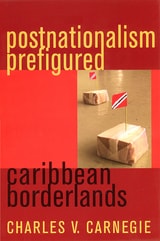
Postnationalism Prefigured
Caribbean BorderlandsCarnegie, Charles V
Rutgers University Press, 2002
Carnegie shows not only that the nation-state is an exhausted form of political organization, but that in the Caribbean the ideological and political reach of the nation-state has always been tenuous at best. Caribbean peoples, he suggests, live continually in breach of the nation-state configuration. Drawing both on his own experiences as a Jamaican-born anthropologist and on the examples provided by those who have always considered national borders as little more than artificial administrative nuisances, Carnegie investigates a fascinating spectrum of individuals, including Marcus Garvey, traders, black albinos, and Caribbean Ba’hais. If these people have not themselves developed a scholarly doctrine of transnationalism, they have, nevertheless, effectively lived its demand and prefigured a postnational life.
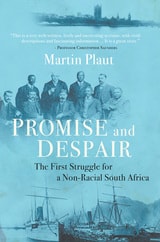
Promise and Despair
The First Struggle for a Non-Racial South AfricaMartin Plaut
Ohio University Press, 2016
The struggle for freedom in South Africa goes back a long way. In 1909, a remarkable interracial delegation of South Africans traveled to London to lobby for a non-racialized constitution and franchise for all. Among their allies was Mahatma Gandhi, who later encapsulated lessons from the experience in his most important book, Hind Swaraj. Though the mission failed, the London debates were critical to the formation of the African National Congress in 1912.
With impeccable storytelling and rich character depictions, Martin Plaut describes the early quest for black franchise and the seeds it planted for a new South Africa. While most people believe that black South Africans obtained the vote in 1994, men of all races voted in the Cape Colony for almost a century, sometimes deciding election outcomes. The London mission was part of a long history of nonwhite political agency.
Taking as its centerpiece the 1909 delegation, Promise and Despair covers the twelve years between the South African War and the First World War, during which the major forces that would shape twentieth-century South Africa were forged. Plaut reveals new details of the close collaboration between Gandhi and the ANC leadership during the Indian-South African community’s struggle for their rights, the influence of the American South on South African racial practices, and the workings of the Imperial system.