Results by title
25 books match the query 'Consumption'
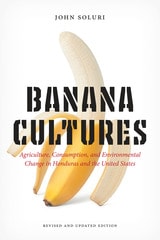
Banana Cultures
Agriculture, Consumption, and Environmental Change in Honduras and the United StatesBy John Soluri
University of Texas Press, 2021
Bananas, the most frequently consumed fresh fruit in the United States, have been linked to Miss Chiquita and Carmen Miranda, "banana republics," and Banana Republic clothing stores—everything from exotic kitsch, to Third World dictatorships, to middle-class fashion. But how did the rise in banana consumption in the United States affect the banana-growing regions of Central America? In this lively, interdisciplinary study, John Soluri integrates agroecology, anthropology, political economy, and history to trace the symbiotic growth of the export banana industry in Honduras and the consumer mass market in the United States.
Beginning in the 1870s, when bananas first appeared in the U.S. marketplace, Soluri examines the tensions between the small-scale growers, who dominated the trade in the early years, and the shippers. He then shows how rising demand led to changes in production that resulted in the formation of major agribusinesses, spawned international migrations, and transformed great swaths of the Honduran environment into monocultures susceptible to plant disease epidemics that in turn changed Central American livelihoods. Soluri also looks at labor practices and workers' lives, changing gender roles on the banana plantations, the effects of pesticides on the Honduran environment and people, and the mass marketing of bananas to consumers in the United States. His multifaceted account of a century of banana production and consumption adds an important chapter to the history of Honduras, as well as to the larger history of globalization and its effects on rural peoples, local economies, and biodiversity.
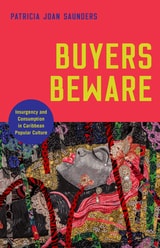
Buyers Beware
Insurgency and Consumption in Caribbean Popular CulturePatricia Joan Saunders
Rutgers University Press, 2022
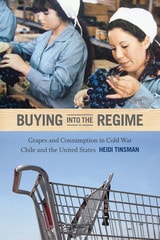
Buying into the Regime
Grapes and Consumption in Cold War Chile and the United StatesHeidi Tinsman
Duke University Press, 2014

Come Buy, Come Buy
Shopping and the Culture of Consumption in Victorian Women’s WritingKrista Lysack
Ohio University Press, 2008
From the 1860s through the early twentieth century, Great Britain saw the rise of the department store and the institutionalization of a gendered sphere of consumption. Come Buy, Come Buy considers representations of the female shopper in British women’s writing and demonstrates how women’s shopping practices are materialized as forms of narrative, poetic, and cultural inscription, showing how women writers emphasize consumerism as productive of pleasure rather than the condition of seduction or loss. Krista Lysack examines works by Christina Rossetti, Mary Elizabeth Braddon, George Eliot, and Michael Field, as well as the suffragette newspaper Votes for Women, in order to challenge the dominant construction of Victorian femininity as characterized by self-renunciation and the regulation of appetite.
Come Buy, Come Buy considers not only literary works, but also a variety of archival sources (shopping guides, women’s fashion magazines, household management guides, newspapers, and advertisements) and cultural practices (department store shopping, shoplifting and kleptomania, domestic economy, and suffragette shopkeeping). With this wealth of sources, Lysack traces a genealogy of the woman shopper from dissident domestic spender to aesthetic connoisseur, from curious shop-gazer to political radical.
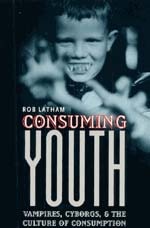
Consuming Youth
Vampires, Cyborgs, and the Culture of ConsumptionRobert Latham
University of Chicago Press, 2002
Inspired by Marx's use of the cyborg vampire as a metaphor for the objectification of physical labor in the factory, Latham shows how contemporary images of vampires and cyborgs illuminate the contradictory processes of empowerment and exploitation that characterize the youth-consumer system. While the vampire is a voracious consumer driven by a hunger for perpetual youth, the cyborg has incorporated the machineries of consumption into its own flesh. Powerful fusions of technology and desire, these paired images symbolize the forms of labor and leisure that American society has staked out for contemporary youth.
A startling look at youth in our time, Consuming Youth will interest anyone concerned with film, television, and popular culture.

Consumption and Violence
Radical Protest in Cold-War West GermanyAlexander Sedlmaier
University of Michigan Press, 2014
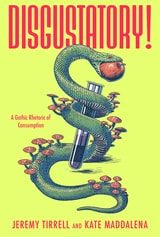
Disgustatory!
A Gothic Rhetoric of ConsumptionJeremy Tirrell and Kate Maddalena
University of Alabama Press, 2026
A critical exploration of how Gothic tropes infiltrate wellness discourse, revealing the rhetorical forces behind our cultural obsession with food, health, and bodily control.
Disgustatory! A Gothic Rhetoric of Consumption unearths the darkness behind modern obsessions with food, health, and bodily optimization. In this provocative and richly interdisciplinary work, Jeremy Tirrell and Kate Maddalena argue that contemporary discourses around food, medicine, and the body are steeped in Gothic rhetoric—where the promise of purity and control is shadowed by monstrosity, abjection, and the uncanny.
From Soylent and nootropics to probiotics and lab-grown meat, Tirrell and Maddalena show how wellness discourse is haunted by Gothic tropes: body horror, hybridity, and existential dread. Wellness culture, they argue, is not merely pseudoscience or fraud but a complex, persuasive rhetoric that blurs science and myth, purity and decay, medicine and mysticism.
Disgustatory! offers a fresh framework: a “Gothic rhetoric of consumption” that explains why we are drawn to weird diets, digital detoxes, and miracle cures. Through case studies of strange substances and stranger practices—Reddit fasting rituals, magic dirt supplements, fecal transplants— Tirrell and Maddalena reveal how fear, fascination, and the fantasy of bodily control animate our health choices. Each chapter explores a rhetorical element—quantification, hybridity, abjection, optimization, and regulation—to show how food becomes a site of cultural anxiety and existential longing. This book will appeal to rhetoricians, scholars of science and technology studies, cultural theorists, and anyone interested in the strange intersections of health, horror, and persuasion.
Distant Reading
Performance, Readership, and Consumption in Contemporary PoetryPeter Middleton
University of Alabama Press, 2005
A dynamic account of the history, practice, and theory of poetry as performance.
Distant Reading considers poetry as performance, offers new insights into its popularity, and proposes a new history of its origins. It also explores related issues concerning the reception of poetry, the impact of the computer on how we read poetry, the persistence of the letter "I" in poems by avant-garde poets, the strangeness of the line-break as a demand on the reader's attention, and the idea of the reader as consumer. These themes are connected by a historically contextualized and theoretically sophisticated discussion of contemporary American and British poets continuing to work in the modernist tradition.
The introductory essay establishes a new methodology that transforms close reading into what Middleton calls "distant reading," interpretive reading that acknowledges the distances that texts travel from their point of composition to readers in other geographical and historical locations. It indicates that poetic innovation is often driven by a desire on the part of the poet to make this distance do cultural work in the meanings that the poem generates.
Ultimately, Distant Reading treats poetry as a cultural practice that is always situated within specific sites of performance—recited on stage, displayed in magazines, laid out on a page, scrolled on the computer screen—rather than as a transcendent cloud of meaning tethered only to its words.
Everyday Ecofascism
Crisis and Consumption in American LiteratureAlexander Menrisky
University of Minnesota Press, 2025
A timely look into how fascist ideas permeate contemporary culture well beyond the far right
As challenges posed by climate change have intensified in the twenty-first century, right-wing figures in the United States and abroad have increasingly framed anti-immigrant, anti-Indigenous, and white-supremacist sentiments in terms of environmental survival. Everyday Ecofascism explores the insidious nature of this tendency, revealing how permutations of these perspectives in fact resonate across the political spectrum. Drawing on comparative studies of fascism writ large, Alexander Menrisky demonstrates that ecofascism is best understood not as a uniquely right-wing ideology but as a political genre that reinforces white supremacy and other forms of domination.
Presenting a view of fascism as a complex power network that plays out on scales both large and small, Menrisky shows how extremist sentiments have crept into everyday language, stories, and ideas. Through a literary and cultural studies lens, he illuminates ecofascism’s narrative patterns and their easy permeation of environmentalist discourses, from back-to-the-land movements to the resurgence of psychedelic drugs, food localism, and pandemic politics. Opposite his analysis of ecofascism in action, Menrisky sheds important light on narrative resistances to dominant conceptions of race, nation, and territory by Native, queer, and women-of-color writers who have countered ethnonationalism for generations.
Bridging past and present, Menrisky powerfully nails down the emergent concept of ecofascism and forms a basis for understanding phenomena like Covid-19, ecological utopianism, and psychedelic environmentalism that detangles ecofascist tendencies from justice-oriented visions of place-based belonging.
Retail e-book files for this title are screen-reader friendly.

Fantasies of Hong Kong Disneyland
Attempted Indigenizations of Space, Labor, and ConsumptionJenny Banh
Rutgers University Press, 2025
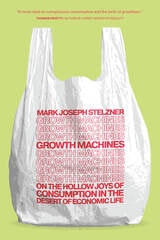
Growth Machines
On the Hollow Joys of Consumption in the Desert of Economic LifeMark Joseph Stelzner
University of Chicago Press, 2026
A provocative look at America’s compulsion to consume and our obsession’s surprising—and strange—origins.
In a capitalist society, people sell their labor to purchase staples like food, shelter, and anxiety medication. That’s the equation of everyday economic life that we’ve always been told is true. Except, is it really that simple anymore? No matter how unmaterialistic you may think you are, odds are that deep within is a drive to consume because it feels good: books you won’t read, clothes you won’t like and might wear even less, a replacement phone whose novelty runs out as quickly as its upgrade hits the market. But what drives this impulse?
In Growth Machines, Mark Joseph Stelzner shows how today’s consumers are now programmed by a US economy intent on infinite growth to work for goods they’ve been convinced they need and conditioned to want. Stelzner establishes the gaps between economic thinking and economic reality, arguing that consumption is no longer just a reflection of needs, but rather, it reflects a need for transaction—in many cases, a treat we seek out because it feels good. We work not only to be able to consume the essentials for living, but also to consume for consumption's sake. Yet such consumption doesn’t make us happier. Stelzner traces this strange nature of consumption to an environmental source: an economy that demands growth. To keep its economy pumping, the US must keep Americans consuming. This makes Stelzner’s book an uncomfortable reflection on how we internalize our economy. To be an American is to consume; to consume is what makes America.
Mex-Ciné
Mexican Filmmaking, Production, and Consumption in the Twenty-first CenturyFrederick Luis Aldama
University of Michigan Press, 2013
RECIPROCAL INFLUENCES
Literary Production, Distribution, and Consumption in AmericaEdited by Steven Fink and Susan S. Williams
The Ohio State University Press, 1999

Regulating Football
Commodification, Consumption and the LawSteve Greenfield and Guy Osborn
Pluto Press, 2001
Reluctant Capitalists
Bookselling and the Culture of ConsumptionLaura J. Miller
University of Chicago Press, 2006
In Reluctant Capitalists, Miller looks at a century of book retailing, demonstrating that the independent/chain dynamic is not entirely new. It began one hundred years ago when department stores began selling books, continued through the 1960s with the emergence of national chain stores, and exploded with the formation of “superstores” in the 1990s. The advent of the Internet has further spurred tremendous changes in how booksellers approach their business. All of these changes have met resistance from book professionals and readers who believe that the book business should somehow be “above” market forces and instead embrace more noble priorities.
Miller uses interviews with bookstore customers and members of the book industry to explain why books evoke such distinct and heated reactions. She reveals why customers have such fierce loyalty to certain bookstores and why they identify so strongly with different types of books. In the process, she also teases out the meanings of retailing and consumption in American culture at large, underscoring her point that any type of consumer behavior is inevitably political, with consequences for communities as well as commercial institutions.
Salvadoran Imaginaries
Mediated Identities and Cultures of ConsumptionCecilia M. Rivas
Rutgers University Press, 2014
In Salvadoran Imaginaries, Cecilia M. Rivas takes us on a journey through twenty-first century El Salvador and to the diverse range of sites where the nation’s postwar identity is being forged. Combining field ethnography with media research, Rivas deftly toggles between the physical spaces where the new El Salvador is starting to emerge and the virtual spaces where Salvadoran identity is being imagined, including newspapers, literature, and digital media. This interdisciplinary approach enables her to explore the multitude of ways that Salvadorans negotiate between reality and representation, between local neighborhoods and transnational imagined communities, between present conditions and dreams for the future.
Everyday life in El Salvador may seem like a simple matter, but Rivas digs deeper, across many different layers of society, revealing a wealth of complex feelings that the nation’s citizens have about power, opportunity, safety, migration, and community. Filled with first-hand interviews and unique archival research, Salvadoran Imaginaries offers a fresh take on an emerging nation and its people.
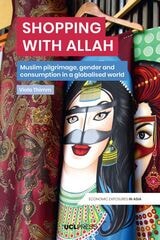
Shopping with Allah
Muslim Pilgrimage, Gender and Consumption in a Globalized WorldViola Thimm
University College London, 2023
Shopping with Allah illustrates the ways in which religion is mobilized in package tourism and how spiritual, economic, and gendered practices are combined in a form of tourism where the goal is not purely leisure but also ethical and spiritual cultivation. Drawing on extensive ethnographic fieldwork in Malaysia, the United Arab Emirates, and Oman, Thimm sheds light on how Islam and gender frame Malaysian religious tourism and pilgrimage to the Arabian Peninsula and raises many issues that are of great importance beyond these regional contexts.
This book also offers an innovative methodological-analytical toolkit to research mobility and intersectionality across sociogeographic scales. By bringing methodological holism into a fruitful engagement with the antiracist-feminist framework intersectionality, Thimm argues that hierarchical relationships, such as marginalization, power, and empowerment, can shift for an individual or a social group depending upon the social sphere.
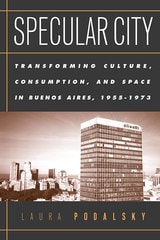
Specular City
The Transformation Of Culture, ConsumptionLaura Podalsky
Temple University Press, 2004

The Making and Unmaking of the Haya Lived World
Consumption, Commoditization, and Everyday PracticeBrad Weiss
Duke University Press, 1996
Grounded in a richly detailed ethnography of Haya practice, Weiss’s analysis considers the symbolic qualities and values embedded in goods and transactions across a wide range of cultural activity: agricultural practice and food preparation, the body’s experience of epidemic disease from AIDS to the infant affliction of “plastic teeth,” and long-standing forms of social movement and migration. Weiss emphasizes how Haya images of consumption describe the relationship between their local community and the global economy. Throughout, he demonstrates that particular commodities and more general market processes are always material and meaningful forces with the potential for creativity as well as disruption in Haya social life. By calling attention to the productive dimensions of this spatial and temporal world, his work highlights the importance of human agency in not only the Haya but any sociocultural order.
Offering a significant contribution to the anthropological theories of practice, embodiment, and agency, and enriching our understanding of the lives of a rural African people, The Making and Unmaking of the Haya Lived World will interest historians, anthropologists, ethnographers, and scholars of cultural studies.
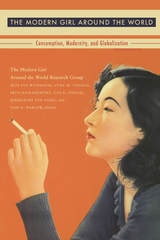
The Modern Girl Around the World
Consumption, Modernity, and GlobalizationThe Modern Girl Around the World Research Group
Duke University Press, 2008
Scholars of history, women’s studies, literature, and cultural studies follow the Modern Girl around the world, analyzing her manifestations in Germany, Australia, China, Japan, France, India, the United States, Russia, South Africa, and Zimbabwe. Along the way, they demonstrate how the economic structures and cultural flows that shaped a particular form of modern femininity crossed national and imperial boundaries. In so doing, they highlight the gendered dynamics of interwar processes of racial formation, showing how images and ideas of the Modern Girl were used to shore up or critique nationalist and imperial agendas. A mix of collaborative and individually authored chapters, the volume concludes with commentaries by Kathy Peiss, Miriam Silverberg, and Timothy Burke.
Contributors: Davarian L. Baldwin, Tani E. Barlow, Timothy Burke, Liz Conor, Madeleine Yue Dong, Anne E. Gorsuch, Ruri Ito, Kathy Peiss, Uta G. Poiger, Priti Ramamurthy, Mary Louise Roberts, Barbara Sato, Miriam Silverberg, Lynn M. Thomas, Alys Eve Weinbaum
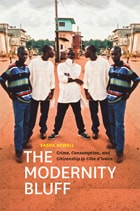
The Modernity Bluff
Crime, Consumption, and Citizenship in Côte d’IvoireSasha Newell
University of Chicago Press, 2012
In Côte d’Ivoire, appearing modern is so important for success that many young men deplete their already meager resources to project an illusion of wealth in a fantastic display of Western imitation, spending far more than they can afford on brand name clothing, accessories, technology, and a robust nightlife. Such imitation, however, is not primarily meant to deceive—rather, as Sasha Newell argues in The Modernity Bluff, it is an explicit performance so valued in Côte d’Ivoire it has become a matter of national pride.
Called bluffeurs, these young urban men operate in a system of cultural economy where reputation is essential for financial success. That reputation is measured by familiarity with and access to the fashionable and expensive, which leads to a paradoxical state of affairs in which the wasting of wealth is essential to its accumulation. Using the consumption of Western goods to express their cultural mastery over Western taste, Newell argues, bluffeurs engage a global hierarchy that is profoundly modern, one that values performance over authenticity—highlighting the counterfeit nature of modernity itself.
The Motherhood Business
Consumption, Communication, and PrivilegeEdited by Anne Teresa Demo, Jennifer L. Borda, and Charlotte Kroløkke
University of Alabama Press, 2015
Examining how motherhood, consumption, and privilege shape identities in contemporary culture.
The Motherhood Business is a piercing collection of ten original essays that reveal the rhetoric of the motherhood industry. Focusing on the consumer life of mothers and the emerging entrepreneurship associated with motherhood, the collection considers how different forms of privilege (class, race, and nationality) inform discourses about mothering, consumption, mobility, and leisure.
The Motherhood Business follows the harried mother’s path into the anxious maelstrom of intelligent toys, healthy foods and meals, and educational choices. It also traces how some enterprising mothers leverage cultural capital and rhetorical vision to create thriving baby- and child-based businesses of their own, as evidenced by the rise of mommy bloggers and “mompreneurs”over the last decade.
Starting with the rapidly expanding global fertility market, The Motherhood Business explores the intersection of motherhood, consumption, and privilege in the context of fertility tourism, international adoption, and transnational surrogacy. The synergy between motherhood and the marketplace demonstrated across the essays affirms the stronghold of “intensive mothering ideology” in decisions over what mothers buy and how they brand their businesses even as that ideology evolves. Across diverse contexts, the volume also identifies how different forms or privilege shape how mothers construct their identities through their consumption and entrepreneurship.
Although social observers have long commented on the link between motherhood and consumerism, little has been written within the field of rhetoric. Penetrating and interdisciplinary, The Motherhood Business illuminates how consumer culture not only shapes contemporary motherhood but also changes in response to mothers who constitute a driving force of the economy.
The Native Leisure Class
Consumption and Cultural Creativity in the AndesRudi Colloredo-Mansfeld
University of Chicago Press, 1999
Tracing the connections among newly invented craft traditions, social networks, and consumption patterns, Rudi Colloredo-Mansfeld highlights the way ethnic identities and class cultures materialize in a sensual world that includes luxurious woven belts, powerful stereos, and garlic roasted cuyes (guinea pigs). Yet this case reaches beyond the Andes. He shows how local and global interactions intensify the cultural expression of the world's emerging "native middle classes," at times leaving behind those unable to afford the new trappings of indigenous identity.
Colloredo-Mansfeld also comments on his experiences working as an artist in Otavalo. His drawings, along with numerous photographs, animate this engaging study in economic anthropology.

The Public Life of the Fetal Sonogram
Technology, Consumption, and the Politics of ReproductionTaylor, Janelle S
Rutgers University Press, 2008
This book offers much-needed critical awareness of the less easily recognized ways in which ultrasound technology is profoundly social and political in the United States today.
The White Savior Film
Content, Critics, and ConsumptionMatthew Hughey
Temple University Press, 2014
In The White Savior Film, Matthew Hughey provides a cogent, multipronged analysis of this subgenre of films to investigate the underpinnings of the Hollywood-constructed images of idealized (and often idealistic) white Americans.
Hughey considers the production, distribution, and consumption of white savior films to show how the dominant messages of sacrifice, suffering, and redemption are perceived by both critics and audiences. Examining the content of fifty films, nearly 3,000 reviews, and interviews with viewer focus groups, he accounts for the popularity of this subgenre and its portrayal of "racial progress."
The White Savior Film shows how we as a society create and understand these films and how they reflect the political and cultural contexts of their time.