Results by title
86 books match the query 'Chile' and 8 start with p
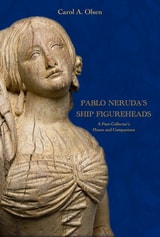
Pablo Neruda's Ship Figureheads
A Poet-Collector's Muses and CompanionsCarol A. Olsen, Foreword by Fernando Sáez Garcia
University of Alabama Press, 2025
Unlock the stories of Pablo Neruda’s rare nineteenth-century carved-wood ship figurehead collection in Chile, why they mattered in his tumultuous life, and how we benefit from them now.
Poet Pablo Neruda’s nineteenth-century ship figurehead collection in Chile is one of the most significant in the world. Containing carved wood images of dramatically postured men and women, these figures are now better understood due to years of research, a willingness to challenge Neruda’s ever-changing stories about them, and a realization that the names Neruda chose for his figureheads perhaps had more to do with his life than theirs. The rhythm and beauty of Neruda’s worn wood figures is counterpoint to his own tumultuous life as an author, politician, and communist dissident.
Collecting ship figureheads was central to Neruda’s passion for owning things made of wood, a material he said was his best friend, and for standing out among others as he gradually built the public persona that helped move him toward winning the Nobel Prize in Literature. With his choir of immobilized figureheads stationed upright in his living room and facing the Pacific Ocean, Neruda was surrounded by dramatic images from the sea that ignited his most powerful feelings.
The nineteenth century saw figureheads on the bows of ships of sail and steam, yet when a figurehead was lost or removed, its history soon disappeared. The significant ship figureheads that Neruda avidly collected preserve that history and reveal new dimensions concerning his life and work. Each year, his collection is viewed by thousands of visitors to the Pablo Neruda Foundation’s house museum at Isla Negra.
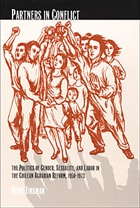
Partners in Conflict
The Politics of Gender, Sexuality, and Labor in the Chilean Agrarian Reform, 1950–1973Heidi Tinsman
Duke University Press, 2002
Tinsman restores women to a scholarly narrative that has been almost exclusively about men, recounting the centrality of women’s labor to the pre-Agrarian Reform world of the hacienda during the 1950s and recovering women’s critical roles in union struggles and land occupations during the Agrarian Reform itself. Providing a theoretical framework for understanding why the Agrarian Reform ultimately empowered men more than women, Tinsman argues that women were marginalized not because the Agrarian Reform ignored women but because, under both the Frei and Allende governments, it promoted the male-headed household as the cornerstone of a new society. Although this emphasis on gender cooperation stressed that men should have more respect for their wives and funneled unprecedented amounts of resources into women’s hands, the reform defined men as its protagonists and affirmed their authority over women.
This is the first monographic social history of Chile’s Agrarian Reform in either English or Spanish, and the first historical work to make sexuality and gender central to the analysis of the reforms.
Past Disquiet
Artists, International Solidarity and Museums in ExileEdited by Kristine Khouri and Rasha Salti
Museum of Modern Art in Warsaw, 2018
Peasants in Revolt
A Chilean Case Study, 1965–1971By James Petras and Hugo Zemelman Merino; translated by Thomas Flory
University of Texas Press, 1973
Based on extended interviews at the Culiprán fundo in Chile with peasants who recount in their own terms their political evolution, this is an in-depth study of peasants in social and political action. It deals with two basic themes: first, the authoritarian structure within a traditional latifundio and its eventual replacement by a peasant-based elected committee, and second, the events shaping the emergence of political consciousness among the peasantry. Petras and Zemelman Merino trace the careers of local peasant leaders, followers, and opponents of the violent illegal land seizure in 1965 and the events that triggered the particular action.
The findings of this study challenge the oft-accepted assumption that peasants represent a passive, traditional, downtrodden group capable only of following urban-based elites. The peasant militants, while differing considerably in their ability to grasp complex political and social problems, show a great deal of political skill, calculate rationally on the possibility of success, and select and manipulate political allies on the basis of their own primary needs. The politicized peasantry lend their allegiance to those forces with whom they anticipate they have the most to gain—and under circumstances that minimize social costs. The authors identify the highly repressive political culture within the latifundio—reinforced by the national political system—as the key factor inhibiting overt expressions of political demands.
The emergence of revolutionary political consciousness is found to be the result of cumulative experiences and the breakdown of traditional institutions of control. The violent illegal seizure of the farm is perceived by the peasantry as a legitimate act based on self-interest as well as general principles of justice—in other words, the seizure is perceived as a “natural act,” suggesting that perhaps two sets of moralities functioned within the traditional system.
The book is divided into two parts: the first part contains a detailed analysis of peasant behavior; the second contains transcriptions of peasant interviews. Combined, they give the texture and flavor of insurgent peasant politics.
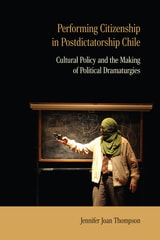
Performing Citizenship in Postdictatorship Chile
Cultural Policy and the Making of Political DramaturgiesJennifer Joan Thompson
Northwestern University Press, 2025
Offering a nuanced understanding of the performing arts’ relationship to politics
Through careful readings of key political performances in Chile's transition from military dictatorship to neoliberal democracy, Jennifer Joan Thompson examines how the production and aesthetics of theater are intertwined in processes of democratization, enactments of citizenship, and the development of cultural policy. Performing Citizenship in Postdictatorship Chile: Cultural Policy and the Making of Political Dramaturgies reveals how artists performed changing models of democratic citizenship. Thompson traces the ways artists confronted and resisted the military dictatorship of Augusto Pinochet, how they then reimagined the body politic during the early transitional period and challenged official constructions of history and memory as the transition to democracy progressed, how they critiqued Chile’s neoliberal economic model and its violence, and, finally, how they have made claims for feminist and Indigenous citizen subjectivities throughout Chile’s current social crisis. Incorporating archival and ethnographic research alongside readings of theatrical and political performances, this study offers a nuanced understanding of the performing arts’ relationship to politics, one that accounts for the ways artists and the state collaborate in the production of the political imagination.
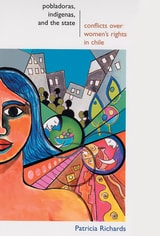
Pobladoras, Indígenas, and the State
Conflict Over Women's Rights in ChileRichards, Patricia
Rutgers University Press, 2004
Chile has made a public commitment to equality between women and men through the creation of a National Women’s Service, SERNAM. Yet, indigenous Mapuche women and working-class pobladora activists assert that they have been excluded from programs implemented by SERNAM. Decisions about what constitutes "women’s interests" are usually made by middle class, educated, lighter-skinned women, and the priorities and concerns of poor, working-class, and indigenous women have not come to the fore.
Through critical analysis of the role of the state, the diversity of women’s movements, and the social and political position of indigenous peoples in Latin America, Richards provides an illuminating discussion of the ways in which the state defines women’s interests and constructs women’s citizenship. This book makes important contributions to feminist studies, theories of citizenship, and studies of the intersections of class, gender, and race.
Political Groups in Chile
The Dialogue between Order and ChangeBy Ben G. Burnett
University of Texas Press, 1970
Before the Pinochet coup in 1973, Chile had a lengthy history of constitutionalism. Early in the republican era the aristocracy established order in the political system; a century later the emergent middle sectors infused politics with wider democratic practices and, relative to most of Latin America, a level of pluralism came to characterize group politics.
Despite the distinctive advantages that embellished Chile’s political system, however, certain unfulfilled promises still marred the actual picture in the early 1960s. As the lower economic strata of society were continually passed over by most of the social reforms and economic advances that bettered the general outlook of the nation, their frustrations were brought out into the open and their votes were appealed to by reformist and radical political parties anxious to break the political hegemony of moderates and conservatives.
Thus, the 1960s stood out as a high-water mark in the confrontation between, on the one side, those desirous of maintaining the status quo, or at most admitting to prescriptive change, and, on the other, progressive elements demanding deep structural alterations in the entire social fabric. This study seeks to analyze the sources of alienation, the styles and objectives of the participants in the confrontation, and the relative ability of groups to gain satisfaction of their claims upon the political system. Ben G. Burnett delineates this dialogue between order and change as it inexorably pushed toward a showdown in the presidential elections of 1964 and the congressional elections of 1965.
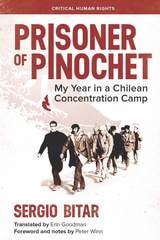
Prisoner of Pinochet
My Year in a Chilean Concentration CampSergio Bitar
University of Wisconsin Press, 2017
Prisoner of Pinochet is the gripping first-person chronicle of Bitar's year as a political prisoner before being expelled from Chile; a poignant narrative of men held captive together in a labor camp under harsh conditions, only able to guess at their eventual fate; and an insightful memoir of the momentous events of the early 1970s that led to seventeen years of bloody authoritarian rule in Chile. Available in English for the first time, this edition includes maps and photos from the 1970s and contextual notes by historian Peter Winn.