Results by title
17 books match the query 'Inventors'
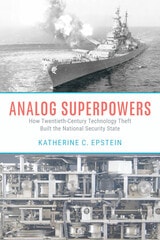
Analog Superpowers
How Twentieth-Century Technology Theft Built the National Security StateKatherine C. Epstein
University of Chicago Press, 2024
At the beginning of the twentieth century, two British inventors, Arthur Pollen and Harold Isherwood, became fascinated by a major military question: how to aim the big guns of battleships. These warships—of enormous geopolitical import before the advent of intercontinental missiles or drones—had to shoot in poor light and choppy seas at distant moving targets, conditions that impeded accurate gunfire. Seeing the need to account for a plethora of variables, Pollen and Isherwood built an integrated system for gathering data, calculating predictions, and transmitting the results to the gunners. At the heart of their invention was the most advanced analog computer of the day, a technological breakthrough that anticipated the famous Norden bombsight of World War II, the inertial guidance systems of nuclear missiles, and the networked “smart” systems that dominate combat today. Recognizing the value of Pollen and Isherwood’s invention, the British Royal Navy and the United States Navy pirated it, one after the other. When the inventors sued, both the British and US governments invoked secrecy, citing national security concerns.
Drawing on a wealth of archival evidence, Analog Superpowers analyzes these and related legal battles over naval technology, exploring how national defense tested the two countries’ commitment to individual rights and the free market. Katherine C. Epstein deftly sets out Pollen’s and Isherwood’s pioneering achievements, the patent questions raised, the geopolitical rivalry between Britain and the United States, and the legal precedents each country developed to control military tools built by private contractors.
Epstein’s account reveals that long before the US national security state sought to restrict information about atomic energy, it was already embroiled in another contest between innovation and secrecy. The America portrayed in this sweeping and accessible history isn’t yet a global hegemon but a rising superpower ready to acquire foreign technology by fair means or foul—much as it accuses China of doing today.
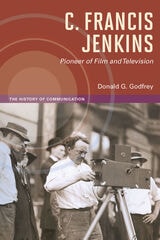
C. Francis Jenkins, Pioneer of Film and Television
Donald G. Godfrey
University of Illinois Press, 2014
This is the first biography of the important but long-forgotten American inventor Charles Francis Jenkins (1867-1934). Historian Donald G. Godfrey documents the life of Jenkins from his childhood in Indiana and early life in the West to his work as a prolific inventor whose productivity was cut short by an early death. Jenkins was an inventor who made a difference.
As one of America's greatest independent inventors, Jenkins's passion was to meet the needs of his day and the future. In 1895 he produced the first film projector able to show a motion picture on a large screen, coincidentally igniting the first film boycott among his Quaker viewers when the film he screened showed a woman's ankle. Jenkins produced the first American television pictures in 1923, and developed the only fully operating broadcast television station in Washington, D.C. transmitting to ham operators from coast to coast as well as programming for his local audience.
Godfrey's biography raises the profile of C. Francis Jenkins from his former place in the footnotes to his rightful position as a true pioneer of today's film and television. Along the way, it provides a window into the earliest days of both motion pictures and television as well as the now-vanished world of the independent inventor.
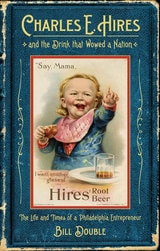
Charles E. Hires and the Drink that Wowed a Nation
The Life and Times of a Philadelphia EntrepreneurBill Double
Temple University Press, 2018
Introduced at the 1876 Centennial Exposition and powered by an historic advertising campaign, Hires Root Beer—launched 10 years before Coca-Cola—blazed the trail for development of the American soft drink industry. Its inventor, Charles Elmer Hires, has been described as “a tycoon with the soul of a chemist.” In addition to creating root beer, Hires, a devoted family man and a pillar of the Quaker community, became a leading importer of botanical commodities, an authority on the vanilla bean. Starting from scratch, he also built one of the world’s largest condensed milk companies.
Charles E. Hires and the Drink that Wowed a Nation chronicles the humble origin and meteoric business success of this extraordinary entrepreneur. Author Bill Double uses published interviews, correspondence, newspaper reports, magazine articles, financial data, and a small family archive to tell this story of native ingenuity. Here, the rough-hewn capitalism of the gilded age, the evolution of the neighborhood drugstore, the rise of advertising in creating mass markets, and the emerging temperance movement all come together in a biography that, well, fizzes with entrepreneurial spirit.

Edison's Electric Light
Friedel, Robert
Rutgers University Press, 1986
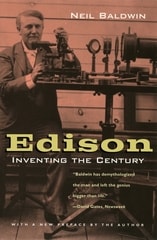
Edison
Inventing the CenturyNeil Baldwin
University of Chicago Press, 2001
Franklin in His Own Time
A Biographical Chronicle of His Life, Drawn from Recollections, Interviews, and Memoirs by Family, Friends, and AssociatesKevin J. Hayes
University of Iowa Press, 2011
@font-face { font-family: "Courier New";}@font-face { font-family: "Times";}@font-face { font-family: "Cambria";}@font-face { font-family: "Palatino";}p.MsoNormal, li.MsoNormal, div.MsoNormal { margin: 0in 0in 0.0001pt; font-size: 12pt; font-family: "Times New Roman"; }div.Section1 { page: Section1; }
In his time Benjamin Franklin (1706–1790) was the most famous American in the world. Even those personally unacquainted with the man knew him as the author of Poor Richard’s Almanack, as a pioneer in the study of electricity and a major figure in the American Enlightenment, as the creator of such life-changing innovations as the lightning rod and America’s first circulating library, and as a leader of the American Revolution. His friends also knew him as a brilliant conversationalist, a great wit, an intellectual filled with curiosity, and most of all a master anecdotist whose vast store of knowledge complemented his conversational skills. In Franklin in His Own Time, by reprinting the original documents in which those anecdotes occur, Kevin Hayes and Isabelle Bour restore those oft-told stories to their cultural contexts to create a comprehensive narrative of his life and work.
The thirty-five recollections gathered in Franklin in His Own Time form an animated, collaborative biography designed to provide a multitude of perspectives on the “First American.” Opening with an account by botanist Peter Kalm showing that Franklin was doing all he could to encourage the development of science in North America, it includes on-the-spot impressions from Daniel Fisher’s diary, the earliest surviving interview with Franklin, recollections from James Madison and Abigail Adams, Manasseh Cutler’s detailed description of the library at Franklin Court, and extracts from Alexander Hamilton’s unvarnished Minutes of the Tuesday Club. Franklin’s political missions to Great Britain and France, where he took full advantage of rich social and intellectual opportunities, are a source of many reminiscences, some published here in new translations. Genuine memories from such old friends as Thomas Jefferson and John Adams, as opposed to memories influenced by the Autobiography, clarify Franklin’s reputation. Robert Carr may have been the last remaining person who knew Franklin personally, and thus his recollections are particularly signific
John Logie Baird
Television pioneerRussell W. Burns
The Institution of Engineering and Technology, 2000
Lincoln the Inventor
Jason Emerson
Southern Illinois University Press, 2009
In Lincoln the Inventor, Jason Emerson offers the first treatment of Abraham Lincoln’s invention of a device to buoy vessels over shoals and its subsequent patent as more than mere historical footnote.
In this book, Emerson shows how, when, where, and why Lincoln created his invention; how his penchant for inventions and inventiveness was part of his larger political belief in internal improvements and free labor principles; how his interest in the topic led him to try his hand at scholarly lecturing; and how Lincoln, as president, encouraged and even contributed to the creation of new weapons for the Union during the Civil War.
During his extensive research, Emerson also uncovered previously unknown correspondence between Lincoln’s son, Robert, and his presidential secretary, John Nicolay, which revealed the existence of a previously unknown draft of Abraham Lincoln’s lecture “Discoveries and Inventions.” Emerson not only examines the creation, delivery, and legacy of this lecture, but also reveals for the first time how Robert Lincoln owned this unknown version, how he lost and later tried to find it, the indifference with which Robert and Nicolay both held the lecture, and their decision to give it as little attention as possible when publishing President Lincoln’s collected works.
The story of Lincoln’s invention extends beyond a boat journey, the whittling of some wood, and a trip to the Patent Office; the invention had ramifications for Lincoln’s life from the day his flatboat got stuck in 1831 until the day he died in 1865. Besides giving a complete examination of this important—and little known—aspect of Lincoln’s life, Lincoln the Inventor delves into the ramifications of Lincoln’s intellectual curiosity and inventiveness, both as a civilian and as president, and considers how it allows a fresh insight into his overall character and contributed in no small way to his greatness. Lincoln the Inventor is a fresh contribution to the field of Lincoln studies about a topic long neglected. By understanding Lincoln the inventor, we better understand Lincoln the man.
Lincoln the Inventor
Jason Emerson
Southern Illinois University Press, 2009
The book that inspired the popular Concise Lincoln Library series
In April 1831, on a flatboat grounded on the Rutledge milldam below the town of New Salem, Abraham Lincoln worked to pry the boat loose, directed the crew, and ran into the village to borrow an augur to bore a hole in the end hanging over the dam, causing the water to drain and the boat to float free. Seventeen years later, while traveling home from a round of political speeches, Lincoln witnessed another similar occurrence. For the rest of his journey, he considered how to construct a device to free stranded boats from shallow waters.
In this first thorough examination of Abraham Lincoln’s mechanical mind, Jason Emerson brings forth the complete story of Lincoln’s invention and patent as more than mere historical footnote. Emerson shows how, when, where, and why Lincoln developed his invention; how his penchant for inventions and innovation was part of his larger political belief in internal improvements and free labor principles; how his interest in the topic led him to try his hand at scholarly lecturing; and how Lincoln, as president, encouraged and even contributed to the creation of new weapons for the Union during the Civil War.
Lincoln the Inventor delves into the ramifications of Lincoln’s intellectual curiosity and inventiveness, both as a civilian and as president, and considers how they allow a fresh insight into his overall character and contributed in no small way to his greatness. By understanding Lincoln the inventor, we better understand Lincoln the man.
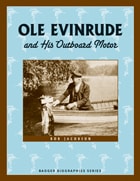
Ole Evinrude and His Outboard Motor
Bob Jacobson
Wisconsin Historical Society Press, 2009
Wisconsin entrepreneur Ole Evinrude will inspire children in this addition to the Badger Biographies series for young readers, where the story of Ole's invention, from drawing board to factory floor, is told in a reader-friendly format that includes historic images, a glossary of terms, and sidebars explaining how an outboard motor works.
Ole Evinrude was born in Norway in 1877 and immigrated to the United States when he was five years old. The Evinrude family settled in Wisconsin and began farming, but it was clear from a very young age that Ole would not follow the family tradition. Ole Evinrude was meant to work with boats.
Building an outboard motor was not easy, though - Ole suffered numerous mechanical and financial setbacks along the way. After years of hard work and persistence, the Evinrude motor company was founded and Ole's outboard motors were an instant hit around the world. Ole continued to improve the design of his motor and attracted other entrepreneurs to the area, making Wisconsin the center of the outboard motor industry for decades.
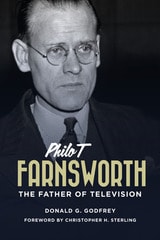
Philo T Farnsworth
Donald Godfrey
University of Utah Press, 2001
Philo T. Farnsworth (1906–1971) has been called the "forgotten father of television." He grew up in Utah and southern Idaho, and was described as a genius by those who knew and worked with him. With only a high school education, Farnsworth drew his first television schematic for his high school teacher in Rigby, Idaho. Subsequent claims and litigation notwithstanding, he was the first to transmit a television image.
Farnsworth filed ten patents between 1927 and 1929 for camera tubes (transmitting), circuitry, and the cathode ray tube (viewing). After his early years as an inventor in San Francisco, he worked as an engineer, doing battle with RCA in the 1930s over patent rights, formed the Farnsworth Television Company in the 1940s, and worked for IT&T after their purchase of the Farnsworth enterprises. Every television set sold utilized at least six of his basic patents.
Because of endless legal wrangling with RCA over patent rights, he received very little financial reward for his television patents. Donald Godfrey examines the genius and the failures in the life of Philo Farnsworth as he struggled to be both inventor and entrepreneur.

Restoring Baird's Image
Donald F. McLean
The Institution of Engineering and Technology, 2000
The Accidental Network
How a Small Company Sparked a Global Broadband TransformationRouzbeh Yassini-Fard
West Virginia University Press, 2025
The Accidental Network shares the untold story of the invention of the cable modem by the small, struggling tech company LANcity in the early 1990s, illustrating how Yassini-Fard overcame a cascade of technical challenges, investment community naysayers, and unnerving business obstacles to create the cable modem technology that has changed the way billions of individuals across the globe now manage their daily lives and commerce. The cable modem delivered broadband, with speeds ranging from 10 megabits per second (Mbps) to 10 gigabits per second (Gbps)—a big leap from the dial-up speeds of 56 kilobits per second (Kbps). This platform, along with the adoption of the DOCSIS (Data Over Cable Service Interface Specification) standard, engendered the modern revolution in broadband Internet access. Shunned by venture capitalists and surviving on a shoestring budget, Yassini-Fard and his colleagues were willing to bet it all (including the deed for Yassini-Fard’s home) on the creation of the cable modem and the pursuit of global adoption.
The Accidental Network is both a valuable history of technology innovation and an engrossing account of business conducted at high speed. The book details Yassini-Fard’s journey from electrical engineer to entrepreneur in the race to secure technology partners, create a wholly new marketplace, and convince cable industry executives that a bold business awaited in transmitting data to households at a time when skepticism about the reach of personal computing was the norm.
Written from the lens of a devoted idealist and WVU alum known as “the father of the cable modem,” this book reveals how a perfect storm of forces—the rise of cable television, the onset of the personal computing era, a growing awareness of the Internet for information and commerce, and the development of the cable modem—converged to usher in the age of broadband access.
The Inventors
And Other PoemsRené Char
Seagull Books, 2015
The Inventors includes a brief introduction to Char’s life and work, as well as a series of notes on the backstories of the works, which explain allusions that may not be immediately familiar to the English-speaking reader. These new translations stay true to the originals, while at the same time conveying much of the music and beauty of the French poems.
Praise for René Char
“Char, I believe, is a poet who will tower over twentieth-century French poetry.”—George Steiner
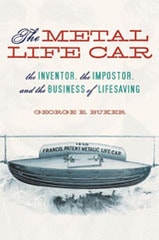
The Metal Life Car
The Inventor, the Impostor, and the Business of LifesavingGeorge E. Buker
University of Alabama Press, 2008
Engineering the battlefield—one armored advance at a time.
For centuries sailing vessels crept along the coastline, ready to flee ashore in case of danger or trouble; this worked well until weather or poor sailing drove these ships against an unforgiving coast. Saviors and salvors (often the same people) struggled to rescue both humans and cargo, often with results as tragic for them as for the sailors and passengers.
Joseph Francis (b. Boston, Massachusetts, 1801) was an inventor who also had the ability to organize a business to produce his inventions and the salesmanship to sell his products. His metal lifeboats, first used in survey expeditions in Asia Minor and Central America, came into demand among the world’s merchant marine, the U.S. Navy, and the U.S. Revenue Service. His corrugated “life car” was the keystone to development of the U.S. Life-Saving Service. Francis’s metal bateaux and lifeboats played an important role in the Third Seminole War in Florida. His metal pontoon army wagons served in the trans-Mississippi campaigns against the Indians.
In Europe, he was acclaimed as a genius and sold patent rights to shipyards in Liverpool and the Woolwich Arsenal in England, Le Havre seaport in France, in the free city of Hamburg, and in the Russian Empire. But while Francis was busy in Europe, Captain Douglass Ottinger, U.S. Revenue Marine Service, claimed to be the inventor of Francis’s life car and obtained support in the U.S. Congress and the Patent Office for his claim. Francis had to battle for decades to prove his rights, and Americans remained generally unfamiliar with his devices, thereby condemning Civil War armies to inferior copies while Europe was using, and acclaiming, his inventions.

We Have All Gone Away
Curtis Harnack
University of Iowa Press, 1973
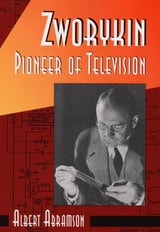
Zworykin, Pioneer of Television
Albert Abramson. Foreword by Erik Barnouw
University of Illinois Press, 1995
"His achievements rank him with Thomas Edison and Alexander Graham Bell," states Albert Abramson in this discerning, often dramatic biography of Vladimir Kosma Zworykin, the Russian-born scientist who "did more to create our present system of cathode-ray television than any other person."