Results by title
662 books match the query 'China' and 32 start with p
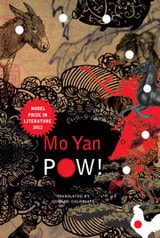
POW!
Mo Yan
Seagull Books, 2012
In this novel by the 2012 Nobel Laureate in Literature, Mo Yan, a benign old monk listens to a prospective novice’s tale of depravity, violence, and carnivorous excess while a nice little family drama—in which nearly everyone dies—unfurls. But in this tale of sharp hatchets, bad water, and a rusty WWII mortar, we can’t help but laugh. Reminiscent of the novels of dark masters of European absurdism like Günter Grass, Witold Gombrowicz, or Jakov Lind, Mo Yan’s POW! is a comic masterpiece.
In this bizarre romp through the Chinese countryside, the author treats us to a cornucopia of cooked animal flesh—ostrich, camel, donkey, dog, as well as the more common varieties. As his dual narratives merge and feather into one another, each informing and illuminating the other, Mo Yan probes the character and lifestyle of modern China. Displaying his many talents, as fabulist, storyteller, scatologist, master of allusion and cliché, and more, POW! carries the reader along quickly, hungrily, and giddily, up until its surprising dénouement.
Mo Yan has been called one of the great novelists of modern Chinese literature and the New York Times Book Review has hailed his work as harsh and gritty, raunchy and funny. He writes big, sometimes mystifying, sometimes infuriating, but always entertaining novels—and POW! is no exception.
Pacific Crossing
California Gold, Chinese Migration, and the Making of Hong KongElizabeth Sinn
Hong Kong University Press, 2014
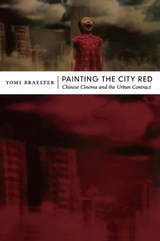
Painting the City Red
Chinese Cinema and the Urban ContractYomi Braester
Duke University Press, 2010
Drawing on extensive archival research, interviews with leading filmmakers and urban planners, and close readings of scripts and images, Braester describes how films and stage plays have promoted and opposed official urban plans and policies as they have addressed issues such as demolition-and-relocation plans, the preservation of vernacular architecture, and the global real estate market. He shows how the cinematic rewriting of historical narratives has accompanied the spatial reorganization of specific urban sites, including Nanjing Road in Shanghai; veterans’ villages in Taipei; and Tiananmen Square, centuries-old courtyards, and postmodern architectural landmarks in Beijing. In Painting the City Red, Braester reveals the role that film and theater have played in mediating state power, cultural norms, and the struggle for civil society in Chinese cities.
Pan Chao
Foremost Woman Scholar of ChinaNancy Lee Swann
University of Michigan Press, 2001
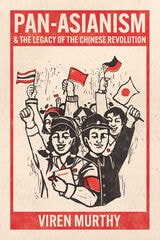
Pan-Asianism and the Legacy of the Chinese Revolution
Viren Murthy
University of Chicago Press, 2023
Recent proposals to revive the ancient Silk Road for the contemporary era and ongoing Western interest in China’s growth and development have led to increased attention to the concept of pan-Asianism. Most of that discussion, however, lacks any historical grounding in the thought of influential twentieth-century pan-Asianists. In this book, Viren Murthy offers an intellectual history of the writings of theorists, intellectuals, and activists—spanning leftist, conservative, and right-wing thinkers—who proposed new ways of thinking about Asia in their own historical and political contexts. Tracing pan-Asianist discourse across the twentieth century, Murthy reveals a stronger tradition of resistance and alternative visions than the contemporary discourse on pan-Asianism would suggest. At the heart of pan-Asianist thinking, Murthy shows, were the notions of a unity of Asian nations, of weak nations becoming powerful, and of the Third World confronting the “advanced world” on equal terms—an idea that grew to include non-Asian countries into the global community of Asian nations. But pan-Asianists also had larger aims, imagining a future beyond both imperialism and capitalism. The fact that the resurgence of pan-Asianist discourse has emerged alongside the dominance of capitalism, Murthy argues, signals a profound misunderstanding of its roots, history, and potential.
Pandemic Crossings
Digital Technology, Everyday Experience, and Governance in the COVID-19 CrisisGuobin Yang
Michigan State University Press, 2024
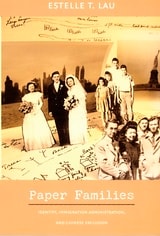
Paper Families
Identity, Immigration Administration, and Chinese ExclusionEstelle T. Lau
Duke University Press, 2006
Drawing on these documents as well as immigration case files, legislative materials, and transcripts of interviews and court proceedings, Lau reveals immigration as an interactive process. Chinese immigrants and their U.S. families were subject to regulation and surveillance, but they also manipulated and thwarted those regulations, forcing the U.S. government to adapt its practices and policies. Lau points out that the Exclusion Acts and the pseudo-familial structures that emerged in response have had lasting effects on Chinese American identity. She concludes with a look at exclusion’s legacy, including the Confession Program of the 1960s that coerced people into divulging the names of paper family members and efforts made by Chinese American communities to recover their lost family histories.
Paths to Power
Elite Mobility in Contemporary ChinaBy David M. Lampton with the assistance of Yeung Sai-cheung
University of Michigan Press, 2000
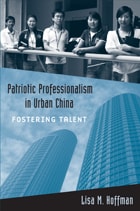
Patriotic Professionalism in Urban China
Fostering TalentAuthored by Lisa M. Hoffman
Temple University Press, 2010
In the post-Maoist era, China adopted a strategy for investing in the “quality” of its people—through education and training opportunities—that created talented labor. In her significant ethnographic study, Patriotic Professionalism in Urban China, Lisa Hoffman explains why the development of “human capital” is seen as fundamental for economic growth and national progress. She examines these new urban employees, who were deemed vital to the success of the global city in China, and who hoped for social mobility, a satisfying career, and perhaps a family.
Patriotic Professionalism in Urban China addresses the emergence of this urban professional subject in Dalian, a port city in China. Hoffman identifies who these new professionals are, what choices they have made, and how they have remained closely connected with the nation—although not necessarily the Communist party—leading to a new social form she calls “Patriotic Professionalism.”
Hoffman contributes to the understanding of changing urban life in China while providing an analysis of the country’s “late-socialist neoliberalism.” In the process, she asks pressing questions about how such shifts in urban life reshape cities, impact individual and family decisions, and reflect economic growth in China in tandem with “global” neoliberal practices.
Pattern and Loom
A Practical Study of the Development of Weaving Techniques in China, Western Asia and EuropeJohn Becker
National University of Singapore Press, 2014
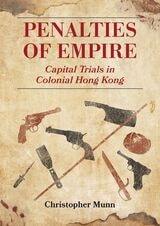
Penalties of Empire
Capital Trials in Colonial Hong KongChristopher Munn
Hong Kong University Press, 2025
"We must have a procedure – if we are going to hang anyone – that is just," said Chief Justice Sir Francis Piggott in 1909, on discovering that Chinese persons accused of murder were being denied interpretation in Hong Kong’s courts. Due process, no matter how costly or inconvenient, was "one of the penalties of empire," he declared.
Penalties of Empire explores how judges, juries, and lawyers strove to deliver justice during the 150 years when the death penalty was in force in Hong Kong. Nine main chapters focus on key capital trials in the first century of British rule. Among the cases are piracies, assassinations, crimes of passion, and murders committed from desperation. These chapters describe the proceedings and participants in court. They also examine the public debates surrounding each case and the exercise of mercy by governors. Two final chapters discuss the decline of the death penalty after World War II, its suspension after 1966, and the controversies leading to its formal abolition in 1993. Penalties of Empire traces the evolution of criminal justice at its highest levels. It also offers a prism for understanding some of the broader forces at work in Hong Kong’s history.
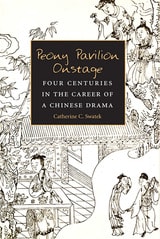
Peony Pavilion Onstage
Four Centuries in the Career of a Chinese DramaCatherine C. Swatek
University of Michigan Press, 2012
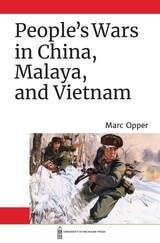
People's Wars in China, Malaya, and Vietnam
Marc Opper
University of Michigan Press, 2020
People’s Wars in China, Malaya, and Vietnam explains why some insurgencies collapse after a military defeat while under other circumstances insurgents are able to maintain influence, rebuild strength, and ultimately defeat the government. The author argues that ultimate victory in civil wars rests on the size of the coalition of social groups established by each side during the conflict. When insurgents establish broad social coalitions (relative to the incumbent), their movement will persist even when military defeats lead to loss of control of territory because they enjoy the support of the civilian population and civilians will not defect to the incumbent. By contrast, when insurgents establish narrow coalitions, civilian compliance is solely a product of coercion. Where insurgents implement such governing strategies, battlefield defeats translate into political defeats and bring about a collapse of the insurgency because civilians defect to the incumbent. The empirical chapters of the book consist of six case studies of the most consequential insurgencies of the 20th century including that led by the Chinese Communist Party from 1927 to 1949, the Malayan Emergency (1948–1960), and the Vietnam War (1960–1975). People’s Wars breaks new ground in systematically analyzing and comparing these three canonical cases of insurgency. The case studies of China and Malaya make use of Chinese-language archival sources, many of which have never before been used and provide an unprecedented level of detail into the workings of successful and unsuccessful insurgencies. The book adopts an interdisciplinary approach and will be of interest to both political scientists and historians.
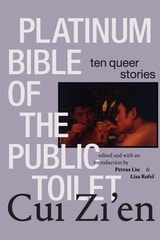
Platinum Bible of the Public Toilet
Ten Queer StoriesCui Zi'en. Edited and with an introduction by Petrus Liu and Lisa Rofel
Duke University Press, 2024
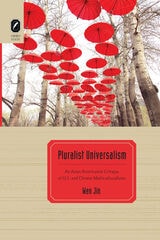
Pluralist Universalism
An Asian Americanist Critique of U.S. and Chinese MulticulturalismsWen Jin
The Ohio State University Press, 2012
Pluralist Universalism: An Asian Americanist Critique of U.S. and Chinese Multiculturalisms by Wen Jin is an extended comparison of U.S. and Chinese multiculturalisms during the post–Cold War era. Her book situates itself at the intersection of Asian American literary critique and the growing field of comparative multiculturalism. Through readings of fictional narratives that address the issue of racial and ethnic difference in both national contexts simultaneously, the author models a “double critique” framework for U.S.–Chinese comparative literary studies.
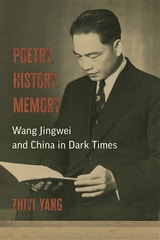
Poetry, History, Memory
Wang Jingwei and China in Dark TimesZhiyi Yang
University of Michigan Press, 2023
Wang Jingwei, poet and politician, patriot and traitor, has always been a figure of major academic and popular interest. Until now, his story has never been properly told, let alone critically investigated. The significance of his biography is evident from an ongoing war on cultural memory: modern mainland China prohibits serious academic research on wartime collaboration in general, and on Wang Jingwei in particular. At this critical juncture, when the recollection of World War II is fading from living memory and transforming into historical memory, this knowledge embargo will undoubtedly affect how China remembers its anti-fascist role in WWII. In Poetry, History, Memory: Wang Jingwei and China in Dark Times, Zhiyi Yang brings us a long overdue reexamination of Wang’s impact on cultural memory of WWII in China.
In this book, Yang brings disparate methodologies into a fruitful dialogue, including sophisticated methods of poetic interpretation. The author argues that Wang’s lyric poetry, as the public performance of a private voice, played a central role in constructing his political identity and heavily influenced the public’s posthumous memory of him. Drawing on archives (in the PRC, Taiwan, Japan, the USA, France, and Germany), memoires, historical journals, newspapers, interviews, and other scholarly works, this book offers the first biography of Wang that addresses his political, literary, and personal life in a critical light and with sympathetic impartiality.

Poets and Murder
A Judge Dee MysteryRobert van Gulik
University of Chicago Press, 1968
Judge Dee, the master detective of seventh-century China, sets out to solve a puzzling double murder and discovers complex passions lurking beneath the placid surface of academic life. A mild-mannered student is rumored to have been slain by a fox-demon, while a young dancer meets her death as she dresses to perform for the magistrate's illustrious dinner guests—an obese Zen monk revered for his calligraphy, a beautiful poetess accused of murder, and the past president of the imperial academy. To connect the present crimes with betrayals and adulteries from decades past, the clever judge must visit a high-class brothel and the haunted shrine of the Black Fox. From the moment the young scholar is found dead on the eve of the Autumn Festival, the pace never lets up.
Policing Chinese Politics
A HistoryMichael Dutton
Duke University Press, 2005
The economic reform period that followed Mao Zedong’s rule contained a hint as to how the magic spell of political faith and commitment could be broken, but the cost of such disenchantment was considerable. This detailed, empirical tale of Chinese socialist policing is, therefore, more than simply a police story. It is a parable that offers a cogent analysis of Chinese politics generally while radically redrafting our understanding of what politics is all about. Breaking away from the traditional elite modes of political analysis that focus on personalities, factions, and betrayals, and from “rational” accounts of politics and government, Dutton provides a highly original understanding of the far-reaching consequences of acts of faith and commitment in the realm of politics.
Political Trust in China
Lianjiang Li
University of Michigan Press, 2025
Politics of Legitimacy
State-Society Relations and Patterns of Chinese PoliticsDingxin Zhao
University of Chicago Press, 2026
The Chinese communist state has survived massive social changes, including the introduction of capitalist markets, an ongoing explosion of technological innovation, and an unprecedented jump in wealth and education, accompanied by a major cultural transformation. How has China managed to maintain its power even as the ground has so profoundly shifted? In Politics of Legitimacy, Dingxin Zhao argues that state power can be legitimized in three ideal-typical ways: a set of values upheld by the state (ideological legitimacy), recognized political processes such as regular competitive elections (procedural legitimacy), and the state’s capacity to provide public goods (performance legitimacy).
Building on this theoretical framework, Zhao analyzes different aspects of Chinese politics, including the tragic ending of the 1989 pro-democracy movement, the weak development of mass-based nationalism in post-Mao China, the reasons behind China’s economic success, the anti-establishment tendency of the Chinese mass media and social media, and the sources of political tension in China, despite a superb economy. Moreover, Zhao’s innovative framework is widely applicable beyond China, shifting our attention from regime-type categories to the tools and relationships that determine their survival or collapse, and illuminating the current global emergence of conservatism and religious nationalism.
Politics, Ideology, and Literary Discourse in Modern China
Theoretical Interventions and Cultural CritiqueKang Liu and Xiaobing Tang, eds.
Duke University Press, 1993
With chapters by writers, scholars, and critics from mainland China, Hong Kong, and the United States, this volume explores the complexity of representing modernity within the Chinese context. Addressing the problem of finding a proper language for articulating fundamental issues in the historical experience of twentieth-century China, the authors critically re-examine notions of realism, the self/subject, and modernity and draw on perspectives from feminist criticism, ideological analysis, and postmodern theory. Among the many topics explored are subjectivity in Chinese cultural theory, Chinese gender relations, the viability of a Lacanian approach to Chinese identity, the politics of subversion in Chinese reportage, and the ambivalent status of the icon of paternity since Mao.
At the same time this book offers a probing look into the transformation that Chinese culture as well as the study of that culture is currently undergoing, it also reconfirms private discourse as an ideal site for an investigation into a real and imaginary, private and collective encounter with history.
Contributors. Liu Kang, Xiaobing Tang, Liu Zaifu, Stephen Chan, Lydia H. Liu, Wendy Larson, Theodore Huters, David Wang, Tonglin Lu, Yingjin Zhang, Yuejin Wang, Li Tuo, Leo Ou-fan Lee
Postmodernism and China
Arif Dirlik and Xudong Zhang, eds.
Duke University Press, 2000
Collectively, these essays question the implications of specific phenomena, like literature, architecture, rock music, and film, in a postsocialist society. Some essays address China’s complicity in—as well as its resistance to—the culture of global capitalism. Others evaluate the impact of efforts to redefine national culture in terms of enhanced freedoms and expressions of the imagination in everyday life. Still others discuss the general relaxation of political society in post-Mao China, the emergence of the market and its consumer mass culture, and the fashion and discourse of nostalgia. The contributors make a clear case for both the historical uniqueness of Chinese postmodernism and the need to understand its specificity in order to fully grasp the condition of postmodernity worldwide. Although the focus is on mainland China, the volume also includes important observations on social and cultural realities in Hong Kong and Taiwan, whose postmodernity has so far been confined—in both Chinese and English-speaking worlds—to their economic and consumer activities instead of their political and cultural dynamism.
First published as a special issue of boundary 2, Postmodernism and China includes seven new essays. By juxtaposing postmodernism with postsocialism and by analyzing China as a producer and not merely a consumer of the culture of the postmodern, it will contribute to critical discourses on globalism, modernity, and political economics, as well as to cultural and Asian studies.
Contributors. Evans Chan, Arif Dirlik, Dai Jinhua, Liu Kang, Anthony D. King, Jeroen de Kloet, Abidin Kusno, Wendy Larson, Chaoyang Liao, Ping-hui Liao, Sebastian Hsien-hao Liao, Sheldon Hsiao-peng Lu, Wang Ning, Xiaobing Tang, Xiaoying Wang, Chen Xiaoming, Xiaobin Yang, Zhang Yiwu, Xudong Zhang

Postmodernism and China, Volume 24
Arif Dirlik and Zhang Xudong
Duke University Press, 0
Postsocialism and Cultural Politics
China in the Last Decade of the Twentieth CenturyXudong Zhang
Duke University Press, 2008
Zhang examines the reactions of intellectuals, authors, and filmmakers to the cultural and political conflicts in China during the 1990s. He offers a nuanced assessment of the changing divisions and allegiances within the intellectual landscape, and he analyzes the postsocialist realism of the era through readings of Mo Yan’s fiction and the films of Zhang Yimou. With Postsocialism and Cultural Politics, Zhang applies the same keen insight to China’s long 1990s that he brought to bear on the 1980s in Chinese Modernism in the Era of Reforms.
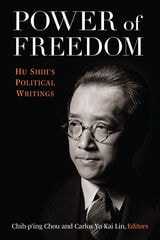
Power of Freedom
Hu Shih's Political WritingsChih-p'ing Chou and Carlos Yu-Kai Lin, Editors
University of Michigan Press, 2022
For decades—and today to a certain extent—Hu Shih’s political writings were considered sensitive and even dangerous. As a strident critic of the Chinese Communist Party’s oligarchical practices, he was targeted by the CCP in a concerted national campaign to smear his reputation, cast aspersions on his writings, and generally destroy any possible influence he might have in China. This volume brings together a collection of Hu Shih’s most important, mostly unpublished, English-language speeches, interviews, and commentaries on international politics, China-U.S. relations, and the International Communist Movement. Taken together, these works provide an insider’s perspective on Sino-American relations and the development of the International Communist Movement over the course of the 20th century.
Power over Property
The Political Economy of Communist Land Reform in ChinaMatthew Noellert
University of Michigan Press, 2020
Power Over Property argues that in practice, however, the opposite occurred: the redistribution of political power led to a more equal distribution of property. China’s land reform was accomplished not only through the state’s power to define the distribution of resources, but also through village communities prioritizing political entitlements above property rights. Through the systematic analysis of never-before studied micro-level data on practices of land reform in over five hundred villages, Power Over Property demonstrates how land reform primarily involved the removal of former power holders, the mobilization of mass political participation, and the creation of a new social-political hierarchy. Only after accomplishing all of this was it possible to redistribute land. This redistribution, moreover, was determined by political relations to a new structure of power, not just economic relations to the means of production.
The experience of China’s land reform complicates our understanding of the relations between economic, social, and political equality. On the one hand, social equality in China was achieved through political, not economic means. On the other hand, the fundamental solution was a more effective hierarchy of fair entitlements, not equal rights. This book ultimately suggests that focusing on economic equality alone may obscure more important social and political dynamics in the development of the modern world.
Power, Money, and Media
Communication Patterns and Bureaucratic Control in Cultural ChinaChin-Chuan Lee
Northwestern University Press, 2000
Precarious Accumulation
Fast Fashion Bosses in Transnational GuangzhouNellie Chu
Duke University Press, 2026
Preschool in Three Cultures Revisited
China, Japan, and the United StatesJoseph Tobin, Yeh Hsueh, and Mayumi Karasawa
University of Chicago Press, 2009
Published twenty years ago, the original Preschool in Three Cultures was a landmark in the study of education: a profoundly enlightening exploration of the different ways preschoolers are taught in China, Japan, and the United States. Here, lead author Joseph Tobin—along with new collaborators Yeh Hsueh and Mayumi Karasawa—revisits his original research to discover how two decades of globalization and sweeping social transformation have affected the way these three cultures educate and care for their youngest pupils. Putting their subjects’ responses into historical perspective, Tobin, Hsueh, and Karasawa analyze the pressures put on schools to evolve and to stay the same, discuss how the teachers adapt to these demands, and examine the patterns and processes of continuity and change in each country.
Featuring nearly one hundred stills from the videotapes, Preschool in Three Cultures Revisited artfully and insightfully illustrates the surprising, illuminating, and at times entertaining experiences of four-year-olds—and their teachers—on both sides of the Pacific.
Prisoners of Shangri-La
Tibetan Buddhism and the WestDonald S. Lopez Jr.
University of Chicago Press, 1998
"Lopez lifts the veil on America's romantic vision of Tibet to reveal a country and a spiritual history more complex and less ideal than popular perceptions allow. . . . Lively and engaging, Lopez's book raises important questions about how Eastern religions are often co-opted, assimilated and misunderstood by Western culture."—Publishers Weekly
"Proceeding with care and precision, Lopez reveals the extent to which scholars have behaved like intellectual colonialists. . . . Someone had to burst the bubble of pop Tibetology, and few could have done it as resoundingly as Lopez."—Booklist
"Fascinating. . . [A] provocative exploration. Lopez conveys the full dizziness of the Western encounter with Tibet and Tibetan Buddhism."—Fred Pheil, Tricycle: The Buddhist Review
"A timely and courageous exploration. . . . [Lopez's] book will sharpen the terms of the debate over what the Tibetans and their observers can or should be doing about the place and the idea of Tibet. And that alone is what will give us all back our Shambhala."—Jonathan Spence, Lingua Franca Book Review
"Lopez's most important theme is that we should be wary of the idea . . . that Tibet has what the West lacks, that if we were only to look there we would find the answers to our problems. Lopez's book shows that, on the contrary, when the West has looked at Tibet, all that it has seen is a distorted reflection of itself."—Ben Jackson, Times Higher Education Supplement
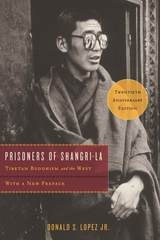
Prisoners of Shangri-La
Tibetan Buddhism and the WestDonald S. Lopez, Jr.
University of Chicago Press, 2018
Upon its original publication, Prisoners of Shangri-La sent shockwaves through the field of Tibetan studies—hailed as a timely, provocative, and courageous critique. Twenty years hence, the situation in Tibet has only grown more troubled and complex—with the unrest of 2008, the demolition of the dwellings of thousands of monks and nuns at Larung Gar in 2016, and the scores of self-immolations committed by Tibetans to protest the Dalai Lama’s exile.
In his new preface to this anniversary edition, Lopez returns to the metaphors of prison and paradise to illuminate the state of Tibetan Buddhism—both in exile and in Tibet—as monks and nuns still seek to find a way home. Prisoners of Shangri-La remains a timely and vital inquiry into Western fantasies of Tibet.
Producing Guanxi
Sentiment, Self, and Subculture in a North China VillageAndrew B. Kipnis
Duke University Press, 1997
Producing Guanxi combines the theory of Pierre Bourdieu and the insights of symbolic anthropology to contest past portrayals of guanxi as either a function of Chinese political economics or an unchanging Confucian social structure. In this analysis guanxi emerges as a purposeful human effort that makes use of past cultural logics while generating new ones. By exploring the role of sentiment in the creation of self, Kipnis critiques recent theories of subjectivity for their narrow focus on language and discourse, and contributes to the anthropological discussion of comparative selfhood. Navigating a path between mainstream social science and abstract social theory, Kipnis presents a more nuanced examination of guanxi than has previously been available and contributes generally to our understanding of relationships and human action.