401 books match the query 'Civil War, 1861-1865' and 12 start with p

cover of Pea Ridge and Prairie Grove: Scenes and Incidents fo the War in Arkansas

Pea Ridge and Prairie Grove

Scenes and Incidents fo the War in Arkansas

William Baxter

University of Arkansas Press, 2000

With the goal of sketching “at least some of the bright lights and dark shadows of the war;” William Baxter authored his regional classic, Pea Ridge and Prairie Grove, in 1864, before the actual end of the Civil War.

Primarily focusing on the civilians of the region, Baxter vividly describes their precarious and vulnerable positions during the advances and retreats of armies as Confederate and Federal forces marched across their homeland. In his account, Baxter describes skirmishes and cavalry charges outside his front door, the “firing” of his town’s buildings during a Confederate retreat, clashes between secessionist and Unionist neighbors, the feeding of hungry soldiers and the forceful appropriation of his remaining food supply, and the sickening sight of the wounded emerging from the Prairie Grove battlefield.

Since its original printing, this firsthand account has only been reprinted once, in 1957, and both editions are considered collectors’ items today. Of interest to Civil War scholars and general readers alike, Baxter’s compelling social history is rendered even more comprehensive by William Shea’s introduction. Pea Ridge and Prairie Grove is a valuable personal account of the Civil War in the Trans-Mississippi West which enables us to better comprehend the conflict as a whole and its devastating effect on the general populace of the war-torn portions of the country.
[more]
cover of Peculiar Honor: A History of the 28th Texas Cavalry 1862-1865

Peculiar Honor

A History of the 28th Texas Cavalry 1862-1865

Jane Johansson

University of Arkansas Press, 1998
This regimental history tells the story of the 28th Texas Cavalry (dismounted), a unit of Walker's Texas Division which campaigned throughout the Civil War in Arkansas, Louisiana and Texas. Part of the division known as "Walker's Greyhounds" because of their amazing mobility and stamina, the men of the 28th, helped preserve Texas from Federal invasion. 1997 Winner of the Ottis Lock Award for the Best Book on East Texas History
[more]
cover of Personal Memoirs of John H. Brinton: Civil War Surgeon, 1861-1865

Personal Memoirs of John H. Brinton

Civil War Surgeon, 1861-1865

John H. Brinton. Preface by John S. Haller, Jr. Foreword by John Y. Simon

Southern Illinois University Press, 1996

John Hill Brinton (1832–1907) met, observed, and commented on practically the entire hierarchy of the Union army; serving as medical director for Ulysses S. Grant, he came into contact with Philip H. Sheridan, John C. Frémont, Henry W. Halleck, William A. Hammond, D. C. Buell, John A. Rawlins, James Birdseye McPherson, C. F. Smith, John A. McClernand, William S. Rosecrans, and his first cousin George Brinton McClellan. John Y. Simon points out in his foreword that Brinton was one of the first to write about a relatively obscure Grant early in the war:

"Brinton found a quiet and unassuming man smoking a pipe—he could not yet afford cigars— and soon recognized a commander with mysterious strength of intellect and character."

Positioned perfectly to observe the luminaries of the military, Brinton also occupied a unique perspective from which to comment on the wretched state of health and medicine in the Union army and on the questionable quality of medical training he found among surgeons. With both A.B. and A.M. degrees from the University of Pennsylvania and postgraduate training in Paris and Vienna at a time when most medical schools required only a grammar school education, Brinton was exceptional among Civil War doctors. He found, as John S. Haller, Jr., notes in his preface, "the quality of candidates for surgeon’s appointments was meager at best." As president of the Medical Examining Board, Brinton had to lower his standards at the insistence of Secretary of War Edwin Stanton. Haller points out that one "self-educated candidate for an appointment as brigade surgeon explained to the board that he could do ‘almost anything, from scalping an Indian, up and down.’" Brinton assigned this singular candidate to duty in Kansas "where Brinton hoped he would do the least amount of damage." Throughout the war, the dearth of qualified surgeons created problems.

Brinton’s memoirs reveal a remarkable Civil War surgeon, a witness to conditions in Cairo, the Battle of Belmont, and the Siege of Fort Donelson who encountered almost every Union military leader of note.

Brinton wrote his memoirs for the edification of his family, not for public consumption. Yet he was, as Haller notes, a "keen observer of character." And with the exception of Brinton’s acceptance of late nineteenth-century gossip favorable to his cousin General McClellan, Simon finds the memoirs "remarkable for accuracy and frankness." His portrait of Grant is vivid, and his comments on the state of medicine during the war help explain, in Haller’s terms, why the "Civil War was such a medical and human tragedy."
[more]
cover of Portraits of Conflict: A Photographic History of Alabama in the Civil War

Portraits of Conflict

A Photographic History of Alabama in the Civil War

Ben H. Severance

University of Arkansas Press, 2012

Portraits of Conflict: A Photographic History of Alabama in the Civil War is the tenth volume in this acclaimed series showing the human side of the country's great national conflict. Over 230 photographs of soldiers and civilians from Alabama, many never seen before, are accompanied by their personal stories and woven into the larger narrative of the war both on the battlefield and the home front. Alabama is unusual among the Rebel states in that, while its people saw little fighting inside its boundaries, nearly one hundred thousand Alabamians served with Confederate units throughout the South. This volume chronicles their experiences in almost every battle east of the Mississippi River--especially at Sharpsburg, Chancellorsville, and Gettysburg under the legendary Robert E. Lee; at Murfreesboro and Chickamauga as part of the ill-fated Army of Tennessee; and at the famous siege of Vicksburg. Ultimately Union soldiers did invade the state, and Alabamians defended their homeland against enemy cavalry raiders at Selma and against Federal warships in the fight for Mobile Bay. The volume also includes accounts of some of Alabama's leading politicians as well as several of its more ordinary citizens. This new volume contains the same quality of photography and storytelling that has attracted Civil War enthusiasts since the first volume was published in 1987, making it another welcome addition to the series Civil War History called "a sensibly priced, beautifully produced photographic history."
[more]
cover of Portraits of Conflict: A Photographic History of Louisiana in the Civil War

Portraits of Conflict

A Photographic History of Louisiana in the Civil War

Carl H. Moneyhon

University of Arkansas Press, 1990
[more]
cover of Portraits of Conflict: A Photographic History of Missouri in the Civil War

Portraits of Conflict

A Photographic History of Missouri in the Civil War

William Garrett Piston

University of Arkansas Press, 2009
A deeply divided border state, heir to the “Bleeding Kansas” era, Missouri became the third most fought-over state in the war, following Virginia and Tennessee. Rich in resources and manpower, critical politically to both the Union and the Confederacy, it was the scene of conventional battles, river warfare, and cavalry raids. It saw the first combat by organized units of Native Americans and African Americans. It was also marked by guerrilla warfare of unparalleled viciousness. This volume, the ninth in the series, includes hundreds of photographs, many of them never before published. The authors provide text and commentary, organizing the photographs into chapters covering the origins of the war, its conventional and guerrilla phases, the war on the rivers, medicine (Sweeny’s medical knowledge adds a great deal to this chapter and expands our knowledge of its practice in the west), the experiences of Missourians who served out of state, and the process of reunion in the postwar years.
[more]
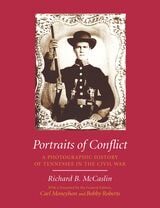
cover of Portraits of Conflict: Tennessee: A Photographic History of Tennessee in the Civil War

Portraits of Conflict

Tennessee: A Photographic History of Tennessee in the Civil War

Richard B. McCaslin

University of Arkansas Press, 2007
It’s one thing to understand that over twenty-thousand Confederate and Union soldiers died at the Battle of Murfreesboro. It’s quite another to study an ambrotype portrait of twenty-year-old private Frank B. Crosthwait, dressed in his Sunday best, looking somberly at the camera. In a tragically short time, he’ll be found on the battlefield, mortally wounded, still clutching the knotted pieces of handkerchief he used in a hopeless attempt to stop the bleeding from his injuries. Private Crosthwait’s image is one of more than 250 portraits—many never before published—to be found in the much anticipated Portraits of Conflict: A Photographic History of Tennessee in the Civil War. The eighth in the distinguished Portraits of Conflict series, this volume joins the personal and the public to provide a uniquely rich portrayal of Tennesseans—in uniforms both blue and gray—who fought and lost their lives in the Civil War. Here is the story of a widow working as a Union spy to support herself and her children. Of a father emerging from his house to find his Confederate soldier son dying at his feet. Of a nine-year-old boy who attached himself to a Union regiment after his mother died. Their stories and faces, joined with personal remembrances from recovered letters and diaries and ample historical information on secession, famous battles, surrender, and Reconstruction, make this new Portraits of Conflict a Civil War treasure.
[more]
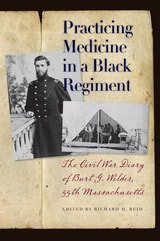
cover of Practicing Medicine in a Black Regiment: The Civil War Diary of Burt G. Wilder, 55th Massachusetts

Practicing Medicine in a Black Regiment

The Civil War Diary of Burt G. Wilder, 55th Massachusetts

Richard M. Reid

University of Massachusetts Press, 2010

In early 1863, in the aftermath of Abraham Lincoln's Emancipation Proclamation, Massachusetts began recruiting black soldiers to serve in the Civil War. Although the first regiment formed, the 54th Massachusetts, would become the best-known black regiment in the war, the second regiment raised, the 55th Massachusetts Volunteer Infantry, performed equally valuable service in the Union Army.

Burt Green Wilder, a Boston-born, Harvard-educated doctor-in-training, was among the first white officers commissioned to staff the 55th Massachusetts. Like other officers serving in the state's African American units, Wilder was selected for his military experience, his "firm Anti-Slavery principles," and his faith in the value of black troops. From the time he joined the 55th in May 1863 until the regiment was discharged in September 1865, Wilder recorded his experiences and observations. He described the day-to-day activities of a Civil War surgeon, the indignities suffered by black enlisted men at the hands of a War Department that denied them the same treatment offered to white troops, and the role of the regiment in the campaign around Charleston and in Florida.

Service in the southern states also allowed Wilder to indulge a passion for natural science and comparative anatomy, including the collection of unusual species, one of which—the spider known as Nephila wilderi—still bears his name. After the war he completed his medical studies at Harvard and joined the faculty of Cornell University, where he became a distinguished professor of zoology as well as an outspoken advocate of racial equality.

In his introduction to the volume, Richard M. Reid analyzes Burt Wilder's diary and places it within the context of the war, the experience of African American troops, and Wilder's life and career.
[more]
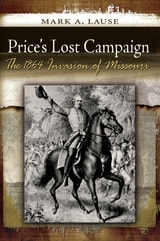
cover of Price's Lost Campaign: The 1864 Invasion of Missouri

Price's Lost Campaign

The 1864 Invasion of Missouri

Mark A. Lause

University of Missouri Press, 2013
 
In the fall of 1864, during the last brutal months of the Civil War, the Confederates made one final, desperate attempt to rampage through the Shenandoah Valley, Tennessee, and Missouri. Price’s Raid was the common name for the Missouri campaign led by General Sterling Price. Involving tens of thousands of armed men, the 1864 Missouri campaign has too long remained unexamined by a book-length modern study, but now, Civil War scholar Mark A. Lause fills this long-standing gap in the literature, providing keen insights on the problems encountered during and the myths propagated about this campaign.
Price marched Confederate troops 1,500 miles into Missouri, five times as far as his Union counterparts who met him in the incursion. Along the way, he picked up additional troops; the most exaggerated estimates place Price’s troop numbers at 15,000. The Federal forces initially underestimated the numbers heading for Missouri and then called in troops from Illinois and Kansas, amassing 65,000 to 75,000 troops and militia members. The Union tried to downplay its underestimation of the Confederate buildup of troops by supplanting the term campaign with the impromptu raid.
            This term was also used by Confederates to minimize their lack of military success. The Confederates, believing that Missourians wanted liberation from Union forces, had planned a two-phase campaign. They intended not only to disrupt the functioning government through seizure of St. Louis and the capital, Jefferson City, but also to restore the pro-secessionist government driven from the state three years before. The primary objective, however, was to change the outcome of the Federal elections that fall, encouraging votes against the Republicans who incorporated ending slavery into the Union war goals. What followed was widespread uncontrolled brutality in the form of guerrilla warfare, which drove support for the Federalists. Missouri joined Kansas in reelecting the Republicans and ensuring the end of slavery.
Lause’s account of the Missouri campaign of 1864 brings new understanding of the two distinct phases of the campaign, as based upon declared strategic goals. Additionally, as the author reveals the clear connection between the military campaign and the outcome of the election, he successfully tests the efforts of new military historians to integrate political, economic, social, and cultural history into the study of warfare. In showing how both sides during Price’s Raid used self-serving fictions to provide a rationale for their politically motivated brutality and were unwilling to risk defeat, Lause reveals the underlying nature of the American Civil War as a modern war.
 
[more]
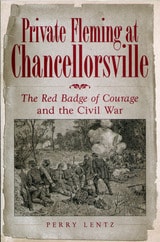
cover of Private Fleming at Chancellorsville: The Red Badge of Courage and the Civil War

Private Fleming at Chancellorsville

The Red Badge of Courage and the Civil War

Perry Lentz

University of Missouri Press, 2006
Famous for its insight into a young, inexperienced soldier’s psychology, Stephen Crane’s The Red Badge of Courage has long been assumed to have been based on little more than magazine articles and veterans’ reminiscences. It also has been subject to various misreadings, including ones unduly influenced by fictional responses to the wars of the twentieth century. Perry Lentz now draws on more than three decades of teaching the novel and his own experience as a historical novelist to plumb the historical realities that actually shaped Crane’s work and to confront these misreadings.
Taking a new look at a classic work that many may feel they already know, Lentz shows how this apparently impressionistic novel is actually a faithful reflection of Civil War combat based on thorough knowledge about combat in general and the battle of Chancellorsville in particular. Anchoring the novel’s action firmly in the Civil War, Lentz challenges the long-standing assumption that Crane did little research for the novel, arguing that he made extensive use of contemporary sources to fashion an accurate depiction of Chancellorsville.
Rich with information about infantry combat in the Civil War, from uniforms and weaponry to formations and battlefield tactics, Lentz’s study invites readers to follow the exploits of Private Henry Fleming of the 304th New York Volunteer Infantry Regiment as he and his fellow soldiers participate in this legendary battle. Lentz shows how Crane evokes a set of traditional responses from his reader and how close reading expands those responses. He examines Private Fleming’s adventures behind the lines of battle in terms of the historical situations in which they are set, then explains how Crane repeatedly entices readers into imposing their initial expectations and final evaluations upon the experiences of this particular soldier.
Lentz also investigates why the novel’s portrayal of its hero’s experiences on the second day of battle is sometimes ignored and always undervalued. By focusing on events both as they actually unfolded at Chancellorsville and as Crane depicted Fleming and his comrades experiencing them, he shows how these soldiers judge themselves, how others judge them, and how a reader can achieve a more sophisticated understanding of these judgments. Lentz’s work reclaims a place for this novel in the American canon and enhances our understanding of Crane, of a legendary battle, and of war literature in general.
[more]
cover of Public Debate in the Civil War Era: A Rhetorical History of the United States, Volume IV

Public Debate in the Civil War Era

A Rhetorical History of the United States, Volume IV

David Zarefsky

Michigan State University Press, 2023
Public debate and discussion was overshadowed by the slavery controversy during the period of the U.S. Civil War. Slavery was attacked, defended, amplified, and mitigated. This happened in the halls of Congress, the courts, the political debate, the public platform, and the lecture hall. This volume examines the issues, speakers, and venues for this controversy between 1850 and 1877. It combines exploration of the broad contours of controversy with careful analysis of specific speakers and texts.
 
[more]
cover of Pulpits of the Lost Cause: The Faith and Politics of Former Confederate Chaplains during Reconstruction

Pulpits of the Lost Cause

The Faith and Politics of Former Confederate Chaplains during Reconstruction

Steve Longenecker

University of Alabama Press, 2023

A comparison of the faith and politics of former Confederate chaplains with intriguing insights about the evolution of their postwar beliefs and the Lost Cause

Pulpits of the Lost Cause: The Faith and Politics of Former Confederate Chaplains during Reconstruction is the first in-depth study of former chaplains that juxtaposes their religion and politics, thereby revealing important insights about the Lost Cause movement. Steve Longenecker demonstrates that while some former chaplains vigorously defended the Lost Cause and were predictably conservative in the pulpit, embracing orthodoxy and resisting religious innovation, others were unexpectedly progressive and advocated on behalf of evolution, theological liberalism, and modern biblical criticism.

Former Confederate chaplains embodied both the distinctive white, Southern, regional identity and the variation within it. Most were theologically conservative and Lost Cause racists. But as with the larger South, variation abounded. The Lost Cause, which Longenecker interprets as a broad popular movement with numerous versions, meant different things to different chaplains. It ranged from diehard-ism to tempered sectional forgiveness to full reconciliation to a harmless once-a-year Decoration Day ritual.

This volume probes the careers of ten former chaplains, including their childhoods, wartime experiences, Lost Cause personas, and theologies, making use of manuscripts and published sermons as well as newspapers, diaries, memoirs, denominational periodicals, letters, and the books they themselves produced. In theology, many former chaplains were predictably conservative, while others were unexpectedly broad-minded and advocated evolution, theological liberalism, and modern Biblical criticism. One former chaplain became a social-climbing Harvard progressive. Another wrote innovative, liberal theology read by European scholars. Yet another espoused racial equality, at least in theory if not full practice. Additionally, former chaplains often exhibited the fundamental human trait of compartmentalization, most notably by extolling the past as they celebrated the Lost Cause while simultaneously looking to the future as religious progressives or New South boosters. The stereotypical preacher of the Lost Cause—a gray-clad Bible thumper—existed sufficiently to create the image but hardly enough to be universally accurate.
 

[more]