440 books match the query 'Colonialism & Post-Colonialism' and 20 start with p
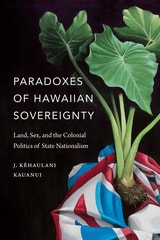
cover of Paradoxes of Hawaiian Sovereignty: Land, Sex, and the Colonial Politics of State Nationalism

Paradoxes of Hawaiian Sovereignty

Land, Sex, and the Colonial Politics of State Nationalism

J. Kehaulani Kauanui

Duke University Press, 2018
In Paradoxes of Hawaiian Sovereignty J. Kēhaulani Kauanui examines contradictions of indigeneity and self-determination in U.S. domestic policy and international law. She theorizes paradoxes in the laws themselves and in nationalist assertions of Hawaiian Kingdom restoration and demands for U.S. deoccupation, which echo colonialist models of governance. Kauanui argues that Hawaiian elites' approaches to reforming and regulating land, gender, and sexuality in the early nineteenth century that paved the way for sovereign recognition of the kingdom complicate contemporary nationalist activism today, which too often includes disavowing the indigeneity of the Kanaka Maoli (Indigenous Hawaiian) people. Problematizing the ways the positing of the Hawaiian Kingdom's continued existence has been accompanied by a denial of U.S. settler colonialism, Kauanui considers possibilities for a decolonial approach to Hawaiian sovereignty that would address the privatization and capitalist development of land and the ongoing legacy of the imposition of heteropatriarchal modes of social relations.
[more]
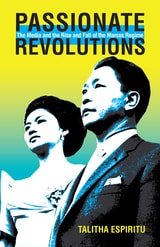
cover of Passionate Revolutions: The Media and the Rise and Fall of the Marcos Regime

Passionate Revolutions

The Media and the Rise and Fall of the Marcos Regime

Talitha Espiritu

Ohio University Press, 2017

In the last three decades, the dictatorship of Ferdinand Marcos has commanded the close scrutiny of scholars. These studies have focused on the political repression, human rights abuses, debt-driven growth model, and crony capitalism that defined Marcos’ so-called Democratic Revolution in the Philippines. But the relationship between the media and the regime’s public culture remains underexplored.

In Passionate Revolutions, Talitha Espiritu evaluates the role of political emotions in the rise and fall of the Marcos government. Focusing on the sentimental narratives and melodramatic cultural politics of the press and the cinema from 1965 to 1986, she examines how aesthetics and messaging based on heightened feeling helped secure the dictator’s control while also galvanizing the popular struggles that culminated in “people power” and government overthrow in 1986.

In analyzing news articles, feature films, cultural policy documents, and propaganda films as national allegories imbued with revolutionary power, Espiritu expands the critical discussion of dictatorships in general and Marcos’s in particular by placing Filipino popular media and the regime’s public culture in dialogue. Espiritu’s interdisciplinary approach in this illuminating case study of how melodrama and sentimentality shape political action breaks new ground in media studies, affect studies, and Southeast Asian studies.
[more]
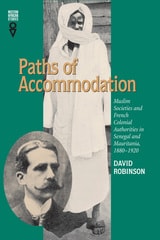
cover of Paths of Accommodation: Muslim Societies and French Colonial Authorities in Senegal and Mauritania, 1880–1920

Paths of Accommodation

Muslim Societies and French Colonial Authorities in Senegal and Mauritania, 1880–1920

David Robinson

Ohio University Press, 2000

Between 1880 and 1920, Muslim Sufi orders became pillars of the colonial regimes and economies of Senegal and Mauritania. In Paths of Accommodation, David Robinson examines the ways in which the leaders of the orders negotiated relations with the Federation of French West Africa in order to preserve autonomy within the religious, social, and economic realms while abandoning the political sphere to their non-Muslim rulers.

This was a striking development because the local inhabitants had a strong sense of belonging to the Dar al-Islam, the “world of Islam” in which Muslims ruled themselves.

Drawing from a wide variety of archival, oral, and Arabic sources, Robinson describes the important roles played by Muslim merchants and the mulatto community of St. Louis, Senegal. He also examines the impact of the electoral institutions established by the Third Republic, and the French effort to develop a reputation as a “Muslim power”—a European imperial nation with a capacity for ruling over Islamic subjects.

By charting the similarities and differences of the trajectories followed by leading groups within the region as they responded to the colonial regimes, Robinson provides an understanding of the relationship between knowledge and power, the concepts of civil society and hegemony, and the transferability of symbolic, economic, and social capital.
[more]
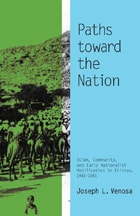
cover of Paths toward the Nation: Islam, Community, and Early Nationalist Mobilization in Eritrea, 1941–1961

Paths toward the Nation

Islam, Community, and Early Nationalist Mobilization in Eritrea, 1941–1961

Joseph L. Venosa

Ohio University Press, 2014
In the early and mid-1940s, during the period of British wartime occupation, community and religious leaders in the former Italian colony of Eritrea engaged in a course of intellectual and political debate that marked the beginnings of a genuine national consciousness across the region. During the late 1940s and 1950s, the scope of these concerns slowly expanded as the nascent nationalist movement brought together Muslim activists with the increasingly disaffected community of Eritrean Christians. The Eritrean Muslim League emerged as the first genuine proindependence organization in the country to challenge both the Ethiopian government’s calls for annexation and international plans to partition Eritrea between Sudan and Ethiopia. The league and its supporters also contributed to the expansion of Eritrea’s civil society, formulating the first substantial arguments about what made Eritrea an inherently separate national entity. These concepts were essential to the later transition from peaceful political protest to armed rebellion against Ethiopian occupation. Paths toward the Nation is the first study to focus exclusively on Eritrea’s nationalist movement before the start of the armed struggle in 1961.
[more]
cover of Planetary Longings

Planetary Longings

Mary Louise Pratt

Duke University Press, 2022
In Planetary Longings eminent cultural theorist Mary Louise Pratt posits that the last decade of the twentieth century and the first decades of the twenty-first mark a turning point in the human and planetary condition. Examining the forces of modernity, neoliberalism, coloniality, and indigeneity in their pre- and postmillennial forms, Pratt reflects on the crisis of futurity that accompanies the millennial turn in relation to environmental disaster and to the new forms of thinking it has catalyzed. She turns to 1990s Latin American vernacular culture, literary fiction, and social movements, which simultaneously registered neoliberalism’s devastating effects and pursued alternate ways of knowing and living. Tracing the workings of colonialism alongside the history of anticolonial struggles and Indigenous mobilizations in the Americas, Pratt analyzes indigeneity both as a key index of coloniality, neoliberal extraction, and ecological destruction, and as a source for alternative modes of thought and being. Ultimately, Pratt demonstrates that the changes on either side of the millennium have catalyzed new forms of world-making and knowledge-making in the face of an unknowable and catastrophic future.
[more]
cover of Poetics of Repair: Contemporary Arts and Afterlives of Colonial-Era Mass Housing in the Maghreb

Poetics of Repair

Contemporary Arts and Afterlives of Colonial-Era Mass Housing in the Maghreb

Katarzyna Pieprzak

Duke University Press, 2025
Today, most colonial-era modernist mass housing is seen as fundamentally broken: crumbling concrete spaces of social alienation and containment that fractured societies both then and now. In Poetics of Repair, Katarzyna Pieprzak examines how contemporary visual, literary, and performance art of the Maghreb has the potential to change the terms, histories, and imagined futures of mass housing in North Africa and France. Pieprzak dives deeply into contemporary art engagements with three mass housing sites that epitomize the French colonial geography of modernist architecture in the Maghreb. She identifies in this art what she names a transformative “poetics of repair”: a practice that conjoins, puts in relation, or simply brings closer together broken materials, separated people, and severed timelines. Reading art and its engagements with mass housing, Pieprzak argues, has the potential to unmoor established knowledge and rehearse the tensions and productive ambiguities inherent to practices of constitution and revision. She demonstrates that such a reading practice is a step toward a reparative epistemology for mass housing that turns sites of wreckage and alienation into sites of possible solidarities and new formulations of history and experience.
[more]
cover of Policing America’s Empire: The United States, the Philippines, and the Rise of the Surveillance State

Policing America’s Empire

The United States, the Philippines, and the Rise of the Surveillance State

Alfred W. McCoy

University of Wisconsin Press, 2009

At the dawn of the twentieth century, the U.S. Army swiftly occupied Manila and then plunged into a decade-long pacification campaign with striking parallels to today’s war in Iraq. Armed with cutting-edge technology from America’s first information revolution, the U.S. colonial regime created the most modern police and intelligence units anywhere under the American flag. In Policing America’s Empire Alfred W. McCoy shows how this imperial panopticon slowly crushed the Filipino revolutionary movement with a lethal mix of firepower, surveillance, and incriminating information. Even after Washington freed its colony and won global power in 1945, it would intervene in the Philippines periodically for the next half-century—using the country as a laboratory for counterinsurgency and rearming local security forces for repression. In trying to create a democracy in the Philippines, the United States unleashed profoundly undemocratic forces that persist to the present day.
    But security techniques bred in the tropical hothouse of colonial rule were not contained, McCoy shows, at this remote periphery of American power. Migrating homeward through both personnel and policies, these innovations helped shape a new federal security apparatus during World War I. Once established under the pressures of wartime mobilization, this distinctively American system of public-private surveillance persisted in various forms for the next fifty years, as an omnipresent, sub rosa matrix that honeycombed U.S. society with active informers, secretive civilian organizations, and government counterintelligence agencies. In each succeeding global crisis, this covert nexus expanded its domestic operations, producing new contraventions of civil liberties—from the harassment of labor activists and ethnic communities during World War I, to the mass incarceration of Japanese Americans during World War II, all the way to the secret blacklisting of suspected communists during the Cold War.

“With a breathtaking sweep of archival research, McCoy shows how repressive techniques developed in the colonial Philippines migrated back to the United States for use against people of color, aliens, and really any heterodox challenge to American power. This book proves Mark Twain’s adage that you cannot have an empire abroad and a republic at home.”—Bruce Cumings, University of Chicago

 “This book lays the Philippine body politic on the examination table to reveal the disease that lies within—crime, clandestine policing, and political scandal. But McCoy also draws the line from Manila to Baghdad, arguing that the seeds of controversial counterinsurgency tactics used in Iraq were sown in the anti-guerrilla operations in the Philippines. His arguments are forceful.”—Sheila S. Coronel, Columbia University
 
“Conclusively, McCoy’s Policing America’s Empire is an impressive historical piece of research that appeals not only to Southeast Asianists but also to those interested in examining the historical embedding and institutional ontogenesis of post-colonial states’ police power apparatuses and their apparently inherent propensity to implement illiberal practices of surveillance and repression.”—Salvador Santino F. Regilme, Jr., Journal of Current Southeast Asian Affairs
 
“McCoy’s remarkable book . . . does justice both to its author’s deep knowledge of Philippine history as well as to his rare expertise in unmasking the seamy undersides of state power.”—POLAR: Political and Legal Anthropology Review
 
Winner, George McT. Kahin Prize, Southeast Asian Council of the Association for Asian Studies
[more]
cover of Popular Politics and Rebellion in Mexico: Manuel Lozada and La Reforma, 1855-1876

Popular Politics and Rebellion in Mexico

Manuel Lozada and La Reforma, 1855-1876

Zachary Brittsan

Vanderbilt University Press, 2015

The political conflict during Mexico's Reform era in the mid-nineteenth century was a visceral battle between ideologies and people from every economic and social class. As Popular Politics and Rebellion in Mexico develops the story of this struggle, the role of one key rebel, Manuel Lozada, comes into focus. The willingness of rural peasants to take up arms to defend the Catholic Church and a conservative political agenda explains the bitterness of the War of Reform and the resulting financial and political toll that led to the French Intervention. Exploring the activities of rural Jalisco's residents in this turbulent era and Lozada's unique position in the drama, Brittsan reveals the deep roots of colonial religious and landholding practices, exemplified by Lozada, that stood against the dominant political current represented by Benito Juarez and liberalism.


Popular Politics and Rebellion in Mexico also explores the conditions under which a significant segment of Mexican society aligned itself with conservative interests and French interlopers, revealing this constituency to be more than a collection of reactionary traitors to the nation. To the contrary, armed rebellion--or at least the specter of force--protected local commercial interests in the short run and enhanced the long-term prospects for political autonomy. Manuel Lozada's story adds a necessary layer of complexity to our understanding of the practical and ideological priorities that informed the tumultuous conflicts of the mid-nineteenth century.
[more]
cover of Popular Protest in Palestine: The History and Uncertain Future of Unarmed Resistance

Popular Protest in Palestine

The History and Uncertain Future of Unarmed Resistance

Marwan Darweish and Andrew Rigby

Pluto Press, 2015

Popular Protest in Palestine provides an overview and analysis of the role and significance of unarmed civil resistance in the Palestinian national movement. Marwan Darweish and Andrew Rigby focus on the contemporary popular resistance movement in the Occupied Palestinian Territories, prefaced by a historical review of the thread of unarmed civil resistance that has run throughout the history of the Palestinian liberation struggle. The authors explore this underemphasized dimension of the Palestinian struggle, arguing that at the present juncture the popular resistance movement, especially in the West Bank, is the most significant form of struggle against the ongoing occupation.
[more]
cover of Portugal and Africa: Ris Af#81

Portugal and Africa

Ris Af#81

David Birmingham

Ohio University Press, 2004
Portugal was the first European nation to assert itself aggressively in African affairs. David Birmingham’s Portugal and Africa, a collection of uniquely accessible historical essays, surveys this colonial encounter from its earliest roots. The Portuguese established sugar plantations on Africa’s offshore islands and built factories on the beaches in the fifteenth century, but Professor Birmingham explains that their focus shifted to regions where medieval African miners had discovered deep seams of gold ore. Later, when even richer mines and more fertile lands were captured from the native peoples of the Americas, Portuguese ships became the great “slave bridge” that spanned the Atlantic and ferried captive black workers to the colonies of the New World. Portugal lost its major mining claims in Africa to the British, but it left a legacy of a new pattern of white settler colonization based on American-style plantations. The blending of European and African cultures and races led to the emergence of elite communities, from the Kongo princes of the seventeenth century to the creolized generals of today. Portugal and Africa focuses extensively on Angola to cast new light on the final years of the colonial experience and its traumatic legacies. After 1950, Portuguese Angola became one of the most dynamic of Africa’s colonies and the largest white colony outside of Algeria or South Africa. Angola’s eventual collapse in a series of wars had devastating results. Birmingham brings the terror and devastation to life in a series of powerful chapters that are a model of disciplined scholarship and informed passion.
[more]
cover of Postcolonial Air and Atmospheres: Elemental life and environmental crisis

Postcolonial Air and Atmospheres

Elemental life and environmental crisis

Edited by Sarah Nuttall and Isabel Hofmeyr

University College London, 2026
This study expands the traditional scope of air and atmosphere studies to explore atmospheres and aesthetics in postcolonial contexts. 
 
This volume puts two traditions of scholarship into conversation: Euro-American work on air and atmospheres, and emergent postcolonial debates on these themes. Drawing on the strengths of the first, this collection probes its limits, while mapping an emergent field of postcolonial research on air and atmospheres.
 
Postcolonial Air and Atmospheres recontextualizes debates on atmospheres and aesthetics, exploring these themes in relation to the uneven hemispheric terrains of material decay and toxicity. It extends the narrow spatial purview of the Euro-American scholarship by taking an empire-wide perspective, considering historical questions of air and enslavement alongside South Asian histories of air conditioning and the toxic atmospheres of extractive industries. It develops a phenomenology of breathing in a range of postcolonial settings to revisit the theorizations of air and breath in Western critical theoretical scholarship. The collection comprises three sections. “Affective Atmospheres” explores the materialities of air while foregrounding atmospheres as sites of affect, politics, and power in the postcolony. “Unfree and Impure Airs” foregrounds clean and toxic air and who breathes them, along with the politics and technologies of how these unequal forms of air were and are produced. “Breathing In” centers practices of breath as a means of analyzing air and atmospheres.
[more]
cover of Postcolonial Disaster: Narrating Catastrophe in the Twenty-First Century

Postcolonial Disaster

Narrating Catastrophe in the Twenty-First Century

Pallavi Rastogi

Northwestern University Press, 2020

Postcolonial Disaster studies literary fiction about crises of epic proportions in contemporary South Asia and Southern Africa: the oceanic disaster in Sri Lanka, the economic disaster in Zimbabwe, the medical disaster in South Africa and Botswana, and the geopolitical disaster in India and Pakistan. Pallavi Rastogi argues that postcolonial fiction about catastrophe is underpinned by a Disaster Unconscious, a buried but mobile agenda that forces disastrous events to narrate themselves. She writes that in disaster fiction, a literary Story and its real-life Event are in constant dialectic tension. In recent disasters, Story and Event are tied together as the urgency to circulate information and rebuild in the aftermath of the disaster dictates the flow of the narrative. As the Story acquires temporal distance from the Event, such as the seventy-three years since the partition of India in 1947, it plays more with form and theme, to expand beyond a tale about an all-consuming tragedy. Story and Event are in a constant dance with each other, and the Disaster Unconscious plays the tune to which they move.
 
Rastogi creates a narratology for postcolonial disaster fiction and brings concepts from Disaster Studies into the realm of literary analysis.
 
[more]
cover of Postcolonial Hauntings: Play and Transnational Feminism

Postcolonial Hauntings

Play and Transnational Feminism

Sushmita Chatterjee

University of Illinois Press, 2024

Often examined separately, play and hauntings in fact act together to frame postcolonial issues. Sushmita Chatterjee showcases their braided workings in social and political fabrics. Drawing on this intertwined idea of play and hauntings, Chatterjee goes to the heart of conundrums within transnational postcolonial feminisms by examining the impossible echoes of translations, differing renditions of queer, and the possibilities of solidarity beyond the fraternal friendships that cement nation-states. Meaning-plays, or slippages through language systems as we move from one language to another, play a pivotal role in a global world. As Chatterjee shows, an attentiveness to meaning-plays discerns the past and present, here and there, and moves us toward responsive ethics in our theories and activisms.

Insightful and stimulating, Postcolonial Hauntings centers the inextricable work of play and hauntings as a braided ethics for postcolonial transnational struggles.
[more]
cover of Postcolonial Imperialism: Critique of the Society of Dazzlements

Postcolonial Imperialism

Critique of the Society of Dazzlements

Joseph Tonda. Translated by Cheryl Smeall

Duke University Press, 2026
Postcolonial Imperialism considers the inability to distinguish between reality and fiction as a key condition of contemporary life. If postcolonial theory has highlighted how white colonizers created images of racialized Others which project their own self-hatred or disavowal, Joseph Tonda here shows how these images have in turn colonized Western imaginaries. He argues that the Global North’s obsession with its own phantoms takes a newly powerful form in the dazzling images of postcolonial screens. With examples ranging from Nicki Minaj to Osama Bin Laden and child soldier Johnny Mad Dog, Tonda reflects on power by analyzing the dazzlements of both Central Africa and the West, showing how African life prefigures Western experiences. Translated from its original French, Postcolonial Imperialism is a prescient critique of authoritarian attempts to enforce alternate realities, and of the many ways screens can distort our vision.
[more]
cover of Postcolonial Paris: Fictions of Intimacy in the City of Light

Postcolonial Paris

Fictions of Intimacy in the City of Light

Laila Amine

University of Wisconsin Press, 2021

In the global imagination, Paris is the city's glamorous center, ignoring the Muslim residents in its outskirts except in moments of spectacular crisis such as terrorist attacks or riots. But colonial immigrants and their French offspring have been a significant presence in the Parisian landscape since the 1940s. Expanding the narrow script of what and who is Paris, Laila Amine explores the novels, films, and street art of Maghrebis, Franco-Arabs, and African Americans in the City of Light, including fiction by Charef, Chraïbi, Sebbar, Baldwin, Smith, and Wright, and such films as La haine, Made in France, Chouchou, and A Son.

Spanning the decades from the post–World War II era to the present day, Amine demonstrates that the postcolonial other is both peripheral to and intimately entangled with all the ideals so famously evoked by the French capital—romance, modernity, equality, and liberty. In their work, postcolonial writers and artists have juxtaposed these ideals with colonial tropes of intimacy (the interracial couple, the harem, the Arab queer) to expose their hidden violence. Amine highlights the intrusion of race in everyday life in a nation where, officially, it does not exist.
[more]
cover of Postcolonial Vietnam: New Histories of the National Past

Postcolonial Vietnam

New Histories of the National Past

Patricia M. Pelley

Duke University Press, 2002

New nations require new histories of their struggles for nationhood. Postcolonial Vietnam takes us back to the 1950s to see how official Vietnamese historians and others rethought what counted as history, what producing history entailed, and who should be included as participants and agents in the story. Beginning with government-appointed historians’ first publications in 1954 and following their efforts over the next thirty years, Patricia M. Pelley surveys this daunting process and, in doing so, opens a wide window on the historical forces and tensions that have gone into shaping the new nation of Vietnam.

Although she considers a variety of sources—government directives, census reports, statistics, poetry, civic festivities, ethnographies, and museum displays—Pelley focuses primarily on the work of official historians in Hanoi who argued about and tried to stabilize the meaning of topics ranging from prehistory to the Vietnam War. She looks at their strained and idiosyncratic attempts to plot the Vietnamese past according to Marxist and Stalinist paradigms and their ultimate abandonment of such models. She explores their struggle to redefine Vietnam in multiethnic terms and to normalize the idea of the family-state. Centering on the conversation that began in 1954 among historians in North Vietnam, her work identifies a threefold process of creating the new history: constituting historiographical issues, resolving problems of interpretation and narration, and conventionalizing various elements of the national narrative. As she tracks the processes that shaped the history of postcolonial Vietnam, Pelley dismantles numerous clichés of contemporary Vietnamese history and helps us to understand why and how its history-writing evolved.
[more]
cover of Postwar Revisited: A Global Art History

Postwar Revisited

A Global Art History

Okwui Enwezor and Atreyee Gupta, editors

Duke University Press, 2025

Okwui Enwezor’s 2016 exhibition Postwar: Art between the Pacific and the Atlantic, 1945–1965 redefined the history of art produced in those two decades. Nearly a decade later, Postwar Revisited returns to these debates to present an image of a historical period in which Western conceptions of art, aesthetics, and philosophy are all thrown into intense flux after Auschwitz and Hiroshima, while the cultural energies of decolonization generate myriad artistic and intellectual practices across the globe, which re-engage the connections of art to life itself. Focusing on modernist artists, artist collectives, and architects central to dissonant regional traditions, as well as influential exhibitions and patronage systems, the contributors produce a new understanding of emergent postwar global art. Provoking new ways of thinking, engaging, and narrating art history, Postwar Revisited is essential reading for those interested in debates on global art history and global modernism, the intersections between art and decolonization, the cultural aspects of the Cold War and the Non-Aligned Movement, and modern and contemporary art more generally.

Contributors. Iftikhar Dadi, Okwui Enwezor, Patrick Flores, Hal Foster, Boris Groys, Atreyee Gupta, Elizabeth Harney, Jennifer Josten, Vivian Li, Tara McDowell, Alexandra Munroe, Nada Shabout, Terry Smith, Jenni Sorkin, Ming Tiampo
 
[more]
cover of Primitive Normativity: Race, Sexuality, and Temporality in Colonial Kenya

Primitive Normativity

Race, Sexuality, and Temporality in Colonial Kenya

Elizabeth W. Williams

Duke University Press, 2024
In Primitive Normativity Elizabeth W. Williams traces the genealogy of a distinct narrative about African sexuality that British colonial authorities in Kenya used to justify their control over indigenous populations. She identifies a discourse of “primitive normativity” that suggested that Africans were too close to nature to develop sexual neuroses and practices such as hysteria, homosexuality, and prostitution which supposedly were common among Europeans. Primitive normativity framed Kenyan African sexuality as less polluted than that of the more deviant populations of their colonizers. Williams shows that colonial officials and settlers used this narrative to further the goals of white supremacy by arguing that Africans’ sexuality was proof that Kenyan Africans must be protected from the forces of urbanization, Western-style education, and political participation, lest they be exposed to forms of civilized sexual deviance. Challenging the more familiar notion that Europeans universally viewed Africans as hypersexualized, Williams demonstrates how narratives of African sexual normativity rather than deviance reinforced ideas about the evolutionary backwardness of African peoples and their inability to govern themselves.
[more]
cover of Prosthetic Memories: Postcolonial Feminisms in a More-Than-Human World

Prosthetic Memories

Postcolonial Feminisms in a More-Than-Human World

Hyaesin Yoon

Duke University Press, 2025
In Prosthetic Memories, Hyaesin Yoon examines the entanglements of humans, animals, and technologies across South Korea and the United States at the turn of the twenty-first century. Interrogating a variety of body-technology interfaces, Yoon outlines an emergent mode of prosthetic memory in which human memory is extended into both machines and animals. Prosthetic memory overflows and provides an alternative to familiar human perception, Western scientific reason, and other senses of knowledge in ways that can foster networks of solidarity, care, and empathy between human and nonhuman subjects. Among other sites and subjects, Yoon examines tongue surgery to correct English pronunciation in Korea, Asian American poetry that engages the human-machine divide, transnational dog cloning, and stem cell research, each of which activates potent postcolonial feminist mnemonics and alliances. In so doing, Yoon narrates the countermemories of racialized, gendered, diasporic, queer, and marginalized human and nonhuman others that work against the violent and isolating biopolitical and neoliberal forces in contemporary society.
[more]
cover of Psychiatric Contours: New African Histories of Madness

Psychiatric Contours

New African Histories of Madness

Nancy Rose Hunt and Hubertus Büschel, editors

Duke University Press, 2024

Psychiatric Contours investigates new histories of psychiatry, derangement, and agitated subjectivities in colonial and decolonizing Africa. The volume lets the multivalent term madness broaden perception, well beyond the psychiatric. Many chapters detect the mad or the psychiatric in unhinged persons, frantic collectives, and distressing situations. Others investigate individuals suffering from miscategorization. A key Foucauldian word, vivacity, illuminates how madness aligns with pathology, creativity, turbulence, and psychopolitics. The archives, patient-authored or not, speak to furies and fantasies inside asylums, colonial institutions, decolonizing missions, and slave ships. The frayed edges of politicized deliria open up the senses and optics of psychiatry’s history in Africa far beyond clinical spaces and classification. The volume also proposes fresh concepts, notably the vernacular, to suggest how to work with emic clues in a granular fashion and telescope the psychiatric within histories of madness. With chapters stretching across much of ex-British and ex-French colonial Africa, Psychiatric Contours attends to the words, autobiographies, and hallucinations of the stigmatized and afflicted as well as of the powerful. Expatriate psychiatrists with cameras, prying authorities, fearful missionaries, and colonial anthropologists enter these readings beside patients, asylums, and boarding schools via research on possession “hysteria” and schizophrenia. In brief, this book demonstrates novel ways of writing not only medical history but all subaltern and global histories.

Contributors. Hubertus Büschel, Raphaël Gallien, Matthew M. Heaton, Richard Hölzl, Nancy Rose Hunt, Richard C. Keller, Sloan Mahone, Nana Osei Quarshie, Jonathan Sadowsky, Romain Tiquet
[more]