148 books match the query 'Colonization' and 6 start with p

cover of Planetary Longings

Planetary Longings

Mary Louise Pratt

Duke University Press, 2022

In Planetary Longings eminent cultural theorist Mary Louise Pratt posits that the last decade of the twentieth century and the first decades of the twenty-first mark a turning point in the human and planetary condition. Examining the forces of modernity, neoliberalism, coloniality, and indigeneity in their pre- and postmillennial forms, Pratt reflects on the crisis of futurity that accompanies the millennial turn in relation to environmental disaster and to the new forms of thinking it has catalyzed. She turns to 1990s Latin American vernacular culture, literary fiction, and social movements, which simultaneously registered neoliberalism’s devastating effects and pursued alternate ways of knowing and living. Tracing the workings of colonialism alongside the history of anticolonial struggles and Indigenous mobilizations in the Americas, Pratt analyzes indigeneity both as a key index of coloniality, neoliberal extraction, and ecological destruction, and as a source for alternative modes of thought and being. Ultimately, Pratt demonstrates that the changes on either side of the millennium have catalyzed new forms of world-making and knowledge-making in the face of an unknowable and catastrophic future.
[more]
cover of Possessing Polynesians: The Science of Settler Colonial Whiteness in Hawai`i and Oceania

Possessing Polynesians

The Science of Settler Colonial Whiteness in Hawai`i and Oceania

Maile Arvin

Duke University Press, 2019
From their earliest encounters with Indigenous Pacific Islanders, white Europeans and Americans asserted an identification with the racial origins of Polynesians, declaring them to be racially almost white and speculating that they were of Mediterranean or Aryan descent. In Possessing Polynesians Maile Arvin analyzes this racializing history within the context of settler colonialism across Polynesia, especially in Hawai‘i. Arvin argues that a logic of possession through whiteness animates settler colonialism, by which both Polynesia (the place) and Polynesians (the people) become exotic, feminized belongings of whiteness. Seeing whiteness as indigenous to Polynesia provided white settlers with the justification needed to claim Polynesian lands and resources. Understood as possessions, Polynesians were and continue to be denied the privileges of whiteness. Yet Polynesians have long contested these classifications, claims, and cultural representations, and Arvin shows how their resistance to and refusal of white settler logic have regenerated Indigenous forms of recognition.
[more]
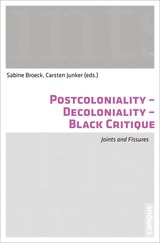
cover of Postcoloniality-Decoloniality-Black Critique: Joints and Fissures

Postcoloniality-Decoloniality-Black Critique

Joints and Fissures

Edited by Sabine Broeck and Carsten Junker

Campus Verlag, 2014
Can Western modernity be analyzed and critiqued through the lens of enslavement and colonial history? As this volume reveals, such analysis is not only possible, it is essential to our understanding of contemporary race relations and society generally. Drawing from the fields of  postcolonial, decolonial, and black studies, this book assembles contributions from renowned scholars that offer timely and critical perspectives from a variety of disciplines, including history, sociology, political science, gender studies, cultural and literary studies, and philosophy.
[more]
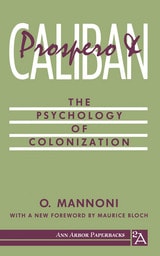
cover of Prospero and Caliban: The Psychology of Colonization

Prospero and Caliban

The Psychology of Colonization

O. Mannoni

University of Michigan Press, 1990

In his now classic volume Prospero and Caliban, Octave Mannoni gives his firsthand account of a 1948 revolt in Madagascar that led to one of the bloodiest episodes of colonial repression on the African continent. It is in Prospero and Caliban that Mannoni constructs the notion of the “dependency complex,” for which his book has since been remembered and widely discussed in both psychoanalytical and anthropological writing. Prospero and Caliban was one of the first books to challenge traditional approaches to the study of native American societies by Western colonizers and anthropologists; and Mannoni is recognized today for his close association with and influence on the French psychoanalyst Lacan.
 
Noted anthropologist Maurice Bloch has written a powerful and critical new foreword to the English translation, which allows the reader to view Mannoni’s unique work in its historical and intellectual context.
 
[more]
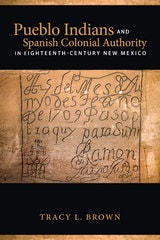
cover of Pueblo Indians and Spanish Colonial Authority in Eighteenth-Century New Mexico

Pueblo Indians and Spanish Colonial Authority in Eighteenth-Century New Mexico

Tracy L. Brown

University of Arizona Press, 2013

Pueblo people reacted to Spanish colonialism in many different ways. While some resisted change and struggled to keep to their long-standing traditions, others reworked old practices or even adopted Spanish ones. Pueblo Indians and Spanish Colonial Authority in Eighteenth-Century New Mexico examines the multiple approaches Pueblo individuals and villages adopted to mitigate and manage the demands that Spanish colonial authorities made upon them. In doing so, author Tracy L. Brown counters the prevailing argument that Pueblo individuals and communities’ only response to Spanish colonialism was to compartmentalize—and thus freeze in time and space—their traditions behind a cultural “iron curtain.”
 
Brown addresses an understudied period of Pueblo Indian/Spanish colonial history of New Mexico with a work that paints a portrait of pre-contact times through the colonial period with a special emphasis on the eighteenth century. The Pueblo communities that the Spaniards encountered were divided by language, religion,and  political and kinship organization. Brown highlights the changes to, but also the maintenance of, social practices and beliefs in the economic, political, spiritual and familial and intimate realms of life that resulted from Pueblo attempts to negotiate Spanish colonial power.
 
The author combines an analysis of eighteenth century Spanish documentation with archaeological findings concerning Pueblo beliefs and practices that spans the pre-contact period to the eighteenth century in the Southwest. Brown presents a nonlinear view of Pueblo life that examines politics, economics, ritual, and personal relationships. The book paints a portrait of the Pueblo peoples and their complex responses to Spanish colonialism by making sense of little-researched archival documents and archaeological findings that cast light on the daily life of Pueblo peoples.
[more]
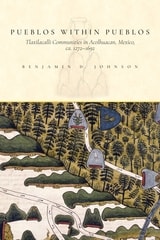
cover of Pueblos within Pueblos: Tlaxilacalli Communities in Acolhuacan, Mexico, ca. 1272-1692

Pueblos within Pueblos

Tlaxilacalli Communities in Acolhuacan, Mexico, ca. 1272-1692

Benjamin Johnson

University Press of Colorado, 2017

Focusing on the specific case of Acolhuacan in the eastern Basin of Mexico, Pueblos within Pueblos is the first book to systematically analyze tlaxilacalli history over nearly four centuries, beginning with their rise at the dawn of the Aztec empire through their transformation into the “pueblos” of mid-colonial New Spain. Even before the rise of the Aztecs, commoners in pre-Hispanic central Mexico set the groundwork for a new style of imperial expansion. Breaking free of earlier centralizing patterns of settlement, they spread out across onetime hinterlands and founded new and surprisingly autonomous local communities called, almost interchangeably, tlaxilacalli or calpolli.

Tlaxilacalli were commoner-administered communities that coevolved with the Acolhua empire and structured its articulation and basic functioning. They later formed the administrative backbone of both the Aztec and Spanish empires in northern Mesoamerica and often grew into full and functioning existence before their affiliated altepetl, or sovereign local polities. Tlaxilacalli resembled other central Mexican communities but expressed a local Acolhua administrative culture in their exacting patterns of hierarchy. As semiautonomous units, they could rearrange according to geopolitical shifts and even catalyze changes, as during the rapid additive growth of both the Aztec Triple Alliance and Hispanic New Spain. They were more successful than almost any other central Mexican institution in metabolizing external disruptions (new gods, new economies, demographic emergencies), and they fostered a surprising level of local allegiance, despite their structural inequality. Indeed, by 1692 they were declaring their local administrative independence from the once-sovereign altepetl. Administration through community, and community through administration—this was the primal two-step of the long-lived Acolhua tlaxilacalli, at once colonial and colonialist.

Pueblos within Pueblos examines a woefully neglected aspect of pre-Hispanic and early colonial Mexican historiography and is the first book to fully demonstrate the structuring role tlaxilacalli played in regional and imperial politics in central Mexico. It will be of interest to students and scholars of Latin American ethnohistory, history, and anthropology.

[more]