Results by title
65 books match the query 'Comedy' and 5 start with p
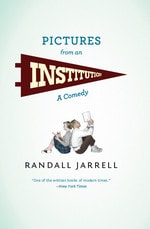
Pictures from an Institution
A ComedyRandall Jarrell
University of Chicago Press, 1952
A finalist for the National Book Award, this classic novel of midcentury campus life is demonically funny and brutally cutting
Beneath the unassuming surface of a progressive women’s college lurks a world of intellectual pride and pomposity awaiting devastation by the pens of two brilliant and appalling wits. Randall Jarrell’s classic novel was originally published to overwhelming critical acclaim in 1954, forging a new standard for campus satire—and instantly yielding comparisons to Dorothy Parker’s razor-sharp barbs. Like his fictional nemesis, Jarrell cuts through the earnest conversations at Benton College—mischievously, but with mischief nowhere more wicked than when crusading against the vitriolic heroine herself.
“A most literate account of a group of most literate people by a writer of power. . . . A delight of true understanding.”—Wallace Stevens
“I’m greatly impressed by the real fun, the incisive satire, the closeness of observation, and in the end by a kind of sympathy and human warmth. It’s a remarkable book.”—Robert Penn Warren
“Move over Dorothy Parker. Pictures . . . is less a novel than a series of poisonous portraits, set pieces, and endlessly quotable put-downs. Read it less for plot than sharp satire, Jarrell’s forte.”—Mary Welp
“One of the wittiest books of modern times.”—New York Times
“[T]he father of the modern campus novel, and the wittiest of them all. Extraordinary to think that ‘political correctness’ was so deliciously dissected 50 years ago.”—Noel Malcolm, Sunday Telegraph
“A sustained exhibition of wit in the great tradition. . . . Immensely and very devastatingly shrewd.”—Edmund Fuller, Saturday Review
“[A] work of fiction, and a dizzying and brilliant work of social and literary criticism. Not only ‘a unique and serious joke-book,’ as Lowell called it, but also a meditation made up of epigrams.”—Michael Wood
Plato and Aristophanes
Comedy, Politics, and the Pursuit of a Just LifeMarina Marren
Northwestern University Press, 2022
Marren makes this case by delving into Plato’s Republic, a foundational work of political philosophy. While the Republic straightforwardly condemns the decadence and greed of a tyrant, Plato’s attack on political idealism is both solemn and comedic. In fact, Plato draws on the same comedic stock and tropes as do Aristophanes’s plays. Marren’s book strikes up an innovative conversation between three works by Aristophanes—Assembly Women, Knights, and Birds—and Plato’s philosophy, prompting important questions about individual convictions and one’s personal search for justice. These dialogic works offer critiques of tyranny that are by turns brilliant, scathing, and exuberant, making light of faults and ideals alike. Philosophical comedy exposes despotism in individuals as well as systems of government claiming to be just and good. This critique holds as much bite against contemporary injustices as it did at the time of Aristophanes and Plato.
An ingenious new work by an emerging scholar, Plato and Aristophanes shows that comedy—in tandem with philosophy and politics—is essential to self-examination. And without such examination, there is no hope for a just life.
Played Out
The Race Man in Twenty-First-Century SatireBrandon J. Manning
Rutgers University Press, 2022
Post-Personal Romanticism
Democratic Terror, Prosthetic Poetics, and the Comedy of Modern Ethical LifeBo Earle
The Ohio State University Press, 2017
Tracing this insight to Hegel’s suggestion that modern subjectivity is in some sense post-individual or even posthumous, Earle argues that signature Romantic lyrics offer a way forward that avoids postmodernism’s wholesale rejection of autonomous selfhood. With chapters on Wordsworth, Blake, Byron, Shelley, and Keats, Earle traces how Romantic lyrics mine this interminability to recover figurative emblems or masks of selfhood from experiences of its inevitable normative failure. This model is of particularly urgent value today when the costs of modern narcissism, economic exploitation, and political imperialism have come to include the normalization of torture, signature drone strikes, and climate change.
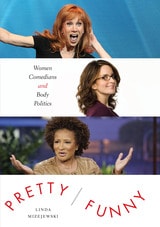
Pretty/Funny
Women Comedians and Body PoliticsBy Linda Mizejewski
University of Texas Press, 2014
Women in comedy have traditionally been pegged as either “pretty” or “funny.” Attractive actresses with good comic timing such as Katherine Hepburn, Lucille Ball, and Julia Roberts have always gotten plum roles as the heroines of romantic comedies and television sitcoms. But fewer women who write and perform their own comedy have become stars, and, most often, they’ve been successful because they were willing to be funny-looking, from Fanny Brice and Phyllis Diller to Lily Tomlin and Carol Burnett. In this pretty-versus-funny history, women writer-comedians—no matter what they look like—have ended up on the other side of “pretty,” enabling them to make it the topic and butt of the joke, the ideal that is exposed as funny.
Pretty/Funny focuses on Kathy Griffin, Tina Fey, Sarah Silverman, Margaret Cho, Wanda Sykes, and Ellen DeGeneres, the groundbreaking women comics who flout the pretty-versus-funny dynamic by targeting glamour, postfeminist girliness, the Hollywood A-list, and feminine whiteness with their wit and biting satire. Linda Mizejewski demonstrates that while these comics don’t all identify as feminists or take politically correct positions, their work on gender, sexuality, and race has a political impact. The first major study of women and humor in twenty years, Pretty/Funny makes a convincing case that women’s comedy has become a prime site for feminism to speak, talk back, and be contested in the twenty-first century.