Results by title
89 books match the query 'Communities' and 5 start with p
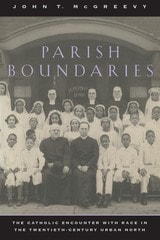
Parish Boundaries
The Catholic Encounter with Race in the Twentieth-Century Urban NorthJohn T. McGreevy
University of Chicago Press, 1996
"Parish Boundaries can take its place in the front ranks of the literature of urban race relations."—Jonathan Dorfman, Washington Post Book Review
"A prodigiously researched, gracefully written book distinguished especially by its seamless treatment of social and intellectual history."—Robert Orsi, American Historical Review
"Parish Boundaries will fascinate historians and anyone interested in the historic connection between parish and race."—Ed Marciniak, Chicago Tribune
"The history that remains to be written will rest on the firm foundation of Mr. McGreevy's remarkable book."—Richard Wightman Fox, New York Times Book Review

Potters and Communities of Practice
Glaze Paint and Polychrome Pottery in the American Southwest, AD 1250 to 1700Edited by Linda S. Cordell and Judith A. Habicht-Mauche
University of Arizona Press, 2012
The peoples of the American Southwest during the 13th through the 17th centuries witnessed dramatic changes in settlement size, exchange relationships, ideology, social organization, and migrations that included those of the first European settlers. Concomitant with these world-shaking events, communities of potters began producing new kinds of wares—particularly polychrome and glaze-paint decorated pottery—that entailed new technologies and new materials. The contributors to this volume present results of their collaborative research into the production and distribution of these new wares, including cutting-edge chemical and petrographic analyses. They use the insights gained to reflect on the changing nature of communities of potters as they participated in the dynamic social conditions of their world.
Public and Private in Thought and Practice
Perspectives on a Grand DichotomyEdited by Jeff Weintraub and Krishan Kumar
University of Chicago Press, 1997
In contexts ranging from friendship, the family, and personal life to nationalism, democratic citizenship, the role of women in social and political life, and the contrasts between western and (post-)Communist societies, this book brings out the ways the various uses of the public/private distinction are simultaneously distinct and interconnected. Public and Private in Thought and Practice will be of interest to students and scholars in disciplines including politics, law, philosophy, history, sociology, and women's studies.
Contributors include Jeff Weintraub, Allan Silver, Craig Calhoun, Daniela Gobetti, Jean L. Cohen, Jean Bethke Elshtain, Alan Wolfe, Krishan Kumar, David Brain, Karen Hansen, Marc Garcelon, and Oleg Kharkhordin.
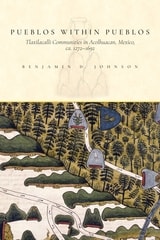
Pueblos within Pueblos
Tlaxilacalli Communities in Acolhuacan, Mexico, ca. 1272-1692Benjamin Johnson
University Press of Colorado, 2017
Focusing on the specific case of Acolhuacan in the eastern Basin of Mexico, Pueblos within Pueblos is the first book to systematically analyze tlaxilacalli history over nearly four centuries, beginning with their rise at the dawn of the Aztec empire through their transformation into the “pueblos” of mid-colonial New Spain. Even before the rise of the Aztecs, commoners in pre-Hispanic central Mexico set the groundwork for a new style of imperial expansion. Breaking free of earlier centralizing patterns of settlement, they spread out across onetime hinterlands and founded new and surprisingly autonomous local communities called, almost interchangeably, tlaxilacalli or calpolli.
Tlaxilacalli were commoner-administered communities that coevolved with the Acolhua empire and structured its articulation and basic functioning. They later formed the administrative backbone of both the Aztec and Spanish empires in northern Mesoamerica and often grew into full and functioning existence before their affiliated altepetl, or sovereign local polities. Tlaxilacalli resembled other central Mexican communities but expressed a local Acolhua administrative culture in their exacting patterns of hierarchy. As semiautonomous units, they could rearrange according to geopolitical shifts and even catalyze changes, as during the rapid additive growth of both the Aztec Triple Alliance and Hispanic New Spain. They were more successful than almost any other central Mexican institution in metabolizing external disruptions (new gods, new economies, demographic emergencies), and they fostered a surprising level of local allegiance, despite their structural inequality. Indeed, by 1692 they were declaring their local administrative independence from the once-sovereign altepetl. Administration through community, and community through administration—this was the primal two-step of the long-lived Acolhua tlaxilacalli, at once colonial and colonialist.
Pueblos within Pueblos examines a woefully neglected aspect of pre-Hispanic and early colonial Mexican historiography and is the first book to fully demonstrate the structuring role tlaxilacalli played in regional and imperial politics in central Mexico. It will be of interest to students and scholars of Latin American ethnohistory, history, and anthropology.

Pursuing Opportunitites Through Partnerships
Higher Education and CommunitiesBRUCE A. BEHRINGER
West Virginia University Press, 2004
In 1998, the W.W. Kellogg Foundation provided funding for four universities to collaborate with surrounding communities on mutually beneficial projects, through the Expanding Community Partnerships Program. In a series of innovative learning collaborations, East Tennessee University, the University of Texas at El Paso, West Virginia University, and Northeastern University established strong, sustainable partnerships with organizations in their local communities. Although each university approached its partnering differently, they all shared the goal of benefiting the underserved communities where they are located and transforming their institutions by enhancing students’ educational experiences and strengthening faculty, student, administration, and staff relationships with local residents. This book shares those relationship-building experiences of the four universities and communities. Highly recommended for all public and higher education administrators; for students and teachers of education, business, and sociology; and for those interested in innovative business and social-service models.