Results by title
162 books match the query 'Comparative Politics' and 12 start with p
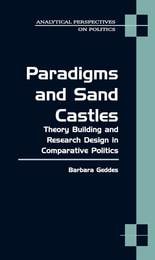
Paradigms and Sand Castles
Theory Building and Research Design in Comparative PoliticsBarbara Geddes
University of Michigan Press, 2003
Barbara Geddes is Professor of Political Science at the University of California, Los Angeles.
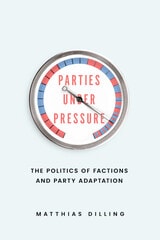
Parties under Pressure
The Politics of Factions and Party AdaptationMatthias Dilling
University of Chicago Press, 2024
An illuminating investigation into why some parties evolve with their times while others fall behind.
Around the world, established political parties face mounting pressures: insurgents on the Left and Right, altered media environments, new policy challenges, and the erosion of traditional strongholds, to name just a few. Yet parties have differed enormously in their ability to move with the times and update their offers to voters. This variation matters. While adaptation does not guarantee a party’s electoral success, the failure to modernize can spell its decline, even collapse, and create openings for radical and populist parties that may threaten the future of liberal democracy.
Parties under Pressure examines why some parties adapt meaningfully to social, economic, and political transformations while others flounder, focusing especially on the fate of Western Europe’s Christian democratic parties. Matthias Dilling reveals the under-appreciated importance of party factions. While very high levels of factionalism are counter-productive and create paralysis, more moderate levels of factionalism help parties to adapt by giving visibility to fresh groups and ideas. Dilling draws on extensive archival research in Germany, Italy, and Austria, as well as evidence from France, Japan, and beyond. Taking a comparative-historical approach, Parties under Pressure sheds new light on parties’ varying records of adaptive reforms over more than seventy-five years.
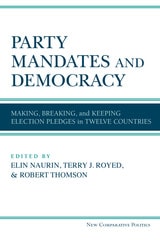
Party Mandates and Democracy
Making, Breaking, and Keeping Election Pledges in Twelve CountriesElin Naurin, Terry J. Royed, and Robert Thomson, Editors
University of Michigan Press, 2019
The fulfillment of parties’ election pledges is an essential part of the democratic process. This book is the first major, genuinely comparative study of promises across a broad range of countries and elections, including the United States, Canada, nine Western European countries, and Bulgaria. The book thus adds to the body of literature on the variety of outcomes stemming from alternative democratic institutions.
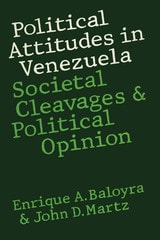
Political Attitudes in Venezuela
Societal Cleavages and Political OpinionBy Enrique A. Baloyra and John D. Martz
University of Texas Press, 1979
Here is a benchmark study of voter attitudes in a Latin American country. This volume is based on extensive survey research conducted during the Venezuelan elections of 1973. The methods employed by Baloyra and Martz to poll an "unpollable" society successfully challenge previously established paradigms.
The authors interviewed a representative sample of over 1,500 voters to determine relationships between class, status, community, context, religion, ideology, and partisanship on the one hand and political attitudes and preferences on the other. They found that the Venezuelan electorate is defined by a series of contradictory tendencies, and they place their conclusions in the context of contemporary political science literature regarding class and party, ideology and party, and inequality and participation.
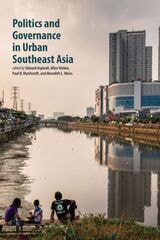
Politics and Governance in Urban Southeast Asia
Edited by Edward Aspinall, Allen Hicken, Paul D. Hutchcroft, and Meredith Weiss
National University of Singapore Press, 2026
As Southeast Asia’s cities continue to swell, this timely volume analyzes urban politics in the region.
Why have some Southeast Asian cities become laboratories of reform while others remain mired in old patterns of patronage politics and substandard public services? This has become an important question now that over half of Southeast Asia’s population lives in urban areas, transforming the politics of the region. Quintessentially urban problems—traffic congestion, sanitation, public transport, housing, and the like—increasingly preoccupy policymakers, while the region’s swelling urban middle classes expect their mayors and city governments to provide ever-better infrastructure and amenities.
Drawing on close case studies of a diverse set of seventeen urban areas across four Southeast Asian countries—Indonesia, Malaysia, the Philippines, and Thailand—this volume offers fresh insights into how the region’s urban politics are changing. It provides a new framework for understanding why some cities are flourishing and others are not. Exploring the factors that shape distinct local governance regimes in these cities, Politics and Governance in Urban Southeast Asia also throws light on how urban residents use community associations, informal networks, and other political mechanisms to access the public services they want and need.
Popular Sovereignty and the Crisis of German Constitutional Law
The Theory and Practice of Weimar ConstitutionalismPeter C. Caldwell
Duke University Press, 1997
Caldwell makes accessible the rich literature in German constitutional thought of the Weimar period, most of which has been unavailable in English until now. On the liberal left, Hugo Preuss and Hans Kelsen defended a concept of democracy that made the constitution sovereign and, in a way, created the "Volk" through constitutional procedure. On the right, Carl Schmitt argued for a substantial notion of the "Volk" that could overrule constitutional procedure in a state of emergency. Rudolf Smend and Heinrich Triepel located in the constitution a set of inviolable values of the political community, while Hermann Heller saw in it a guarantee of substantial social equality. Drawing on the work of these major players from the 1920s, Caldwell reveals the various facets of the impassioned constitutional struggles that permeated German legal and political culture during the Weimar Republic.
Postcolonial Insecurities
India, Sri Lanka, and the Question of NationhoodSankaran Krishna
University of Minnesota Press, 1999
An exploration of the connections between ethnicity and nation-building.
This ambitious work explores the vexed connections among nation-building, ethnic identity, and regional conflict by focusing on a specific event: Indian political and military intervention in the ethnic conflict between the Sinhalese and Tamils in Sri Lanka.
Drawing on interviews with leading players in the Indian–Sri Lankan debacle, Sankaran Krishna offers a persuasive analysis of this episode. The intervention serves as a springboard to a broader inquiry into the interworkings of nation building, ethnicity, and “foreign” policy. Krishna argues that the modernist effort to construct nation-states on the basis of singular notions of sovereignty and identity has reached a violent dead end in the postcolonial world of South Asia. Showing how the nationalist agenda that seeks to align territory with identity has unleashed a spiral of regional, statist, and insurgent violence, he makes an eloquent case for reimagining South Asia along postnational lines—as a “confederal” space.Postcolonial Insecurities counters the perception of “ethnicity” as an inferior and subversive principle compared with the progressive ideal of the “nation.” Krishna, in fact, shows ethnicity to be indispensable to the production and reproduction of the nation itself.
Postmodernism and China
Arif Dirlik and Xudong Zhang, eds.
Duke University Press, 2000
Collectively, these essays question the implications of specific phenomena, like literature, architecture, rock music, and film, in a postsocialist society. Some essays address China’s complicity in—as well as its resistance to—the culture of global capitalism. Others evaluate the impact of efforts to redefine national culture in terms of enhanced freedoms and expressions of the imagination in everyday life. Still others discuss the general relaxation of political society in post-Mao China, the emergence of the market and its consumer mass culture, and the fashion and discourse of nostalgia. The contributors make a clear case for both the historical uniqueness of Chinese postmodernism and the need to understand its specificity in order to fully grasp the condition of postmodernity worldwide. Although the focus is on mainland China, the volume also includes important observations on social and cultural realities in Hong Kong and Taiwan, whose postmodernity has so far been confined—in both Chinese and English-speaking worlds—to their economic and consumer activities instead of their political and cultural dynamism.
First published as a special issue of boundary 2, Postmodernism and China includes seven new essays. By juxtaposing postmodernism with postsocialism and by analyzing China as a producer and not merely a consumer of the culture of the postmodern, it will contribute to critical discourses on globalism, modernity, and political economics, as well as to cultural and Asian studies.
Contributors. Evans Chan, Arif Dirlik, Dai Jinhua, Liu Kang, Anthony D. King, Jeroen de Kloet, Abidin Kusno, Wendy Larson, Chaoyang Liao, Ping-hui Liao, Sebastian Hsien-hao Liao, Sheldon Hsiao-peng Lu, Wang Ning, Xiaobing Tang, Xiaoying Wang, Chen Xiaoming, Xiaobin Yang, Zhang Yiwu, Xudong Zhang

Primal Screams
How the Sexual Revolution Created Identity PoliticsEberstadt, Mary
Templeton Press, 2021
Who am I? The question today haunts every society in the Western world.
Legions of people—especially the young—have become unmoored from a firm sense of self. To compensate, they join the ranks of ideological tribes spawned by identity politics and react with frenzy against any perceived threat to their group.
As identitarians track and expose the ideologically impure, other citizens face the consequences of their rancor: a litany of “isms” run amok across all levels of cultural life, the free marketplace of ideas muted by agendas shouted through megaphones, and a spirit of general goodwill warped into a state of perpetual outrage.
How did we get here? Why have we divided against one another so bitterly? In Primal Screams, acclaimed cultural critic Mary Eberstadt presents the most provocative and original theory to come along in recent years. The rise of identity politics, she argues, is a direct result of the fallout of the sexual revolution, especially the collapse and shrinkage of the family.
As Eberstadt illustrates, humans have forged their identities within the kinship structure from time immemorial. The extended family, in a real sense, is the first tribe and teacher. But with its unprecedented decline across various measures, generations of people have been set adrift and can no longer answer the question Who am I? concerning primordial ties. Desperate for solidarity and connection, they claim membership in politicized groups whose displays of frantic irrationalism amount to primal screams for familial and communal loss.
Written in her impeccable style and with empathy rarely encountered in today’s divisive discourse, Eberstadt’s theory holds immense explanatory power that no serious citizen can afford to ignore. The book concludes with three incisive essays by Rod Dreher, Mark Lilla, and Peter Thiel, each sharing their perspective on the author’s formidable argument.
Proper Women
Feminism and the Politics of Respectability in IranFae Chubin
Temple University Press, 2024
Chubin brings attention to the varying class, ethnic, religious, and national identities of NGO staff and clients that shaped their differing understandings of oppression and justice. Her examination of the tensions within the organization reveals why the efforts of the NGO workers failed to gain purchase among the intended beneficiaries.
Proper Women concludes by encouraging feminist activists to not only examine the role of local politics and transnational connections in shaping their definitions of empowerment, but also consider the advantages of a justice-enhancing practice as opposed to justice monism for their target populations.

Protest In Belgrade
Winter of DiscontentMladen Lazic
Central European University Press, 1999
Protest in Belgrade addresses one of the most important social movements of this decade - the civil and student peace demonstrations which took place in Belgrade during the winter of 1996/97. The demonstrations, the largest ever in history, were in response to Milošević’s nullifying of the results of local elections in fourteen towns in Serbia which created global media attention and attracted worldwide sympathy.
This in-depth study of a society calling for democracy is based on interviews with over 1000 civilians and students. The book is unique because much of the research was carried out and completed while the demonstrations were still in progress and before the outcome of events was known. A chronology of events is also included.
The book provides an abundance of valuable information for analysts of post-socialist transformation, researchers of social movements and social change, and for all those concerned with the tragic events in Southeast Europe.
Public Religions in the Modern World
José Casanova
University of Chicago Press, 1994
During the 1980s, religious traditions around the world, from Islamic fundamentalism to Catholic liberation theology, began making their way, often forcefully, out of the private sphere and into public life, causing the "deprivatization" of religion in contemporary life. No longer content merely to administer pastoral care to individual souls, religious institutions are challenging dominant political and social forces, raising questions about the claims of entities such as nations and markets to be "value neutral", and straining the traditional connections of private and public morality.
Casanova looks at five cases from two religious traditions (Catholicism and Protestantism) in four countries (Spain, Poland, Brazil, and the United States). These cases challenge postwar—and indeed post-Enlightenment—assumptions about the role of modernity and secularization in religious movements throughout the world.
This book expands our understanding of the increasingly significant role religion plays in the ongoing construction of the modern world.