Results by title
214 books match the query 'Constitutional' and 8 start with p

Politics and the Constitution in the History of the United States
William W. Crosskey
University of Chicago Press, 1980
This third volume of Politics and the Constitution, which Crosskey began and William Jeffrey has finished, treats political activity in the period 1776-87, and is in many ways the heart of the work as Crosskey conceived it. In support of the lexicographic analysis of volumes 1 and 2, volume 3 shows that nationalist ideas and sentiments were a powerful force in American public opinion from the Revolution to the eve of the Constitutional Convention. The creation of a generally empowered national government in Philadelphia, it is argued, was the fruition of a long-active political movement, not the unintended or accidental result of a temporary conservative coalition.
This view of the political background of the Constitutional Convention directly challenges the Madisonian-Jeffersonian orthodoxy on the subject. In support of his interpretation, Crosskey amassed a wealth of primary source materials, including heretofore unexplored pamphlets and newspapers. This exhaustive research makes this unique work invaluable for scholars of the period, both for the primary sources collected as well as for the provocative interpretation offered.
Politics and the Constitution in the History of the United States, Volumes 1 and 2
William W. Crosskey
University of Chicago Press, 1953
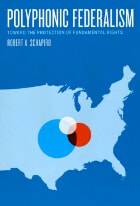
Polyphonic Federalism
Toward the Protection of Fundamental RightsRobert A. Schapiro
University of Chicago Press, 2009
The relationship between the states and the national government is among the most contested issues in the United States. And questions about where power should reside, how decisions should be made, and how responsibility should be allocated have been central to the American experiment in federalism. In Polyphonic Federalism, Robert A. Schapiro defends the advantages of multiple perspectives in government, arguing that the resulting “polyphony” creates a system that is more efficient, democratic, and protective of liberties.
This groundbreaking volume contends that contemporary views of federalism are plagued by outmoded dualist notions that seek to separate state and federal authority. Instead, Schapiro proposes a polyphonic model that emphasizes the valuable interaction of state and federal law, one that more accurately describes the intersecting realities of local and national power. Through an analysis of several legal and policy debates, Polyphonic Federalism demonstrates how a multifaceted government can best realize the potential of federalism to protect fundamental rights.
Popular Sovereignty and the Crisis of German Constitutional Law
The Theory and Practice of Weimar ConstitutionalismPeter C. Caldwell
Duke University Press, 1997
Caldwell makes accessible the rich literature in German constitutional thought of the Weimar period, most of which has been unavailable in English until now. On the liberal left, Hugo Preuss and Hans Kelsen defended a concept of democracy that made the constitution sovereign and, in a way, created the "Volk" through constitutional procedure. On the right, Carl Schmitt argued for a substantial notion of the "Volk" that could overrule constitutional procedure in a state of emergency. Rudolf Smend and Heinrich Triepel located in the constitution a set of inviolable values of the political community, while Hermann Heller saw in it a guarantee of substantial social equality. Drawing on the work of these major players from the 1920s, Caldwell reveals the various facets of the impassioned constitutional struggles that permeated German legal and political culture during the Weimar Republic.
Post-Communist Restitution and the Rule of Law
Csongor Kuti
Central European University Press, 2009
Prejudicial Appearances
The Logic of American Antidiscrimination LawRobert C. Post, with K. Anthony Appiah, Judith Butler, Thomas C. Grey, and Reva B. Siegel
Duke University Press, 2001
Four distinguished commentators respond to Post’s provocative essay. Each adopts a distinctive perspective. K. Anthony Appiah investigates the philosophical logic of stereotyping and of equality. Questioning whether the law ought to endorse any social practices that define persons, Judith Butler explores the tension between sociological and postmodern approaches to antidiscrimination law. Thomas C. Grey examines whether Post’s proposal can be reconciled with the values of the rule of law. And Reva B. Siegel applies critical race theory to query whether antidiscrimination law’s reshaping of race and gender should best be understood in terms of practices of subordination and stratification.
By illuminating the consequential rhetorical maneuvers at the heart of contemporary U.S. antidiscrimination law, Prejudical Appearances forces readers to reappraise the relationship between courts of law and social behavior. As such, it will enrich scholars interested in the relationships between law, rhetoric, postmodernism, race, and gender.
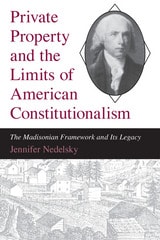
Private Property and the Limits of American Constitutionalism
The Madisonian Framework and Its LegacyJennifer Nedelsky
University of Chicago Press, 1990
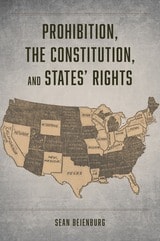
Prohibition, the Constitution, and States' Rights
Sean Beienburg
University of Chicago Press, 2019
Sean Beienburg recovers a largely forgotten constitutional debate, revealing how Prohibition became a battlefield on which skirmishes of American political development, including the debate over federalism and states’ rights, were fought. Beienburg focuses on the massive extension of federal authority involved in Prohibition and the passage of the Eighteenth Amendment, describing the roles and reactions of not just Congress, the presidents, and the Supreme Court but political actors throughout the states, who jockeyed with one another to claim fidelity to the Tenth Amendment while reviling nationalism and nullification alike. The most comprehensive treatment of the constitutional debate over Prohibition to date, the book concludes with a discussion of the parallels and differences between Prohibition in the 1920s and debates about the legalization of marijuana today.