Results by title

7 books match the query 'Holiness'
cover of Called to Holiness

Called to Holiness

Pope Emeritus Benedict XVI Pope Emeritus Benedict XVI

Catholic University of America Press, 2017
This edited collection is the first to gather in one volume the most relevant addresses, speeches, and homilies of His Holiness, Pope Emeritus Benedict XVI to seminarians and consecrated men and women into a single volume for the English-speaking world.
[more]
cover of Habits and Holiness: Ethics, Theology, and Biopsychology

Habits and Holiness

Ethics, Theology, and Biopsychology

Ezra, OP Sullivan

Catholic University of America Press, 2021

The topic of habitus is one of Thomas Aquinas’s greatest contributions to moral theology, but it has been generally neglected in theological scholarship until now. Habits and Holiness is the first work in English to explore Aquinas’s rich theology of habit in all of its grandeur and depth. Habits and Holiness shows that most facets of human life and behavior are greatly influenced by habits, which Thomas appraises as an analogous concept that is much broader than previous scholarship has recognized. Habits and Holiness accomplishes three tasks. First, it gives a complete and coherent account of Aquinas’s account of habitus. Most accounts of Aquinas’s view of habitus focus almost exclusively on “Treatise on Habits” in the Summa Theologiae I-II, qq. 49-54, and speak of habitus in reference to the virtues. However, Aquinas speaks of habitus in many other places, especially his commentaries on Aristotle’s works and his commentaries on Sacred Scripture. Aquinas employs the concept of habitus to explain a wide variety of human inclinations, such as instincts, personal and societal custom, acquired skills and virtues, original sin, grace, infused virtues, and Gifts of the Holy Spirit. Second, this book indicates how biological psychology illuminates and enriches Aquinas’s account of habit, and vice versa. Finally, Habits and Holiness provides readers with a framework for interpreting and utilizing the vast amount of practical habit literature that exists: it offers a practical analysis of habit development found in Aquinas’s works and those of empirical studies. The topic of habits is a golden thread that helps readers find their way through Aquinas’s extensive writings on morals. By describing the many kinds of habits we possess, and their widespread but often hidden effects in our lives, this book offers a new and unique reevaluation of many issues central to the moral life. It addresses childhood development, pagan virtue, akrasia, circumstances that limit free choice, how heroic virtue operates, and more. By seeing habits in general as a prism for understanding human action and its influences, Habits and Holiness provides a unique and appealing synthesis of Thomistic virtue theory, the contemporary science of habits, and best practices for eliminating bad habits and living good habits.
[more]
cover of Hollywood Faith: Holiness, Prosperity, and Ambition in a Los Angeles Church

Hollywood Faith

Holiness, Prosperity, and Ambition in a Los Angeles Church

Marti, Gerardo

Rutgers University Press, 2008

In Christianity, as with most religions, attaining holiness and a higher spirituality while simultaneously pursuing worldly ideals such as fame and fortune is nearly impossible. So how do people pursuing careers in Hollywood's entertainment industry maintain their religious devotion without sacrificing their career goals? For some, the answer lies just two miles south of the historic center of Hollywood, California, at the Oasis Christian Center.

In Hollywood Faith, Gerardo Marti shows how a multiracial evangelical congregation of 2,000 people accommodates itself to the entertainment industry and draws in many striving to succeed in this harsh and irreverent business. Oasis strategically sanctifies ambition and negotiates social change by promoting a new religious identity as "champion of life"-an identity that provides people who face difficult career choices and failed opportunities a sense of empowerment and endurance.

The first book to provide an in-depth look at religion among the "creative class," Hollywood Faith will fascinate those interested in the modern evangelical movement and anyone who wants to understand how religion adapts to social change.
[more]
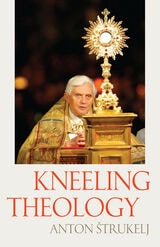
cover of Kneeling Theology

Kneeling Theology

Anton Strukelj

Catholic University of America Press, 2022
Anton Štrukelj, in this English edition of his book Kneeling Theology, which was published in German, Italian, Polish, Russian and Slovenian, based his theme on the concept first developed by Hans Urs von Balthasar. This Swiss intellectual is considered one of the most important theologians of the 20th century. Štrukelj sees as his task, through a synthetic survey of questions, to seek from his subjects a holistic perspective regarding the role of the theologian, without doing a critical analysis of all their work. Kneeling Theology analyzes the process and its consequences that gave rise to the religious and cultural developments of the past and the present. It is his thesis that the essence of theology should flow from holiness. He relies for his evidence on the life and work of Hans Urs von Balthasar (which included the insights of Adrienne von Speyr, physician and mystic), Cardinal Joseph Ratzinger (Pope Benedict XVI), the Slovenian theologian Anton Strle (now servant of God) and Anton Vovk, former Archbishop of Ljubljana, fearless witness of Christ and his Church, also servant of God. Štrukelj's purpose with this book is to point out that Catholic theology is best served, not only by competent research and a thorough knowledge of Church tradition, but by theologians who approach their work prayerfully and on their knees. The rich theological and pastoral heritage that has been bequeathed to us by a small group of special people in this book has come about because of their scholarship and their holiness. They have, each in their own way, demonstrated what it means to do theology on their knees, and they have shared their scholarship and insights with us.
[more]
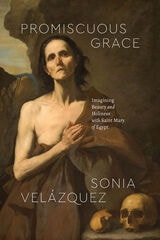
cover of Promiscuous Grace: Imagining Beauty and Holiness with Saint Mary of Egypt

Promiscuous Grace

Imagining Beauty and Holiness with Saint Mary of Egypt

Sonia Velázquez

University of Chicago Press, 2023

A meditation on holiness and beauty through the study of Saint Mary of Egypt.
 
Saint Mary of Egypt has fascinated theologians, poets, and artists since the seventh century. Her story is richly evocative, encompassing sin and sanctity, concupiscence and asceticism, youth and old age. In Promiscuous Grace, Sonia Velázquez thinks with Saint Mary of Egypt about the relationship between beauty and holiness. Drawing on an archive spanning Spanish medieval poetry, Baroque paintings, seventeenth-century hagiography, and Balzac’s Le chef-d’œuvre  inconnu, Velázquez argues for the importance of the senses on the surface of religious texts on her way to revealing why the legend of Saint Mary of Egypt still matters today.
[more]
cover of Saints: Faith without Borders

Saints

Faith without Borders

Edited by Françoise Meltzer and Jas Elsner

University of Chicago Press, 2011

While the modern world has largely dismissed the figure of the saint as a throwback, we remain fascinated by excess, marginality, transgression, and porous subjectivity—categories that define the saint. In this collection, Françoise Meltzer and Jas Elsner bring together top scholars from across the humanities to reconsider our denial of saintliness and examine how modernity returns to the lure of saintly grace, energy, and charisma.
Addressing such problems as how saints are made, the use of saints by political and secular orders, and how holiness is personified, Saints takes us on a photo tour of Graceland and the cult of Elvis and explores the changing political takes on Joan of Arc in France. It shows us the self-fashioning of culture through the reevaluation of saints in late-antique Judaism and Counter-Reformation Rome, and it questions the political intent of underlying claims to spiritual attainment of a Muslim sheikh in Morocco and of Sephardism in Israel. Populated with the likes of Francis of Assisi, Teresa of Avila, and Padre Pio, this book is a fascinating inquiry into the status of saints in the modern world.
[more]
cover of Spiraling Into God: Bonaventure on Grace, Hierarchy , and Holiness

Spiraling Into God

Bonaventure on Grace, Hierarchy , and Holiness

Katherine Wrisley Shelby

Catholic University of America Press, 2023

Spiraling into God: Bonaventure on Grace, Hierarchy, and Holiness offers a systematic account of the Seraphic Doctor’s doctrine of grace across his speculative-academic, mystical, hagiographical, and pastoral texts. It does so by arguing that an account of this kind can only be provided by also attending to his theology of hierarchy, a methodology derived from Bonaventure’s claim in the Major Legend of St. Francis that Francis of Assisi was a “vir hierarchicus,” or hierarchical man. As the book explores in great depth, this appellation relies upon Bonaventure’s reading of a Victorine Dionysian interpreter by the name of Thomas Gallus, whose “angelic anthropology”—or notion of the hierarchical soul—becomes a crucial component within the Seraphic Doctor’s teaching on grace as he interprets the sanctity of St. Francis. Throughout the course of his career, Bonvaenture will define sanctifying grace as a created “inflowing” (influentia) that “hierarchizes” human beings by purifying, illuminating, and perfecting them from within, thus causing them to become a similitude of the Trinity. This book explains what this means and why it matters. Most existing scholarship on this subject in Bonaventure’s thought interprets it as a subtopic with respect to other themes—for example, with respect to his Christology or his Trinitarian theology—rather than taking the time to understand his doctrine of grace in its own right. Alternatively, scholarly treatments of his doctrine of grace will treat it at length, but will only examine the topic as it appears in his more speculative-academic texts—most especially his Commentary on the Sentences or his famous Itinerarium Mentis in Deum—without bringing these into conversation with his pastoral works, sermon literature, or hagiographical texts. This book provides the first unified treatment of Bonaventure’s doctrine of grace across all these different genres of his known corpus, and in so doing, fills a massive lacuna in both Bonaventurean scholarship and in the field of medieval historical theology.
[more]