Results by title
56 books match the query 'Context' and 2 start with p
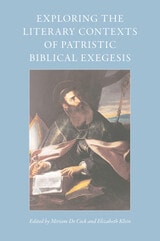
Patristic Exegesis in Context
Exploring the Genres of Early Christian Biblical InterpretationMiriam De Cock
Catholic University of America Press, 2023
The essays of Patristic Exegesis in Context examine the biblical exegesis of early Christians beyond the formal genre of biblical commentary. The past couple of decades have seen a broadening of perspective on the study of patristic exegesis; the phenomenon is increasingly situated within its various literary contexts and genres, and the definition of what counts as patristic exegesis is therefore widened. This volume thus situates itself within this emerging scholarly tradition, which aims not to give an account of exegetical strategies and methodologies as found primarily in exegetical commentaries and homilies, but to demonstrate the highly sophisticated nature of biblical exegesis in other genres, and the manifold uses to which this exegesis was put. Ancient Christian authors lived and breathed scripture; it served as their primary source of theological and liturgical vocabulary, their way of processing the world, their social ethic, and their mode of constructing self and communal identity. Scripture therefore permeates all ancient Christian literature, regardless of genre, and the various contexts in which interpretation of scripture took place resulted in a wide variety of uses of the church’s authoritative texts. The essays in this volume demonstrate the interpretive skill, creativity, and sophistication of early Christian authors in a myriad of other early Christian genres, such as poetry, paraphrase, hymns, martyr accounts, homilies, prophetic vision accounts, monastic writings, argumentative treatises, encomia, apocalypses, and catenae. Accordingly, the volume aims to help the modern person, who is used to hearing the Bible explained in explicitly expository situations (for example, in academic commentaries or religious sermons) to become more habituated to ancient ways of interacting with and expounding the biblical text. These essays attempt to contextualize various types of patristic exegesis, in order for us to glimpse the complex and diverse uses of the Bible in this period.
[more]
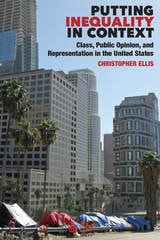
Putting Inequality in Context
Class, Public Opinion, and Representation in the United StatesChristopher Ellis
University of Michigan Press, 2017
Rising income inequality is highlighted as one of the largest challenges facing the United States, affecting civic participation and political representation. Although the wealthy often can and do exert more political influence, this is not always the case. To fix political inequality, it is important to understand exactly how class divisions manifest themselves in political outcomes, and what factors serve to enhance, or depress, inequalities in political voice.
Christopher Ellis argues citizens’—and legislators’—views of class politics are driven by lived experience in particular communities. While some experience is formally political, on an informal basis citizens learn a great deal about their position in the broader socioeconomic spectrum and the social norms governing how class intersects with day-to-day life. These factors are important for policymakers, since most legislators do not represent “the public” at large, but specific constituencies.
Focusing on U.S. congressional districts as the contextual unit of interest, Ellis argues individuals’ political behavior cannot be separated from their environment, and shows how income’s role in political processes is affected by the contexts in which citizens and legislators interact. Political inequality exists in the aggregate, but it does not exist everywhere. It is, rather, a function of specific arrangements that depress the political influence of the poor. Identifying and understanding these factors is a crucial step in thinking about what reforms might be especially helpful in enhancing equality of political voice.
[more]