Results by title
60 books match the query 'Corrupt practices' and 4 start with p
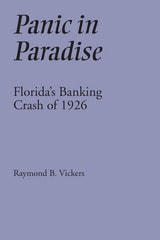
Panic in Paradise
Florida's Banking Crash of 1926Raymond B. Vickers
University of Alabama Press, 1994
Panic in Paradise is a comprehensive study of bank loan failures during the Florida land boom of the mid-1920s, during the years preceding the stock market crash of 1929. Florida and Georgia experienced a banking panic in 1926 when, in a ten-day period in July, after uncontrollable depositor runs, 117 banks closed in the two states. Uninsured depositors lost millions, and several suicides followed the financial havoc. This volume makes use of banking records that were legally sealed for almost 70 years and provides a shocking story of professional corruption and conspiracy.
"An extraordinary and unusual book that makes an important contribution to our understanding of banking history and the general economic history oof the 1920s. The banking collapse in the Southeast is virtually unknown, even to specialists in banking and financial history. No one who is interested in the banking history of the United States will want to miss this book." -- Eugene N. White, Rutgers University
"An exhaustively researched pioneering study; brilliant investigative reporting." -- Jack Blicksilver, Georgia State University

Pop Song Piracy
Disobedient Music Distribution since 1929Barry Kernfeld
University of Chicago Press, 2011

Possessed
Hypnotic Crimes, Corporate Fiction, and the Invention of CinemaStefan Andriopoulos
University of Chicago Press, 2008
Tracing this preoccupation through the period’s films—as well as its legal, medical, and literary texts—Andriopoulos pays particular attention to the terrifying notion of murder committed against one’s will. He returns us to a time when medical researchers described the hypnotized subject as a medium who could be compelled to carry out violent crimes, and when films like The Cabinet of Dr. Caligari and Dr. Mabuse, the Gambler famously portrayed the hypnotist’s seemingly unlimited power on the movie screen. Juxtaposing these medicolegal and cinematic scenarios with modernist fiction, Andriopoulos also develops an innovative reading of Kafka’s novels, which center on the merging of human and corporate bodies.
Blending theoretical sophistication with scrupulous archival research and insightful film analysis, Possessed adds a new dimension to our understanding of today’s anxieties about the onslaught of visual media and the expanding reach of vast corporations that seem to absorb our own identities.
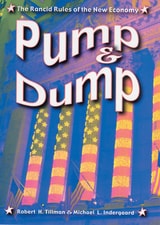
Pump and Dump
The Rancid Rules of the New EconomyTillman, Robert H
Rutgers University Press, 2005
In Pump and Dump: The Rancid Rules of the New Economy,Robert H. Tillman and Michael L. Indergaard argue that these scandals are symptoms of a corporate governance problem that began in the 1990s as New Economy pundits claimed that advances in technology and forms of business organization were changing the rules. A decade later, it looked more like a case of no rules. Endless revelations of fraud in the wake of corporate bankruptcies left ordinary investors bewildered and employees out of work with little or nothing.
Tillman and Indergaard observe that victims were taken in by organized behavior that calls to mind “pump and dump” schemes where shadowy swindlers push penny stocks. Yet, in the 1990s it was high-profile firms and high-status accomplices (financial analysts, bankers, and accountants) who used powerful institutional levers to pump the value of stock—duping investors while insiders sold their holdings for fantastic profits before the crash.
The authors explain how it was that so much of corporate America came to resemble a two-bit securities scam by focusing on the rules that mattered in three critical industries—energy trading, telecommunications, and dot-coms. Free-market hype and policies at the national level set the tone. While Wall Street wrapped itself in star-spangled packaging and celebrated its purported “democratization,” in the real halls of democracy congressional allies of business gutted protections for ordinary investors. In the regulatory vacuum that resulted, business professionals who were supposed to watch corporations instead promoted New Economy doctrines and worked with executives to tout their firms as New Economy contenders. Ringleaders in the inner circles that committed fraud made their own rules, which they enforced through a mix of bribery and bullying.
At a time when there is growing debate about proposals to privatize programs like Social Security and to promote an “ownership society,” Pump and Dump offers a path-breaking analysis of America’s most urgent economic problem: a system that relies on self-regulation and the rancid politics that continue to support the short-term interests of financial elites over the long-term interests of most Americans.