Results by title
170 books match the query 'Death, Grief, Loss' and 6 start with p
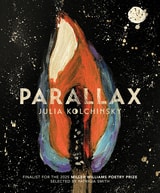
Parallax
Julia Kolchinsky
University of Arkansas Press, 2025
Finalist, 2025 Miller Williams Poetry Prize
Julia Kolchinsky’s Parallax offers a lyrical narrative of parenting a neurodiverse child under the shadow of the ongoing war in Ukraine, the poet’s birthplace. As her child expresses a fascination with death and violence, Kolchinsky struggles to process the war unfolding far away, on the same soil where so many of her ancestors perished during the Holocaust.
Anchored by a series of poems that look to the moon, this collection explores displaced perspectives and turns to the celestial to offer meditations on how elements formed in distant stars account for so much of our human DNA. In these poems, writes series editor Patricia Smith, Kolchinsky “clutches at a feeling of home that is both unfamiliar and deeply treasured, longs for all that was left behind, struggles to come to terms with the rampant violence devastating a landscape that still, in so many encouraging and heartbreaking ways, belongs to her.”
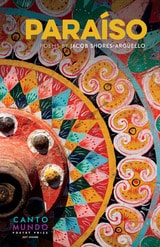
Paraíso
Poems byJacob Shores-Argüello
University of Arkansas Press, 2017
Paraíso, the first book in the new CantoMundo Poetry Series, which celebrates the work of Latino/a poets writing in English, is a pilgrimage against sorrow. Erupting from a mother’s death, the poems follow the speaker as he tries to survive his grief. Catholicism, family, good rum . . . these help, but the real medicine happens when the speaker pushes into the cloud forest alone.
In a Costa Rica far away from touristy beaches, we encounter bus trips over the cold mountains of the dead, drug dealers with beautiful dogs, and witches with cell phones. Science fuses with religion, witchcraft is joined with technology, and eventually grief transforms into belief.
Throughout, Paraíso defies categorization, mixing its beautiful sonnets with playful games and magic cures for the reader. In the process, moments of pure life mingle with the aftermath of a death.
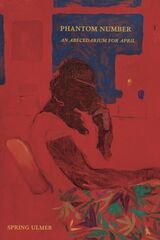
Phantom Number
An Abecedarium for AprilSpring Ulmer
Tupelo Press, 2025
Phantom Number listens for an absent voice. To survive and answer to her best friend and fellow poet April Freely’s death, Spring Ulmer rips meaning apart in her poems, then repairs it, only to rip it up again. Words bend, meaning shifts—abstraction a tool Ulmer wields to better get at the question at the heart of Phantom Number: How might a white friend write in protest of intimate Black death at a time when the push is to write Black joy as antidote to the commodification of Black trauma? Ulmer understands her position is suspect yet cannot shirk her love or rage. Ulmer asks the reader to do the work or else. Her abstracted poems vibrate, emotion emerging from a poem made rag. Ulmer’s abecedarium long form holds these fragments, inviting lines into an order of alliteration and words into an otherwise coherence, a belonging that has nothing to do with their origin. Phantom Number finds in abstraction a radical wail.
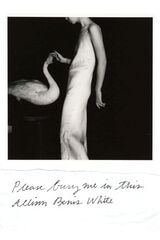
Please Bury Me in This
Allison Benis White
Four Way Books, 2017
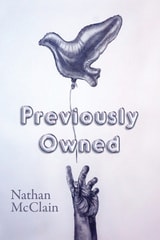
Previously Owned
Nathan McClain
Four Way Books, 2022
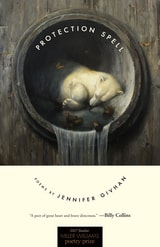
Protection Spell
PoemsJennifer Givhan
University of Arkansas Press, 2017
Finalist, 2017 Miller Williams Poetry Prize, edited by Billy Collins
“A poet of great heart and brave directness.”
—Billy Collins
In Protection Spell Jennifer Givhan explores the guilt, sadness, and freedom of relationships: the sticky love that keeps us hanging on for no reason other than love, the inky place that asks us to continue revising and reimagining, tying ourselves to this life and to each other despite the pain (or perhaps because of it). These poems reassemble safe spaces from the fissures cleaving the speaker’s own biracial home and act as witnesses speaking to the racial iniquity of our broader social landscape as well as to the precarious standpoint of a mother-woman of color whose body lies vulnerable to trauma and abuse. From insistent moments of bravery, a collection of poems arises that asks the impossible, like the childhood chant that palliates suffering by demanding nothing less than magical healing: sana sana colita de rana, si no sanas hoy, sanas mañana (the frog who loses his tail is commanded to grow another). In the end, Givhan’s verse offers a place where healing may begin.