Results by title
345 books match the query 'Design' and 12 start with p
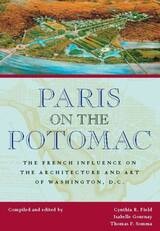
Paris on the Potomac
The French Influence on the Architecture and Art of Washington, D.C.Cynthia R. Field
Ohio University Press, 2007
In 1910 John Merven Carrère, a Paris-trained American architect, wrote, “Learning from Paris made Washington outstanding among American cities.” The five essays in Paris on the Potomac explore aspects of this influence on the artistic and architectural environment of Washington, D.C., which continued long after the well-known contributions of Peter Charles L’Enfant, the transplanted French military officer who designed the city’s plan.
Isabelle Gournay’s introductory essay provides an overview and examines the context and issues involved in three distinct periods of French influence: the classical and Enlightenment principles that prevailed from the 1790s through the 1820s, the Second Empire style of the 1850s through the 1870s, and the Beaux-Arts movement of the early twentieth century. William C. Allen and Thomas P. Somma present two case studies: Allen on the influence of French architecture, especially the Halle aux Blés, on Thomas Jefferson’s vision of the U.S. Capitol; and Somma on David d’Angers’s busts of George Washington and the Marquis de Lafayette. Liana Paredes offers a richly detailed examination of French-inspired interior decoration in the homes of Washington’s elite in the late nineteenth and early twentieth centuries. Cynthia R. Field concludes the volume with a consideration of the influence of Paris on city planning in Washington, D.C., including the efforts of the McMillan Commission and the later development of the Federal Triangle complex.
The essays in this collection, the latest addition to the series Perspectives on the Art and Architectural History of the United States Capitol, originated in a conference held by the U.S. Capitol Historical Society in 2002 at the French Embassy’s Maison Française.
Participatory Composition
Video Culture, Writing, and ElectracySarah J. Arroyo
Southern Illinois University Press, 2013
Like. Share. Comment. Subscribe. Embed. Upload. Check in. The commands of the modern online world relentlessly prompt participation and encourage collaboration, connecting people in ways not possible even five years ago. This connectedness no doubt influences college writing courses in both form and content, creating possibilities for investigating new forms of writing and student participation. In this innovative volume, Sarah J. Arroyo argues for a “participatory composition,” inspired by the culture of online video sharing and framed by theorist Gregory Ulmer’s concept of electracy.
Electracy, according to Ulmer, “is to digital media what literacy is to alphabetic writing.” Although electracy can be compared to digital literacy, it is not something shut on and off with the power buttons on computers or mobile devices. Rather, electracy encompasses the cultural, institutional, pedagogical, and ideological implications inherent in the transition from a culture of print literacy to a culture saturated with electronic media, regardless of the presence of actual machines.
Arroyo explores the apparatus of electracy in many of its manifestations while focusing on the participatory practices found in online video culture, particularly on YouTube. Chapters are devoted to questions of subjectivity, definition, authorship, and pedagogy. Utilizing theory and incorporating practical examples from YouTube, classrooms, and other social sites, Arroyo presents accessible and practical approaches for writing instruction. Additionally, she outlines the concept of participatory composition by highlighting how it manifests in online video culture, offers student examples of engagement with the concept, and advocates participatory approaches throughout the book.
Arroyo presents accessible and practical possibilities for teaching and learning that will benefit scholars of rhetoric and composition, media studies, and anyone interested in the cultural and instructional implications of the digital age.

Performative Materials in Architecture and Design
Edited by Rashida Ng and Sneha Patel
Intellect Books, 2013
Planet Cosplay
Costume Play, Identity and Global FandomEdited by Paul Mountfort, Anne Peirson-Smith and Adam Geczy
Intellect Books, 2019
Poetries - Politics
A Celebration of Language, Art, and LearningJenevieve DeLosSantos
Rutgers University Press, 2023
Reproduced in full color and with the accompanying poems in both their original language and a translation, this catalogue commemorates the incredible creative spirit of the project and provides a new way of contemplating these great poetic works.
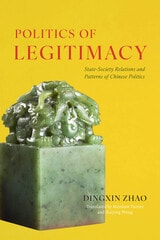
Politics of Legitimacy
State-Society Relations and Patterns of Chinese PoliticsDingxin Zhao
University of Chicago Press, 2026
The Chinese communist state has survived massive social changes, including the introduction of capitalist markets, an ongoing explosion of technological innovation, and an unprecedented jump in wealth and education, accompanied by a major cultural transformation. How has China managed to maintain its power even as the ground has so profoundly shifted? In Politics of Legitimacy, Dingxin Zhao argues that state power can be legitimized in three ideal-typical ways: a set of values upheld by the state (ideological legitimacy), recognized political processes such as regular competitive elections (procedural legitimacy), and the state’s capacity to provide public goods (performance legitimacy).
Building on this theoretical framework, Zhao analyzes different aspects of Chinese politics, including the tragic ending of the 1989 pro-democracy movement, the weak development of mass-based nationalism in post-Mao China, the reasons behind China’s economic success, the anti-establishment tendency of the Chinese mass media and social media, and the sources of political tension in China, despite a superb economy. Moreover, Zhao’s innovative framework is widely applicable beyond China, shifting our attention from regime-type categories to the tools and relationships that determine their survival or collapse, and illuminating the current global emergence of conservatism and religious nationalism.
Postmodern Advertising in Japan
Seduction, Visual Culture, and the Tokyo Art Directors ClubOry Bartal
Dartmouth College Press, 2015

Potters and Communities of Practice
Glaze Paint and Polychrome Pottery in the American Southwest, AD 1250 to 1700Edited by Linda S. Cordell and Judith A. Habicht-Mauche
University of Arizona Press, 2012
The peoples of the American Southwest during the 13th through the 17th centuries witnessed dramatic changes in settlement size, exchange relationships, ideology, social organization, and migrations that included those of the first European settlers. Concomitant with these world-shaking events, communities of potters began producing new kinds of wares—particularly polychrome and glaze-paint decorated pottery—that entailed new technologies and new materials. The contributors to this volume present results of their collaborative research into the production and distribution of these new wares, including cutting-edge chemical and petrographic analyses. They use the insights gained to reflect on the changing nature of communities of potters as they participated in the dynamic social conditions of their world.

Power Circuit Breaker Theory and Design
C.H. Flurscheim
The Institution of Engineering and Technology, 1982
Principles of Waveform Diversity and Design
Michael C. Wicks
The Institution of Engineering and Technology, 2011
Product Design, Technology, and Social Change
A Short Cultural HistoryLaura Scherling
Intellect Books, 2024
This cultural history critically examines the development of product design, considering major milestones in the mass production of goods and services and aiming to incorporate a more inclusive worldview than traditional surveys of the topic.
The breadth and versatility of product design throughout history have been profound. Products have long supported the integration and interpretation of emerging technologies into our lives. These objects include everything from tools, accessories, furniture, and clothing to types of transportation, websites, and mobile applications. Products provide singular or multiple functions, are tangible and intangible, and in many instances have affected the quality of our lives by saving time or money or by increasing feelings of personal satisfaction. At the same time, many products have negatively affected people and the environment. For nearly every product that makes it into the hands of a consumer, there is also a designer who created it and someone who labored to make it.
An eye-opening survey of product design from preindustrial times to the present day, Product Design, Technology, and Social Change provides a thorough examination of the relationship between products, consumption, sustainability, politics, and social movements.
Prototyping Across the Disciplines
Designing Better FuturesEdited by Jennifer Roberts-Smith, Stan Ruecker, Milena Radzikowska
Intellect Books, 2020
Fields of study progress not by understanding more about what already exists, although that is a useful step, but by making guesses about possible better futures. The guesses consist of small forays into those futures, using strategies that are variously called learning through making, research through design, or more simply: prototyping. While traditionally associated primarily with industrial design, and more recently with software development, prototyping is now used as an important tool in areas ranging from materials engineering to landscape architecture to the digital humanities. This book collects current theories and methods of prototyping across a dozen disciplines and illustrates them through case studies of actual projects, whether in industry or the classroom.
Prototyping Across the Disciplines provides context, a theoretical framework, and a set of methodologies for interdisciplinary collaboration in design. Each chapter offers a different disciplinary perspective on prototyping and provides a case study as a point of comparison for identifying commonalities and divergences in current practices. In examining the central role of prototyping in design research, this edited collection demonstrates theoretical and methodological transferability across disciplines not typically thought to be related, including post-human design, theatre, tabletop game design, landscape architecture, and arts entrepreneurship.