Results by title
141 books match the query 'Developing countries' and 14 start with p
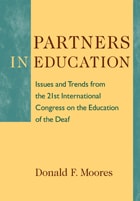
Partners in Education
Issues and Trends from the 21st International Congress on the Education of the DeafDonald F. Moores
Gallaudet University Press, 2011
The 21st International Congress on the Education of the Deaf (ICED) witnessed revolutionary exchanges on the vital themes in education. Presenters addressed topics encompassing seven major strands: Educational Environments, Language and Literacy, Early Intervention, Unique Challenges in Developing Countries, Educating Learners with Diverse Needs, Technology in Education, and Sign Language and Deaf Culture. These presentations and ensuing dialogues raised many complex questions. Partners in Education: Issues and Trends from the 21st International Congress on the Education of the Deaf features all of the keynote addresses by renowned luminaries in deaf education: Breda Carty, Karen Ewing, Nassozi Kiyaga, John Luckner, Connie Mayer and Beverly Trezek, volume editor Donald F. Moores, Peter V. Paul, Antti Raike, Claudine Storbeck, James Tucker, and Alys Young.
Most critically, the contributors to this collection explore the many multifaceted challenges facing the world’s deaf students. Deaf children are being diagnosed with overlays of disabilities; more deaf children are growing up in poverty; and many deaf children represent minority racial/ethnic groups or are immigrants to their country of residence. The situation for deaf individuals in the most impoverished countries of the world is desperate and of crisis proportions. This volume brings these themes to light through its exceptional synthesis of the outstanding discourse that took place at ICED 2010, including abstracts from 30 celebrated conference presentations.
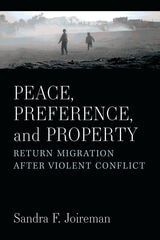
Peace, Preference, and Property
Return Migration after Violent ConflictSandra F. Joireman
University of Michigan Press, 2022
Growing numbers of people are displaced by war and violent conflict. In Ukraine, Afghanistan, Ethiopia, Myanmar, Syria, and elsewhere violence pushes civilian populations from their homes and sometimes from their countries, making them refugees. In previous decades, millions of refugees and displaced people returned to their place of origin after conflict or were resettled in countries in the Global North. Now displacements last longer, the number of people returning home is lower, and opportunities for resettlement are shrinking. More and more people spend decades in refugee camps or displaced within their own countries, raising their children away from their home communities and cultures. In this context, international policies encourage return to place of origin.
Using case studies and first-person accounts from interviews and fieldwork in post-conflict settings such as Uganda, Liberia, and Kosovo, Sandra F. Joireman highlights the divergence between these policies and the preferences of conflict-displaced people. Rather than looking from the top down, at the rights that people have in international and domestic law, the perspective of this text is from the ground up—examining individual and household choices after conflict. Some refugees want to go home, some do not want to return, some want to return to their countries of origin but live in a different place, and others are repatriated against their will when they have no other options. Peace, Preference, and Property suggests alternative policies that would provide greater choice for displaced people in terms of property restitution and solutions to displacement.

Peripheral Visions
Deterrence Theory and American Foreign Policy in the Third World, 1965-1990Ted Hopf
University of Michigan Press, 1994

Perspectives on Trade and Development
Anne O. Krueger
University of Chicago Press, 1990
Providing an important and original perspective for understanding both the development process and policies aimed at raising the standard of living in poorer nations, Perspectives on Trade and Development gathers sixteen of Anne O. Krueger's most important essays on international trade and development economics. Her essays discuss the relationships between trade strategies and development; the links between factor endowments, developing countries' policies, and trade strategies in terms of their growth; the role of economic policy in development; and the international economic environment in which development efforts are taking place. Her analyses are extended to trade and development policies generally, and account for a substantial part of the residue unexplained by past theories. This insightful contribution by an influential scholar will be essential reading for all scholars of trade and development.

Planning Education Reforms in Developing Countries
The Contigency ApproachDennis A. Rondinelli, John Middleton, and Adriaan Verspoor
Duke University Press, 1990

Polarizing Development
Alternatives to Neoliberalism and the CrisisEdited by Lucia Pradella and Thomas Marois
Pluto Press, 2015
The global economic crisis has exposed the limits of neoliberalism and dramatically deepened social polarization. Yet, despite increasing social resistance and opposition, neoliberalism prevails globally.
Radical alternatives, moreover, are only rarely debated. And if they are, such alternatives are reduced to new Keynesian and new developmental agendas, which fail to address existing class divisions and imperialist relations of domination.
This collection of essays polarizes the debate between radical and reformist alternatives by exploring head-on the antagonistic structure of capitalist development. The contributors ground their proposals in an international, non-Eurocentric and Marxian inspired analysis of capitalism and its crises. From Latin America to Asia, Africa to the Middle East and Europe to the US, social and labour movements have emerged as the protagonists behind creating alternatives.
This book’s new generation of scholars has written accessible yet theoretically informed and empirically rich chapters elaborating radical worldwide strategies for moving beyond neoliberalism, and beyond capitalism. The intent is to provoke critical reflection and positive action towards substantive change.
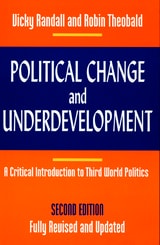
Political Change and Underdevelopment
A Critical Introduction to Third World PoliticsVicky Randall and Robin Theobald
Duke University Press, 1998
This second edition has been expanded to include discussions of the international debt crisis, the impact of globalization on the postcolonial world, the rise of newly industrialized countries, and the upsurge in religion-based conflict in the post–Cold War era. Describing the strengths and weaknesses of the existing interpretive approaches to these issues, the authors explore the often difficult relationship between political change and economic development. At the same time they provide a comprehensive view into the turbulent politics of the Third World and suggest how future analysis can build on present approaches to reflect political reality more fully.
An essential text for students of political science and Third World societies, this volume will also interest anyone seeking a clearer understanding of the current issues underlying the politics of these countries.
Political Film
The Dialectics of Third CinemaMike Wayne
Pluto Press, 2001
Population and Economic Change in Developing Countries
Edited by Richard A. Easterlin
University of Chicago Press, 1987
"An important landmark in the growing field of economic demography."—Dudley Kirk, Journal of Developing Areas

Postcolonial America
Edited by C. Richard King
University of Illinois Press, 2000
Advancing multiple, even conflicted visions of postcolonial America, this important volume interrogates postcolonial theory and traces the emergence and significance of postcolonial practices and precepts in the United States. Contributors discuss how the unique status of the United States as the colony that became a superpower has shaped its sense of itself. They assess the global networks of inequality that have displaced neocolonial systems of conquest, exploitation, and occupation. They also examine how individuals and groups use music, the Internet, and other media to reconfigure, reinvent, and resist postcoloniality in American culture.
Candidly facing the inherent contradictions of "the American experience," this collection demonstrates the patterns, connections, and histories characteristic of postcoloniality in America and initiates important discussions about how these conditions might be changed.
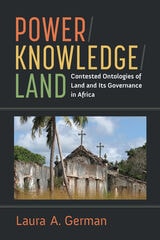
Power / Knowledge / Land
Contested Ontologies of Land and Its Governance in AfricaLaura A. German
University of Michigan Press, 2022
The 2008 outcry over the “global land grab” made headlines around the world, leading to a sustained interest in the dynamics and fate of customary land among both academics and development practitioners. In Power/Knowledge/Land, author Laura German profiles the consolidation of a global knowledge regime surrounding land and its governance within international development circles in the decade following this outcry, and the growing enrollment of previously antagonistic actors within it. Drawing theoretical insights on the inseparability of power and knowledge, German reveals the dynamics of knowledge practices that have enabled the longstanding project of commodifying customary land – and the more contemporary interests in acquiring and financializing it – to be advanced and legitimated by capturing the energies of socially progressive forces. By bringing theories of change from the emergent land governance orthodoxy into dialogue with the ethnographic evidence from across the African continent and beyond, concepts masquerading as universal and self-evident truths are provincialized, and their role in commodifying customary land and entrenching colonial futurities put on display. In doing so, the volume brings wider academic debates surrounding productive forms of power into the heart of the land grab debate, while enhancing their accessibility to a wider audience.
Power/Knowledge/Land takes current scholarly debates surrounding land grabs beyond their theoretical moorings in critical agrarian studies, political economy and globalization into contemporary debates surrounding the politics of knowledge—from theories of coloniality to ontological anthropology, thereby enabling new dynamics of the phenomenon to be revealed. The book deploys a pioneering epistemology integrating deconstructionist approaches (to reveal the tactics, truth claims and ontological assumptions of global knowledge brokers), with systematic qualitative reviews and comparative study (to contrast these dominant constructs with the evidence and reveal alternative ways of knowing “land” and practicing “security” from the ethnographic literature). This helps to reveal the Western and modernist biases in the narratives that have been advanced about women, custom, and security, revealing how the coloniality of knowledge works to grease the wheels of land takings by advancing highly provincialized constructs aligned with western interests as universal truths.
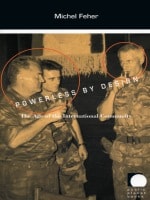
Powerless by Design
The Age of the International CommunityMichel Feher
Duke University Press, 2000
Exemplary of this new approach were Western responses to ethnic cleansing in the former Yugoslavia and genocide in Rwanda. In order to avoid costly interventions, U.S. and European leaders traced these crimes to ancient tribal enmities and professed that the role of the international community should be limited to a humanitarian, impartial, and conciliatory engagement with all the warring parties. They thus managed to appear righteous but powerless, at least until NATO’s intervention in Kosovo. Faced with this doctrine, both the liberal and radical wings of the Western Left found themselves in an uneasy position. Liberals, while lured by their leaders’ humanitarianism were nonetheless disturbed by the dismal results of the policies carried out in the name of the international community. Conversely, anti-imperialist militants were quick to mock the hypocrisy of their governments’ helpless indignation, yet certainly not prepared to demand that Western powers resort to force.
Are we still in this “age of the international community”? Feher shows that with NATO’s intervention in Kosovo, both liberal and radical activists suddenly found their mark: the former welcomed the newfound resolve of their governments, while the latter condemned it as the return of the imperialist “new world order.” For Western leaders, however, the war against Serbia proved an accident rather than a turning point. Indeed, less than a year later, their indifference to the destruction of Chechnya by Russian troops suggested that the discursive strategy exposed in Powerless by Design might remain with us for quite some time.
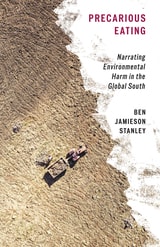
Precarious Eating
Narrating Environmental Harm in the Global SouthBen Jamieson Stanley
University of Minnesota Press, 2024
The role of food and hunger in contemporary South African and Indian environmental writing
From GMOs to vegetarianism and veganism, questions of what we should (and shouldn’t) eat can be frequent sources of debate and disagreement. In Precarious Eating, Ben Jamieson Stanley asks how recentering global South representations of food might shift understandings of environmental precarity.
Precarious Eating follows the lead of writers and thinkers in South Africa and India who are tracing the production and consumption of food, exploring ways to reconnect our narratives about climate change, global capitalism, and social justice. Taking up a diverse range of novels, films, scholar/activist writings, intellectual histories, and cookbooks, Stanley connects the ethics of eating to histories of empire and apartheid, uneven globalization, gender and sexuality, and global South experiences of climate change. They shift the lens of environmental humanities from climate-focused paradigms developed in the global North to food-focused environmental culture and activism in the South, addressing topics that range from foraging and farmer suicides to disordered eating and queer intimacy.
By highlighting authors, activists, and environments of the global South, Precarious Eating joins with scholarship from postcolonial, decolonial, Indigenous, and Black studies to underscore how capitalism and empire shape our planetary environmental crisis.
Retail e-book files for this title are screen-reader friendly with images accompanied by short alt text and/or extended descriptions.
Preventing Currency Crises in Emerging Markets
Edited by Sebastian Edwards and Jeffrey A. Frankel
University of Chicago Press, 2002
Topics covered include exchange rate regimes, contagion (transmission of currency crises across countries), the current account of the balance of payments, the role of private sector investors and of speculators, the reaction of the official sector (including the multilaterals), capital controls, bank supervision and weaknesses, and the roles of cronyism, corruption, and large players (including hedge funds).
Ably balancing detailed case studies, cross-country comparisons, and theoretical concerns, this book will make a major contribution to ongoing efforts to understand and prevent international currency crises.