Results by title
126 books match the query 'Early modern, 1500-1700' and 7 start with p
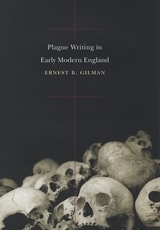
Plague Writing in Early Modern England
Ernest B. Gilman
University of Chicago Press, 2009
During the seventeenth century, England was beset by three epidemics of the bubonic plague, each outbreak claiming between a quarter and a third of the population of London and other urban centers. Surveying a wide range of responses to these epidemics—sermons, medical tracts, pious exhortations, satirical pamphlets, and political commentary—Plague Writing in Early Modern England brings to life the many and complex ways Londoners made sense of such unspeakable devastation.
Ernest B. Gilman argues that the plague writing of the period attempted unsuccessfully to rationalize the catastrophic and that its failure to account for the plague as an instrument of divine justice fundamentally threatened the core of Christian belief. Gilman also trains his critical eye on the works of Jonson, Donne, Pepys, and Defoe, which, he posits, can be more fully understood when put into the context of this century-long project to “write out” the plague. Ultimately, Plague Writing in Early Modern England is more than a compendium of artifacts of a bygone era; it holds up a distant mirror to reflect our own condition in the age of AIDS, super viruses, multidrug resistant tuberculosis, and the hovering threat of a global flu pandemic.

Playing Dirty
Sexuality and Waste in Early Modern ComedyWill Stockton
University of Minnesota Press, 2010
Noting that psychoanalysis has traditionally operated in a paranoid framework that relentlessly produces evidence of the same “truths,” Stockton turns to a minority practice in psychoanalysis—associated with Jean Laplanche—to develop a more “playful” analytic for literary studies. This analytic brings together different discourses of sexuality and the body and allows individual writings to reform psychoanalytic wisdom about sexuality, waste, and comedy. Through original explorations of works by William Shakespeare, Ben Jonson, Sir John Harington, Thomas Nashe, and Geoffrey Chaucer, Stockton further encourages the reconciliation of psychoanalysis and queer historicism. He focuses in large part on the less-often-read texts of the early modern English canon, assessing the ways in which these books have been purged from the canon in the name of generic purity.
Playing Dirty builds on recent calls by Renaissance and medieval queer scholars for a method of literary analysis that is less constrained by the boundaries of periodicity and the supposed exigencies of historicism. To take Playing Dirty seriously is to accept its invitation to “play”—to queerly disrupt the modern divide in moving promiscuously between texts past and present.
Poetic Relations
Intimacy and Faith in the English ReformationConstance M. Furey
University of Chicago Press, 2017
As Furey demonstrates, John Donne, George Herbert, Anne Bradstreet, and others describe inner lives that are surprisingly crowded, teeming with human as well as divine companions. The same early modern writers who bequeathed to us the modern distinction between self and society reveal here a different way of thinking about selfhood altogether. For them, she argues, the self is neither alone nor universally connected, but is forever interactive and dynamically constituted by specific relationships. By means of an analysis equally attentive to theological ideas, social conventions, and poetic form, Furey reveals how poets who understand introspection as a relational act, and poetry itself as a form ideally suited to crafting a relational self, offer us new ways of thinking about selfhood today—and a resource for reimagining both secular and religious ways of being in the world.
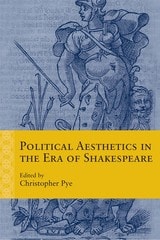
Political Aesthetics in the Era of Shakespeare
Edited by Christopher Pye
Northwestern University Press, 2020
Taking up this expansive conception of aesthetics, Political Aesthetics in the Era of Shakespeare suggests that the political stakes of the literary work—and Shakespeare’s work in particular—extend from the most intimate dimensions of affective response to the problem of the grounds of political society. The approaches to aesthetic thought included in this volume explore the intersections between the literary work and the full range of concerns animating the field today: political philosophy, affect theory, and ecocritical analysis of environs and habitus.
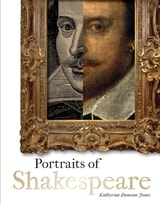
Portraits of Shakespeare
Katherine Duncan-Jones
Bodleian Library Publishing, 2015
With Portraits of Shakespeare, Katherine Duncan-Jones poses a series of questions about the mysterious physical appearance of the brilliant writer of plays, poems, and sonnets: Why is it so difficult to find images of Shakespeare that were made during his lifetime? Which images are most likely to have been made by those close to the writer? And why do newly discovered images emerge with such startling regularity? With an eye toward answering these questions, the book begins with a broad analysis of the tradition of the “author portrait” before, during, and after Shakespeare’s lifetime. Duncan-Jones provides a detailed critique of three of the most widely accepted portraits: the engraving facing the First Folio’s title page; the sculptured stone bust that adorns Shakespeare’s funerary monument at Holy Trinity Church, Stratford-upon-Avon; and the “Chandos portrait,” an early seventeenth-century painting on canvas which is widely recognized as the best image. Through a painstaking historical analysis of the painting’s early history and provenance, Duncan-Jones arrives at a plausible new identification of both the artist and the artist’s personal connections with Shakespeare. Finally, taking the book into the present, she considers the afterlife of all three images in memorials, advertising, and in graphic art—all evidence of a continuing desire to put a face to one of literature’s most famous names.
Print, Manuscript, and Performance
THE CHANGING RELATIONS OF THE MEDIA IN EARLY MODERN ENGLANDArthur F. Marotti and Michael D. Bristol
The Ohio State University Press, 2000
Although canonical literary writers such as Shakespeare, Jonson, and Rochester are discussed, the field of writing examined is a broad one, embracing political speeches, coterie manuscript poetry, popular pamphlets, parochially targeted martyrdom accounts, and news reports. Setting writers, audiences, and texts in their specific historical context, the contributors focus on a period in early modern England, from the late sixteenth through the late seventeenth century, when the shift from orality and manuscript communication to print was part of large-scale cultural change. Arthur F. Marotti’s and Michael D. Bristol’s introduction analyzes some of the sociocultural issues implicit in the collection and relates the essays to contemporary work in textual studies, bibliography, and publication history.
Publishing Women
Salons, the Presses, and the Counter-Reformation in Sixteenth-Century ItalyDiana Robin
University of Chicago Press, 2007
Even the most comprehensive Renaissance histories have neglected the vibrant groups of women writers that emerged in cities across Italy during the mid-1500s—and the thriving network of printers, publishers, and agents that specialized in producing and selling their books. In Publishing Women, Diana Robin finally brings to life this story of women’s cultural and intellectual leadership in early modern Italy, illuminating the factors behind—and the significance of—their sudden dominance.
Focusing on the collective publication process, Robin portrays communities in Naples, Venice, Rome, Siena, and Florence, where women engaged in activities that ranged from establishing literary salons to promoting religious reform. Her innovative cultural history considers the significant roles these women played in tandem with men, rather than separated from them. In doing so, it collapses the borders between women’s history, Renaissance and Reformation studies, and book history to evoke a historical moment that catapulted women’s writings and women-sponsored books into the public sphere for the first time anywhere in Europe.