917 books match the query 'Economics' and 36 start with p

cover of Palestine Is Throwing a Party and the Whole World Is Invited: Capital and State Building in the West Bank

Palestine Is Throwing a Party and the Whole World Is Invited

Capital and State Building in the West Bank

Kareem Rabie

Duke University Press, 2021
In 2008, Palestinian Prime Minister Salam Fayyad invited international investors to the first-ever Palestine Investment Conference, which was designed to jump-start the process of integrating Palestine into the global economy. As Fayyad described the conference, Palestine is “throwing a party, and the whole world is invited.” In this book Kareem Rabie examines how the conference and Fayyad's rhetoric represented a wider shift in economic and political practice in ways that oriented state-scale Palestinian politics toward neoliberal globalization rather than a diplomatic two-state solution. Rabie demonstrates that private firms, international aid organizations, and the Palestinian government in the West Bank focused on large-scale private housing development in an effort toward state-scale economic stability and market building. This approach reflected the belief that a thriving private economy would lead to a free and functioning Palestinian state. Yet, as Rabie contends, these investment-based policies have maintained the status quo of occupation and Palestine's subordinate and suspended political and economic relationship with Israel.
[more]
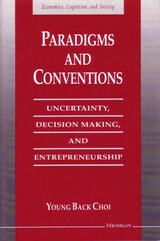
cover of Paradigms and Conventions: Uncertainty, Decision Making, and Entrepreneurship

Paradigms and Conventions

Uncertainty, Decision Making, and Entrepreneurship

Young Back Choi

University of Michigan Press, 1993
An innovative approach to the analysis of decision making under uncertainty
[more]
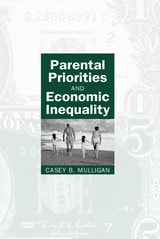
cover of Parental Priorities and Economic Inequality

Parental Priorities and Economic Inequality

Casey B. Mulligan

University of Chicago Press, 1997

What determines whether children grow up to be rich or poor? Arguing that parental actions are some of the most important sources of wealth inequality, Casey B. Mulligan investigates the transmission of economic status from one generation to the next by constructing an economic model of parental preferences.

In Mulligan's model, parents determine the degree of their altruistic concern for their children and spend time with and resources on them accordingly—just as they might make choices about how they spend money. Mulligan tests his model against both old and new evidence on the intergenerational transmission of consumption, earnings, and wealth, including models that emphasize "financial constraints." One major prediction of Mulligan's model confirmed by the evidence is that children of wealthy parents typically spend more than they earn.

Mulligan's innovative approach can also help explain other important behavior, such as charitable giving and "corporate loyalty," and will appeal to a wide range of quantitatively oriented social scientists and sociobiologists.
[more]
cover of Paternalistic Capitalism

Paternalistic Capitalism

Andreas G. Papandreou

University of Minnesota Press, 1972

Paternalistic Capitalism was first published in 1972. Minnesota Archive Editions uses digital technology to make long-unavailable books once again accessible, and are published unaltered from the original University of Minnesota Press editions.

The distinguished economist and Greek political leader presents here a powerful critique of American capitalism and its relationship to government and foreign policy. Dr. Papandreou first examines the orthodox view of the contemporary capitalist economy and the "myth of market capitalism" which it has engendered. He then considers the Neo-Marxist view that the economy can best be understood as monopoly capitalism, and the technocratic interpretation of society proposed by J. K. Galbraith. Dr. Papandreou accepts and rejects various aspects of these two interpretations, and moves to define the salient features of what he calls paternalistic capitalism, wherein privatized decentralized planning increasingly is carried out by the corporate managerial elite, in the interest not of the consumer, but of the "system." The paternalism is that of the autocratic big brother.

The author then explores the relationship between the managerial elite and the instrumentalities of the State, and claims that next to the managerial elite stand the national security managers—not by accident, for paternalistic capitalism is aggressively expansionist, as is reflected in the foreign policy of the capitalist metropolis, the United States. The global aspect of paternalistic capitalism is further delineated in Dr. Papandreou's discussion of the "new mercantilism" and of the institutional device of the multinational corporation. Finally, he considers briefly two alternatives—the Soviet experiment, which he rejects as paternalistic socialism, and a vision of a regionally decentralized society, in which man will control rather than be at the mercy of his social environment.
[more]
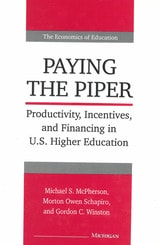
cover of Paying the Piper: Productivity, Incentives, and Financing in U.S. Higher Education

Paying the Piper

Productivity, Incentives, and Financing in U.S. Higher Education

Michael S. McPherson, Morton Owen Schapiro, and Gordon C. Winston, Editors

University of Michigan Press, 1994

Rising tuitions and shrinking government budgets have pushed questions about productivity and resource use in U.S. higher education to the fore. In Paying the Piper three distinguished researchers examine the many successes of U.S. higher education, identify real problems, and carefully analyze potential solutions. Among the questions addressed are: On what do colleges and universities spend their money and how have their spending patterns changed over time; what does "quality" really mean in higher education and how is it related to price and cost; what are appropriate measures of "productivity"; and does increasing the amount of federal financial aid encourage colleges to raise their tuitions? The essays comprising this volume demonstrate that the application of basic economic principles and a combination of both descriptive and econometric analyses can illuminate a number of issues. Using economic concepts and tools to provide insight into these pressing questions, Paying the Piper helps us to understand the recent past, anticipate the future, and develop policies that can influence the future.
[more]
cover of Pension Puzzles: Social Security and the Great Debate

Pension Puzzles

Social Security and the Great Debate

Melissa Hardy

Russell Sage Foundation, 2007
The rancorous debate over the future of Social Security reached a fever pitch in 2005 when President Bush unsuccessfully proposed a plan for private retirement accounts. Although efforts to reform Social Security seem to have reached an impasse, the long-term problem—the projected Social Security deficit—remains. In Pension Puzzles, sociologists Melissa Hardy and Lawrence Hazelrigg explain for a general audience the fiscal challenges facing Social Security and explore the larger political context of the Social Security debate. Pension Puzzles cuts through the sloganeering of politicians in both parties, presenting Social Security's technical problems evenhandedly and showing how the Social Security debate is one piece of a larger political struggle. Hardy and Hazelrigg strip away the ideological baggage to explicate the basic terms and concepts needed to understand the predicament of Social Security. They compare the cases for privatizing Social Security and for preserving the program in its current form with adjustments to taxes and benefits, and they examine the different economic projections assumed by proponents of each approach. In pursuit of its privatization agenda, Hardy and Hazelrigg argue, the Bush administration has misled the public on an issue that was already widely misunderstood. The authors show how privatization proponents have relied on dubious assumptions about future rates of return to stock market investments and about the average citizen's ability to make informed investment decisions. In addition, the administration has painted the real but manageable shortfalls in Social Security revenue as a fiscal crisis. Projections of Social Security revenues and benefits by the Social Security Administration have treated revenues as fixed, when in fact they are determined by choices made by Congress. Ultimately, as Hardy and Hazelrigg point out, the clash over Social Security is about more than technical fiscal issues: it is part of the larger culture wars and the ideological struggle over what kind of social responsibilities and rights American citizens should have. This rancorous partisan wrangling, the alarmist talk about a "crisis" in Social Security, and the outright deception employed in this debate have all undermined the trust between citizens and government that is needed to restore the solvency of Social Security for future generations of retirees. Drawing together economic analyses, public opinion data, and historical narratives, Pension Puzzles is a lucid and engaging guide to the major proposals for Social Security reform. It is also an insightful exploration of what that debate reveals about American political culture in the twenty-first century. A Volume in the American Sociological Association's Rose Series in Sociology
[more]
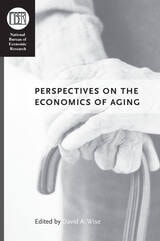
cover of Perspectives on the Economics of Aging

Perspectives on the Economics of Aging

Edited by David A. Wise

University of Chicago Press, 2004

This book investigates several important issues in the economics of aging, including the accumulation of wealth and the relationship between health and financial prosperity.

Examining the changes in savings behavior and investment priorities in the United States over the past few decades, contributors to the volume point to a dramatic shift from employer-managed, defined benefit pensions to employee-controlled retirement savings plans. Further, the legislative reforms of the 1980s and the booming stock market of the 1990s did their share to influence individual wealth accumulation patterns of Americans.

These studies also explore the relationship between health status and economic status. Considering issues like pension income and health, mortality, and medical care, contributors present evidence from the United States, Britain, South Africa, and Russia. The volume culminates with wide-ranging discussions on a number of key topics in the field including the innovations that have contributed to a decline in mortality rates; the various medical advances that have benefited populations over time; and the determinants of expenditures on health. The findings with regard to cross-sectional differences in health outcomes and health care utilization also pose troubling questions for policymakers seeking to democratize health care across regions and races.

[more]
cover of Pervasive Prejudice?: Unconventional Evidence of Race and Gender Discrimination

Pervasive Prejudice?

Unconventional Evidence of Race and Gender Discrimination

Ian Ayres

University of Chicago Press, 2001

If you're a woman and you shop for a new car, will you really get the best deal? If you're a man, will you fare better? If you're a black man waiting to receive an organ transplant, will you have to wait longer than a white man?

In Pervasive Prejudice? Ian Ayres confronts these questions and more. In a series of important studies he finds overwhelming evidence that in a variety of markets—retail car sales, bail bonding, kidney transplantation, and FCC licensing—blacks and females are consistently at a disadvantage. For example, when Ayres sent out agents of different races and genders posing as potential buyers to more than 200 car dealerships in Chicago, he found that dealers regularly charged blacks and women more than they charged white men. Other tests revealed that it is commonly more difficult for blacks than whites to receive a kidney transplant because of federal regulations. Moreover, Ayres found that minority male defendants are frequently required to post higher bail bonds than their Caucasian counterparts.

Traditional economic theory predicts that free markets should drive out discrimination, but Ayres's startling findings challenge that position. Along with empirical research, Ayres offers game—theoretic and other economic methodologies to show how prejudice can enter the bargaining process even when participants are supposedly acting as rational economic agents. He also responds to critics of his previously published studies included here. These studies suggest that race and gender discrimination is neither a thing of the past nor merely limited to the handful of markets that have been the traditional focus of civil rights laws.

[more]
cover of Plowshares into Swords: Weaponized Knowledge, Liberal Order, and the League of Nations

Plowshares into Swords

Weaponized Knowledge, Liberal Order, and the League of Nations

David Ekbladh

University of Chicago Press, 2022

An in-depth look at how the ideas formulated by the interwar League of Nations shaped American thinking on the modern global order.
 
In Plowshares into Swords, David Ekbladh recaptures the power of knowledge and information developed between World War I and World War II by an international society of institutions and individuals committed to liberal international order and given focus by the League of Nations in Geneva. That information and analysis revolutionized critical debates in a world in crisis. In doing so, Ekbladh transforms conventional understandings of the United States’ postwar hegemony, showing that important elements of it were profoundly influenced by ideas that emerged from international  exchanges. The League’s work was one part of a larger transnational movement that included the United States and which saw the emergence of concepts like national income, gross domestic product, and other attempts to define and improve the standards of living, as well as new approaches to old questions about the role of government. Forged as tools for peace these ideas were beaten into weapons as World War II threatened. Ekbladh recounts how, though the US had never been a member of the organization, vital parts of the League were rescued after the fall of France in 1940 and given asylum at the Institute for Advanced Study in Princeton.  However, this presence in the US is just one reason its already well-regarded economic analyses and example were readily mobilized by influential American and international figures for an Allied “war of ideas,” plans for a postwar world, and even blueprints for the new United Nations. How did this body of information become so valuable? As Ekbladh makes clear, the answer is that information and analysis themselves became crucial currencies in global affairs: to sustain a modern, liberal global order, a steady stream of information about economics, politics, and society was, and remains, indispensable.
[more]
cover of Political Arithmetic: Simon Kuznets and the Empirical Tradition in Economics

Political Arithmetic

Simon Kuznets and the Empirical Tradition in Economics

Robert William Fogel, Enid M. Fogel, Mark Guglielmo, and Nathaniel Grotte

University of Chicago Press, 2013

We take for granted today that the assessments, measurements, and forecasts of economists are crucial to the decision-making of governments and businesses alike. But less than a century ago that wasn’t the case—economists simply didn’t have the necessary information or statistical tools to understand the ever more complicated modern economy.

With Political Arithmetic, Nobel Prize–winning economist Robert Fogel and his collaborators tell the story of economist Simon Kuznets, the founding of the National Bureau of Economic Research, and the creation of the concept of GNP, which for the first time enabled us to measure the performance of entire economies. The book weaves together the many strands of political and economic thought and historical pressures that together created the demand for more detailed economic thinking—Progressive-era hopes for activist government, the production demands of World War I, Herbert Hoover’s interest in business cycles as President Harding’s commerce secretary, and the catastrophic economic failures of the Great Depression—and shows how, through trial and error, measurement and analysis, economists such as Kuznets rose to the occasion and in the process built a discipline whose knowledge could be put to practical use in everyday decision-making.

The product of a lifetime of studying the workings of economies and skillfully employing the tools of economics, Political Arithmetic is simultaneously a history of a key period of economic thought and a testament to the power of applied ideas.

[more]
cover of Political Business Cycles: The Political Economy of Money, Inflation, and Unemployment

Political Business Cycles

The Political Economy of Money, Inflation, and Unemployment

Thomas D. Willett, ed.

Duke University Press, 1988

The "political business cycle", according to economist William Nordhaus, creates a situation in which political and bureaucratic incentives create artificial economic booms just before elections, with consequent and deleterious side effects after the ballots are counted. This work examines the issue of whether federal governmental structure inevitably leaves the U.S. economy exposed to unhealthy political influences.
[more]
cover of Political Economy of Environmental Protection: Analysis and Evidence

Political Economy of Environmental Protection

Analysis and Evidence

Roger D. Congleton, Editor

University of Michigan Press, 1996
Underlying all the contributions to this volume is the understanding that both political and economic considerations affect environmental outcomes. Political decisions largely determine the feasible uses of natural resources by defining and enforcing fundamental property rights and entitlements over matters with environmental consequences. By determining the rules of the game, political decisions determine the extent to which humanity is empowered to transform the world, the processes used, and the waste products remaining. Environmental policies and thereby environmental outcomes emerge from a complex political process that accommodates a variety of conflicting interests. The essays in this volume examine the links between politics and economic interdependencies, using the modern tools of economics and public choice. Each essay develops a balanced and generally positive analysis of a particular environmental policy area ranging from international treaties on global warming to EPA regulations regarding pesticide usage. Contributors use a variety of mathematical and statistical methods to examine policy formation in such policy areas as global warming, wildlife management, undersea oil rights, and the location of NIMBYs. The volume will be of interest to those who study environmental policy from the perspectives of economics, political science, public policy, and environmental studies.
[more]
cover of Political Standards: Corporate Interest, Ideology, and Leadership in the Shaping of Accounting Rules for the Market Economy

Political Standards

Corporate Interest, Ideology, and Leadership in the Shaping of Accounting Rules for the Market Economy

Karthik Ramanna

University of Chicago Press, 2015

Prudent, verifiable, and timely corporate accounting is a bedrock of our modern capitalist system. In recent years, however, the rules that govern corporate accounting have been subtly changed in ways that compromise these core principles, to the detriment of the economy at large. These changes have been driven by the private agendas of certain corporate special interests, aided selectively—and sometimes unwittingly—by arguments from business academia
           
With Political Standards, Karthik Ramanna develops the notion of “thin political markets” to describe a key problem facing technical rule-making in corporate accounting and beyond. When standard-setting boards attempt to regulate the accounting practices of corporations, they must draw on a small pool of qualified experts—but those experts almost always have strong commercial interests in the outcome. Meanwhile, standard setting rarely enjoys much attention from the general public. This absence of accountability, Ramanna argues, allows corporate managers to game the system. In the profit-maximization framework of modern capitalism, the only practicable solution is to reframe managerial norms when participating in thin political markets. Political Standards will be an essential resource for understanding how the rules of the game are set, whom they inevitably favor, and how the process can be changed for a better capitalism.
[more]
cover of Politics and Economics in the Eighties

Politics and Economics in the Eighties

Edited by Alberto Alesina and Geoffrey Carliner

University of Chicago Press, 1991

Is the federal budget deficit a result of congressional deadlocks, gross miscalculation of economic trends, or a Republican strategy to tie the budgetary hands of future Democratic leadership? To what extend does the partisan split between Congress and the executive branch constrain the president's agenda? In this volume, political scientists and economists tackle these and many other contentious issues, offering a variety of analytical perspectives.
Certain to provoke controversy, this interdisciplinary volume brings together policy experts to provide a coherent analysis of the most important economic policy changes of the 1980s. Through a detailed examination of voting patterns, monetary and fiscal policies, welfare spending, tax reform, minimum wage legislation, the savings and loan collapse, and international trade policy, the authors explore how politics can influence the direction of economic policymaking.
[more]
cover of Politics, Process, and American Trade Policy

Politics, Process, and American Trade Policy

Sharyn O'Halloran

University of Michigan Press, 1994
Relying on the New Economics of Organizations (NEO), or New Institutionalism, Politics, Process, and American Trade Policy shows why conventional models do not adequately describe the formation of American trade policy. Rejecting both the pressure group model and the presidential-ascendancy model, this study's institution-based approach emphasizes the influence Congress has in setting trade policy, connecting theories of institutional design with the procedural details of regulating trade policy.To reach her conclusions, Sharyn O'Halloran uses time series data and econometric analysis to test a set of propositions concerning trade policy. She examines detailed case studies and provides a comprehensive history of the institutions that govern trade policy making. Unlike most scholars who see trade policy as disparate and ad hoc, O'Halloran is able to explain both early and contemporary American trade policy in a consistent and integrated fashion. She argues that a single set of procedures may lead to apparently different outcomes under differing initial conditions; therefore, the key is to identify the common logic, derived from constitutional imperatives, that underlies all policy outcomes.
[more]
cover of Polycentric Games and Institutions: Readings from the Workshop in Political Theory and Policy Analysis

Polycentric Games and Institutions

Readings from the Workshop in Political Theory and Policy Analysis

Michael D. McGinnis, Editor

University of Michigan Press, 2000

Polycentric Games and Institutions summarizes contributions to the analysis of institutions made by scholars associated with the Workshop in Political Theory and Policy Analysis at Indiana University.
The readings in this volume illustrate several varieties of institutional analysis. Each reading builds upon the foundation of game theory to address similar sets of questions concerning institutions and self-governance. The chapters in the first section lay out interrelated frameworks for analysis. Section two illustrates the normative component of institutions and their effects on human behavior. Readings in the following two sections detail how these frameworks have been applied to models of specific situations. Section five presents a modeling exercise exploring the functions of monitoring and enforcement, and the sixth section discusses approaches to the problems of complexity that confront individuals playing polycentric games. The final readings provide overviews of experimental research on the behavior of rational individuals.
Contributors include Arun Agrawal, Sue E. S. Crawford, Clark C. Gibson, Roberta Herzberg, Larry L. Kiser, Michael McGinnis, Stuart A. Marks, Elinor Ostrom, Vincent Ostrom, James Walker, Franz J. Weissing, John T. Williams, and Rick Wilson.
Michael McGinnis is Associate Professor, Department of Political Science and Co-Associate Director, Workshop in Political Theory and Policy Analysis, Indiana University.
[more]
cover of Positive Political Theory I: Collective Preference

Positive Political Theory I

Collective Preference

David Austen-Smith and Jeffrey S. Banks

University of Michigan Press, 2000
Positive Political Theory I is concerned with the formal theory of preference aggregation for collective choice. The theory is developed as generally as possible, covering classes of aggregation methods that include such well-known examples as majority and unanimity rule and focusing in particular on the extent to which any aggregation method is assured to yield a set of "best" alternatives. The book is intended both as a contribution to the theory of collective choice and a pedagogic tool.
Austen-Smith and Banks have made the exposition both rigorous and accessible to people with some technical background (e.g., a course in multivariate calculus). The intended readership ranges from more technically-oriented graduate students and specialists to those students in economics and political science interested less in the technical aspects of the results than in the depth, scope, and importance of the theoretical advances in positive political theory.
"This is a stunning book. Austen-Smith and Banks have a deep understanding of the material, and their text gives a powerfully unified and coherent perspective on a vast literature. The exposition is clear-eyed and efficient but never humdrum. Even those familiar with the subject will find trenchant remarks and fresh insights every few pages. Anyone with an interest in contemporary liberal democratic theory will want this book on the shelf." --Christopher Achen, University of Michigan
David Austen-Smith is Professor of Political Science, Professor of Economics, and Professor of Management and Strategy, Northwestern University. Jeffrey S. Banks is Professor of Political Science, California Institute of Technology.
[more]
cover of Positive Political Theory II: Strategy and Structure

Positive Political Theory II

Strategy and Structure

David Austen-Smith and Jeffrey S. Banks

University of Michigan Press, 2005

“A major piece of work . . . a classic. There is no
other book like it.”
—Norman Schofield, Washington University

“The authors succeed brilliantly in tackling a large
number of important questions concerning the
interaction among voters and elected representatives
in the political arena, using a common, rigorous
language.”
—Antonio Merlo, University of Pennsylvania

Positive Political Theory II: Strategy and Structure
is the second volume in Jeffrey Banks and David
Austen-Smith’s monumental study of the links
between individual preferences and collective choice.
The book focuses on representative systems, including
both elections and legislative decision-making
processes, clearly connecting individual preferences to
collective outcomes. This book is not a survey. Rather,
it is the coherent, cumulative result of the authors’
brilliant efforts to indirectly connect preferences to
collective choice through strategic behaviors such as
agenda-selection and voting.

The book will be an invaluable reference and teaching
tool for economists and political scientists, and an
essential companion to any scholar interested in the
latest theoretical advances in positive political theory.


[more]
cover of Pound in Purgatory: From Economic Radicalism to Anti-Semitism

Pound in Purgatory

From Economic Radicalism to Anti-Semitism

Leon Surette

University of Illinois Press, 1999

Pound in Purgatory, available now in paperback, overturns all previous explanations of Ezra Pound's anti-Semitism by uncovering its roots in economic and conspiracy theory. Leon Surette demonstrates that, contrary to popular opinion, Pound was not a life-long anti-Semite and consistently ignored or resisted anti-Semitic comments from his correspondents until after 1931.
 
From 1931 to 1945 Pound's poetry took a back seat to his activities as an economic reformer and propagandist for the corporate state. Pound believed he had a simple and practical solution for the economic woes of the world brought on by the Great Depression, and he became increasingly preoccupied with capturing political power for the economic reform he envisioned.
 
As the world spiraled toward war, Pound's program of economic reform foundered and he gradually succumbed to a paranoid belief in a Jewish conspiracy. Through an incisive analysis of Pound's correspondence and writings, much of it previously unexamined, Surette shows how this belief fostered the virulent anti-Semitism that pervades his work-–both poetry and prose-–from this time forward.

 
[more]
cover of Preference Pollution: How Markets Create the Desires We Dislike

Preference Pollution

How Markets Create the Desires We Dislike

David George

University of Michigan Press, 2004

Seldom considered is whether markets do an adequate job of shaping our tastes. David George argues that they do not, and that the standard economic definition of efficiency can be used to demonstrate that the market ignores people's desires about their desires. He concludes that markets perform poorly with respect to second-order preferences, thus worsening the problem of undesired desires. The book further investigates changes in perceptions and public policy toward such activities as gambling, credit, entertainment, and sexual behavior.
David George is Chair and Professor Economics, LaSalle University.
[more]
cover of Presence and Social Obligation: An Essay on the Share

Presence and Social Obligation

An Essay on the Share

James Ferguson

Prickly Paradigm Press, 2021

In precarious and tumultuous times, schemes of social support, including cash transfers, are increasingly indispensable. Yet the inadequacy of the nation-state frame of membership that such schemes depend on is becoming evermore evident, as non-citizens form a growing proportion of the populations that welfare states attempt to govern. In Presence and Social Obligation, James Ferguson argues that conceptual resources for solving this problem are closer to hand than we might think. Drawing on a rich anthropology of sharing, he argues that the obligation to share never depends only on membership, but also on presence: on being “here.” Presence and Social Obligation strives to demonstrate that such obligatory sharing based on presence can be observed in the way that marginalized urban populations access state services, however unequally, across the global South. Examples show that such sharing with non-nationals is not some sort of utopian proposal but part of the everyday life of the modern service-delivering state. Presence and Social Obligation is a critical yet refreshing approach to an ever-growing way of being together.
 
[more]
cover of Preventing Currency Crises in Emerging Markets

Preventing Currency Crises in Emerging Markets

Edited by Sebastian Edwards and Jeffrey A. Frankel

University of Chicago Press, 2002

Economists and policymakers are still trying to understand the lessons recent financial crises in Asia and other emerging market countries hold for the future of the global financial system. In this timely and important volume, distinguished academics, officials in multilateral organizations, and public and private sector economists explore the causes of and effective policy responses to international currency crises.

Topics covered include exchange rate regimes, contagion (transmission of currency crises across countries), the current account of the balance of payments, the role of private sector investors and of speculators, the reaction of the official sector (including the multilaterals), capital controls, bank supervision and weaknesses, and the roles of cronyism, corruption, and large players (including hedge funds).

Ably balancing detailed case studies, cross-country comparisons, and theoretical concerns, this book will make a major contribution to ongoing efforts to understand and prevent international currency crises.
[more]
cover of Price Measurements and Their Uses

Price Measurements and Their Uses

Edited by Murray F. Foss, Marilyn E. Manser, and Allan H. Young

University of Chicago Press, 1993

In an economy characterized by frequent change in technology, in the types of goods and services purchased, and in the forms of business organization, keeping track of price change continues to pose many difficulties. Price change affects the way we perceive changes in such basic measures as real output, productivity, and living standards. This volume, which brings together academic economists with those responsible for official price indexes, presents outstanding new research on price measurement.

Half of the papers focus on prices for mainframe and personal computers, semiconductors, and other high-tech products, using mainly hedonic techniques. The volume includes a panel discussion by distinguished economists about the theoretical and practical considerations of how best to measure price change of capital goods whose quality is changing rapidly. The authors also present new research on more conventional but still unsettled problems in the price field affecting both the consumer and producer price indexes of the Bureau of Labor Statistics.

[more]
cover of Prisoner's Dilemma

Prisoner's Dilemma

Anatol Rapoport and Albert M. Chammah

University of Michigan Press, 1965

The term "Prisoner's Dilemma" comes from the original anecdote used to illustrate this game of strategy. Two prisoners, held incommunicado, are charged with the same crime. They can be convicted only if either confesses. If both prisoners confess, their payoff is minus one. If neither confesses, it is plus one. If only one confesses, he is set free for having turned state's evidence and is given a reward of plus two to boot. The prisoner who holds out is convicted on the strength of the other's testimony and is given a more severe sentence than if he had confessed. His payoff is minus two. It is in the interest of each to confess no matter what the other does, but it is in their collective interest to hold out. There is no satisfactory solution to the paradox of this game. Its simplicity is misleading. What seems rational from your own point of view, turns out to be detrimental in the end. This book is an account of many experiments in which Prisoner's Dilemma was played. Analyzing the results, one can learn how people are motivated to trust or distrust their partners, to keep faith or to betray, to be guided by joint or selfish interest. The method represents an important step toward building a bridge between psychology which is based on hard data and reproducible experiments and psychology which is concerned with internal conflict.
[more]
cover of Private Equity at Work: When Wall Street Manages Main Street

Private Equity at Work

When Wall Street Manages Main Street

Eileen Appelbaum

Russell Sage Foundation, 2014
Private equity firms have long been at the center of public debates on the impact of the financial sector on Main Street companies. Are these firms financial innovators that save failing businesses or financial predators that bankrupt otherwise healthy companies and destroy jobs? The first comprehensive examination of this topic, Private Equity at Work provides a detailed yet accessible guide to this controversial business model. Economist Eileen Appelbaum and Professor Rosemary Batt carefully evaluate the evidence—including original case studies and interviews, legal documents, bankruptcy proceedings, media coverage, and existing academic scholarship—to demonstrate the effects of private equity on American businesses and workers. They document that while private equity firms have had positive effects on the operations and growth of small and mid-sized companies and in turning around failing companies, the interventions of private equity more often than not lead to significant negative consequences for many businesses and workers. Prior research on private equity has focused almost exclusively on the financial performance of private equity funds and the returns to their investors. Private Equity at Work provides a new roadmap to the largely hidden internal operations of these firms, showing how their business strategies disproportionately benefit the partners in private equity firms at the expense of other stakeholders and taxpayers. In the 1980s, leveraged buyouts by private equity firms saw high returns and were widely considered the solution to corporate wastefulness and mismanagement. And since 2000, nearly 11,500 companies—representing almost 8 million employees—have been purchased by private equity firms. As their role in the economy has increased, they have come under fire from labor unions and community advocates who argue that the proliferation of leveraged buyouts destroys jobs, causes wages to stagnate, saddles otherwise healthy companies with debt, and leads to subsidies from taxpayers. Appelbaum and Batt show that private equity firms’ financial strategies are designed to extract maximum value from the companies they buy and sell, often to the detriment of those companies and their employees and suppliers. Their risky decisions include buying companies and extracting dividends by loading them with high levels of debt and selling assets. These actions often lead to financial distress and a disproportionate focus on cost-cutting, outsourcing, and wage and benefit losses for workers, especially if they are unionized. Because the law views private equity firms as investors rather than employers, private equity owners are not held accountable for their actions in ways that public corporations are. And their actions are not transparent because private equity owned companies are not regulated by the Securities and Exchange Commission. Thus, any debts or costs of bankruptcy incurred fall on businesses owned by private equity and their workers, not the private equity firms that govern them. For employees this often means loss of jobs, health and pension benefits, and retirement income. Appelbaum and Batt conclude with a set of policy recommendations intended to curb the negative effects of private equity while preserving its constructive role in the economy. These include policies to improve transparency and accountability, as well as changes that would reduce the excessive use of financial engineering strategies by firms. A groundbreaking analysis of a hotly contested business model, Private Equity at Work provides an unprecedented analysis of the little-understood inner workings of private equity and of the effects of leveraged buyouts on American companies and workers. This important new work will be a valuable resource for scholars, policymakers, and the informed public alike.
[more]
cover of Privatizing the Economy: Telecommunications Policy in Comparative Perspective

Privatizing the Economy

Telecommunications Policy in Comparative Perspective

Raymond M. Duch

University of Michigan Press, 1991
During the 1980s government economic policies in the United States and many Western countries promoted the privatization of state-owned activities and the liberalization of competition. This has been the Reagan-Thatcher legacy to contemporary political economy. Privatizing the Economy takes a careful second look at the economic arguments that link government ownership with poor economic performance. Through a rigorous comparative analysis of telecommunications policies in France, Germany, and the United Kingdom, Raymond Duch shows that it is political control rather than economic ownership that accounts for variations in economic performance. He also provides a political explanation of why privatization has progressed further in some countries than others. Privatizing the Economy strikes a unique balance between economic and political theory, empirical and theoretical analysis, and cross-national and case-study research design. Having identified the weaknesses of economic arguments regarding public versus private ownership, the author proposes an alternative political explanation for the variations in the performance of public and private firms. The author seeks to explain why some governments have adopted liberal economic policies while others have not. The discussion draws upon an extensive political economy literature, pointing out weaknesses of existing theories and suggesting a novel way of looking at policy change. Evidence supporting the author's theoretical propositions comes from two distinct comparative research traditions: cross-national and case-study analyses. This novel way of looking at policy change and the author's broad use of political economy literature offers readers an understanding of what benefits liberal economic policies might deliver and of the likelihood that such policy initiatives might succeed.
[more]
cover of Producer Dynamics: New Evidence from Micro Data

Producer Dynamics

New Evidence from Micro Data

Edited by Timothy Dunne, J. Bradford Jensen, and Mark J. Roberts

University of Chicago Press, 2009

The Census Bureau has recently begun releasing official statistics that measure the movements of firms in and out of business and workers in and out of jobs.  The economic analyses in Producer Dynamics exploit this newly available data on establishments, firms, and workers, to address issues in industrial organization, labor, growth, macroeconomics, and international trade.

This innovative volume brings together a group of renowned economists to probe topics such as firm dynamics across countries; patterns of employment dynamics; firm dynamics in nonmanufacturing industries such as retail, health services, and agriculture; employer-employee turnover from matched worker/firm data sets; and turnover in international markets. Producer Dynamics will serve as an invaluable reference to economists and policy makers seeking to understand the links between firms and workers, and the sources of economic dynamics, in the age of globalization.
[more]
cover of Prosperity For All?: The Economic Boom and African Americans

Prosperity For All?

The Economic Boom and African Americans

Robert Cherry

Russell Sage Foundation, 2000

With the nation enjoying a remarkable long and robust economic expansion, AfricanAmerican employment has risen to an all-time high. Does this good news refute the notion of a permanently disadvantaged black underclass, or has one type of disadvantage been replaced by another? Some economists fear that many newly employed minority workers will remain stuck in low-wage jobs, barred from better-paying, high skill jobs by their lack of educational opportunities and entrenched racial discrimination. Prosperity for All? draws upon the research and insights of respected economists to address these important issues. Prosperity for All? reveals that while African Americans benefit in many ways from a strong job market, serious problems remain. Research presented in this book shows that the ratio of black to white unemployment has actually increased over recent expansions. Even though African American men are currently less likely to leave the workforce, the number of those who do not find work at all has grown substantially, indicating that joblessness is now concentrated among the most alienated members of the population. Other chapters offer striking evidence that racial inequality is still pervasive. Among men, black high school dropouts have more difficulty finding work than their Latino or white counterparts. Likewise, the glass ceiling that limits minority access to higher paying promotions persists even in a strong economy. Prosperity for All? ascribes black disadvantage in the labor force to employer discrimination, particularly when there is strong competition for jobs. As one study illustrates, economic upswings do not appear to change racial preferences among employers, who remain less willing to hire African Americans for more skilled low-wage jobs. Prosperity for All? offers a timely investigation into the impact of strong labor markets on low-skill African-American workers, with important insights into the issues engendered by the weakening of federal assistance, job training, and affirmative action programs.
[more]
cover of Prostitution, Power and Freedom

Prostitution, Power and Freedom

Julia O'Connell Davidson

University of Michigan Press, 1998

Prostitution, Power and Freedom brings new insights to the ongoing debate among scholars, activists, and others on the controversial subject of prostitution. Sociologist Julia O'Connell Davidson's concise, accessibly-written study is based on wide research from various corners of the world. The study employs a range of theoretical analyses and argues against simplistic explanations of the prostitution phenomenon, showing it to be a complex relationship where economics, power relations, gender, age, class, and "choice" intersect.
The author has conducted an impressive amount of research in nine countries, including conversations with male and female sex tourists, adult and child prostitutes, procurers, and clients. Through her research, O'Connell Davidson demonstrates the complexity of prostitution, arguing that it is not simply an effect of male oppression and violence or insatiable sexual needs, nor is it an unproblematic economic encounter. The book provides a sophisticated explanation of the economic and political inequalities underlying prostitution, but also shows that while prostitution necessarily implies certain freedoms for the clients, the amount of freedom experienced by individual prostititutes varies greatly.
This highly accessible book will be of great interest to those in gender and women's studies, sexuality and cultural studies, the sociology of work and organizations, and social policy. General readers will also appreciate having new ways of thinking about this age-old social phenomenon.
Julia O'Connell Davidson is Lecturer in Sociology, University of Leicester.
[more]
cover of Prudential Supervision: What Works and What Doesn't

Prudential Supervision

What Works and What Doesn't

Edited by Frederic S. Mishkin

University of Chicago Press, 2001

Since banking systems play a crucial role in maintaining the overall health of the economy, the adverse effects of poorly supervised systems may be quite severe. Without some form of vigilant external oversight, banking systems could fall prey to excessive risk taking, moral hazard, and corruption. Prudential supervision provides that oversight, using government regulation and monitoring to ensure the soundness of the banking system and, by extension, the economy at large.

The contributors to this thoughtful volume examine the current state of prudential supervision, focusing on fundamental issues and key pragmatic concerns. Why is prudential supervision so important? What kinds of excess must it guard against? What particular forms does it take? Which of these are the most effective deterrents against mismanagement and system overload in today's rapidly shifting financial climate? The contributors foresee a continued movement beyond simple regulatory rules in banking and toward a more active evaluation and supervision of a bank's risk management practices.
[more]
cover of Public Policies and Household Saving

Public Policies and Household Saving

Edited by James M. Poterba

University of Chicago Press, 1994

The declining U.S. national saving rate has prompted economists and policymakers to ask, should the federal government encourage household saving, and if so, through which policies? In order to better understand saving programs, this volume provides a systematic and detailed description of saving policies in the G-7 industrialized nations: the United States, Canada, France, Germany, Italy, Japan, and the United Kingdom.

Each of the seven chapters focuses on one country and addresses a core set of topics: types of accumulated household savings and debt; tax policies toward capital income; saving in the form of public and private pensions, including Social Security and similar programs; saving programs that receive special tax treatment; and saving through insurance.

This detailed summary of the saving incentives of the G-7 nations will be an invaluable reference for policymakers and academics interested in personal saving behavior.
[more]
cover of Public Policy and the Income Distribution

Public Policy and the Income Distribution

Alan J. Auerbach

Russell Sage Foundation, 2006

Over the last forty years, rising national income has helped reduce poverty rates, but this has been accompanied by an increase in economic inequality. While these trends are largely attributed to technological change and demographic shifts, such as changing birth rates, labor force patterns, and immigration, public policies have also exerted a profound affect on the welfare of Americans. In Public Policy and the Income Distribution, editors Alan Auerbach, David Card, and John Quigley assemble a distinguished roster of policy analysts to confront the key questions about the role of government policy in altering the level and distribution of economic well being. Public Policy and the Income Distribution tackles many of the most difficult and intriguing questions about how government intervention—or lack thereof—has affected the incomes of everyday Americans. Rebecca Blank analyzes welfare reform, and presents systematic research on income, poverty rates, and welfare and labor force participation of single mothers. She finds that single mothers worked more and were less dependent on public assistance following welfare reform, and that low-skilled single mothers had no greater difficulty finding work than others. Timothy Smeeding compares poverty reduction programs in the United States with policies in other developed countries. Poverty and inequality are higher in the United States than in other advanced economies, but Smeeding argues that this is largely a result of policy choices. Poverty rates based on market incomes alone are actually lower in the United States than elsewhere, but government interventions in the United States were less than half as effective at reducing poverty as were programs in the other countries. The most dramatic poverty reduction story of twentieth century America was seen among the elderly, who went from being the age group most likely to live in poverty in the 1960s to the group least likely to be poor at the end of the century. Gary Englehardt and Jonathan Gruber examine the role of policy in alleviating old-age poverty by estimating the impact of Social Security benefits on the income of the elderly poor. They find that the growth in Social Security almost completely explains the large decline in elderly poverty in the United States The twentieth century was remarkable in the extent to which advances in public policy helped improve the economic well being of Americans. Synthesizing existing knowledge on the effectiveness of public policy and contributing valuable new research, Public Policy and the Income Distribution examines public policy's successes, and points out the areas in which progress remains to be made.
[more]
cover of Purchasing Population Health: Paying for Results

Purchasing Population Health

Paying for Results

David A. Kindig

University of Michigan Press, 1997
The fundamental assertion of this book is that population health improvement will not be achieved until appropriate financial incentives are designed for this outcome.This one sentence summarizes the message of David Kindig’s book, which directly addresses the current turbulence in health care and the lack of focus on value for all public and private investments to improve health. This proposal for a new health outcome purchasing standard is derived from Dr. Kindig’s training as a physician and his experience in public and private health care management. While intended to address the cost, quality, and access goals of the failed federal reform effort of 1994, it envisions using health outcomes as a public- and private-sector purchasing standard for medical care as well as other health-promoting sectors such as educationand the environment.In language accessible to public and corporate policymakers, Kindig summarizes the vast technical literature in the areas of health outcomes and quality measurement, the determinants of health, health economics, rationing, and vertical integration. Drawing from the literature familiar to faculty and students in the health professions and business, this book will serve to inform a lay readership concerned about health care quality and expenditures.While based on research evidence, the final two chapters, “Making It Happen” and “The Case for Action, the Price of Inertia” outline how the ideas in this book can actually be put to work for the health and benefit of all in the twenty-first century.
[more]
cover of Putting Children First: How Low-Wage Working Mothers Manage Child Care

Putting Children First

How Low-Wage Working Mothers Manage Child Care

Ajay Chaudry

Russell Sage Foundation, 2004
In the five years following the passage of federal welfare reform law, the labor force participation of low-income, single mothers with young children climbed by more than 25 percent. With significantly more hours spent outside the home, single working mothers face a serious childcare crunch—how can they provide quality care for their children? In Putting Children First, Ajay Chaudry follows 42 low-income families in New York City over three years to illuminate the plight of these mothers and the ways in which they respond to the difficult challenge of providing for their children's material and developmental needs with limited resources. Using the words of the women themselves, Chaudry tells a startling story. Scarce subsidies, complicated bureaucracies, inflexible work schedules, and limited choices force families to piece together care arrangements that are often unstable, unreliable, inconvenient, and of limited quality. Because their wages are so low, these women are forced to rely on inexpensive caregivers who are often under-qualified to serve the developmental needs of their children. Even when these mothers find good, affordable care, it rarely lasts long because their volatile employment situations throw their needs into constant flux. The average woman in Chaudry's sample had to find five different primary caregivers in her child's first four years, while over a quarter of them needed seven or more in that time. This book lets single, low-income mothers describe the childcare arrangements they desire and the ways that options available to them fail to meet even their most basic needs. As Chaudry tracks these women through erratic childcare spells, he reveals the strategies they employ, the tremendous costs they incur and the anxiety they face when trying to ensure that their children are given proper care. Honest, powerful, and alarming, Putting Children First gives a fresh perspective on work and family for the disadvantaged. It infuses a human voice into the ongoing debate about the effectiveness of welfare reform, showing the flaws of a social policy based solely on personal responsibility without concurrent societal responsibility, and suggesting a better path for the future.
[more]
cover of Putting Poor People to Work: How the Work-First Idea Eroded College Access for the Poor

Putting Poor People to Work

How the Work-First Idea Eroded College Access for the Poor

Kathleen M. Shaw

Russell Sage Foundation, 2006
Today, a college education is increasingly viewed as the gateway to the American Dream—a necessary prerequisite for social mobility. Yet recent policy reforms in the United States effectively steer former welfare recipients away from an education that could further their career prospects, forcing them directly into the workforce where they often find only low-paying jobs with little opportunity for growth. In Putting Poor People to Work, Kathleen Shaw, Sara Goldrick-Rab, Christopher Mazzeo, and Jerry A. Jacobs explore this troubling disconnect between the principles of "work-first" and "college for all." Using comprehensive interviews with government officials and sophisticated data from six states over a four year period, Putting Poor People to Work shows how recent changes in public policy have reduced the quantity and quality of education and training available to adults with low incomes. The authors analyze how two policies encouraging work—the federal welfare reform law of 1996 and the Workforce Investment Act of 1998—have made moving people off of public assistance as soon as possible, with little regard to their long-term career prospects, a government priority. Putting Poor People to Work shows that since the passage of these "work-first" laws, not only are fewer low-income individuals pursuing postsecondary education, but when they do, they are increasingly directed towards the most ineffective, short-term forms of training, rather than higher-quality college-level education. Moreover, the schools most able and ready to serve poor adults—the community colleges—are deterred by these policies from doing so. Having a competitive, agile workforce that can compete with any in the world is a national priority. In a global economy where skills are paramount, that goal requires broad popular access to education and training. Putting Poor People to Work shows how current U.S. policy discourages poor Americans from seeking out a college education, stranding them in jobs with little potential for growth. This important new book makes a powerful argument for a shift in national priorities that would encourage the poor to embrace both work and education, rather than having to choose between the two. Institute for Research on Poverty Affiliated Books on Poverty and Public Policy">An Institute for Research on Poverty Affiliated Book on Poverty and Public Policy
[more]
cover of Putting the Invisible Hand to Work: Concepts and Models for Service Learning in Economics

Putting the Invisible Hand to Work

Concepts and Models for Service Learning in Economics

KimMarie McGoldrick and Andrea L. Ziegert, Editors

University of Michigan Press, 2002

Service learning is an experiential learning pedagogy that enables students to integrate their study of economics in the classroom with service activities in their communities. It can enhance both economic literacy and the quality of our communities by helping to make economics more accessible to an increasingly diverse student body, increasing student citizenship skills, and improving the relationship between colleges and universities and their communities.
The two parts of this volume provide a theoretical basis for service learning and offer lessons gleaned from applying it in the classroom. The theoretical chapters outline the learning theory and models of service learning as they can be applied in economics. Service learning is introduced here as a technique that teaches students to "do economics." Also included are specific models of service learning and an overview of assessment issues. The applications chapters detail various examples of using service to enhance learning. These range from using a single service experience in a class to courses that use service experiences as the focus and context for learning economics. Course topics cover environmental and natural resources, statistics, econometrics and research methods, principles and economic issues, labor, the economics of gender, forensic economics, and development economics. Each application provides details regarding the institutional environment in which it was implemented, type of course, enrollment, and process through which student learning was enhanced. Handouts and abbreviated syllabi are included.
Economics educators have a stake in improving their students' long-term economic literacy. Service learning offers significant benefits beyond those offered by pedagogies traditionally found in economics classrooms and should be considered as a teaching strategy by economics professors everywhere.
Kim Marie McGoldrick is Associate Professor of Economics, University of Richmond. Andrea L. Ziegert is Associate Professor of Economics, Denison University.
[more]