Results by title
18 books match the query 'Developing'

Ask the Animals
Developing a Biblical Animal HermeneuticArthur W. Walker-Jones
SBL Press, 2024
Ask the animals, and they will tell you.
Birds, beasts, and creeping things swarm throughout the Bible’s pages. Despite their prevalence, most biblical scholars have viewed them merely as metaphors, passive objects, or background embellishment to the human experience. This collection seeks to move beyond this traditional view of biblical animals by engaging the growing interdisciplinary field of animal studies. Contributors Peter Joshua Atkins, Jared Beverly, William P. Brown, Margaret Cohen, Jacob R. Evers, Michael J. Gilmour, William “Chip” Gruen, Dong Hyeon Jeong, Brian Fiu Kolia, Anne Létourneau, Robert R. MacKay, Suzanna R. Millar, Timothy J. Sandoval, Robert Paul Seesengood, Ken Stone, Brian James Tipton, Arthur W. Walker-Jones, and Jaime L. Waters showcase the breadth and depth of inquiry that animal studies can foster in biblical studies as well as what animal studies can gain from a more rigorous engagement with biblical texts. Together the essays offer an animal hermeneutic that supports the flourishing of all creatures.
Building Internationalized Spaces
Second Language Perspectives on Developing Language and Cultural Exchange Programs in Higher EducationEdited by Matthew Allen, Estela Ene, and Kyle McIntosh
University of Michigan Press, 2022
This volume contributes to emerging interdisciplinary conversations in higher education about how to refine internationalization in terms of praxis and how to coordinate curricular and pedagogical efforts to achieve meaningful learning outcomes for all students. The chapters provide suggestions for how L2 specialists can reframe their work in their individual programs to help internationalize the entire university in ways that lead to improved learning outcomes for students at different points in their degree programs, including:
- Orientation programs (early arrival on campus, before classes start)
- Language Center contexts (support during studies)
- Volunteer programs for International Teaching Assistants (ITA) and undergraduate students
- Graduate-level writing support structures
- Instructional design (virtual learning spaces)
- Virtual Partner programs (co-curricular)
- Intercultural composition (placement, interdisciplinary collaborations)

Developing The Next Gen Library Leaders
ACRL Pub In LibrarianLori Birrell
Assoc of College & Research Libraries, 2020

Developing a Make or Buy Strategy for Manufacturing Business
David Probert
The Institution of Engineering and Technology, 1997
Developing a Sense of Place
The Role of the Arts in Regenerating CommunitiesEdited by Tamara Ashley and Alexis Weedon
University College London, 2020
Developing a Sense of Place offers a range of viewpoints, including those of the arts strategist, the academic, the practice-researcher, and the artist. Through its innovative models, from performing arts to architectural design, the book serves diverse interests, such as the arts and cultural policy managers, master planners, and arts workers, as well as students of human geography, cultural planning, business and the creative industries, and arts administration, at the undergraduate and postgraduate levels.

Developing an Outstanding Core Collection
A Guide for LibrariesCarol Alabaster
American Library Association, 2010
Developing and Maintaining Practical Archives
Gregory S. Hunter
American Library Association, 2003
Developing and Maintaining Practical Archives
A How-To-Do-It ManualGregory S. Hunter
American Library Association, 2020
- a history of archives, including the roles of historical societies and local history collections in libraries;
- new sections on community archives, diversity, and inclusion;
- conducting a survey and starting an archival program;
- selection, appraisal, acquisition, accessioning, and deaccessioning;
- important points of copyright, privacy, and ethics;
- arrangement of archival collections, with a discussion of new theories;
- description, including DACS, EAD, and tools such as ArchivesSpace;
- access, reference, and outreach, with a look at how recent innovations in finding aids can help researchers;
- preservation, including guidance on how to handle rare books, maps, architectural records, and artifacts;
- digital records, addressing new and popular methods of storage and preservation of email, social media, image files, webpages, Word documents, spreadsheets, databases, and media files;
- disaster planning, security, and theft prevention;
- metrics, assessment, establishing employee procedures and policies, working with interns and volunteers, and other managerial duties;
- public relations and marketing, from social media and the Web to advocacy; and
- professional guidelines and codes, such as the newly developed SAA Statement of Core Values of Archivists.
Developing and Managing Electronic Collections
The EssentialsPeggy Johnson
American Library Association, 2013

Developing the City
Community Development, Power, and Urban Democracy in U.S. CitiesEdited by Ashley E. Nickels and Zachary D. Wood
Temple University Press, 2027
Developing the City investigates the forms, levels, and spaces of power (visible, hidden, and invisible) involved in community development ecosystems. The editors and contributors, a mix of embedded activists, academics, and community leaders, provide a series of diverse case studies that evaluate the local dynamics that shape urban policy.
Chapters address racialized power dynamics in Cleveland, OH, community development funding in Memphis, TN, economic growth and inclusion in Newark, NJ, housing policies in Denver and Colorado Springs, CO, and participatory governance in Reno, NV among other topics. They reflect the unique manifestations of power within each local context, shaped by distinctive histories and sociopolitical dynamics.
In addition to exploring how various dimensions of power influence decision-making, resource allocation, democratic engagement, and civic participation, Developing the City provides a systematic framework for understanding and questioning these power dynamics, and advocates for a power-conscious approach to foster more equitable and democratic urban futures with respect to economic, racial, social, and environmental justice.
Contributors: Nakeefa Cilicia Bernard, Prentiss A. Dantzler, Caraline Feairheller, Austin Harrison, Brad A. M. Johnson, Katherine Lambert-Pennington, Eric Stokan, Robert Stoker, Jill Yordy, and the editors
Developing the Higher Education Curriculum
Research-Based Education in PracticeEdited by Brent Carnell and Dilly Fung
University College London, 2017

Developing the Teacher Workforce
Edited by Mark A. Smylie and Debra Miretzky
University of Chicago Press, 2004
The authors argue that current ways of thinking are inadequate for the nature of the work and future demands because of the neglect of the context, the lack of understanding of teacher career stages, and disregard of the "ripple effect" of educational policy. A coherent, cohesive approach must replace the fragmented and autonomous efforts that predominate today. The volume's authors demonstrate that until a more seamless and comprehensive human resource system is employed, widespread improvements in teacher quality are unlikely and the quality of learning will itself remain compromised.
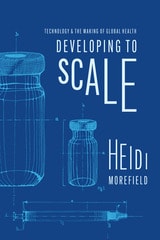
Developing to Scale
Technology and the Making of Global HealthHeidi Morefield
University of Chicago Press, 2023
In 1973, economist E. F. Schumacher published Small Is Beautiful, which introduced a mainstream audience to his theory of “appropriate technology”: the belief that international development projects in the Global South were most sustainable when they were small-scale, decentralized, and balanced between the traditional and the modern. His theory gained widespread appeal, as cuts to the foreign aid budget, the national interests of nations seeking greater independence, postcolonial activism, and the rise of the United States’ tech sector drove stakeholders across public and private institutions toward cheaper tools. In the ensuing decades, US foreign assistance shifted away from massive modernization projects, such as water treatment facilities, toward point-of-use technologies like village water pumps and oral rehydration salts. This transition toward the small scale had massive implications for the practice of global health.
Developing to Scale tells the history of appropriate technology in international health and development, relating the people, organizations, and events that shaped this consequential idea. Heidi Morefield examines how certain technologies have been defined as more or less “appropriate” for the Global South based on assumptions about gender, race, culture, and environment. Her study shows appropriate technology to be malleable, as different constituencies interpreted its ideas according to their own needs. She reveals how policymakers wielded this tool to both constrain aid to a scale that did not threaten Western interests and to scale the practice of global health through the development and distribution of technical interventions.
Developing to Scale
Technology and the Making of Global HealthHeidi Morefield
University of Chicago Press, 2023
The first critical book on “appropriate technology,” Developing to Scale shows how global health came to be understood as a problem to be solved with the right technical interventions.
In 1973, economist E. F. Schumacher published Small Is Beautiful, which introduced a mainstream audience to his theory of “appropriate technology”: the belief that international development projects in the Global South were most sustainable when they were small-scale, decentralized, and balanced between the traditional and the modern. His theory gained widespread appeal, as cuts to the foreign aid budget, the national interests of nations seeking greater independence, postcolonial activism, and the rise of the United States’ tech sector drove stakeholders across public and private institutions toward cheaper tools. In the ensuing decades, US foreign assistance shifted away from massive modernization projects, such as water treatment facilities, toward point-of-use technologies like village water pumps and oral rehydration salts. This transition toward the small scale had massive implications for the practice of global health.
Developing to Scale tells the history of appropriate technology in international health and development, relating the people, organizations, and events that shaped this consequential idea. Heidi Morefield examines how certain technologies have been defined as more or less “appropriate” for the Global South based on assumptions about gender, race, culture, and environment. Her study shows appropriate technology to be malleable, as different constituencies interpreted its ideas according to their own needs. She reveals how policymakers wielded this tool to both constrain aid to a scale that did not threaten Western interests and to scale the practice of global health through the development and distribution of technical interventions.
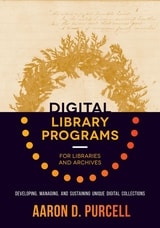
Digital Library Programs for Libraries and Archives
Developing, Managing, and Sustaining Unique Digital CollectionsAaron D. Purcell
American Library Association, 2016

One Shot for Gold
Developing a Modern Mine in Northern CaliforniaEleanor Herz Swent
University of Nevada Press, 2021
An account of the creation of a modern, environmentally sensitive mine as told by the people who developed and worked it.
In 1978, a geologist working for the Homestake Mining Company discovered gold in a remote corner of California’s Napa County. This discovery led to the establishment of California’s most productive gold mine in the twentieth century. Named the McLaughlin Mine, it produced about 3.4 million ounces of gold between 1985 and 2002. The mine was also one of the first attempts at creating a new full-scale mine in California after the advent of environmental regulations and the first to use autoclaves to extract gold from ore.
One Shot for Gold traces the history of the McLaughlin Mine and how it transformed a community and an industry. This lively and detailed account is based largely on oral history interviews with a wide range of people associated with the mine, including Homestake executives, geologists, and engineers as well as local neighbors of the mine, officials from county governments, townspeople, and environmental activists. Their narratives— supported by thorough research into mining company documents, public records, newspaper accounts, and other materials—chronicle the mine from its very beginning to its eventual end and transformation into a designated nature reserve as part of the University of California Natural Reserve System.
A mine created at the end of the twentieth century was vastly different from the mines of the Gold Rush. New regulations and concerns about the environmental, economic, and social impacts of a large mine in this remote and largely rural region of the state-required decisions at many levels. One Shot for Gold offers an engaging and accessible account of a modern gold mine and how it managed to exist in balance with the environment and the human community around it.
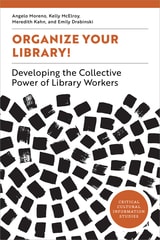
Organize Your Library!
Developing the Collective Power of Library WorkersAngelo Moreno, Kelly McElroy, Meredith Kahn, and Emily Drabinski
American Library Association, 2025
Interest in unions and the real, day-to-day benefits they secure for employees is on the rise—including among library workers, who are beginning to realize that on their own they have little leverage. But with a union they have the power of numbers, and their working conditions are decided by a collectively negotiated agreement rather than by the malleable judgement of an individual administrator or library board. This handbook will equip readers with the knowledge, skills, and strategies necessary for organizing and maintaining a union at their library. Peppered throughout by illuminating stories from successful library union leaders and members, this book
- discusses why library workers need unions and explores some of the benefits that a collective bargaining agreement can assure, such as job security, increased salaries, codification of the rules for overtime pay and time off, and protection from harassment by patrons;
- explains why a contract won't limit employees' autonomy;
- walks readers through how to launch a union drive, including the basics of talking with co-workers, combating apathy and fear, and running a campaign;
- offers an overview of the steps involved in building a new union, from forming an organizing committee to getting recognition and setting up a governance structure;
- sketches out the key issues relating to contracts, the details of bargaining and negotiation, and arbitration;
- lays out approaches and strategies for dealing with supervisors and administrators in the context of your union work, including effective communication between labor and management, contract enforcement, and handling bad behavior such as unfair labor practices and retaliation;
- gives advice on pursuing changes in your workplace in a right-to-work state;
- explores the constructive roles that bosses can play to support the union efforts of the workers who organize them; and
- provides an Action Plan at the end of each chapter with suggested readings, questions for reflection, and activities designed to help deepen your knowledge, broaden your network, and practice important skills.
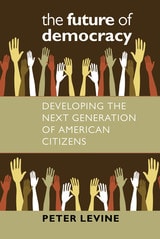
The Future of Democracy
Developing the Next Generation of American CitizensPeter Levine
University Press of New England, 2015