Results by title
240 books match the query 'English as a Second Language' and 12 start with p
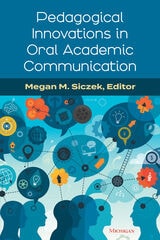
Pedagogical Innovations in Oral Academic Communication
Megan M. Siczek, Editor
University of Michigan Press, 2022
Pedagogical Innovations in Oral Academic Communication is grounded in four key principles: academic discourse socialization; context-responsive instruction; instructional approaches of English for Academic Purposes and English for Specific Purposes; and asset-oriented pedagogy. In the chapters in this collection, the authors share their teaching context, the details and underlying principles of their pedagogical approach, and recommendations for practitioners. Readers will develop a deeper understanding of the communicative contexts their students inhabit, including the types of speaking situations they are likely to encounter, and understand how to innovate their approach to teaching oral communication to students from diverse cultural, linguistic, educational, and disciplinary backgrounds. Such innovations prepare students for more effective communication during their academic studies and professional career, a goal that is of central importance in our globally interconnected society.
Peer Response in Second Language Writing Classrooms
Jun Liu and Jette G. Hansen
University of Michigan Press, 2002
Peer Response in Second Language Writing Classrooms, Second Edition
Jun Liu and Jette G. Hansen Edwards
University of Michigan Press, 2018
Now that classes are as likely to be online as held in physical classrooms and now that a new generation of digital natives can routinely read and respond to what others write via laptops, tablets, and phones, peer response as pedagogical practice is not just more easily implemented, but it is more likely to feel natural to L2 learners.
The Second Edition is a highly accessible guide to how the world is using peer response and serves as a motivator and facilitator for those who want to try it for the first time or want to increase the effectiveness of the activities—whether via CMC or not. The volume includes 11 forms useful in training students to provide good peer feedback, including a final checklist to ensure teachers have taken all the necessary steps to achieve a successful peer feedback activity.
Perspectives on Fluency
Heidi Riggenbach
University of Michigan Press, 2000
Section 1, What Is Fluency? presents papers that all describe fluency, but in different ways.
The articles in Section 2, Essential Components of Fluency, consider features or components that contribute to impressions of fluency.
Section 3, Cognitive Processes Underlying Fluency, is devoted to an exploration of the psycholinguistic factors underlying fluency.
Three studies are presented in Section 4, Empirical Studies on Nonnative Fluency, and they exemplify the range of approaches to characterizing learners as fluent or nonfluent in their target language.
One objective of Perspectives on Fluency is to provide a starting point for language researchers interested in exploring the concept of fluency, a foundation that, until the arrival of this volume, did not exist. The book can be useful to those approaching fluency from a language assessment perspective, and those interested in the relationship of fluency to oral proficiency.
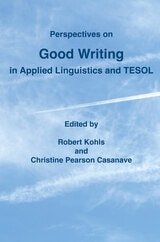
Perspectives on Good Writing in Applied Linguistics and TESOL
Edited by Robert Kohls and Christine Pearson Casanave
University of Michigan Press, 2023
In Perspectives on Good Writing in Applied Linguistics and TESOL, readers will develop their understanding of writing practices through chapters covering the following areas:
- teaching, learning, and assessing
- mentoring, supervising, and publishing
- personal perspectives
- readers and reading
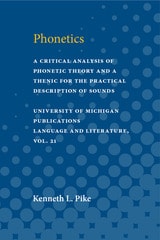
Phonetics
A Critical Analysis of Phonetic Theory and a Technique for the Practical Description of SoundsKenneth L. Pike
University of Michigan Press, 1943
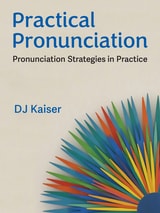
Practical Pronunciation
Pronunciation Strategies in PracticeDJ Kaiser
University of Michigan Press, 2026
CEFR Level: C1
Key Features
- A series of 210 audio recordings provides opportunities for learners to listen for key aspects of pronunciation and practice items from the book on their own.
- Twenty-nine videos provide short explanations and visual demonstrations of many of the strategies included throughout the book.
- Recommendations on ways to integrate digital tools into pronunciation exploration and practice provide learners and teachers with multiple ways to customize pronunciation practice to meet varied professional speaking contexts, academic goals, and personal interests.
- Practice items and exercises incorporate higher-frequency words from the Corpus of Contemporary American English.
- A glossary and several quick-reference charts make it easy to look up or clarify key terms and linguistic terminology or to visually review consonant and vowel charts.

Preparing Adult English Learners to Read for College and the Workplace
Edited by Kirsten Schaetzel, Joy Kreeft Peyton, and Rebeca Fernández
University of Michigan Press, 2024
After reading this book, adult ESL practitioners will be able to
- Prepare adults learning English to apply appropriate reading strategies to a variety of academic and professional contexts and purposes
- Use instructional strategies, including digital technology, to help struggling and developing readers close gaps in skills and conceptual knowledge
- Improve reading comprehension through robust vocabulary instruction
- Enhance reading skills and comprehension through writing instruction that balances sentence-level, discourse, and interactive processes and practices
- Inspire students to become lifelong readers who engage in extensive reading outside of school and professional contexts

Preparing Adult English Learners to Write for College and the Workplace
Kirsten Schaetzel, Joy Kreeft Peyton, and Rebeca Fernández
University of Michigan Press, 2019
The volume is organized into four parts: Setting the Stage for Teaching Writing, Supporting the Writing Process, Working with Beginning Writers, and Aligning Writing with Accountability Systems. Chapters are written by current (or former) adult educators with experience across levels. Each chapter introduces an approach based on research that can guide writing instruction and provides specific guidance and tools for implementation. Questions open and close the chapters to guide reading and frame future exploration. JoAnn (Jodi) Crandall has written the Epilogue.
Readers will discover ways to move adults into higher education and careers by helping them be college and career ready, to integrate writing into the existing curriculum in adult education programs at all levels, including content classes, and to teach writing according to national and state standards.
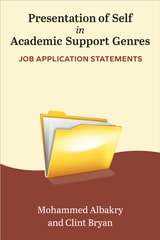
Presentation of Self in Academic Support Genres
Job Application StatementsMohammed Albakry & Clint Bryan
University of Michigan Press, 2025
This theoretically grounded but practice-oriented book will be a valuable guide for recent graduates and newly minted PhD holders about to start their careers in higher education and beyond. Readers will gain awareness of job application expectations and best practices, and job seekers interested in pursuing careers beyond the classroom will also learn how to leverage their skills and qualifications for industry jobs. The book will be a great resource in advanced courses on genre-based writing instruction, English for Academic Purposes, and professional communication. In addition, it can be used in graduate professionalization courses, professional seminars, faculty development workshops, or by individuals working independently.
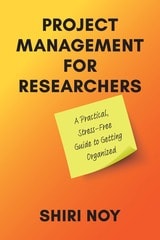
Project Management for Researchers
A Practical, Stress-Free Guide to Getting OrganizedShiri Noy
University of Michigan Press, 2024
Project Management for Researchers tackles the how, what, and why of project management. It offers step-by-step guidance on choosing tools and developing a personalized system that will help the reader manage and organize their research so that steps and decisions are documented for accountability and reproducibility. Readers will find worksheets they can adapt to their own needs, priorities, and research as well as practical tips on issues ranging from emails to scheduling. Suitable for work across methods, experience levels, and disciplines and adaptable for those working alone, with others, or as team managers, this book will guide readers between various research stages–from planning, to execution, to adjustment of research projects big and small.
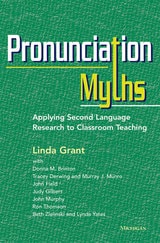
Pronunciation Myths
Applying Second Language Research to Classroom TeachingLinda Grant with Donna M. Brinton, Tracey Derwing and Murray J. Munro, John Field, Judy Gilbert, John Murphy, Ron Thomson, Beth Zielinski and Lynda Yates
University of Michigan Press, 2014
This volume was conceived as a "best practices" resource for pronunciation and speaking teachers in the way that Vocabulary Myths by Keith S. Folse is one for reading and vocabulary teachers. Like others in the Myths series, this book combines research with good pedagogical practices.
The book opens with a Prologue by Linda Grant (author of the Well Said textbook series), which reviews the last four decades of pronunciation teaching, the differences between accent and intelligibility, the rudiments of the English sound system, and other factors related to the ways that pronunciation is learned and taught.
The myths challenged in this book are:
§ Once you’ve been speaking a second language for years, it’s too late to change your pronunciation. (Derwing and Munro)
§ Pronunciation instruction is not appropriate for beginning-level learners. (Zielinski and Yates)
§ Pronunciation teaching has to establish in the minds of language learners a set of distinct consonant and vowel sounds. (Field)
§ Intonation is hard to teach. (Gilbert)
§ Students would make better progress if they just practiced more. (Grant)
§ Accent reduction and pronunciation instruction are the same thing. (Thomson)
§ Teacher training programs provide adequate preparation in how to teach pronunciation (Murphy).
The book concludes with an Epilogue by Donna M. Brinton, who synthesizes some of the best practices explored in the volume.