Results by title
313 books match the query 'Environmental policy' and 10 start with p

Patterns, Thinking, and Cognition
A Theory of JudgmentHoward Margolis
University of Chicago Press, 1988
Illusions of judgment—standard anomalies where people consistently misjudge or misperceive what is logically implied or really present—are often used in cognitive science to explore the workings of the cognitive process. The explanations given for these anomalous results have generally explained only the anomaly under study and nothing more. Margolis provides a provocative and systematic analysis of these illusions, which explains why such anomalies exist and recur.
Offering empirical applications of his theory, Margolis turns to historical cases to show how an individual's cognitive repertoire—the available cognitive patterns and their relation to cues—changes or resists changes over time. Here he focuses on the change in worldview occasioned by the Copernican discovery: not only how an individual might come to see things in a radically new way, but how it is possible for that new view to spread and become the dominant one. A reanalysis of the trial of Galileo focuses on social cognition and its interactions with politics.
In challenging the prevailing paradigm for understanding how the human mind works, Patterns, Thinking, and Cognition is certain to stimulate fruitful debate.
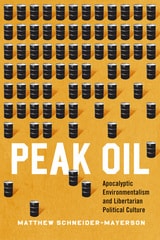
Peak Oil
Apocalyptic Environmentalism and Libertarian Political CultureMatthew Schneider-Mayerson
University of Chicago Press, 2015
In Peak Oil, Matthew Schneider-Mayerson takes readers deep inside the world of “peakists,” showing how their hopes and fears about the postcarbon future led them to prepare for the social breakdown they foresee—all of which are fervently discussed and debated via websites, online forums, videos, and novels. By exploring the worldview of peakists, and the unexpected way that the fear of peak oil and climate change transformed many members of this left-leaning group into survivalists, Schneider-Mayerson builds a larger analysis of the rise of libertarianism, the role of oil in modern life, the political impact of digital technologies, the racial and gender dynamics of post-apocalyptic fantasies, and the social organization of environmental denial.

Peril in the Ponds
Deformed Frogs, Politics, and a Biologist's QuestJudy Helgen
University of Massachusetts Press, 2012
By the 1990s, wetlands across the United States were endangered from pollution and decades of drainage to convert them into farmland and urban developments. But when deformed frogs—many with missing legs or eyes, footless stumps, or misshapen jaws—began to emerge from Minnesota wetlands, alarm bells went off. What caused such deformities? Pollution? Ultraviolet rays? Biological agents? And could the mysterious cause also pose a threat to humans?
Judy Helgen writes with passionate concern about vulnerable frogs and wetlands as she navigates through a maze of inquisitive media and a reluctant government agency. She reports on the complexity of a growing catastrophe for frogs and broadens the issue as she researches and meets with scientists from around the world. She affirms the importance of examining aquatic life to understand pollution and the need to rescue our remaining wetlands. She also shares the fears expressed by the teachers, students, and other citizens who found these creatures, sensed a problem, and looked to her for answers. Ultimately, this is a story about the biological beauty of wetlands and our need to pay attention to the environment around us.
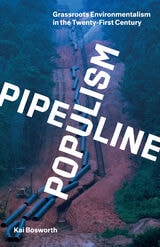
Pipeline Populism
Grassroots Environmentalism in the Twenty-First CenturyKai Bosworth
University of Minnesota Press, 2022
How contemporary environmental struggles and resistance to pipeline development became populist struggles
Stunning Indigenous resistance to the Keystone XL and the Dakota Access pipelines has made global headlines in recent years. Less remarked on are the crucial populist movements that have also played a vital role in pipeline resistance. Kai Bosworth explores the influence of populism on environmentalist politics, which sought to bring together Indigenous water protectors and environmental activists along with farmers and ranchers in opposition to pipeline construction.
Here Bosworth argues that populism is shaped by the “affective infrastructures” emerging from shifts in regional economies, democratic public-review processes, and scientific controversies. With this lens, he investigates how these movements wax and wane, moving toward or away from other forms of environmental and political ideologies in the Upper Midwest. This lens also lets Bosworth place populist social movements in the critical geographical contexts of racial inequality, nationalist sentiments, ongoing settler colonialism, and global empire—crucial topics when grappling with the tensions embedded in our era’s immense environmental struggles.
Pipeline Populism reveals the complex role populism has played in shifting interpretations of environmental movements, democratic ideals, scientific expertise, and international geopolitics. Its rich data about these grassroots resistance struggles include intimate portraits of the emotional spaces where opposition is first formed. Probing the very limits of populism, Pipeline Populism presents essential work for an era defined by a wave of people-powered movements around the world.

Plane Truth
Aviation's Real Impact on People and the EnvironmentRose Bridger
Pluto Press, 2013
As aviation charges ahead to become one of the world's fastest growing industries, with passenger numbers and cargo volumes projected to double in the next 20 years, Plane Truth sounds a highly informed note of scepticism.
Rose Bridger provides a comprehensive account of aviation's impact, including how new airports are gobbling up farmland and wildlife habitats and inflicting noise and air pollution on communities. She reveals the extraordinary level of subsidy for the industry, from government expenditure on infrastructure to tax breaks, which helps to support the industry in the face of rising oil prices and the global economic downturn.
Plane Truth demolishes industry claims that fuel-efficient aircraft and alternative fuels can enable growth without increasing climate change and reveals the symbiotic relationship between aviation and the wider socio-economic problems facing humanity.
Political Economy of Environmental Protection
Analysis and EvidenceRoger D. Congleton, Editor
University of Michigan Press, 1996

Postcolonial Developments
Agriculture in the Making of Modern IndiaAkhil Gupta
Duke University Press, 1998
Based on fieldwork done in the village of Alipur in rural north India from the early 1980s through the 1990s, Postcolonial Developments examines development itself as a post–World War II sociopolitical ideological formation, critiques related policies, and explores the various uses of the concept of the “indigenous” in several discursive contexts. Gupta begins with an analysis of the connections and conflicts between the world food economy, transnational capital, and technological innovations in wheat production. He then examines narratives of village politics in Alipur to show how certain discourses influenced governmental policies on the green revolution. Drawing links between village life, national trends, and global forces, Gupta concludes with a discussion of the implications of environmentalism as exemplified by the Rio Earth Summit and an examination of how global environmental treaties may detrimentally affect the lives of subaltern peoples.
With a series of subtle observations on rural politics, nationalism, gender, modernization, and difference, this innovative study capitalizes on many different disciplines: anthropology, sociology, comparative politics, cultural geography, ecology, political science, agricultural economics, and history.
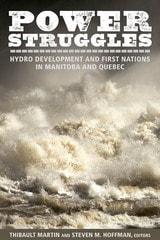
Power Struggles
Hydro Development and First Nations in Manitoba and QuebecThibault Martin
University of Manitoba Press, 2008
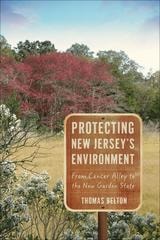
Protecting New Jersey's Environment
From Cancer Alley to the New Garden StateBelton, Thomas
Rutgers University Press, 2011
And you can add even more to the list-ozone depletion, nuclear power, toxic waste, sprawl, racial inequity, brownfields remediation versus environmental justice concerns. Through a series of gripping accounts organized by geographic area, Thomas Belton considers key environmental issues in New Jersey and champions the ways common citizens have sought justice when faced with unseen health threats. Often, as people search for remedies in their neighborhoods, the challenges they face result in what Belton calls bare-knuckles environmental protection, replete with back-room political deals, infighting, criminals, and hapless victims.
With people as its focus, Protecting New Jersey's Environment explores the science underpinning environmental issues and the public policy infighting that goes undocumented behind the scenes and beneath the controversies. Belton demonstrates the ways that scientists, regulators, lobbyists, and politicians interact and offers the public a go-to guide on how to seek environmental protection in practical ways.
Public Lands, Public Debates
A Century of ControversyChar Miller, editor
Oregon State University Press, 2012
—Char Miller, from the introduction