Results by title
520 books match the query 'Family' and 19 start with p
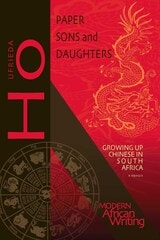
Paper Sons and Daughters
Growing up Chinese in South AfricaUfrieda Ho
Ohio University Press, 2011
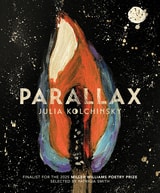
Parallax
Julia Kolchinsky
University of Arkansas Press, 2025
Finalist, 2025 Miller Williams Poetry Prize
Julia Kolchinsky’s Parallax offers a lyrical narrative of parenting a neurodiverse child under the shadow of the ongoing war in Ukraine, the poet’s birthplace. As her child expresses a fascination with death and violence, Kolchinsky struggles to process the war unfolding far away, on the same soil where so many of her ancestors perished during the Holocaust.
Anchored by a series of poems that look to the moon, this collection explores displaced perspectives and turns to the celestial to offer meditations on how elements formed in distant stars account for so much of our human DNA. In these poems, writes series editor Patricia Smith, Kolchinsky “clutches at a feeling of home that is both unfamiliar and deeply treasured, longs for all that was left behind, struggles to come to terms with the rampant violence devastating a landscape that still, in so many encouraging and heartbreaking ways, belongs to her.”
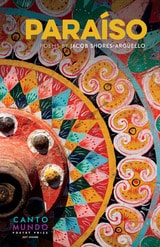
Paraíso
Poems byJacob Shores-Argüello
University of Arkansas Press, 2017
Paraíso, the first book in the new CantoMundo Poetry Series, which celebrates the work of Latino/a poets writing in English, is a pilgrimage against sorrow. Erupting from a mother’s death, the poems follow the speaker as he tries to survive his grief. Catholicism, family, good rum . . . these help, but the real medicine happens when the speaker pushes into the cloud forest alone.
In a Costa Rica far away from touristy beaches, we encounter bus trips over the cold mountains of the dead, drug dealers with beautiful dogs, and witches with cell phones. Science fuses with religion, witchcraft is joined with technology, and eventually grief transforms into belief.
Throughout, Paraíso defies categorization, mixing its beautiful sonnets with playful games and magic cures for the reader. In the process, moments of pure life mingle with the aftermath of a death.
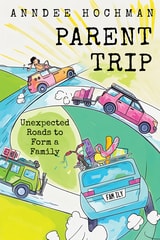
Parent Trip
Unexpected Roads to Form a FamilyAnndee Hochman
Temple University Press, 2026
Hochman recounts the fraught emotions of couples struggling with infertility, the joy of a single gay man becoming a father in his forties, and the anxiety of people waiting for the adoption worker to call with good news. Parent Trip tells of sperm donors and gestational surrogates, midwives and miscarriages; it chronicles how children prompt parents to recalibrate their lives.
In personal essays that weave throughout the profiles, Hochman connects her interviewees’ lives to the love, heartbreak, and uncertainty in her own path to parenthood. Through myriad mundane and extraordinary moments, Parent Trip not only chronicles the magic and labor of childrearing, it also celebrates the infinite ways real families come to be.
Parental Priorities and Economic Inequality
Casey B. Mulligan
University of Chicago Press, 1997
In Mulligan's model, parents determine the degree of their altruistic concern for their children and spend time with and resources on them accordingly—just as they might make choices about how they spend money. Mulligan tests his model against both old and new evidence on the intergenerational transmission of consumption, earnings, and wealth, including models that emphasize "financial constraints." One major prediction of Mulligan's model confirmed by the evidence is that children of wealthy parents typically spend more than they earn.
Mulligan's innovative approach can also help explain other important behavior, such as charitable giving and "corporate loyalty," and will appeal to a wide range of quantitatively oriented social scientists and sociobiologists.
Pinion
Monica Rico
Four Way Books, 2024
Pinnick Kinnick Hill
An American StoryBy G. W. González, Edited by Mark Brazaitis, with a Preface by Suronda González, with a Spanish translation Las colinas sueñan en español by Daniel Ferreras
West Virginia University Press, 2006
Nearly a century ago, hundreds of families journeyed from Spain to the United States, to search for a better life in the growing zinc-industry towns of Harrison County, West Virginia. As they created a new culture and a new home in this strange land, they added another thread to the rich fabric of our nation. Writing from his perspective as a first-generation son of this immigrant community, González recounts his childhood memories of his neighborhood, where these immigrants raised their families, worked in the often insufferable conditions of the zinc factories, and celebrated "romerias" and feast days with their neighbors.
Pioneer Family
Life on Florida's Twentieth-Century FrontierMichel Oesterreicher
University of Alabama Press, 1996
Tracing the roots of resilience on the American frontier.
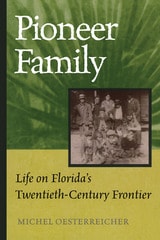
Pioneer Family is based on the recollections of Hugie and Oleta Oesterreicher, who lived in rural northeast Florida in the early decades of the twentieth century. Northeast Florida was still frontier country then, and Hugie and Oleta were pioneers. Although the time and setting of their story are particular, the theme of survival during hard times is universal. Born in a cypress cabin on the edge of the great Durbin Swamp located midway between St. Augustine and Jacksonville, Hugie knew every alligator hole, every bog, every creek; he could dry venison so it lasted without refrigeration for months, could build a potato bank that kept potatoes warm all winter, and put down a well without machinery. He knew how to cope with rattlesnakes and moccasins. Early one morning in 1925, Hugie fell in love with a tall, brown-eyed girl as he passed her place on a cattle drive. He courted this girl, Oleta Brown, with no success at first, but finally they were married in 1927.
Their daughter retells their story from vivid accounts they gave of their childhood, courtship, early years of marriage, and struggles during the Great Depression. In an age bereft of heroes, the story of their courage, their faith, and their commitment provides a fascinating empathy with a time that has passed; a place that has disappeared.
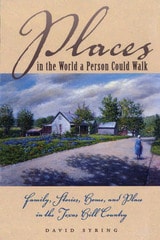
Places in the World a Person Could Walk
Family, Stories, Home, and Place in the Texas Hill CountryBy David Syring
University of Texas Press, 2000
Spring-fed creeks. Old stone houses. Cedar brakes and bleached limestone. The Hill Country holds powerful sway over the imagination of Texans. So many of us dream of having our own little place in the limestone hills. The Hill Country feels just like home, even if you've never lived there.
This beautifully written book explores what the Hill Country has meant as a homeplace to the author, his family, and longtime residents of the area, as well as to newcomers. David Syring listens to the stories that his aunts, uncles, and cousins tell about life in the Hill Country and grapples with their meaning for his own search for a place to belong. He also collects short stories focused around Honey Creek Church to consider how places become containers for memory. And he draws upon several years of living in Fredericksburg to talk about the problems and opportunities created by heritage tourism and the development of the town as a "home" for German Americans. These interconnected stories illuminate what it means to belong to a place and why the Texas Hill Country has become the spiritual, if not actual, home of many people.
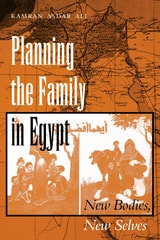
Planning the Family in Egypt
New Bodies, New SelvesBy Kamran Asdar Ali
University of Texas Press, 2002
In this ethnographic study, the author examines the policies and practices of family planning programs in Egypt to see how an elitist, Western-informed state attempts to create obliging citizens. The state sees voluntary compliance with the law for the common good as the cornerstone of modernity. Family planning programs are a training ground for the construction of self-disciplined individuals, and thus a rewarding area of study for the fate of social programs in developing countries.
Through a careful examination of state-endorsed family planning practices in urban and rural contexts, the author shows us the pervasive, high-pressure persuasion of women, who are encouraged to think as individual decision makers of their immediate families and their national interests. But what of the other forces at work in these women’s lives, binding them to their extended families and to their religious identities? And what of the laws that allow for polygamy and discriminate against women in marriage, inheritance, and as part of the workforce?
These forces operate against the received wisdom of the state. Is the Muslim community thought to end at the borders of Egypt? What about local constructions of masculinity when the state appeals to wives to decide for themselves? How does widespread labor migration to foreign countries affect attitudes toward family planning? How is female contraception viewed by the Islamic Brotherhood and other modern Muslim groups?
This book questions much that we have taken for granted and gives us grounds for reexamining our assumptions about family planning and the individual and state in developing countries such as Egypt.

PlayHouse
PoemsJorrell Watkins
Northwestern University Press, 2024
Jorrell Watkins's debut poetry collection is a polyvocal, musically charged disruption of the United States's fixation on drug and gun culture. The poems in Play|House embody many identities, including son, brother, fugitive, bluesman, karate practitioner, and witness. Throughout, Watkins inflects a Black/trap vernacular that defamiliarizes the urban Southern landscape. Across three sections of poetry scored by hip-hop, blues, and trap, Watkins considers how music is a dwelling and wonders which histories, memories, and people haunt each home. Past figures such as John Coltrane, Billie Holiday, and the short-lived 1940s trio Day, Dawn & Dusk intermingle with Migos, the Watkins family, childhood friends, and loved ones both parted and departed. At its core, Play|House reckons with the truths and failures of masculinity for Black boys and men, all the while documenting moments of triumphant Black joy and love.
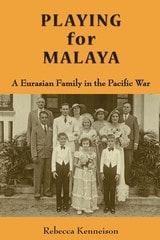
Playing for Malaya
A Eurasian Family in the Pacific WarRebecca Kenneison
National University of Singapore Press, 2011
So begins a stunning personal account of a Eurasian family living in Malaya. One of the many gaps in Reggie's account of his family was that his mother was Eurasian. When Rebecca Kenneison discovered this omission after his death, she set out to learn more about her extended family on the other side of the world. Her voyage of discovery is compelling in itself, but Playing for Malaya has a much larger purpose. Set in the 1930s and 1940s, it recounts the experiences of an extended Eurasian family during the invasion and occupation of Malaya by the Japanese. Colonial society considered Eurasians insufficiently European to be treated as British, but they seemed all too European to the Japanese, who subjected the Eurasian community to discrimination and considerable violence. Because many Eurasians, including members of the Kenneison family, supported the Allied cause, their wartime experiences are an extraordinary account of tragedy, heroism and endurance, presented here with great consequence and clarity.
Playing with Dynamite
Sharon Harrigan
University of Wisconsin Press, 2017
Playing with Dynamite is about the family secrets that can distance us from each other and the honesty that can bring us closer. It’s about a daughter who goes looking for her father but finds her mother instead. It’s about memory and truth, grieving and growing, and what it means to go home again.
Power in the Blood
A Family NarrativeLinda Tate
Ohio University Press, 2009
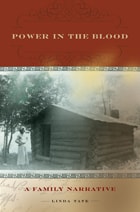
Power in the Blood: A Family Narrative traces Linda Tate’s journey to rediscover the Cherokee-Appalachian branch of her family and provides an unflinching examination of the poverty, discrimination, and family violence that marked their lives. In her search for the truth of her own past, Tate scoured archives, libraries, and courthouses throughout Kentucky, Tennessee, Alabama, Illinois, and Missouri, visited numerous cemeteries, and combed through census records, marriage records, court cases, local histories, old maps, and photographs. As she began to locate distant relatives — fifth, sixth, seventh cousins, all descended from her great-greatgrandmother Louisiana — they gathered in kitchens and living rooms, held family reunions, and swapped stories. A past that had long been buried slowly came to light as family members shared the pieces of the family’s tale that had been passed along to them.
Power in the Blood is a dramatic family history that reads like a novel, as Tate’s compelling narrative reveals one mystery after another. Innovative and groundbreaking in its approach to research and storytelling, Power in the Blood shows that exploring a family story can enhance understanding of history, life, and culture and that honest examination of the past can lead to healing and liberation in the present.
Praying Naked
Katie Condon
The Ohio State University Press, 2020
Proof
Photographs from Four Generations of a Texas FamilyByrd M. Williams IV
University of North Texas Press, 2016
Prospero's Son
Life, Books, Love, and TheaterSeth Lerer
University of Chicago Press, 2013
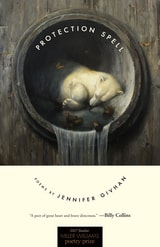
Protection Spell
PoemsJennifer Givhan
University of Arkansas Press, 2017
Finalist, 2017 Miller Williams Poetry Prize, edited by Billy Collins
“A poet of great heart and brave directness.”
—Billy Collins
In Protection Spell Jennifer Givhan explores the guilt, sadness, and freedom of relationships: the sticky love that keeps us hanging on for no reason other than love, the inky place that asks us to continue revising and reimagining, tying ourselves to this life and to each other despite the pain (or perhaps because of it). These poems reassemble safe spaces from the fissures cleaving the speaker’s own biracial home and act as witnesses speaking to the racial iniquity of our broader social landscape as well as to the precarious standpoint of a mother-woman of color whose body lies vulnerable to trauma and abuse. From insistent moments of bravery, a collection of poems arises that asks the impossible, like the childhood chant that palliates suffering by demanding nothing less than magical healing: sana sana colita de rana, si no sanas hoy, sanas mañana (the frog who loses his tail is commanded to grow another). In the end, Givhan’s verse offers a place where healing may begin.
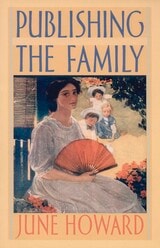
Publishing the Family
June Howard
Duke University Press, 2001
Publishing the Family describes the sources and controversial outcome of a fascinating literary experiment. Howard embeds the story of The Whole Family in the story of Harper & Brothers’ powerful and pervasive presence in American cultural life, treating the publisher, in effect, as an author.
Each chapter of Publishing the Family casts light on some aspect of life in the United States at a moment that arguably marked the beginning of our own era. Howard revises common views of the turn-of-the-century literary marketplace and discusses the perceived crisis in the family as well as the popular and expert discourses that emerged to remedy it. She also demonstrates how creative women like Bazar editor Elizabeth Jordan blended their own ideas about the “New Woman” with traditional values. Howard places these analyses in the framework of far-reaching historical changes, such as the transformation of the public meaning of emotion and “sentimentality.” Taken together, the chapters in Publishing the Family show how profoundly the modern mapping of social life relies on boundaries between family and business, culture and commerce, which The Whole Family and Publishing the Family constantly unsettle.
Publishing the Family will interest students and scholars of American history, literature, and culture, as well as those studying gender, sexuality, and the family.